
Ten-Man England End Spain’s Record 43-Game Unbeaten Run With 3-2 Win in Madrid

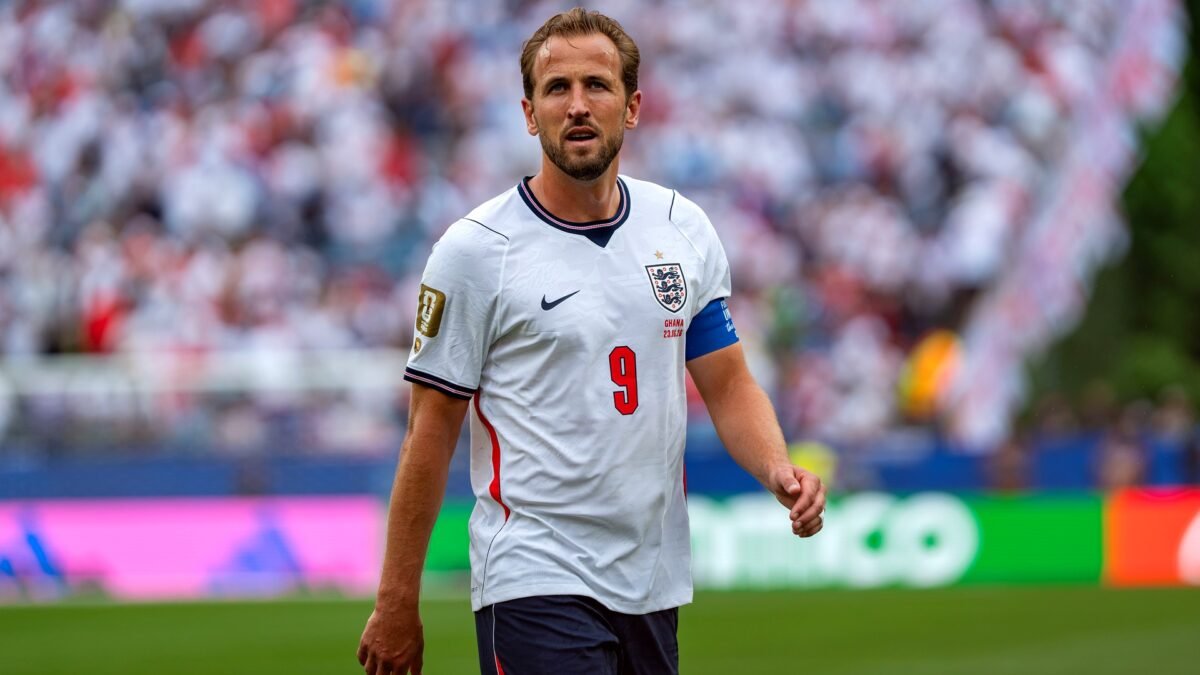
England beat Spain 3-2 in Madrid on Sunday night to end the world champions’ record 43-match unbeaten run, finishing top of their Nations League group in a match that swung from total control to desperate survival in the space of twelve second-half minutes. The victory, sealed in front of 84,525 people at the Riyadh Air Metropolitano, was England’s tenth consecutive away win and the first defeat Spain had suffered in any competition since March 2024.
For an hour, Thomas Tuchel’s side were not merely winning. They were better than the world champions in every department that mattered, and the scoreline at 3-0 after 57 minutes flattered Spain rather than England. Harry Kane scored from the penalty spot on the stroke of half-time for his 93rd England goal, Ezri Konsa headed in a Declan Rice corner eight minutes after the restart, and Ben White finished a flowing move four minutes later to put England three goals clear of a team that had not lost a match in 968 days.
Then the match changed completely. Jarell Quansah was caught in possession as England’s last defender in the 63rd minute, Elliot Anderson hauled back Lamine Yamal inside the penalty area as the teenager raced through, and the French referee Clement Turpin showed a straight red card and awarded a penalty. Mikel Oyarzabal converted from the spot, substitute Nico Williams made it 3-2 in the 75th minute after a low cross from Yamal, and England spent the final quarter of the match with ten men defending their lead against the most dangerous attacking side in world football.
They survived, and the survival was as much the story as the dominance that preceded it. James Trafford, chosen ahead of Jordan Pickford in goal in what was Tuchel’s boldest selection of the night, produced a string of brave late saves, including a stunning double stop to deny Fermin Lopez and Oyarzabal. White, the scorer of the third goal, made a vital last-man challenge on Williams. When the final whistle sounded, England had done something no team had managed in more than two and a half years: they had beaten Spain.
According to Reuters, England became the first team to beat Spain since Colombia won 1-0 in a friendly in March 2024, a run of 43 games without defeat for Luis de la Fuente’s side. The statistics network Opta recorded it as the longest unbeaten run ever achieved by a European nation in all competitions. Both teams finished the group stage on 15 points, but England topped Group A3 on goal difference, plus 13 to Spain’s plus eight, and both sides progress to the quarter-finals, with the draw taking place on Friday 20 November.
The first hour: England’s finest under Tuchel
The opening hour in Madrid was, by several accounts, the best England have played under Tuchel. The German coach, whose side had lost the reverse fixture 3-2 at Wembley in September, set his team up to press Spain high and to move the ball quickly through midfield, and for 60 minutes the plan worked almost perfectly. Jude Bellingham, playing in the city where he represents Real Madrid at club level, drove the side forward from midfield, Rice covered enormous ground, and Anderson, before his dismissal, was arguably England’s best midfielder on the night.
Spain had shown off the World Cup trophy before kick-off, a reminder of what they had achieved in the summer and of the scale of the task facing England. The response from the visitors was to play as though the occasion belonged to them. They were aggressive without the ball and precise with it, and Spain, for all their talent, were second best for much of the game. According to Reuters, Spain “could have few complaints” about the result, a verdict that matched the run of play for the first hour.
The first goal came in the 41st minute, when Anderson played a first-time pass down the inside-right channel into Kane, who turned Pau Cubarsi inside the penalty area and was caught by a clumsy tackle. The referee pointed to the spot, and after a lengthy video review that also examined a possible foul by Anderson on Marc Cucurella as he made the pass, Kane buried the penalty into the corner for his 93rd international goal. It was a small piece of personal revenge: Kane had missed a penalty in the reverse fixture at Wembley, when Spain won 3-2.
England doubled their lead eight minutes into the second half. Rice swung in a corner and Konsa, the Arsenal defender, escaped his marker to power a free header past Unai Simon from inside the six-yard box. Four minutes later it was 3-0. White finished off a flowing move to complete a passage of play that had Spain chasing shadows, and at that point the match looked finished as a contest. England were three goals up against the world champions, away from home, and playing with a confidence that suggested they believed they belonged at this level.
Tuchel’s team selection had raised eyebrows before kick-off, most obviously the decision to start Trafford in goal ahead of Pickford, England’s established first-choice goalkeeper. The choice looked like a gamble. By the end of the night it looked like a decision that had won England the match, though not in the way anyone could have predicted.
The red card and the siege
The match turned on a single sloppy moment in the 63rd minute. Quansah, receiving the ball as England’s last defender, hesitated and surrendered possession to Yamal near the edge of the area. The 19-year-old, already the most dangerous teenager in European football, immediately turned the loose ball into an attack on the penalty area. Anderson scrambled back in desperation and clipped him, and Turpin had no hesitation: a straight red card for denying an obvious goalscoring opportunity, and a penalty to Spain.
Oyarzabal kept his cool from the spot, sending Trafford the wrong way to make it 3-1, and suddenly a match that had looked like a rout had a sharp new emotional direction. Spain, with a man advantage, swarmed forward and camped inside the English defensive third. Tuchel reacted by pulling off his attacking stars, with Myles Lewis-Skelly replacing Kane, Djed Spence coming on for Anthony Gordon, and Dan Burn arriving late to add height to the defence.
The second Spanish goal came in the 75th minute, and both of Spain’s goals started with an England player losing the ball. Gordon was robbed in midfield, Spain worked the ball to Yamal on the right flank, and the teenager slid a pinpoint low cross into the box for Williams, who had come on as a substitute three minutes earlier, to sweep the ball past the keeper and off the left post. At 3-2, with fifteen minutes left and England down to ten men, the Metropolitano believed a comeback was coming.
It did not come, and the reason was Trafford. The goalkeeper produced several brave stops during 29 frantic minutes of Spanish pressure, including the double save from Lopez and Oyarzabal that preserved the win, and defenders threw their bodies in the way of everything Spain could create. White’s last-man challenge on Williams was as important as his goal. England held firm until the final whistle, sealing a 3-2 win, top spot in the group, and a seeded position in the quarter-final draw.
Spain’s coach, Luis de la Fuente, said after the match that his side had been “overwhelmed” in the early stages of the defeat, but backed his team to return stronger. “We also know how to lose,” he said, according to ESPN. It was the first time he had needed to say anything of the sort in more than two and a half years.
The run that England ended
To understand what England achieved in Madrid, it is necessary to understand what Spain had built. Their last defeat had come on 22 March 2024, when Colombia beat them 1-0 in a friendly in London. Since then, according to Opta, they had gone 43 matches without defeat, a run that lasted 968 days and included winning the European Championship in the summer of 2024 and the World Cup in the summer of 2026.
No European national team had ever gone so long without losing. The previous standard-bearers for consistency in international football had all fallen short of it, and Spain’s run had become one of the defining facts of the modern game: a team that could not be beaten, playing a style that opponents admired and feared in equal measure. They had won the European Championship by beating England in the final in Berlin in 2024, and they had followed it by winning the World Cup, the first time a European nation had held both trophies at once in more than a decade.
The run was not built on luck. Spain’s players had won their domestic league, their continental club competitions and their international tournaments, and their manager had built a system in which the ball was kept, the press was relentless and the goals were shared. Yamal, at 19, had become the most exciting young player in the world. Oyarzabal, Williams and Lopez gave them depth in attack. Their midfield controlled matches the way Spain’s great teams of a generation ago had controlled them.
That is the context in which England’s win should be judged. This was not a friendly, and it was not a dead rubber. Both teams needed the result to top the group, both teams fielded strong sides, and the match was played in front of more than 84,000 people in Spain’s capital. England did not beat a weakened Spain, or a Spain that did not care. They beat the full-strength world champions, in Madrid, and for an hour they made it look almost comfortable.
The defeat does not end Spain’s status as the best team in the world. They remain world champions, they remain in the Nations League quarter-finals, and they remain the team every other nation will measure itself against. But the aura of invincibility is gone, and that matters. For two and a half years, opponents had walked onto the pitch against Spain knowing that nobody had beaten them in 43 attempts. From now on, they will know that England did it, in Madrid, with ten men for the last half hour.
The group, and what happens next
England’s win settled Group A3. Both England and Spain finished on 15 points, but England’s goal difference of plus 13, against Spain’s plus eight, put Tuchel’s side top of the group. In the group’s other final match, Croatia beat the Czech Republic 2-1. The quarter-final draw takes place at UEFA headquarters on Friday 20 November at 11am, and England, as group winners, will be seeded.
Anderson, however, will miss England’s next Nations League match. Under UEFA’s disciplinary regulations, a player sent off for denying an obvious goalscoring opportunity is automatically suspended for the next match in the same competition, which means the midfielder will sit out the first leg of the quarter-final in March. It is a heavy price for a player who had been England’s best midfielder until the moment he was forced to make a desperate challenge, and it is a reminder that the red card was not a piece of bad luck but the consequence of a defensive error by a team-mate.
Elsewhere on Sunday, the final round of group matches produced another major result. Italy, who had gone into their match in Brussels top of Group A1 after beating France 3-1 on Thursday, crashed out of the Nations League as they were beaten 4-1 by Belgium. Francesco Pio Esposito gave Italy an early lead, but Belgium scored three times before the interval through Maxim De Cuyper, Nathan Ngoy and Jeremy Doku, and Italy finished third in the group on 10 points. France beat Turkey 2-1 in Bordeaux, thanks to an own goal by Emirhan Topcu and an effort by Eli Junior Kroupi, to win the group with 13 points, ahead of Belgium on 12.
For England, the win in Madrid also extended a remarkable run of their own. According to Opta, the victory was England’s tenth consecutive away win in all competitions, a sequence that speaks to a team that has learned to win on the road. The last time England won in Spain, in Seville in October 2018, the scoreline was also 3-2. Eight years later, they did it again, and this time the team they beat had not lost in 43 matches.
Analysis: Why It Matters
The first hour was the real story, not the last half-hour
It is tempting to remember this match as a backs-to-the-wall survival act, and the final half hour certainly was that. But the more important part of the game was the first hour, when England were not surviving but dominating. Spain had not been outplayed like that by anybody in more than two years, and the 3-0 scoreline after 57 minutes was a fair reflection of the balance of play. England pressed high, moved the ball quickly, and created chances against a defence that had become accustomed to conceding almost nothing. The survival that followed was heroic, but it was only necessary because England had already done the hard part: they had taken the game away from the world champions.
That distinction matters because it changes what this result means for Tuchel. A team that wins 3-2 by defending for half an hour has shown character. A team that goes 3-0 up against Spain in Madrid has shown something rarer: the belief and the quality to impose itself on the best team in the world. England did both in the same match, and that combination is what makes this a defining result rather than merely a memorable one.
A red card, a teenager, and the difference between control and survival
The 63rd minute exposed the thin line between control and chaos in modern football. One misplaced touch by Quansah, one sprint by Yamal, and a match that England were winning 3-0 became a match they were in danger of losing. It is worth being precise about what happened: the red card was Anderson’s, but the error was Quansah’s. Anderson was the player forced to make an impossible choice, and he made the only choice available to him, taking the foul and the dismissal to stop a goal. That is the nature of defending at the highest level. One mistake, by one player, can undo an hour of collective excellence.
Yamal’s role in the turnaround deserves emphasis. He won the penalty, he made the second goal, and he was the only Spanish player who looked capable of beating England on his own before the red card. At 19, he is already the player opponents plan around, and England’s inability to contain him once they were a man down was the clearest evidence of his quality. The fact that Spain’s comeback was built almost entirely on his shoulders tells its own story about where this Spanish team is heading.
James Trafford has changed the goalkeeper conversation
Tuchel’s decision to start Trafford ahead of Pickford was the boldest selection of the night, and it is now the selection that will be talked about most. Pickford has been England’s first-choice goalkeeper for the best part of a decade, and dropping him for a match of this magnitude was a statement of intent from a manager who has never been afraid to make unpopular decisions. Trafford repaid the faith in the most dramatic way possible, with a series of saves that preserved a historic win.
The question now is whether this was a one-off or a changing of the guard. Tuchel praised Trafford’s decisive saves after the match, and the goalkeeper’s performance will have intensified the discussion over England’s first-choice goalkeeper. Pickford’s experience and his record in major tournaments still count for a great deal, and one match, however dramatic, does not settle a debate. But Trafford has now done something Pickford has never done: he has kept goal in a win over the world champions in their own capital. That is a fact that will not be forgotten when the next squad is named.
Spain’s run was real, and that is why losing it matters
There is a temptation, when a long unbeaten run ends, to diminish it in hindsight, to point out the draws, the penalties, the friendly matches that padded the numbers. That would be a mistake here. Spain’s 43-match run included a European Championship and a World Cup, and it was built against the best teams in the world. It was not a statistical curiosity. It was the mark of a team that had solved the problem of how to win consistently at the highest level.
That is precisely why England’s win matters as much as it does. Beating a team that has not lost in 43 matches is a different achievement from beating the same team on an ordinary day. It requires not only quality but the belief that the run can be ended at all, and England showed that belief from the first whistle. The run is over, and Spain will now have to build a new one. Every team that plays them from now on will know that they can be beaten, because England proved it in Madrid.
A group won on goal difference, and a draw that decides the spring
The immediate consequence of the win is a seeded place in the quarter-final draw on Friday 20 November, and that is worth more than it might appear. England finished level on points with Spain but ahead on goal difference, and that margin was built over six matches, not one. It is a reminder that the Nations League group stage rewards consistency, and that England’s campaign, which began with a 3-2 defeat at Wembley to the same opponents, ended with them above the world champions.
The draw will decide England’s path to the finals in the spring, and the identity of their opponents will shape the next four months of discussion. What is already clear is that England will go into the quarter-finals as group winners, with a goalkeeper debate to settle, a midfielder suspended for the first leg, and a manager who now has the defining result of his tenure. The win in Madrid has changed the conversation around this England team. The question is no longer whether they can compete with the best. It is whether they can do it again when it matters most.
What to Watch Next
- The Nations League quarter-final draw on Friday 20 November, when England learn their opponents as seeded group winners.
- Whether James Trafford keeps his place ahead of Jordan Pickford in England’s next squad, after his match-winning performance in Madrid.
- Elliot Anderson’s suspension for the quarter-final first leg in March, and who Tuchel picks to replace him in midfield.
- Spain’s response: whether Luis de la Fuente’s side bounce back immediately or whether the end of the 43-match run leaves a mark.
- Lamine Yamal’s continued rise, after he won a penalty and created a goal against ten-man England and showed again why he is the most dangerous teenager in world football.
- England’s next fixtures and whether the tenth consecutive away win becomes the foundation of a sustained run of results against the world’s best teams.
- Italy’s fallout from their 4-1 defeat in Belgium and their failure to reach the Nations League quarter-finals, after topping Group A1 going into the final round.
Sources
- Reuters — England end Spain’s long unbeaten run, Italy crash out of Nations League
- Sky Sports — Spain 2-3 England: Match Report & Highlights
- ESPN — England hold off Spain rally to end WC winner’s 43-game unbeaten run
- Yardbarker — After 968 days: England halt Spain’s run and achieve a historic feat (Opta statistics)
- The False 9 — Spain vs England: Analysis and England Player Ratings
- Live Scores Wire — Spain vs England: Trafford and Kane seal wild Madrid win

About the Author — Abdul Mannan
Related Articles
Tearful McIlroy Equals Montgomerie’s Record With Eighth Race to Dubai Title
Rory McIlroy carded a bogey-free 67 in Dubai to win a record-equalling eighth Race to Dubai title, edging…

Kayla Harrison Submits Amanda Nunes in Round Four to Retain UFC Title at UFC 334
Kayla Harrison submitted Amanda Nunes with a rear-naked choke at 1:29 of round four at Madison Square Garden…

Seventy-Three Years of Waiting Ended in Eighty Minutes: Wales Stun the All Blacks
Wales beat New Zealand 35-28 in Cardiff on 14 November 2026 — their first win over the All…