
Fed Chair Warsh Keeps Rate Path Open at IMF Meeting as Markets Rally on the Calm

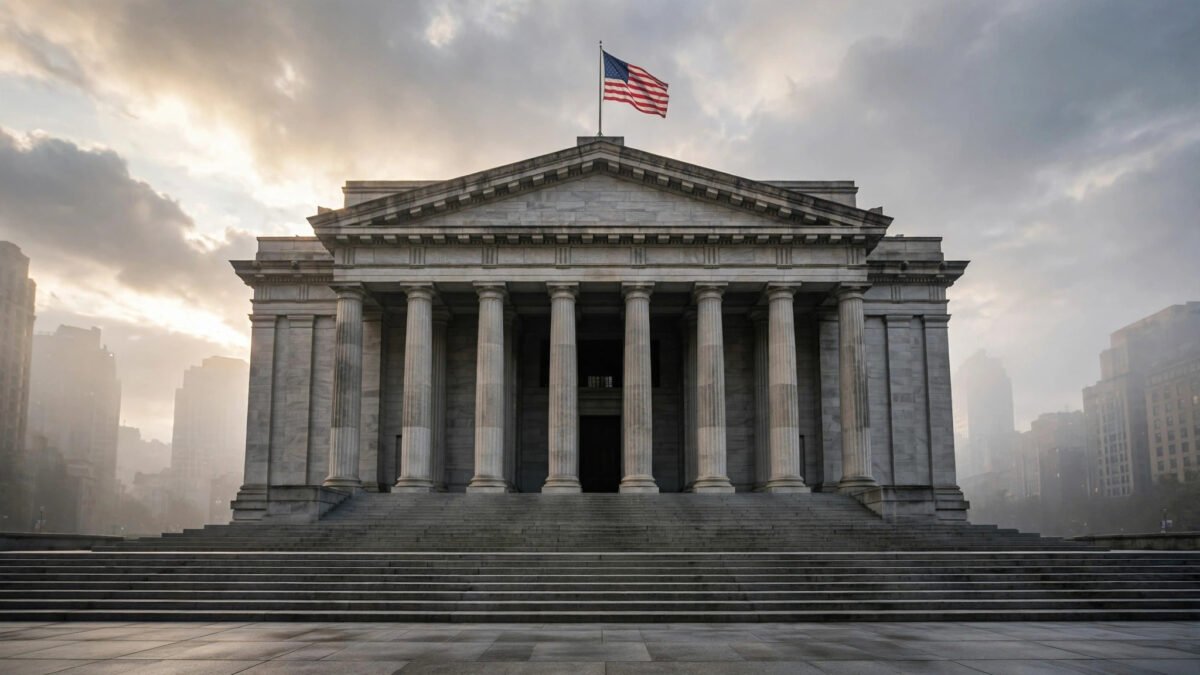
The most powerful man in global finance said very little this morning — and markets loved it. Federal Reserve Chairman Kevin Warsh, speaking Friday at the International Monetary Fund’s annual meetings in Bangkok, declined to signal whether the central bank will raise interest rates at its October 27–28 meeting, telling a moderated audience that he does not “prejudge meetings” and that the Fed is no longer “in that business” of previewing decisions.
The comments, delivered in a half-hour conversation with IMF Managing Director Kristalina Georgieva, arrived just days after a hotter-than-expected U.S. consumer price report had rattled investors and revived talk of an imminent rate increase. By saying almost nothing about the inflation flare-up, Warsh appeared to calm the room.
Traders were pricing only about a 15% chance of an October rate hike after the remarks, according to the CME FedWatch tool — down sharply from roughly 28% a day earlier — as S&P 500 futures climbed into positive territory, the U.S. dollar slid to a 10-day low, and gold pushed back above $4,200 a troy ounce, according to market coverage from the Wall Street Journal and Barron’s.
Warsh, who assumed the chairmanship in May, has made a point of shelving forward guidance — the practice of telegraphing future policy — arguing that markets should follow economic data rather than policymakers’ comments. Friday’s performance was the doctrine in action. He barely mentioned inflation, though he did say the world had “broadly conformed” to the Fed’s expectations since the central bank’s September policy meeting.
That September meeting had produced the Fed’s first interest-rate increase in three years: a quarter-point move, to a range of 3.75% to 4%, on a unanimous vote. Most of Warsh’s colleagues also penciled in at least one more increase this year in their published projections, according to the Wall Street Journal.
The silence that moved markets
What made Friday’s session remarkable was not what Warsh said but what he refused to say. Several of his colleagues have recently signaled that officials are in no hurry to raise rates this month; Warsh declined either to endorse or to push back on those signals, as the Wall Street Journal reported.
“Perhaps the most important thing was what he didn’t say,” Deutsche Bank analyst Jim Reid said, in remarks carried by Barron’s. “Markets took the lack of hawkishness as good news.”
The reaction was immediate and broad. Stock futures, which had been trading in the red before Warsh spoke, turned higher. The DXY dollar index slipped 0.1% to about 101.94 after touching an overnight 10-day low. Treasury yields, which had whipsawed through the week, steadied — the 10-year around 5.08% and the two-year near 4.73%. And the optimism rippled into Asia, where South Korea’s Kospi closed up 2.05% to snap a seven-day losing streak and Japan’s Nikkei gained 1.8%, according to the Wall Street Journal’s markets coverage.
The remarks came hours before Fed officials entered their traditional quiet period ahead of the October 27–28 meeting, meaning investors will hear nothing more from policymakers until the decision itself.
Warsh’s big AI bet
Beyond interest rates, Warsh used the IMF stage to stake out a position on the question dividing Wall Street: whether the historic surge of spending on artificial intelligence is a productive boom or a debt-fueled bubble.
The chairman planted himself firmly in the optimistic camp. Artificial intelligence is “probably the most consequential change to the U.S. and the global economy in my lifetime,” he said, describing it as a “positive supply shock” over the medium term — a force that would ultimately expand the economy’s capacity to produce goods and services without necessarily pushing up prices.
He pointed to what he called a “massive investment surge” in the United States that he said was “not by accident” but reflected good economic policy — and stressed that the surge “isn’t just AI,” arguing that capital spending is broadening across sectors and giving the economy greater “strength and durability.”
At the same time, Warsh acknowledged the near-term tension in his own thesis. “On the path to that positive supply shock, we’re seeing increases in aggregate demand,” he said, in remarks reported by the Wall Street Journal. “That just is what it is” — a candid admission that the boom itself is currently adding to the very price pressures the Fed is supposed to fight.
Some of his colleagues have been more explicit in tying the AI build-out to recent price increases that could justify even higher rates. Warsh stopped short of that, describing the extra demand as a transitional byproduct of a shift he expects will ultimately pay off.
The debt question dividing Wall Street
Warsh’s confidence landed in a market that has spent the week fretting about how the AI boom is being financed. Jefferies economist Mohit Kumar warned this week that the United States is expected to spend 2.5% to 3% of GDP on capital expenditure and AI infrastructure over the next three years — larger than any infrastructure build-out in American history, according to Barron’s — and cautioned that if the pace of the build-out slows, the consequences for AI companies and the economy would be significant.
The anxiety has been visible in markets all week. AI-linked stocks were among the week’s biggest casualties: the Nasdaq was heading for a roughly 2% weekly loss even as the Dow aimed for a 1% gain, a divergence driven by rotation out of technology into defensive sectors such as health care and consumer staples. Chipmakers and AI infrastructure names bore the brunt; CoreWeave, whose soaring borrowing costs helped trigger the latest flight from AI trades, slipped another 2.5% in premarket trading Friday, the Wall Street Journal reported.
Credit headlines have kept the pressure on. Reuters reported that some investors who attended AI startup Anthropic’s roadshow said the company should be worth $1.5 trillion rather than $2 trillion, while the Financial Times has reported the firm’s bankers are targeting top-tier credit ratings ahead of its expected IPO.
Yet the week also showed how much cash remains on the sidelines, waiting for a reason to buy. Bank of America’s weekly fund-flow data, based on EPFR figures, showed investors poured $64.5 billion into stock funds in the week to Wednesday — with $10.7 billion flowing into technology stocks — alongside $11.8 billion into bonds and a massive $53.1 billion outflow from money-market cash funds, Reuters reported. U.S. stocks alone drew $39.1 billion and have now attracted a record $636 billion year-to-date.
A turbulent week in context
Friday’s calm closed one of the year’s most volatile weeks. Big bank earnings, the hot inflation data, a tech selloff, and a roller-coaster bond market sent stocks spinning before bargain hunters and Warsh’s careful silence steadied the ship.
Beyond the rate debate, the broader economy keeps flashing resilience. U.S. business inventories rose 0.4% in August on strong sales growth, according to Commerce Department data reported by Reuters, and economists estimate the economy is growing at around a 3% annualized pace in the third quarter.
Other market cross-currents remain in play. Tesla shares rose 4% overnight after the company demonstrated a flying car it hopes to put into production in 2028, according to MarketWatch. Brent crude held above $105 a barrel as traders weighed an International Energy Agency plan to accelerate the release of around 100 million barrels. Bitcoin partially reversed Thursday’s losses to trade around $82,200.
And the Fed’s own ranks are not speaking with one voice: Fed officials including John Williams and Michelle Bowman have recently sounded cautious about further rate increases, adding to the interpretive puzzle Warsh now leaves investors to solve alone.
Analysis: Why It Matters
Kevin Warsh did not move a single interest rate in Bangkok. He did something subtler and, in its way, more consequential: he confirmed that the Federal Reserve under his leadership will no longer hold the market’s hand. When he says “it’s a new chapter at the Fed,” he means the old contract — in which investors parsed every syllable of Fed speeches for clues — has been torn up. From now on, the data talks and the chairman listens, mostly in silence.
There is a quiet irony in how markets responded. Investors who claim to want data-dependent policy still traded on vibes: the absence of hawkishness was immediately translated into dovishness, and hike odds were cut nearly in half on the strength of what one analyst called the most important thing — what Warsh didn’t say. That reflexive translation shows the market hasn’t fully internalized Warsh’s doctrine; it is still trying to read the chairman’s silences the way it once read his speeches. Sooner or later, that game of telephone will produce a misunderstanding, and the repricing could be violent.
The deeper story is Warsh’s wager on artificial intelligence, and it is worth taking seriously because the entire rate path now runs through it. If the chairman is right — if AI spending is genuinely expanding productive capacity, a “positive supply shock” — then the inflationary pressure of today’s investment boom is a phase, not a regime, and rates can stay put while the economy grows. If he is wrong — if the 2.5% to 3% of GDP pouring into data centers, chips, and power grids is mostly leverage chasing scarcity rents — then the Fed is standing aside while the largest capital build-out in American history is financed on credit. That is a bet with national consequences, and Warsh just made it on an IMF stage, in front of the world.
The venue matters too. Bangkok was not an accident of scheduling; the IMF annual meetings are where the global financial order gathers, and Warsh’s first major public outing as chairman became an international event. Asian markets rallied on his words, the dollar fell worldwide, and the won, the yen, and gold all moved. American monetary policy has always been global policy. Warsh’s silence, broadcast from Thailand, is now the world’s problem to interpret.
Finally, watch the split inside the Fed itself. Williams and Bowman sound cautious about further hikes; the September projections penciled in another move this year; Warsh says he prejudges nothing. That is a committee without a center of gravity — by design. The October 27–28 meeting will be the first real test of whether “no forward guidance” is a communications philosophy or just a cover for a divided board. If the decision surprises markets, the chairman will own both the surprise and the silence that preceded it.
What to Watch Next
- The October 27–28 FOMC meeting: With Fed officials now in their pre-meeting quiet period, the decision will land without further guidance. A hold would validate Friday’s market read; a hike would shatter it.
- December expectations: Traders currently see roughly a 90% probability of a rate increase by December, according to FedWatch data cited by Barron’s. The next inflation prints will decide whether that pricing survives.
- Big Tech earnings next week: The first of the Magnificent Seven, Tesla, reports soon. Results — and any capex guidance — will either soothe or inflame the AI-debt anxiety that defined this week.
- AI credit headlines: CoreWeave’s borrowing costs and Anthropic’s IPO roadshow are the canaries in the AI-credit coal mine. A ratings downgrade or a pulled deal would hit the Nasdaq hard.
- Flow data and the rotation: Bank of America’s weekly flows showed record buying into weakness. If cash keeps pouring in while tech keeps lagging, the defensive rotation into health care and staples may become the market’s defining trade into year-end.
Sources
- Wall Street Journal – Warsh Avoids Signal on October Rate Move
- Korea JoongAng Daily – Kospi rebounds over 2% on eased chip rout, Fed bets
- Reuters – Investors bought stocks and bonds, shed cash in past week, say BofA
- Barron’s – Stock market news today, October 16, 2026
- IMF – 2026 Annual Meetings of the IMF and the World Bank Group

About the Author — Abdul Mannan
Related Articles

Netflix Cuts About 6% of Workforce in Biggest Layoff Since 2022 Amid Attention Battle
Netflix is cutting roughly 1,000 jobs — 6% of its workforce — in its biggest layoff since 2022,…
Asian Chip Stocks Crash as KOSPI Trips Circuit Breaker and Nikkei Tumbles on AI Financing Fears
South Korea's KOSPI plunged about 8% on Thursday, tripping circuit breakers as chip giants collapsed, while Japan's Nikkei…
CoreWeave Crashes 16% as “AI Bond Blues” Grip Wall Street; Traders Pile Into “Bubble Puts”
CoreWeave plunged about 16 percent on Wednesday as its bonds sank into distressed territory, dragging AI infrastructure stocks…