
Iran Says Four Tankers Hit Mines in Strait of Hormuz as British Monitors Report a Vessel on Fire

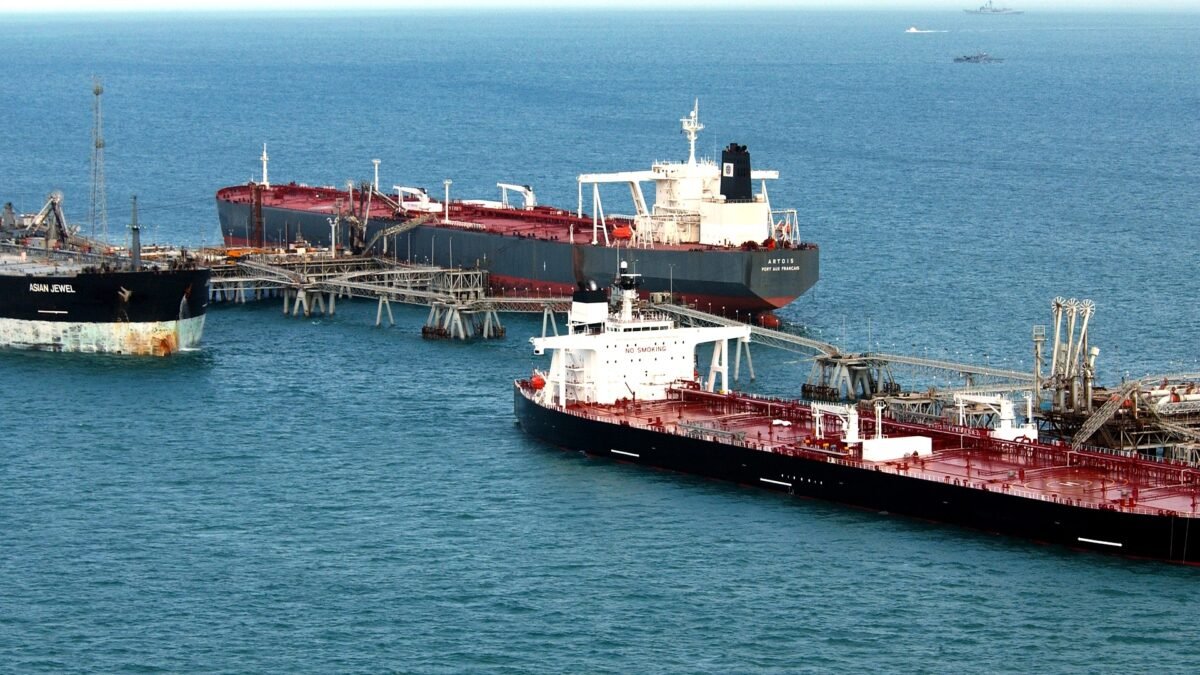
Iran said on Thursday that four oil tankers caught fire after striking naval mines in or near the Strait of Hormuz, the narrow waterway through which about a fifth of the world’s oil normally flows, in the most serious reported incident on the shipping lane since the United States and Israel opened their war against Iran in February. But the claim itself has not been independently verified, and the account given by the British maritime agency that monitors the waterway does not match Tehran’s version of events, leaving the most important question — what actually happened to the ships — unanswered as oil prices climbed on Friday.
According to Agence France-Presse, the Islamic Revolutionary Guard Corps said in a statement that three tankers had exploded and caught fire over the previous 24 hours after hitting mines while trying to pass through what Tehran calls an “unauthorised” southern route through the strait. The Guards said the vessels had switched off their radar and navigation systems and ignored warnings from the Iranian navy. Iran’s army later reported that a fourth tanker had caught fire after striking a mine east of the strait, while it was, in Tehran’s words, “operating in a restricted and dangerous area”.
Iran did not name any of the vessels, and did not identify their flags, their owners or their crews. It gave no exact time for any of the incidents and no casualty figures. The Associated Press reported that it could not confirm Iran’s account, and no shipowner, insurer or independent naval authority had publicly identified a mined tanker by Friday morning.
The British agency that acts as merchant shipping’s point of contact in the region, United Kingdom Maritime Trade Operations, reported a different and more limited picture. According to AFP, UKMTO said it had received a report of a vessel on fire about 25 nautical miles — 46 kilometres — north-east of Khasab, Oman, in the strait. UKMTO had earlier reported two other incidents in the area: a traditional wooden dhow that caught fire and sank following a maritime security incident, and a tanker struck by an unknown projectile while transiting the strait. Reuters reported on Friday that a tanker in the strait had been hit by explosive devices attached to its hull by a small boat, citing UKMTO, and that it was not immediately clear who was behind that attack. UKMTO reported no crew injuries and no environmental impact from the projectile incident at the time of its report.
It has not been established whether the vessel UKMTO reported on fire is one of the ships Iran described, or a different one altogether, and the reports do not establish that the same incident involved both a mine and a projectile. Until the vessels are named, the number of tankers involved — three, four, or fewer — should be treated as disputed, and the cause of any fire as unconfirmed.
The statements came a day after the United States military said it had cleared the main shipping lanes through the waterway of mines. US Central Command, which oversees American military operations in the region, said on Sunday that it had helped Gulf countries export 1.5 billion barrels of oil through Hormuz since the summer, and has insisted on social media that all mines in the “primary transit routes” have been cleared. The Revolutionary Guards rejected that claim outright. “The unauthorised route through the Strait of Hormuz is mined, and vessel owners and crews are responsible for transiting these routes and should not pay attention to CENTCOM’s delusions on social media,” the Guards said in their statement, according to AFP.
IRGC spokesman Hossein Mohebi challenged the American claim directly on X, writing: “Prove your Hormuz mine-clearing claim with independent evidence, not statements!” In a separate statement, the Guards also said their navy’s electronic warfare unit had captured an American MQM-170 reconnaissance drone during an operation in the western Strait of Hormuz. That claim, too, has not been independently confirmed, and no American response to it had been reported by Friday morning.
Oil markets reacted to the uncertainty rather than waiting for proof. Brent crude’s December contract, which expires on Friday, rose 1.04 per cent to $116.08 a barrel by 0323 GMT, according to Reuters, while the more active January contract gained $1.39 to $112.19 and US West Texas Intermediate crude climbed 1.34 per cent to $103.37. Brent was on course for a gain of nearly 11 per cent in October, its fourth consecutive monthly rise, and WTI was heading for a rise of about 14 per cent for the month, on course to close above $100 a barrel for the first time since April. From Monday, the headline Brent price will refer to the January contract, which trades about $4 lower than the expiring December contract.
The incidents came on a day of widening attacks on energy infrastructure across the region. Yemen’s Iran-aligned Houthi movement said on Thursday that it had attacked several sites in Saudi Arabia, including the Ras Tanura refinery, the kingdom’s largest, the Rabigh refinery and an Aramco production facility at Abqaiq, while a Saudi-led coalition said it had intercepted a cruise missile launched by the Houthis towards the kingdom’s western region, according to Reuters. Security concerns in the region have also reached the boardroom: ExxonMobil and Chevron have cancelled plans for their executives to travel to the United Arab Emirates’ biggest oil industry event, the ADIPEC conference in Abu Dhabi next week, two sources familiar with the developments told Reuters.
Eleven European countries, including France, Germany and Italy, have pledged to release 42.6 million barrels of oil from their strategic reserves by the end of January 2027 to ease supply concerns caused by the war and the closure of the strait, according to a statement reported this week. The announcement came weeks after the G7 said it would release 100 million barrels of diesel and crude after President Donald Trump threatened to ban US diesel exports, and after the International Energy Agency called on its members in mid-October to step up releases of oil stocks ahead of winter.
The Strait of Hormuz is only about 21 miles — 34 kilometres — wide at its narrowest point and roughly 96 miles long, separating Iran to the north from the Arabian Peninsula to the south, and it normally carries about one-fifth of global oil and gas consumption. Since the war began on 28 February, when the United States and Israel jointly launched airstrikes against Iran, Tehran has severely restricted traffic through the waterway, and Washington has responded with a blockade on Iranian ports and by escorting tankers through the strait. Traffic through the strait has fallen sharply since February, and shipping through it now moves under military escort and the constant threat of attack.
Diplomacy, meanwhile, appears to be running out of road. Vice President JD Vance wrote last week to Mohsen Rezaei, Iran’s top security official and a former Revolutionary Guards commander, to test whether a negotiating framework could be found. Tehran has confirmed that it received the letter but has not answered it. Iran’s foreign minister, Abbas Araghchi, has said Tehran is in contact with mediators about a seven-day plan under which the strait would reopen within a week if Iran’s conditions are met, including a ceasefire across all fronts in West Asia, the unfreezing of its assets, the lifting of sanctions on its oil sector and an end to the American naval blockade. But Iran’s parliamentary speaker, Mohammad Bagher Ghalibaf, has said negotiations cannot advance unless Washington accepts Tehran’s seven conditions, and Iran has already described Qatar’s latest mediation ideas as “unacceptable”.
On the military side, the signals point in the opposite direction. Admiral Brad Cooper, the commander of US Central Command, briefed President Trump at the White House on Thursday on military options concerning Iran, according to the Wall Street Journal, in a meeting also attended by Defence Secretary Pete Hegseth and the chairman of the Joint Chiefs of Staff, General Dan Caine. The Associated Press separately reported that American officials had warned regional allies to prepare for possible renewed strikes against Iran and retaliatory attacks against energy facilities and other critical infrastructure, with no final decision reported. Mr Trump has repeatedly suggested that the United States may resume major military operations against Iran after the midterm elections on 3 November, telling Fox News on 25 October: “I have a decision to make: Do I finish it off, which would be very easy to do, or do I make a deal?”
The war has already lasted nearly eight months, far longer than Mr Trump initially predicted when he said it would last only a few weeks. The war has cost the US military $47.1 billion as of 16 October, according to an estimate US Central Command provided to Congress and obtained by USA Today, a figure that does not include damage to American bases hit by Iranian strikes. At least 21 American service members have died and 865 have been wounded since 28 February, according to the US military’s official casualty database, and the aircraft carrier USS Abraham Lincoln recently returned home to San Diego after a 321-day deployment in the Middle East, one of the longest in the navy’s recent history.
Analysis: Why It Matters
1. A claim is not a confirmed sinking — and the gap matters
The most important fact about Thursday’s events is not what Iran said happened, but what nobody has yet been able to prove. Four burning tankers would be a major escalation in a war that has already lasted eight months; one vessel on fire after a small-boat attack would be serious but routine for this conflict. The difference between those two pictures is the difference between a strait that is mined and closed and a strait that is dangerous but navigable, and markets, governments and shipowners are being asked to decide which picture is real on the basis of statements from a party to the war. That is why the verification gap should be treated as the story, not as a footnote to it. Iran has an obvious interest in making the strait look impassable: every tanker that turns away tightens the pressure on Washington and on the Gulf states that depend on the waterway. The United States has the opposite interest in making it look safe. Neither side’s word can settle the question. What would settle it is mundane and checkable: the names of the vessels, statements from their owners or insurers, satellite imagery of fires at sea, or a UKMTO advisory that ties a named ship to a mine. Until one of those appears, the honest description of Thursday is that Iran says four tankers hit mines, Britain’s maritime agency says a vessel was on fire and a tanker was hit by an unknown projectile, and the two accounts have not been reconciled. Reporting that gap plainly is not fence-sitting; it is the only accurate account available.
2. The “unauthorised” southern route is a new kind of maritime grey zone
Beneath the dispute over what happened lies a second dispute that may matter more in the long run: which routes through the strait are legitimate at all. Iran considers ships using the southern corridor near the Omani coast “unauthorised”, and now says that route is mined and that crews who use it bear the responsibility. The United States says the primary transit routes have been cleared and points to 1.5 billion barrels of Gulf oil exported through the strait since the summer as proof that the waterway works. Both statements can be true at the same time if they describe different lanes — and that is precisely the danger. A strait with one cleared channel and one declared-mined channel is not a safe strait; it is a strait where a navigational error, a misunderstood instruction or a deliberate test of the boundary can put a civilian crew on top of a mine. The history of the region offers a warning: the tanker war of the 1980s began with exactly this kind of ambiguity about which waters were safe and who had the right to declare them otherwise. The difference now is that the mines, if they are there, are being announced on social media by a military spokesman demanding “independent evidence” from his adversary while offering none of his own. The burden of proof in a shipping lane should fall on the party that claims it is mined, and it should be discharged with charts, coordinates and warnings to mariners, not with posts on X.
3. Oil markets are pricing the risk, not the proof
Brent crude’s rise to $116 a barrel on Friday, and its fourth consecutive monthly gain, tells its own story about how this war is now priced. Traders did not wait to find out whether four tankers or one tanker burned, or whether the cause was a mine or a small boat; they bought oil because the direction of travel is unmistakable. “Continued kinetic action around the Strait of Hormuz amidst doubts of a viable diplomatic pathway are keeping oil prices elevated in expectation of an escalation of the conflict in coming weeks,” said Saul Kavonic, head of energy research at MST Marquee, according to Reuters. That expectation is now embedded in the price: Ole Hansen of Saxo Bank told Reuters he expects crude to trade in a higher range of $70 to $90 a barrel, compared with a pre-war level of $60 to $70, even after the conflict ends, because of the risk of renewed hostilities and the need to rebuild inventories. Europe’s decision to release 42.6 million barrels from strategic reserves is an admission that governments, too, expect the disruption to last into next year. The practical consequence for ordinary people is straightforward: fuel costs that were already a political issue in the United States ahead of next week’s midterm elections are unlikely to fall, and every new incident in the strait, verified or not, adds a little more to the price at the pump. The market has learned to treat an Iranian claim as a price event in itself, which in turn gives Tehran an incentive to keep making claims — a feedback loop that makes verification more, not less, important.
4. The diplomacy clock and the military clock are about to collide
The most consequential date on the calendar is not in the strait but in the United States: the midterm elections on Tuesday, 3 November. The Vance letter to Rezaei, which Tehran has received but not answered, was an attempt to find a diplomatic opening before that date; the briefing Admiral Cooper gave Mr Trump on Thursday was the military alternative being prepared for after it. The Associated Press report that American officials have warned Gulf allies to prepare for possible renewed strikes after the elections suggests the administration has already made its sequencing decision, even if it has not made its final one. Iran’s position, as stated by Mr Ghalibaf, is that talks cannot advance unless Washington accepts Tehran’s seven conditions, while Mr Araghchi continues to talk to mediators about a seven-day plan. Those two positions are not obviously reconcilable, and the gap between them is where the war lives. The cancellation of ExxonMobil’s and Chevron’s plans to send executives to ADIPEC next week is a small but telling detail: the world’s biggest oil companies are no longer willing to put their people in the Gulf’s flagship energy conference while the strait is in this state. Business, like the oil market, is voting with its feet, and its vote is that the diplomatic track is failing.
5. This is no longer one war but a regional pattern
Thursday’s incidents should not be read in isolation. On the same day, the Houthis claimed to have struck Saudi Arabia’s largest refinery at Ras Tanura, the Rabigh refinery and the Abqaiq facility; a dhow caught fire and sank in the strait; and Iran claimed to have captured an American drone. The war that began with airstrikes on Iran in February is now being fought across shipping lanes, refineries, airspace and social media simultaneously, and each front feeds the others. The Houthi attacks on Saudi oil sites raise the same question as the tanker claims: how much of the region’s energy infrastructure can be hit before the economic damage forces a political decision? The drone claim, unverified as it is, points to a quieter contest over surveillance and electronic warfare in the strait that rarely makes headlines but determines what each side can see. And the dhow — a small wooden vessel, almost certainly crewed by ordinary fishermen or traders — is a reminder that the people most likely to be hurt by a mined strait are not the admirals or the oil executives but the small boats that have used these waters for centuries. A war that began as a campaign against a state is becoming a war against a waterway, and waterways do not surrender.
What to Watch Next
- Names and proof: Whether shipowners, insurers, UKMTO or satellite imagery identify the vessels involved and confirm mine damage — or whether the claim quietly fades without corroboration.
- Tehran’s answer: Whether Iran responds to Vice President Vance’s letter or to the Qatari mediation effort, and whether Mr Ghalibaf’s seven conditions soften or harden.
- After the midterms: Whether Washington orders renewed strikes against Iran once the 3 November elections are over, as American officials have warned Gulf allies to expect.
- Oil on Monday: How Brent trades when the January contract becomes the front month, and whether the $116 level holds or the market treats Friday’s rise as a claim-driven spike.
- ADIPEC and Gulf security: Whether next week’s Abu Dhabi energy conference goes ahead as planned, and what further steps Gulf states take to protect tankers and refineries.
Sources
- AFP via Malay Mail: Four tankers ablaze in Strait of Hormuz as Iran disputes US claim that sea lanes are mine-free
- Reuters: Oil set for fourth monthly gain as Hormuz tanker attack highlights supply risks from war
- Al Jazeera live coverage: IRGC says four tankers struck mines in Strait of Hormuz
- The Levant Files: Iran war live — Washington weighs new strikes as Hormuz burns
- FinanceFeeds: Brent crude $116 after Hormuz mine claims (Reuters prices)

About the Author — Abdul Mannan
Related Articles

Vance Letter to Iran’s Top Security Official Tests a Diplomatic Opening as Trump Calls It Medical-Supplies Help
JD Vance wrote to Mohsen Rezaei, Iran's top security official, according to US media reports, while Donald Trump…
Iran Calls Qatar’s Latest Mediation Ideas ‘Unacceptable’ as Accounts Differ on Draft Deal to End War
Tehran has described Qatar's latest mediation ideas as unacceptable and not an offer, while an official briefed on…
Israelis Vote in Record Numbers as Netanyahu Fights for Survival Against Eisenkot
Turnout hit 55.7% by 4 p.m. — the highest at that hour since 1973 — as Israelis voted…