
South Korea’s Top Tax Exam Scorer Admits He Cheated With a Hidden Camera and AI

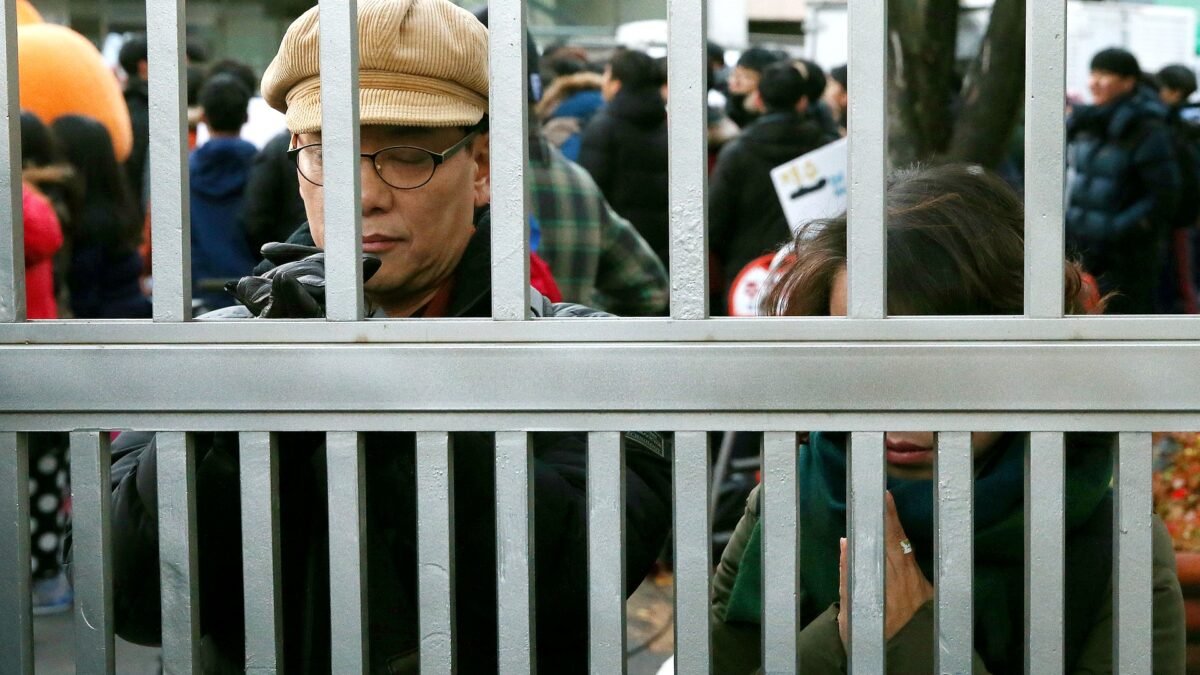
South Korea’s top scorer in this year’s national tax accountant examination has confessed that he cheated his way to the top, photographing the questions with a miniature camera, sending them to an artificial intelligence tool and reading the answers off a smartphone while invigilators watched and saw nothing wrong.
Han Won-seok, 34, made the admission on Sunday in a video posted on the YouTube channel of his lawyer, Lee Don-ho, ending weeks of suspicion over a near-perfect score that many in South Korea had found too good to believe. Wearing a face mask, he told viewers he had cheated in both stages of the tax accountant exam and in the first round of the certified public accountant exam as well.
“I cheated on the tax accountant exam,” he said, according to the Seoul Economic Daily. “I sincerely apologise for the harm I caused to many people through my wrongdoing.”
He said he had already submitted a written confession to the Seoul Metropolitan Police Agency, which confirmed on Sunday that it had received the statement through his lawyer and assigned the case to investigators. Police promised what the Korea Times described as “swift and rigorous” fact-finding.
The confession has landed like a small earthquake in a country where examinations decide careers, and it has come at the worst possible moment for the authorities. South Korea’s national college entrance examination, the College Scholastic Ability Test, known as the Suneung, is due on Thursday, 19 November, and the government has spent the past week warning that it will take a zero-tolerance approach to cheating with AI devices. On Sunday, the presidential office convened an emergency meeting to order countermeasures at every test centre in the country.
A score that looked too good to be true
Han finished first in the 63rd edition of South Korea’s certified tax accountant examination, one of the country’s most demanding professional qualifications. In the first stage, held in April, he answered 159 of 160 multiple-choice questions correctly, scoring 397.5 out of a possible 400. He earned perfect marks in three of the four subjects — introductory tax law, introductory accounting and commercial law — and 97.5 in public finance, according to reports in the Korean press.
The tax law paper drew the most attention. According to the Korea Herald, Han scored a perfect mark in a section where the average among all test-takers was 30.18 out of 100. Three months later, in the second-stage written examination in July, he scored 663 out of 800, an average of 82.87 against a pass mark of 49.75, and was named the overall top scorer.
Only 722 candidates passed this year’s examination out of 6,606 who sat the second round, a pass rate of 10.92 percent, according to the Korea Times. Han was not merely among them. He was first, by a margin that invited questions from the moment the results were published.
Online speculation focused at first on AI-powered smart glasses, the wearable devices that can photograph a question, transmit it and display an answer. Han denied the allegation in a media interview, questioning why his unusually high scores had drawn such intense scrutiny. The Korean Association of Certified Tax Accountants called on Thursday for a thorough investigation, while warning that a high score alone should not make someone a suspect.
His confession, when it came, corrected the speculation. It was not glasses, he said. In the words quoted by the Seoul Economic Daily, he had cheated “by using a miniature camera to photograph the exam questions, sending them to AI and checking the answers on a smartphone”. He declined to name the AI tool he used, and he refused to describe the method in further detail, saying he did not want others to copy it.
Some of the devices have been destroyed, he said, and he plans to hand over the remaining evidence to investigators. He added that he had used the same method in the first round of the certified public accountant examination.
Why he says he did it
Han told viewers he had turned to cheating after leaving a corporate job to start his own business, which struggled. Rising costs and the shame of facing his parents weighed on him, according to the Korea Times. He said he had first denied the wrongdoing and then changed his mind after thinking about the candidate who had finished second, and he apologised to those who had passed fairly.
His top score, he said, “was not the result of fair effort”, according to Reuters.
The explanation will do little to soften the consequences. The government has said that anyone found to have used AI to cheat in the tax accountancy examination will have their qualification revoked and will be banned from retaking the test for five years. The Human Resources Development Service of Korea, the state body that runs the examination, plans to file a criminal complaint and to consult other agencies on the next steps, with the Finance Ministry and the National Tax Service involved in the follow-up, according to the Korea Herald.
The Ministry of Employment and Labour and the Human Resources Development Service held an emergency meeting after the admission, the BBC reported. Whether Han faces criminal charges, and whether his certified public accountant result is also voided, remains to be decided.
What is already clear is that the safeguards failed. The Human Resources Development Service had earlier said it found no concrete evidence of wrongdoing, and the supervisors in the examination rooms reported nothing suspicious across either stage, according to the Korea Times. The examination body’s own internal review found no grading irregularities. The fraud was not detected by the system. It was admitted by the man who committed it.
A country braced for Thursday
The timing could hardly be worse for South Korea’s education authorities. The College Scholastic Ability Test, the once-a-year university entrance examination that carries enormous weight in admissions, takes place on Thursday, and officials have been warning for more than a week that AI devices pose a new threat to its integrity.
On 9 November, the Ministry of Education said a nationwide survey had found four cases of cheating with AI-equipped smart glasses in school examinations this year — one at a middle school and three at high schools. All four students received zero marks for the affected subjects. Similar incidents were uncovered during university entrance examinations at Yonsei University and the University of Seoul in October. At one university, a student was caught switching from ordinary glasses to smart glasses fitted with a camera and battery after the examination had begun. At another, two students were caught wearing or possessing AI glasses and are now barred from taking entrance examinations for the next three years.
Smart glasses are explicitly prohibited at this year’s College Scholastic Ability Test, and using or wearing them during the examination can invalidate a candidate’s results and bar them from the following year’s test. The Education Ministry is seeking to extend the disqualification period for serious cheating from one year to three years and has warned of possible criminal proceedings in deliberate or organised cases.
On 11 November, the Seoul Metropolitan Office of Education held special training for 239 staff assigned to identify smart glasses at the capital’s test centres. Their task is to distinguish ordinary eyewear from devices that can photograph questions, transmit information and connect the wearer to AI systems. The training included examining actual devices and learning how cameras, microphones, speakers and other components can be concealed in otherwise conventional-looking frames.
The difficulty is that, for this year’s examination, proctors must identify smart glasses by sight. They have not been given dedicated radio-wave detectors, and no specialised radio-frequency detectors designed for smart glasses will be distributed nationwide for this year’s test. Metal detectors may be the most practical option for now, according to the Korea JoongAng Daily, which reported that officials plan to use them as an initial screening measure.
On Friday, Prime Minister Han Sung-sook vowed to take a zero-tolerance approach to exam cheating, citing the suspicions around the tax accountant examination. The Office for Government Policy Coordination said specialist staff would be sent to examination sites and that cheaters could face criminal complaints, according to Yonhap. President Lee Jae-myung has requested measures against smart-device cheating across examinations run by the state, public institutions and schools.
On Sunday, after Han’s confession, the presidential office went further. According to KBS, the Blue House convened an emergency meeting presided over by the chief of policy, ordered procedures for inspecting AI devices at all test centres on 19 November, and ordered dedicated personnel to be deployed. All available means, including thermal cameras, will be mobilised to identify AI devices, KBS reported. At the same time, the Blue House instructed ministries to ensure that candidates wearing ordinary glasses or medical devices do not suffer harm or feel intimidated during the process.
The government also plans a comprehensive investigation into suspected cases of AI cheating across all national qualification examinations, not only the tax accountant examination, and investigative agencies have decided to form dedicated teams to respond to new methods of cheating or organised fraud. A meeting of relevant ministries, presided over by the prime minister, is scheduled for Monday, and the National Assembly will also receive a briefing on AI cheating.
The technology is ahead of the defences
The scramble reflects a simple reality: the devices have become smaller, cheaper and harder to spot faster than examination halls have learned to detect them. A miniature camera can be hidden in clothing or a pen. A smartphone can be concealed and consulted in seconds. Smart glasses look, to a proctor walking the rows, like ordinary spectacles.
Researchers are working on the detection problem. A study by researchers at Duke University in the United States, titled “No Guide, No Cheat: Detecting Smart Glasses via AR Optical Signatures”, proposes identifying the devices by exploiting the optical characteristics of their displays. In South Korea, the Korea Communications Agency has issued a tender for a project to develop detection equipment capable of identifying the Bluetooth and Wi-Fi signals that smart glasses emit inside examination rooms.
Private initiative has moved faster than the state. A website called ExamGuard, designed to detect Bluetooth-enabled devices in examination rooms, was unveiled online on Saturday ahead of this year’s College Scholastic Ability Test. Users can visit the site and scan a room by turning on their internet browser to search for nearby Bluetooth-enabled smart glasses and display a list of detected devices. Its developer is Lee Seung-hyun, vice president of the AI company 42Maru, according to the Korea JoongAng Daily.
None of this was in place when Han sat his examinations. And none of it would necessarily have caught him. His method did not depend on smart glasses at all. It depended on a camera small enough to escape notice, a phone small enough to hide, and an AI tool fast enough to answer professional tax questions in the time available. The authorities spent the past week training 239 people to recognise a device he never used.
Analysis: Why It Matters
The score gave him away
Every examination system depends on a quiet assumption: that an extraordinary result is the product of extraordinary preparation. Han’s numbers broke that assumption in public. A perfect paper in tax law, where the average candidate scored barely 30 out of 100, is not the kind of result that hard work alone explains. It is the kind of result that statistics flag before any human does.
That is the first lesson of this case. The suspicion did not begin with a device being found, or a proctor noticing something. It began with arithmetic. One hundred and fifty-nine correct answers out of 160, in a professional examination that only about one candidate in nine passes, was itself the evidence. The system’s failure was not that nobody noticed the numbers. People noticed. The failure was that noticing was not enough, and that the formal review found nothing, because the cheating left no trace in the answer sheet.
Examination bodies everywhere will be studying this. A result that is statistically implausible is a signal, and the question is what an institution is prepared to do with it. South Korea’s answer, until Sunday, was to wait for proof that never arrived. The proof arrived only when the candidate supplied it himself.
The glasses were a red herring
The second lesson is about the danger of preparing for the wrong threat. For a week, South Korea’s public conversation about examination cheating was a conversation about smart glasses. The Education Ministry surveyed schools for smart-glasses cases. Seoul trained 239 inspectors to tell smart glasses from ordinary spectacles. The presidential office ordered thermal cameras and dedicated personnel to look for them.
All of it was reasonable. All of it was aimed at a real and growing problem, and the four school cases and the university incidents prove it. But the man at the centre of the scandal had not used smart glasses at all. He had used a miniature camera and a phone, the oldest and simplest version of the trick, updated with an AI tool that could do the answering.
That matters because it shows how easily a vivid new technology can capture the attention of institutions, while the mundane version of the same fraud slips past. Smart glasses are a good story and a visible target. A hidden camera is neither. Any examination hall that defends itself against the device it can imagine, and not the device a candidate can actually smuggle in, is defending the wrong door.
The proctors never stood a chance
The third lesson is the hardest for the authorities to admit. The supervisors in Han’s examination rooms reported nothing suspicious. That is not necessarily a failure of vigilance. It is a description of the job as it now exists.
A proctor in 2026 is asked to police devices that are designed to be invisible. Smart glasses are built to look like ordinary eyewear. A miniature camera can be sewn into clothing. A phone can be consulted under a desk in seconds. The tools available to the proctor are eyesight, a metal detector and, in Seoul this week, a training session on what the devices look like. There are no radio-frequency detectors in the halls, no routine signal scans, and no way to distinguish a candidate who is thinking hard from one who is reading an answer off a screen.
South Korea is not alone in this. Examination systems around the world were built for an era when cheating meant a crib sheet or a whispered answer, and they are being asked to defend against consumer electronics that improve every year. The gap between what candidates can carry and what invigilators can detect is now the central fact of examination security, and it will not close by itself.
A confession, not a catch
The fourth lesson is the most uncomfortable. Han was not caught. He confessed. The examination body’s review found no evidence. The supervisors saw nothing. The grading showed no irregularity. If he had said nothing, he would still be the top scorer in the 63rd tax accountant examination, and the qualification he won by fraud would still be his.
That raises a question the authorities cannot easily answer: how many others have done the same and said nothing? There is no way to know, and that is precisely the problem. A system that can only detect cheating when the cheater volunteers the information is not a system that detects cheating. It is a system that relies on conscience, and conscience is not a security policy.
Han said he changed his mind after thinking about the candidate who finished second. That second candidate, whoever they are, lost the top rank to a fraud, and the 721 other candidates who passed fairly sat an examination whose integrity has now been called into question. The government’s response — revocation, a five-year ban, a criminal complaint — is severe, and it should be. But it is punishment after the fact, and it depends entirely on a confession that might never have come.
Thursday is the real test
The fifth lesson is that the stakes now extend far beyond one man’s qualification. On Thursday, hundreds of thousands of South Korean teenagers will sit the College Scholastic Ability Test, an examination that shapes university admissions and, in a country where educational credentials carry extraordinary weight, much of what follows. The government has promised zero tolerance, specialist staff, thermal cameras and emergency meetings. It has also admitted, by its own actions, that its defences are improvised.
The credibility of that examination is now on the line. If Thursday passes without incident, the government will claim its measures worked, and it may be right. If a cheating case emerges, the public will ask why a system warned for weeks still could not stop it. Either way, the Han case has already changed the conversation. The question is no longer whether AI can be used to cheat in an examination. That question has been answered, by the top scorer himself, on video.
The question now is whether examination halls can adapt as fast as the technology they are trying to keep out. South Korea, a country that prides itself on both its examination culture and its technological sophistication, is about to find out, in four days, in front of the whole country.
What to Watch Next
- The police investigation: The Seoul Metropolitan Police Agency has opened a formal investigation and received Han’s written confession. The next step is whether prosecutors bring charges, and for what offences, and whether the investigation widens to anyone who supplied devices or assistance.
- Revocation and the criminal complaint: The Human Resources Development Service of Korea is expected to move to void Han’s qualification and file a criminal complaint. Watch for the formal decision, and for whether the five-year retake ban is applied as announced.
- The accountant examination result: Han also admitted cheating in the first round of the certified public accountant examination. Whether that result is voided, and whether that examination’s administrators open their own inquiry, will show how far the fallout spreads.
- Thursday’s college entrance examination: The College Scholastic Ability Test takes place on 19 November, with specialist staff, metal detectors and thermal cameras deployed at test centres. Any cheating incident detected on the day will dominate the national conversation.
- Monday’s ministerial meeting: A meeting of relevant ministries, presided over by Prime Minister Han Sung-sook, is scheduled for Monday to discuss additional response measures, with a briefing for the National Assembly. Watch for concrete commitments on detection equipment and penalties.
- The detection race: The Korea Communications Agency’s tender for Bluetooth and Wi-Fi detection equipment, and tools such as the ExamGuard website, will be watched closely. The question is whether any of them can be deployed in examination halls before the next round of national tests.
- The wider audit: The government plans a comprehensive investigation into suspected AI cheating across all national qualification examinations. Any further admissions or findings will show whether Han’s case was an isolated fraud or the first visible sign of a larger problem.
Sources
- Seoul Economic Daily — Top Scorer in Korea’s Tax Accountant Exam Admits AI Cheating
- MadRobot — Korea tax exam top scorer admits AI cheating with hidden camera
- Korea JoongAng Daily — Hidden in plain sight: Schools hunt for AI smart glasses ahead of college entrance exam
- Aju Press — Seoul steps up AI cheating warnings ahead of CSAT
- AI Affairs — South Korea vows zero tolerance for AI-glasses cheating in entrance exam
- HM Journal — South Korea top tax exam scorer admits to AI cheating

About the Author — Abdul Mannan
Related Articles

OpenAI Hands Its AI Agents a Wallet as Google Takes the Opposite Bet on Your Money
On the same day, OpenAI gave its AI agents the power to pay for things and Google gave…
OpenAI Gives Its AI Agents a Wallet: ChatGPT Can Now Pay for Your Shopping
OpenAI has launched ChatGPT Wallet, letting its dots agents pay for purchases with a payment token instead of…

Hackers Stole Thousands of Uber Drivers’ Licence Details in a Breach at AI Firm Fireworks
Uber has confirmed that hackers stole the personal and driving-licence details of thousands of its US drivers in…