
Kushner Admits Putin ‘Doesn’t Seem That Interested’ in Ceasefire as Ukraine Peace Talks Stall Over Format and Guarantees

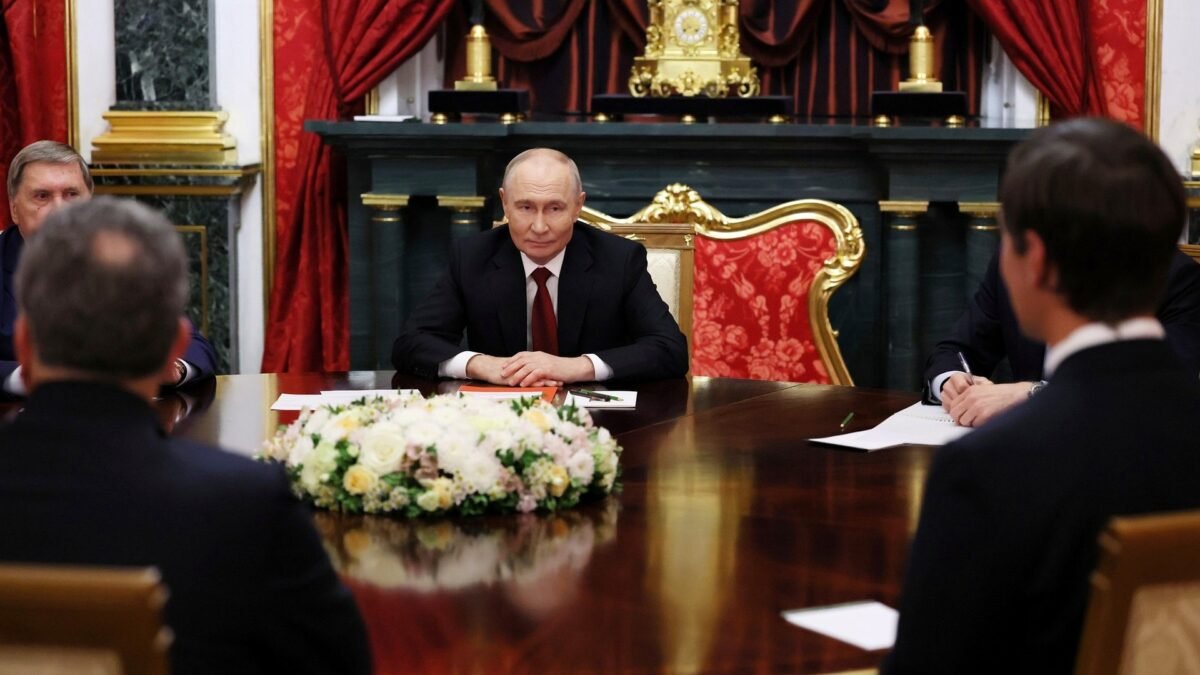
Jared Kushner, the United States envoy leading Washington’s effort to end the war in Ukraine, has admitted that President Vladimir Putin “doesn’t seem that interested” in a ceasefire, in an interview that has alarmed Kyiv and European capitals and exposed how far apart the parties remain on the order, the shape and the substance of any peace deal.
Mr Kushner, who is President Donald Trump’s son-in-law and one of his leading envoys, made the admission in a podcast interview with Mathias Döpfner, the chief executive of Axel Springer, which owns The Telegraph. The interview, for Mr Döpfner’s “MD Meets” podcast, went online on Wednesday, and The Telegraph published its account of the conversation on Wednesday evening.
According to The Telegraph, Mr Kushner said he had pushed Mr Putin “very hard” on the European position that there must be a ceasefire in Ukraine before any wider talks on European security, but added that the Russian leader “doesn’t seem that interested”. Instead, Mr Kushner appeared to side with Mr Putin’s preferred sequence, telling Mr Döpfner: “What we should do is focus on the post-war period, which again, I think makes sense for us because you want to get to a peace that’s going to last.”
The remarks amount to the bluntest public concession yet from inside the American negotiating team that the central demand of Ukraine and its European allies — stop the shooting first, talk about the future afterwards — has not been accepted by Moscow, and that Washington is now organising its diplomacy around Mr Putin’s timetable rather than Kyiv’s.
“Grand master of politics”
Mr Kushner, who has met Mr Putin four times this year, used the interview to praise the Russian president in terms that will have been read with dismay in Kyiv and in European chancelleries. He called Mr Putin a “grand master of politics” and a “historic figure”, and said: “Going into the meetings, President Putin is very organised. People can like what he’s done, they can not like what he’s done, but he’s definitely a grand master of politics. He’s very thoughtful. He takes a lot of notes when we’re speaking, and then he transmits very specifically. But it’s very clear he has a very deep understanding of the issues.”
He also praised Mr Putin’s negotiating team, describing Yuri Ushakov, the Russian president’s national security adviser, as “fantastic”, and Kirill Dmitriev, Mr Putin’s envoy to the United States, as an “incredible friend of mine”. He added: “My assessment is that he does not only want peace, he wants to try and change the relationship with America, and he does want to try and see if there’s maybe a way to start a new beginning.”
Mr Kushner insisted he was a “mediator” carefully balancing the interests of “two sides that have two different perspectives on how to end the war”. But his language echoed Moscow’s own framing of the conflict. According to the Russian state news agency TASS, Mr Kushner told Mr Döpfner that the war had become a proxy war in which Europe funds and arms Ukraine against Russia. Analysts quoted in the British press accused him of repeating Kremlin talking points and of speaking as though he were Mr Putin’s advocate rather than an impartial broker. Maria Popova, director of the Jean Monnet Centre in Montreal, who focuses on the Russia-Ukraine war, wrote on X that “Kushner speaks as if he’s Putin’s spokesman rather than a mediator or a US envoy”, adding that he “praises Putin, denies Russia is an aggressor, and speaks of Russia’s conquest and occupation of Ukraine as ‘peace’.”
Mr Kushner also repeated a Kremlin claim that an alleged Ukrainian attack on Mr Putin’s Valdai residence was to blame for a breakdown in the peace talks earlier in the process. “I got asked to work on this about a year ago, and we started making some progress in about late November,” he told Mr Döpfner, recalling his role in the talks. “Then there was the attack the Ukrainian did on Putin’s house at the end of December, which I think pushed him back.” At the time, Moscow claimed the attack was an effort by Kyiv to scupper intensifying negotiations to end the war. A week later, according to The Telegraph, Mr Trump told reporters that US intelligence had determined that Ukrainian drones had not targeted the residence.
Europe has “no plan”, Mr Kushner says
Mr Kushner’s sharpest words were reserved for Europe. “We’ve asked the Europeans or the Ukrainians if they have a better idea on how to get there, but nobody has presented us with one so far,” he said. Europe, he argued, had yet to come up with a convincing plan to end the war, and he challenged Nato allies to offer alternatives to his own efforts.
He also claimed that Europe had purchased more than $250 billion of energy from Russian sources since the outbreak of the war. “I think Europe has actually paid more money to Russia than they’ve given to Ukraine during this conflict, if the data that I’m seeing is correct,” he added.
His comments are likely to cause concern among leaders in Europe and Ukraine, who insist a ceasefire must come before any negotiations on post-war arrangements. They have repeatedly warned that Mr Putin is trying to use the Ukraine peace process to redraw the continent’s security arrangements in his favour. Recent Russian demands have included Nato withdrawing troops from Eastern Europe.
Mr Kushner and his fellow envoy Steve Witkoff, a property tycoon, have in recent weeks supported broadening the talks to issues of European security architecture, post-war security guarantees and economic recovery packages, as well as humanitarian agreements. Mr Witkoff praised the Russian leader as a “humanitarian” last month, comments that were condemned by European leaders, including the British prime minister, Andy Burnham.
Mr Kushner dismissed accusations that the White House had simultaneously tried to pressure Kyiv into submission to get a deal by cutting off intelligence or weapons supplies. “That’s not the approach we’ve taken … I think that’s a lot of misinformation,” he replied. “Number one, we have not put any pressure on President [Volodymyr] Zelensky or the Ukrainians. Our job is to be a mediator. In fact, we’re actually supporting them. We’re giving them intelligence-sharing and America has been their biggest donor in this war. So President Trump’s posture has been one of support.”
In a separate interview with New York Magazine, reported by RBC-Ukraine, Mr Kushner said he had urged Mr Trump not to pressure Mr Zelensky, and described Mr Trump telling Ukrainian delegates in Miami to find a new president after Mr Zelensky protested a proposal to exchange diesel supplies for sanctions relief.
Mr Kushner also reiterated Mr Trump’s calls for elections in Ukraine, a subject raised during the height of a recent falling-out between the US and Ukraine. “In terms of regime change, President Trump called for an election, obviously. I think that’s a democratic feature that I think he wants,” Mr Kushner said. “And that was after President Zelensky attacked President Trump. And so, as you see with President Trump, he’s a very strong counterpuncher, and President Zelensky attacked him.”
The diesel deal
Questioned on Mr Trump’s controversial deal to buy Russian diesel, Mr Kushner said: “Ukraine started hitting the Russian refineries and what happened from there was Russia put an export ban on diesel and diesel prices went up substantially, which was hurting American farmers and fishermen and other industries. So President Trump tried to see if we could stop that to keep the gas prices down. I saw a lot of people going crazy. The net benefit to Russia of lifting the diesel sanctions was probably … they were selling the diesel somewhere.”
The episode illustrates the tangle at the heart of the American approach: measures presented in Washington as relief for American consumers are seen in Kyiv and in European capitals as concessions that hand Moscow revenue and legitimacy while the war continues. Mr Trump has told Ukrainian delegates that he wants a deal, and the diesel arrangement, like the broader economic incentives dangled before Moscow, is part of an American strategy that pairs pressure on Kyiv to compromise with inducements for the Kremlin to come to the table.
Zelensky waits for a date that has not come
While Mr Kushner was speaking to Mr Döpfner, Mr Zelensky was telling the world that Kyiv is still waiting for Washington to set a date for the next round of talks. The Ukrainian president said on Wednesday that he was waiting for the American side to determine a date for a new round of peace talks with Russia, and that the meeting should now be quadrilateral, bringing Ukraine, Russia, the United States and European representatives to the same table.
“And now we are waiting for the American side to set a date for the next meeting, which should now be quadrilateral,” Mr Zelensky said in a statement on X, the social media company, following talks in Kyiv with the Estonian foreign minister, Margus Tsahkna. He said Ukraine had done “a lot” to fully involve Europe in the peace track with Russia, which is mediated by the US.
His remarks came after Moscow and Kyiv held a new round of peace talks mediated by Washington in Abu Dhabi on 10 and 11 November, after which Mr Kushner said both countries had agreed that the next round of talks would include the participation of European representatives. Europe has not been represented in US-mediated peace talks so far because Russia has opposed European participation.
Mr Putin said last week that Russia had agreed to a proposal by the US envoys to integrate Ukraine’s security into pan-European security. “Of course, it would be rather odd to discuss European security without Europe’s involvement, wouldn’t it? We have no objection to that. However, we need to understand what Europe intends to bring to these negotiations,” he said. “For this reason, we have proposed — through diplomatic channels — that the Europeans come to Moscow so that their position can be clarified. Once that is done, we will decide on the format for continuing the dialogue with Ukraine.”
But the Russian presidential aide Yuri Ushakov said earlier on Wednesday that no agreements had been reached yet on a meeting with European representatives in the Russian capital, and that no decision had been made on their participation in US-mediated Ukraine peace talks. Mr Zelensky told reporters on 23 November, addressing Nato-country lawmakers by video from Berlin, that the four-party meeting should happen as soon as possible. “We must do everything to make sure that the four-party meeting — Ukraine, Europe, America and Russia — happens as soon as possible. We are ready to do this. Literally tomorrow,” he said. “We have heard from our partners that they want to try to make it happen before Christmas. We hope it happens sooner.”
Commenting on his meeting with the Estonian diplomat, Mr Zelensky said he had briefed Mr Tsahkna on Russian strikes against Ukraine’s energy infrastructure and discussed energy assistance and preparations for the next edition of the Ukraine Recovery Conference, which will take place in Estonia early next year. “Of course, we also talked about negotiations and future security guarantees,” he added.
The guarantee gap
The argument over format is only one of the gaps. The other, exposed by new reporting on Wednesday, concerns what any American security guarantee for Ukraine would actually be worth. According to the Kyiv Independent, citing people familiar with the talks, US negotiators have privately ruled out sending troops or setting up military bases in post-war Ukraine as part of security guarantees, exposing a gap between Washington, Kyiv and European allies over what those guarantees should entail.
The disagreement comes as the US pushes for security guarantees modelled on Nato’s Article 5, under which an attack on one member is treated as an attack on all. At a meeting in Berlin on 19 November, Mr Kushner and Mr Witkoff discussed the guarantees with Ukrainian and European officials. Mr Kushner said President Trump was ready to consider an arrangement modelled on Nato’s collective defence clause, and the envoys believe security guarantees are the most “promising” track of the negotiations, one US official told the Kyiv Independent.
But an “Article 5-like” guarantee is not the same as Nato membership. It does not automatically establish who would respond to an attack, or whether the countries involved would be required to use military force. Responding to a question from the Kyiv Independent, Mr Zelensky said Ukraine still had no clear answer about how the proposed arrangement would work. “It’s not clear yet, because we still don’t have a clear answer, a full answer, about what this collective group would be, how it would defend us, and whether this group would be ready to repel the aggressor,” he said. “This has to be on paper. So far, I haven’t seen any such steps on paper.”
While Mr Zelensky insists the guarantees be clearly spelled out in writing now, a US official familiar with the negotiations told the Kyiv Independent that Washington wants them included in the final peace deal. US officials have not specified what Washington would be willing to commit to under the proposed guarantees. One US official said the package could include “support or other measures” to help ensure Ukraine’s security after the war ends. Two US officials also told the Kyiv Independent that career diplomats at the State Department are increasingly being cut out of the talks by Mr Trump’s envoys, and that there is confusion inside the administration about what form the guarantees would take.
Mr Kushner, in the podcast, called the Article 5 language “the gold standard”, and said: “And so from Ukraine’s perspective, I think they’re asking for more specificity, but we will not be able to give more specificities than what already exists in the Nato alliance and what the member states get from each other in that regard.” He also said Mr Putin appeared more willing to “consider” a possible Article 5-like arrangement. Yet the Ukrainians do not believe the talks are moving forward, because they are unsure whether Mr Putin really wants to end the war. A diplomatic source who recently visited Kyiv told The Telegraph: “Nothing changes. They don’t see Russia wanting peace and so the war continues.”
On territory, Mr Kushner was candid about the impasse. “I think once we’re able to define that post-war relationship, I think the issue of territory will become much easier to resolve, because right now there’s no way to bridge that last issue,” he said. So far, the Americans have appeared more favourable to Russia’s insistence that, as the price for peace, Ukraine should hand over the remainder of the eastern Donbas regions that Mr Putin’s forces have not been able to capture. Mr Zelensky said on 21 November that US negotiators had asked whether Ukraine would withdraw from Donbas in exchange for joining Nato, a proposal Kyiv has not accepted.
Brussels draws its own line
Brussels, meanwhile, has locked its own position behind the very precondition Mr Putin is refusing. The European Commission spokeswoman Paula Pinho said at a briefing in Brussels on Monday that discussions on Europe’s security architecture could commence only after a ceasefire in Ukraine, and must involve Nato and EU member states. Ms Pinho acknowledged Russia’s invitation to send a delegation to Moscow, which Mr Putin said on 19 November had been conveyed through diplomatic channels, but said Europe prefers a multilateral format.
The EU’s foreign policy chief, Kaja Kallas, told reporters in Dublin on 13 November that a ceasefire must come first, and said on 16 November that Moscow was escalating. Reuters reported that several EU foreign ministers, including Lithuania’s Kestutis Budrys, warned against falling into a Russian trap, while Russian officials have sought agreement on security architecture before Ukraine war specifics.
The result is a circle with no exit: Washington wants to design the post-war order first and let territory follow; Brussels will not discuss the post-war order until the guns fall silent; Moscow will not fall silent until the post-war order is agreed; and Kyiv, which is doing the bleeding, is waiting for a date for a meeting whose format has not been agreed, to discuss guarantees whose content has not been written down.
Thirty-four countries demand an end to chemical weapons use
On the same day, 34 countries and the European Union issued a joint statement calling on Russia to immediately stop using toxic chemicals and riot-control agents in Ukraine, Reuters reported from The Hague. The statement, signed by non-proliferation directors including those of Britain, France, Germany, Japan and New Zealand, urges identifying perpetrators through the mechanisms of the Organisation for the Prohibition of Chemical Weapons.
It responds to a Ukrainian report, circulated on 17 November to the chemical weapons watchdog’s 193 member states, that documents more than 14,000 Russian uses of such munitions since 2022. The OPCW said designated laboratories confirmed the presence of CS, the riot-control agent 2-chlorobenzalmalononitrile, in samples from a September 2024 incident near Illinka. Russia denies using banned munitions and accuses Ukraine of doing so.
The statement carries no enforcement mechanism. The Chemical Weapons Convention lacks a route to assign blame for riot-control agent use, and the signatories asked only for identification “through OPCW mechanisms”, leaving the route undefined. It may be groundwork for a later push at the Conference of the States Parties to create one. For now, it gives Kyiv diplomatic cover but no remedy, and it underlines the distance between the language of international law and the reality of a war in which, according to the Ukrainian report, chemical munitions have been used thousands of times.
How the talks reached this point
The current round of diplomacy has moved faster in November than at any point this year, but each step forward has exposed a new disagreement. Mr Kushner and Mr Witkoff met Mr Putin in Moscow on 5 September, and again on 12 November, and took the American peace push to Kyiv afterwards. On 19 November, the three leaders of the Shenzhen summit — Mr Trump, the Chinese president, Xi Jinping, and Mr Putin — issued a four-point statement covering United Nations reform, refined petroleum supply and limits on the International Criminal Court. The same day, Mr Kushner and Mr Witkoff sat down in Berlin with Chancellor Friedrich Merz and representatives of Ukraine and European governments at a summit of the so-called Coalition of the Willing.
The Financial Times has reported that the administration wants a deal before January 2027, when a changed Congress takes office. Democrats won the House of Representatives in the midterm elections on 3 November by the largest margin in decades, and the new Congress will take its seats in January. That deadline, if it is real, puts a clock on negotiations that are already straining under incompatible demands, and it may explain why Mr Kushner is publicly lowering expectations about a ceasefire while insisting that a durable peace can still be built around it.
Meanwhile the war itself grinds on. Russian strikes on Ukraine’s energy infrastructure have continued through the autumn, and Kyiv’s air defences are running short of interceptors. The United States has held up the delivery of dozens of Patriot missiles bought for Ukraine through Nato’s Partnership for Ukrainian Resilience and Lethality initiative, and Ukrainian officials have warned that rolling blackouts are likely in Kyiv as the country rations interceptors against nightly attacks on the grid. A leaked-data analysis reported this week put Russian war dead at more than 720,000, a measure of the human cost that both sides are paying while the diplomats argue about sequencing.
Analysis: a mediator who sounds like an advocate
The most striking feature of Mr Kushner’s interview is not what it reveals about Mr Putin. It is what it reveals about the American envoy himself. A mediator’s first duty is to be believed by both sides, and Mr Kushner spent much of the conversation praising one side, blaming the other side’s allies, and adopting the language of the Kremlin’s own case. He called the war a proxy war, a phrase Moscow uses to deny its own responsibility for starting it. He repeated the claim about an attack on Mr Putin’s residence, a claim American intelligence itself has discounted. He praised Mr Putin as a grand master of politics and Mr Dmitriev as an incredible friend. He told the Europeans they had no plan, and told the Ukrainians, in effect, that they had no better idea than his.
None of this proves that Mr Kushner is acting in bad faith. It is possible, as some analysts quoted in the British press suggested, that he is deliberately flattering Mr Putin to keep him at the table, and that the praise is a negotiating tactic rather than a conviction. Envoys have flattered difficult leaders before. But flattery has a cost, and the cost here is visible in the reactions: Kyiv does not believe the talks are moving, European capitals do not believe the American plan is theirs, and the public record now contains the American envoy’s own admission that the Russian president is not interested in the one thing Ukraine and Europe consider non-negotiable.
The deeper problem is structural. The American plan, as Mr Kushner described it, sequences the negotiation backwards from the way ceasefires are normally built. Ordinarily, the shooting stops first, and the political settlement follows, because a ceasefire creates the space in which hard compromises can be made. Mr Kushner’s approach asks the parties to agree the post-war order — security guarantees, territory, economic arrangements, the architecture of European security — while the war is still being fought, on the theory that once the future is defined, the present will resolve itself. That theory has an internal logic, and it is the theory Mr Putin prefers, because it lets Moscow negotiate while its armies keep advancing and its missiles keep striking Ukrainian cities. It is also the theory Kyiv and Brussels reject, because it asks Ukraine to concede territory and accept guarantees whose content is unwritten, while the bombing continues.
The guarantee gap sharpens the point. An Article 5-like guarantee without American troops or bases is a promise whose enforcement mechanism is deliberately left vague. Mr Kushner himself conceded that Washington cannot offer more specificity than Nato members offer each other, which is true but unhelpful: Nato’s Article 5 works because it sits inside an alliance with integrated command, forward-deployed forces and decades of joint planning. An Article 5-like arrangement for a non-member, with no troops, no bases and no written text, is a different creature altogether, and Mr Zelensky is right to ask, on paper, who would defend Ukraine and how. Until that question has an answer, the guarantee is a slogan rather than a shield, and Kyiv’s reluctance to trade territory for it is understandable.
There is also a question of leverage, and the winter will answer it. Ukraine’s air defences are short of interceptors, its energy grid is under nightly attack, and the Patriot missiles it has already paid for are being held up. If the lights go out in Kyiv in December, the pressure on Mr Zelensky to accept whatever is on the table will grow, and Moscow knows it. That is why the calendar matters: the four-way meeting that partners hope to hold before Christmas, the EU’s financing decisions this week, and the question of whether Washington will set a date at all. A meeting without a date is a promise without a deadline, and Mr Putin has shown, across four meetings with Mr Kushner this year, that he is content to talk while his forces keep fighting.
What should be watched next is simple. First, whether Washington sets a date for the quadrilateral meeting, and whether Moscow accepts European participation or insists the Europeans come to the Kremlin first. Second, whether the security guarantees are ever put in writing, and whether that writing mentions troops, bases or any commitment that would bind the United States to act. Third, whether the Patriot missiles are released, because air defence is the most concrete measure of whether Washington is still backing Kyiv while it negotiates. And fourth, whether Europe, having been told it has no plan, produces one — with money, weapons and a common position on the sequencing question — before the new year. Until those things happen, Mr Kushner’s interview will stand as the clearest statement yet of where the American peace effort stands: the envoy has met the Russian president four times, praised him warmly, and come away admitting that the man he is negotiating with does not seem interested in stopping the war.
Sources
- The Telegraph — “Kushner: Europe has no convincing plan for peace” (25 November 2026)
- Anadolu Agency — “Zelenskyy says Ukraine waiting for US to set date for new round of peace talks with Russia” (25 November 2026)
- Kyiv Independent — “US rules out troops, military bases in Ukraine under post-war security guarantees” (25 November 2026)
- Ukraine Daily Brief — 26 November 2026 (Kushner interview, Brussels position, 34-country chemical weapons statement)
- Watan News — “Ukraine Peace Talks Hit a Guarantee Gap as US Rules Out Troops” (25 November 2026)

About the Author — Abdul Mannan
Related Articles

EU Leaders Wrestle Over €1.58 Trillion Budget and €45 Billion Ukraine Loan as Kremlin Warns Funding Threatens Peace Talks
EU leaders opened two days of talks in Brussels on a €1.58 trillion seven-year budget and a €45…
Kim Jong Un Orders Tactical Nuclear Weapons Deployed Across Multiple Domains as North Korea Expands Its Arsenal
North Korean leader Kim Jong Un has ordered tactical nuclear weapons to be deployed across multiple domains, declaring…

At Least 31 Killed as Fuel Tanker Explosion Sets Cairo’s Ring Road Ablaze
A fuel tanker overturned and exploded on Cairo's Ring Road on Wednesday, killing at least 31 people and…