
Los Angeles Just Told Google: Our Children Are Not Your Product

What happens to a child who never has to wonder? I ask you this plainly, because Los Angeles has just forced the whole world to answer it. A child types a question into a search box. Before the teacher can speak, before the child can struggle, before the mind can do the hard and holy work of thinking, a machine hands over the answer, neat and finished, like a meal already chewed. And we call this progress.
I do not call it progress. I call it a quiet theft, and this week, for the first time, a great American city said so out loud.
It Was the Talk of the Playground
On 27 November 2026, the Associated Press reported a story that travelled, within hours, to nearly a hundred news outlets around the world. Los Angeles Unified, the school district that teaches roughly half a million children, had quietly disabled Google’s AI Overview on school-issued devices. When a student searches for something on Google now, no machine-written answer appears above the results. The summary is gone. The child must read, compare, and judge for herself.
The district made no grand announcement. There was no press conference, no ceremony. Parents and students simply noticed that the answers had vanished, and a parent group, Schools Beyond Screens LA, asked families to film their children’s laptop screens as proof. The district then confirmed what the videos showed. Bridie Lee, a leader of the group, put it in words a child would understand: “It was the talk of the playground.”
The timeline matters. On Friday, 13 November, members of Schools Beyond Screens spoke at a meeting of the district’s artificial intelligence committee. By the following Monday, AI Overview was gone. The district later said, in a statement, that it had “temporarily suspended” the feature to ensure student experiences are “age-appropriate and safe”. Temporary, they said. But temporary is how every great change begins — with a door that was supposed to stay shut, opening just a crack.
Los Angeles had already switched off Google’s AI Mode, the deeper conversational search tool, at the start of the school year. What remained was the Overview: the summary that appears whether a child asks for it or not, inside an ordinary search. Google has insisted that it cannot separate its search product from its AI tools for education. So the district found its own way, reportedly through a third-party filtering tool, and did what the company said could not be done.
And Google’s answer, according to the Associated Press, is a warning: it will restrict access to its search tools unless districts enable its AI features. A corporation telling public schools to take its artificial intelligence or lose search itself — that is not a negotiation, it is a threat dressed in the language of product design. Other districts are now weighing whether to drop Google’s products entirely. Los Angeles is the largest to draw this line. It will not be the last.
Socrates Warned Us About This
History is a mirror, and I hold it up now because the present is too bright to look at directly. Nearly two thousand four hundred years ago, in Plato’s dialogue the Phaedrus, Socrates warned that the invention of writing would damage the human mind. People, he said, would trust external marks instead of their own memory. They would hear many things without being properly taught, and they would imagine themselves wise while knowing nothing.
He was wrong about writing, and he was right about us. Writing did not destroy memory; it transformed it. But Socrates was right about the deeper danger, which is not the tool but the surrender. The printing press was feared because cheap books would flood weak minds; it spread literacy instead, but only because societies taught people to read, not merely handed them books. The calculator was feared for the same reason, and schools survived it by teaching arithmetic first and the machine second, as a servant and never as a master.
Now comes the machine that does not merely calculate or print. It answers. It summarises. It reasons, or appears to. And the question Socrates asked returns to us, sharper than ever: when the answer arrives before the question has been truly asked, what is left for the mind to do? That struggle is not a defect of learning. That struggle is learning. A child who is never allowed to struggle is a child who is never allowed to grow.
The Debt No One Sees
This is not sentiment. The science is now arriving, and it is grave. In June 2025, researchers at the MIT Media Lab published a study with a title that should be read in every staff room on earth: “Your Brain on ChatGPT: Accumulation of Cognitive Debt when Using an AI Assistant for Essay Writing Task”. Fifty-four students from universities including MIT and Harvard were asked to write essays while their brain activity was measured. Those who wrote with the help of a chatbot showed the weakest overall brain connectivity. And when the writing was done, 83 per cent of the chatbot users could not quote a single correct line from their own essay minutes later. Among those who wrote with their own brains, or with an ordinary search engine, 90 per cent could.
The researchers gave this a name: cognitive debt. It is the cost of letting a machine do the thinking today, paid tomorrow in weakened memory, weakened judgement, and weakened creativity. The study has not yet been peer-reviewed, and honest people will say so, as I do now. But it is not alone. A 2025 study by Microsoft Research and Carnegie Mellon, covering 319 knowledge workers, found that the more people trusted AI, the less they reported exercising their own critical thinking. And in a Turkish high school in 2025, nearly a thousand pupils were assigned at random to revise for a mathematics exam; those who revised with an unguided chatbot-like AI scored 17 per cent lower than those who revised without it. When the AI was set up as a tutor that guides rather than answers, the loss almost disappeared.
The machine is not the enemy. The machine as a master is. A tutor that guides a child towards the answer builds a mind; a machine that hands over the answer builds dependence. Los Angeles has understood this distinction, and Google, to its shame, has refused to.
The Company That Came Bearing Gifts
Here the mirror of history shows us something darker. I have written before about the East India Company, which came to my part of the world as traders bearing gifts, and stayed as rulers. No one invites a ruler. A ruler arrives as a merchant, as a helper, as a friend bearing presents, and by the time you understand what has happened, the keys of the house have changed hands.
Google came to the classroom the same way. It came bearing gifts: free email, free documents, free classroom software, and laptops so cheap that no school board could refuse them. Today the Chromebook is the most widely used student laptop in America, and Google Docs and Google Classroom are woven into homework, classwork, and the daily conversation between teachers, children, and parents. The gift was real. So was the hook.
And now, when a school district asks for one small thing — the right to use search without the AI summary — the company answers that the two cannot be separated, and that access to search itself may be restricted. The gift has become a leash. The company that gave the classroom its tools now claims the right to decide how the classroom thinks. I am not writing this as an enemy of technology; I make my living with a microphone and a camera, and I know what machines can do. But I also know the oldest rule of power: whoever controls the question controls the answer, and whoever controls the answer controls the mind. A school is not a market. A child is not a user. A classroom is not a platform to be monetised.
Who Governs the Classroom?
The world has been warned about this for years, and the warnings were ignored. In September 2023, UNESCO published the first global guidance on generative AI in education and research. It called on governments to regulate, to protect children’s data, to train teachers, and to set thirteen as the minimum age for the independent use of AI tools in the classroom. It also reported a fact that should shame every education ministry on earth: of more than 450 schools and universities surveyed, fewer than one in ten had any formal guidance on generative AI at all. The machines entered the classroom three years ago. The rules still have not arrived.
In August 2026, Google switched on its Gemini chatbot for many children using Google Classroom. Weeks later, in September, the two largest school districts in America — New York and Los Angeles — announced one-year moratoriums on student use of generative AI. In New York the ban covers elementary and middle school pupils; in Los Angeles it covers every child from kindergarten to twelfth grade on school devices. They banned it not because they hate the future, but because they wanted time to write the rules before the future wrote itself over their children.
But let us be honest about what a single district cannot do. Los Angeles can switch off a feature on its own devices. It cannot rewrite the business model of a trillion-dollar company, and it cannot protect the child who goes home and opens the same search box on a family phone. The ban covers school devices, not private ones.
That is why this story matters beyond California. It is a test of a simple question: does a public institution still have the power to say no to a private corporation when the welfare of children is at stake? If the answer is yes in Los Angeles, it can be yes anywhere. If the answer is no, then we should stop pretending that schools govern themselves at all, and admit that the curriculum is now written in Mountain View. Los Angeles’s AI committee meets again on 9 December 2026, and other districts are now considering other search providers. The pressure is working, slowly, the way pressure always works: not by shouting, but by refusing.
The Question Returns to You
I began with a question, and I end with one, because a column that only gives answers has taught you nothing. What happens to a child who never has to wonder?
She grows up fluent and empty. She can produce, but she cannot ponder. She can summarise, but she cannot doubt. She will be efficient, and she will be obedient, and she will never once have felt the particular joy of a mind that fought for an idea and won it. That is not an education. That is a training programme for a world that wants workers, not citizens. Los Angeles has reminded us that a school is a sanctuary for a child’s mind, not a showroom for a company’s products.
Now the question leaves the school board and comes to your house. When your child asks you something tonight, will you reach for the phone and let the machine answer, or will you sit with the question together and let the child do the sacred, difficult, irreplaceable work of wondering? The classroom begins at home. Guard it.
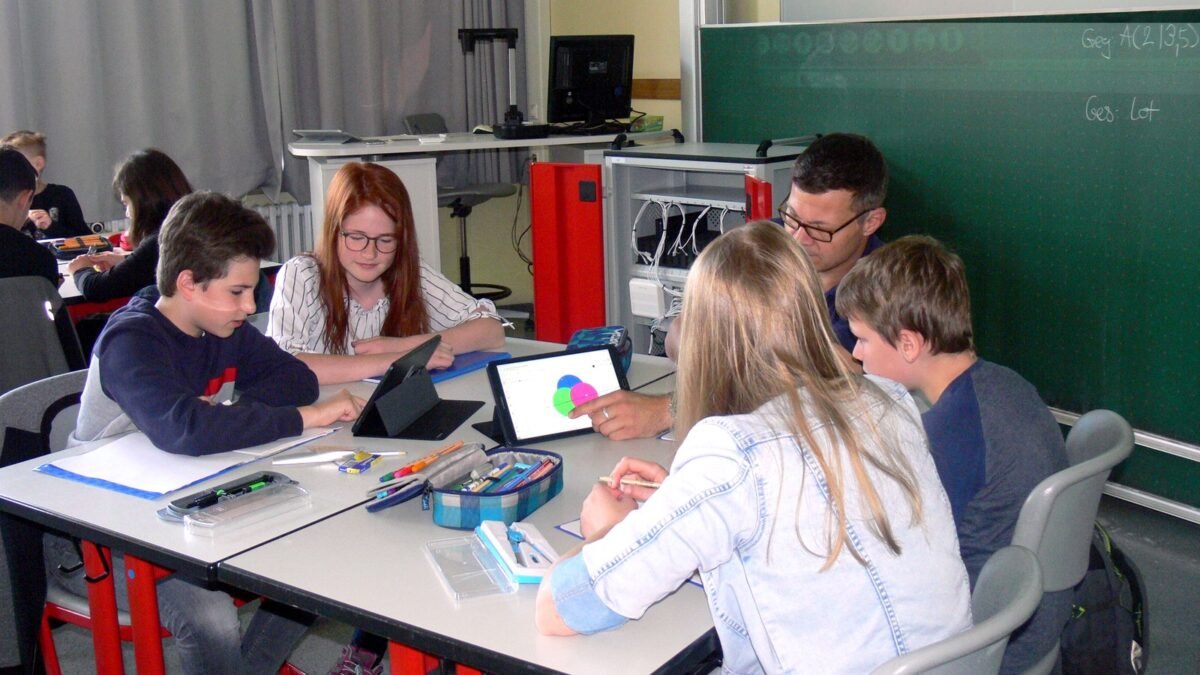
Photo credit: Students using tablets in a classroom. Photo: Aigner Ronja and Kohlmeier Michelle, via Wikimedia Commons (CC0 public domain).
Sources & References
- Associated Press (Barbara Ortutay, Jocelyn Gecker and Cheyanne Mumphrey), “As Google threatens to cut schools’ search access, Los Angeles blocks AI features”, 27 November 2026 — TechXplore
- “LA school district blocks Google’s AI search features”, Engadget, 28 November 2026 — Engadget
- Los Angeles Times, “LAUSD blocks Google AI, despite tech giant’s move to pressure schools to go all in”, Instagram, 27 November 2026 — Instagram
- Kosmyna et al., MIT Media Lab, “Your Brain on ChatGPT: Accumulation of Cognitive Debt when Using an AI Assistant for Essay Writing Task”, June 2025 (preprint, not yet peer-reviewed) — discussed in Springer and Tec de Monterrey Observatory; see also the critical review at Projet Celsius
- UNESCO, “Guidance for generative AI in education and research” (Miao & Holmes), 7 September 2023 — UNESCO
- The World of AI, “AI News Today”, 28–29 November 2026 — The World of AI

About the Author — Abdul Mannan
Related Articles

Africa’s Coastal Cities Are Sinking, Satellites Reveal — Seven Million People at Flood Risk by 2050
Satellite radar shows Africa's coastal cities are sinking faster than global models assumed, putting more than seven million…

Ancient Teeth Found in Southern China Reveal Denisovans — and a Mystery Human Lineage
Four fossil teeth from two caves in Guangxi show Denisovans lived in subtropical southern China — and that…

BepiColombo Reaches Mercury Despite Software Glitch That Cut Its Orbit Burn Short
A software glitch cut BepiColombo's orbit-insertion burn to 28 minutes, leaving the ESA-JAXA spacecraft in a wider orbit…