
NASA’s Perseverance Rover Sets Record for Longest Drive Ever on Another World

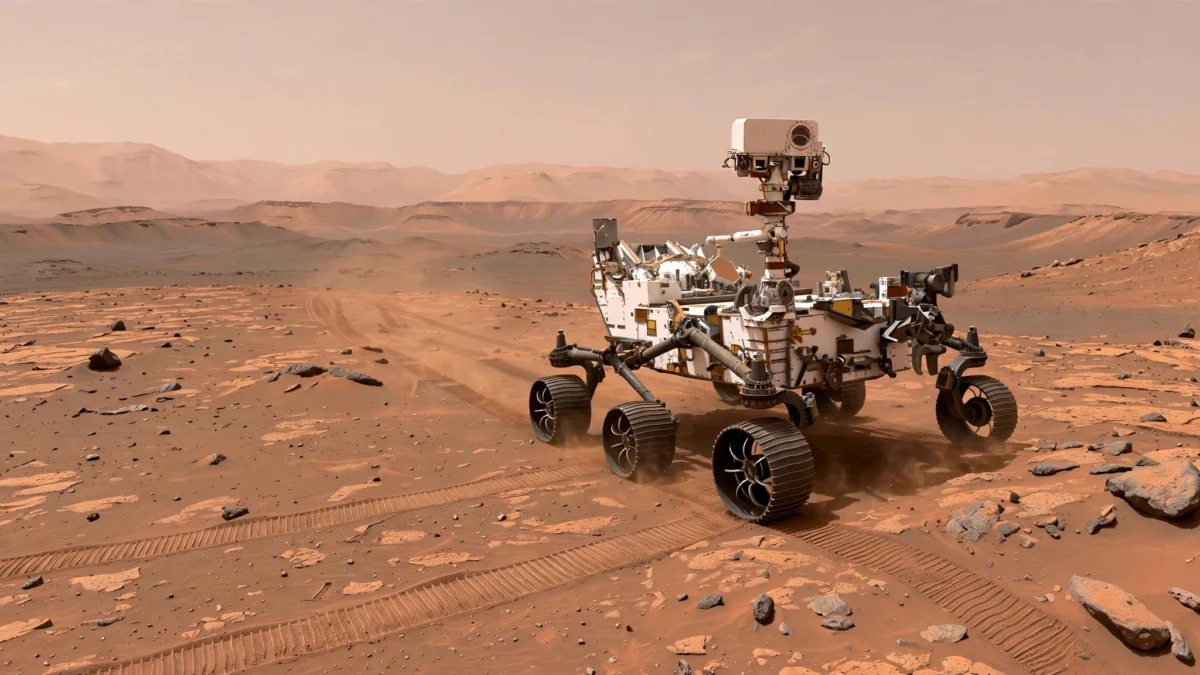
There is a stretch of Martian ground that no machine has ever crossed faster than it was crossed this week. On Sunday, October 11, NASA’s Perseverance rover rolled a modest 91 meters across the western rim of Jezero Crater — and in doing so became the most travelled vehicle in the history of off-world exploration. The six-wheeled rover’s odometer ticked past 28.10 miles (45.22 kilometers), eclipsing the 28.06-mile record set by NASA’s Opportunity rover between 2004 and 2018, the US space agency announced on Tuesday, according to Reuters and NASA’s own mission page.
The raw numbers are impressive. The context is more impressive still. Opportunity needed nearly 15 years — 5,111 Martian days, or sols — to accumulate its mark, surviving far beyond its original 90-day design life. Perseverance covered a slightly greater distance in just five and a half years, on the 2,006th sol of its mission, and its project manager says the machine is nowhere near done.
The milestone is about more than a number. It is the first clear, headline-scale demonstration that autonomous navigation — the rover thinking and driving at the same time — has changed the economics of exploring another planet.
The record drive
The milestone arrived almost casually. Perseverance was en route from a region nicknamed “Lac de Charmes,” on the rim of Jezero Crater, toward an area of ancient, eroded rocks the science team calls Idubi, where researchers hope to find traces of ancient hydrothermal systems. A drive of just over 91 meters — 299 feet — nudged the odometer from 45.13 to 45.22 kilometers, as Guinness World Records documented in its certification of the new mark for greatest distance travelled on another world.
The destination matters. The rocks and terrain of Lac de Charmes are among the oldest ever encountered in the solar system — so ancient, NASA notes, that their Earthly equivalents have long since been erased by erosion and plate tectonics, a process Mars never had. The record was not set on a victory lap. It was set on the way to geology that could rewrite the planet’s early history.
Perseverance’s mission has always had a twofold purpose: to search for signs of ancient microbial life on a planet that was once warmer, wetter, and far more habitable than the cold desert it is today, and to collect rock and soil samples for a potential future return to Earth, according to NASA. The rover has already sealed dozens of sample tubes — including one drilled from a spotted rock nicknamed Cheyava Falls that scientists describe as the strongest candidate yet for an ancient Martian biosignature. That sample, however, sits waiting on Mars; the planned Mars Sample Return mission was effectively cancelled under the FY26 budget, leaving the tubes stranded for now. Perseverance keeps driving anyway, adding to the cache.
A short history of driving on other worlds
The record Perseverance just broke was itself a monument to endurance. It began, properly, on the Moon. The Soviet Union’s Lunokhod-1, the first planetary rover, touched down in the Mare Imbrium in November 1970 and trundled 10.54 kilometers under commands from Earth so primitive — six basic instructions, Guinness World Records notes — that the machine had to be partially autonomous to avoid getting stuck. Its sibling, Lunokhod-2, covered 37 kilometers in about four months in 1973, and that mark stood for more than four decades.
NASA’s twin Mars Exploration Rovers, Spirit and Opportunity, launched in 2004 with expectations that now read as comically modest: land, drive no more than about one kilometer, and shut down after three months. Instead, Opportunity kept going for 14 years, breaking Lunokhod-2’s record in July 2014 and eventually logging 45.16 kilometers — the longest time any spacecraft has ever survived on Mars. The end came in 2018, when a planet-wide dust storm blotted out the sun over the Endeavour Crater, starved the solar-powered rover’s panels, and silenced it.
Curiosity, the car-sized nuclear-powered rover that has worked Gale Crater since 2012, has driven about 38 kilometers to date and, by design, was never chasing the record: its drills, lasers, and instruments are meant for deep investigation of a compact area. Its radioisotope generator makes it immune to the dust storms that killed Opportunity, and it may yet match the distance mark eventually.
Perseverance is bigger than both — at over 1,000 kilograms, the largest planetary rover ever launched — but size is not what broke the record. Brains are.
Why Perseverance is so much faster
Driving on Mars is an exercise in patience imposed by physics. The planets are on average some 225 million kilometers apart, so a radio command takes about 13 minutes to arrive — real-time joystick driving is impossible. Traditionally, every drive had to be planned in painstaking detail on Earth from satellite and rover imagery, then executed blind: drive to the edge of the camera’s view, stop, photograph, analyze, repeat. Space-rated computers are deliberately simple and rugged to survive radiation, and as Guinness World Records explains, Curiosity’s processor cannot drive and think about where it is driving at the same time.
Perseverance carries an extra onboard computer — the Vision Compute Element — dedicated entirely to navigation. Its AutoNav system photographs the terrain while moving, builds a three-dimensional map of hazards, and amends its route on the fly, much like a self-driving car on Earth using AI image recognition. Where Curiosity typically manages 30 to 50 meters per drive, Perseverance can cover more than 410 meters in a single sol — and according to NASA’s Jet Propulsion Laboratory, AutoNav has powered roughly 90 percent of all the distance the rover has ever driven.
Earlier this year, engineers gave the rover another upgrade: the spare computer once used to talk to the Ingenuity helicopter was repurposed for a system called Mars Global Localisation, which matches a 360-degree mast-camera panorama against satellite maps to triangulate the rover’s position to within about 25 centimeters — without human help.
The hardware is holding up. “Perseverance’s engineering hardware and instruments are in excellent shape with all redundant systems still available,” Steven Lee, the project manager for both Perseverance and Curiosity at NASA’s Jet Propulsion Laboratory, told Reuters. “A recent assessment of all systems concluded that they are capable of operating well into the 2030s, likely beyond.” Lee noted that the original mission called for no more than 12.4 miles of driving — a figure the rover has now more than doubled, with its motors, conservatively rated for 20 kilometers, now expected to last for 100 kilometers or more.
Analysis: Why It Matters
Records in space exploration are usually framed as national triumphs or engineering flexes. This one deserves a different reading: it is a quiet proof that autonomy has become the decisive technology of planetary exploration.
Consider what the record actually measures. Perseverance did not beat Opportunity by being tougher — Opportunity remains the longevity champion, a solar-powered machine that survived 14 Martian years including global dust storms. Perseverance beat it by being smarter per kilometer. Ninety percent of its distance was driven by its own judgment. That is not a marginal improvement; it is a change in kind. The bottleneck of Mars exploration was never the wheels. It was the 13-minute speed of light and the human in the loop.
The implications run forward, not backward. Every future Mars mission — sample retrieval, if it is ever funded; the long-discussed human missions; the robotic scouts that would precede them — depends on vehicles that can cover serious ground without waiting for Earth to approve every turn. Perseverance has now field-tested that capability for five and a half years on real Martian terrain, and the odometer is the receipt.
There is a second, less celebratory reading worth keeping in view. Perseverance is the most capable Mars rover ever built, driving record distances with record efficiency — and the samples it is collecting, including the strongest biosignature candidate in the history of Mars science, currently have no funded ride home. The rover’s motors are expected to outlast its mission plan by decades; the institutional plan to retrieve what it finds did not survive a budget cycle. The distance record, then, is also a measure of a gap: between what American robotics can do on Mars and what American policy has chosen to finish.
None of that diminishes the achievement. It frames it. A machine the size of a small car, operating with a 13-minute communications delay, has driven farther than any vehicle on any world but Earth — through terrain its operators have never seen with their own eyes, guided for nine-tenths of the journey by its own eyes. The record will keep growing with each sol. The question it poses is whether the program that built it will keep pace.
What to Watch Next
- The Idubi campaign. The science team hopes the ancient terrain around Idubi preserves traces of hydrothermal systems — exactly the kind of environment where life could once have taken hold. What Perseverance finds there will shape the rest of the extended mission.
- The sample tubes. Dozens of sealed tubes, including the Cheyava Falls biosignature candidate, remain on Mars with no funded return mission. Watch for any revival of a retrieval plan — robotic or otherwise — in NASA’s budget negotiations.
- The 100-kilometer mark. With motors now expected to survive 100 kilometers and systems rated into the 2030s, Perseverance could more than double the current record. The pace of record-breaking will itself become a measure of AutoNav’s maturation.
- Curiosity’s slow chase. The older rover, immune to dust storms thanks to its nuclear power source, is still driving and could eventually approach the distance record on its own long timeline — a different philosophy of exploration, still in play.
- Autonomy on the Moon. The navigation lessons of AutoNav and Mars Global Localisation feed directly into lunar rover designs for the Artemis era. The next off-world driving record may be set much closer to home.
Sources
- NASA Science — “NASA’s Perseverance Sets Off-World Record for Total Distance Driven” (official)
- Reuters — “NASA’s Perseverance rover breaks record for off-planet driving on Mars”
- USA Today — “Mars rover Perseverance breaks driving record on another planet”
- Guinness World Records — “NASA’s Perseverance rover breaks the record for longest road trip on Mars”

About the Author — Abdul Mannan
Related Articles
James Webb Catches Water Clouds Thickening and Thinning on a Frigid World 7.5 Light-Years Away
Astronomers watching the coldest known brown dwarf with the James Webb Space Telescope recorded the first direct evidence…

The Sanction That Built a Rival: How America’s Chip War Forged China’s Silicon Empire
On 13 October 2026, Reuters revealed IDC data showing Nvidia's share of China's AI-chip market has collapsed to…
NASA May Already Hold Proof of Life Beyond Earth — Sealed Inside a Tube on Mars Nobody Can Retrieve
A leopard-spotted rock drilled by NASA's Perseverance rover in 2024 is the strongest potential sign of ancient life…