
PROMISE on the Moon: Humanity Is Going Back — This Time, to Stay

Why Did We Stop Going?
Have you ever stood under a clear night sky, looked up at the Moon, and asked yourself a question that sounds almost childish? Why did we stop going?
Fifty-seven years ago, two men walked on that grey dust and the whole of humanity held its breath. Then we turned away. For half a century the Moon hung above us like an unfinished sentence, a promise made and then quietly forgotten. And now, on an ordinary Saturday in November, NASA has told us the sentence will finally be finished.
On 7 November 2026, at an aerospace expo called MAX POWER at the Kennedy Space Center in Florida, NASA announced a sweeping set of awards for its Moon Base programme. At the centre of it stands a machine with a name that reads like a vow: PROMISE, the Polar Rover for Observation, Mapping, and In-Situ Exploration. A six-wheeled, nuclear-powered rover, built to crawl across the Moon’s South Pole, drill a metre into its frozen soil, and search for the water ice that could one day keep human beings alive there.
I read the announcement twice, because the first time I thought I had misunderstood. We are not going back to the Moon to plant another flag and come home. We are going back to stay.
What PROMISE Actually Is
Let me tell you plainly what this machine is, because the details matter more than the headlines. PROMISE is a six-wheeled rover managed by NASA’s Jet Propulsion Laboratory, the same laboratory that gave us the Mars rovers. In fact, it will be built from spare flight parts and engineering test models left over from Curiosity and Perseverance, the two great robots still working on Mars. There is something quietly beautiful in that: the bones of old explorers, reassembled for a new world.
It is nuclear-powered, which means it carries a radioisotope power system and can keep working through the long lunar night, a fortnight of darkness that kills solar-powered machines, and inside the permanently shadowed craters near the South Pole where sunlight has never reached. It will carry a drill that reaches about a metre, three feet, below the surface, along with spectrometers, temperature and radiation sensors, cameras, and a new radiation-tolerant computer called High Performance Spaceflight Computing. Its job is to prospect: to map the ice, measure the radiation, and scout the ground where astronauts will one day walk.
Blue Origin has won a 94 million dollar base contract, with a further 140 million dollars available as a performance-based option, to deliver PROMISE to the lunar South Pole aboard its Mark 1 lander. NASA is targeting a launch in late 2028 and an eighteen-month mission. Those are targets, not locked dates, and anyone who has followed spaceflight knows how often targets slip. But the direction of travel is now unmistakable.
Why the South Pole, and Why the Ice
You may ask why the South Pole, of all places. The answer is water, and water is everything. In the deep, permanently shadowed craters of the lunar South Pole, temperatures plunge so low that water ice can survive for billions of years. NASA’s LCROSS mission confirmed water ice there in 2009, when it deliberately crashed a spent rocket stage into the crater Cabeus and flew through the debris. India’s Chandrayaan-1 had already found the signature of water molecules scattered across the surface a year earlier.
Water on the Moon is not a curiosity. It is drinking water, it is oxygen to breathe, and, split into hydrogen and oxygen, it is rocket fuel. A base that can make its own water does not need to haul every drop from Earth at ruinous cost. Whoever controls the ice controls the future of the Moon. That is why the South Pole has become the most valuable real estate in the solar system, and why every serious lunar plan on Earth now points at the same dark craters.
PROMISE is the scout sent ahead of the settlers. It will drill where humans cannot yet go, measure what humans cannot yet touch, and tell us whether the dream of a permanent base is built on solid ice or on hope alone.
The New Merchants of the Moon
But there is another story inside this announcement, and it is the one history will remember. NASA did not just announce a rover. It announced a marketplace. Eight companies, Blue Origin, Firefly Aerospace, Intuitive Machines, ispace-U.S., Lockheed Martin Space, Northrop Grumman Space Systems, SpaceX, and Voyager Technologies, were selected to compete for lunar cargo deliveries under the next phase of the Commercial Lunar Payload Services programme, known as CLPS 2. It is a ten-year framework with a combined maximum value of ten billion dollars.
Read that figure carefully, because it is not what it seems. Ten billion dollars is a ceiling, not cash in anyone’s account. Each delivery must still be ordered and paid for, one mission at a time, out of yearly budgets. The original CLPS contract has been raised from 2.6 billion to 4.2 billion dollars and runs through November 2028, with deliveries allowed to finish through November 2033. Alongside it, NASA announced about 1.3 billion dollars in launch and in-space transportation task orders, and a 185 million dollar Moon Base transportation award led by Arrow Science and Technology.
And here history taps me on the shoulder, as it always does. When I see private companies carrying the flag where once only states dared to go, I think of the East India Company, which arrived in the subcontinent as a trading concern and stayed as an empire. I do not say the parallel is exact; the Moon has no people to conquer, and these companies work under contract, not conquest. But the pattern is old and familiar. First come the traders, then the roads, then the settlements, and then the question of who makes the rules. The Moon has no parliament yet, and no constitution. The companies building its roads are writing its first unwritten laws with every contract they sign. We should watch that closely, and we should say so plainly, before the facts on the ground become facts we can no longer question.
The Ghost of Apollo
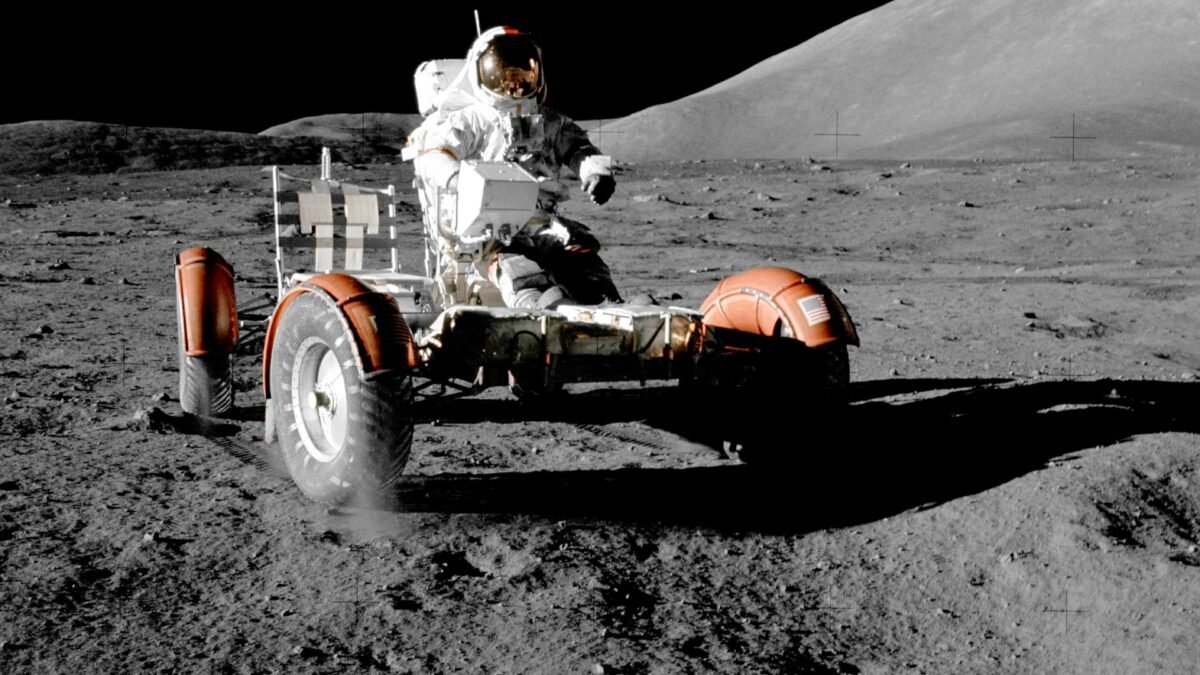
There is a ghost standing behind every word of this announcement, and its name is Apollo. In July 1969, Apollo 11 landed two men on the Sea of Tranquillity, and by December 1972, Apollo 17 had left the last bootprints on the lunar dust. Twelve men walked on the Moon. Then the programme ended, and we told ourselves the story that we had finished the job.
We had not finished the job. We had performed a magnificent feat and mistaken it for a settlement. Flags and footprints are not a civilisation. The Apollo missions were a sprint, and a sprint, however glorious, does not build a home. That is the difference between 1969 and 2026. Apollo went to prove it could be done. PROMISE goes to find out whether we can stay. One was a visit. The other is a survey for a home.
And the timing carries its own warning. Only three days before this announcement, on 4 November, NASA’s Swift Observatory, a telescope that had watched the universe’s most violent explosions for twenty-two years, fell burning back into Earth’s atmosphere after a rescue mission failed. Swift was launched in 2004, it found more than two thousand gamma-ray bursts, and it died because the Sun’s activity dragged it down faster than anyone planned. The same week we announced a base on the Moon, we watched a faithful servant of science burn up over the tropics. Space gives, and space takes, and nothing we build there is permanent unless we learn to maintain it. A base, unlike a visit, must be kept alive.
The Price of a Promise
Now let me ask the uncomfortable question, because a column that only cheers is not a column at all. Can we afford this promise? NASA is currently operating under a continuing resolution that holds its funding at last year’s level, and the White House’s request for the coming fiscal year would cut the agency’s budget sharply, with science bearing the deepest cuts. The ten billion dollar ceiling sounds enormous until you remember that it is spread across a decade, across eight companies, and must survive the politics of every single year in between.
That is the honest tension at the heart of the Moon Base programme. The engineering is ready, or nearly ready. The money is not guaranteed. PROMISE may launch in late 2028, or it may slip, as so many missions have slipped before it. The first Moon Base element is due to launch in December 2026, within weeks, and that will be the first real test of whether this schedule is a plan or a press release. I do not write this to pour cold water on a great endeavour. I write it because promises in spaceflight are cheap, and only launches are real. Judge NASA not by the expo stage in Florida, but by what rises from the pad in December.
The Clock Is Already Ticking
And yet, even with every caution counted, something real is happening. The same week as the Moon Base awards, NASA’s two ESCAPADE orbiters swung past Earth and fired their engines for Mars, where they will arrive in September 2027 to study how the solar wind strips away the red planet’s atmosphere. One spacecraft fell, two flew on, and a rover was promised. The solar system is suddenly busy again, and the Moon is at the centre of it.
So I return to the question I began with. Why did we stop going? Perhaps because we confused arrival with belonging. We went to the Moon as tourists of history, took our photographs, and came home to other worries. The lesson of the last fifty years is that a frontier does not wait politely for your attention. Either you settle it, or you lose it, and the losing is quiet: budgets cut, expertise scattered, dreams deferred until a generation forgets they were ever made.
PROMISE is a small machine with a large name, and its name is also a test. A promise is not kept by announcing it. It is kept by drilling into the dark, by surviving the long night, and by sending back the truth, whatever the truth turns out to be. If the ice is there in the quantities we hope for, the Moon becomes a harbour, and from a harbour, humanity sails further than it has ever sailed. If it is not, we will have learned something harder and more valuable: that the road to the stars runs through patience, not press releases.
Either way, the Moon is watching. It has watched us for the whole of our history, from the first fires on the savannah to the first footprints in its dust. It watched us leave, and it waited without complaint. Now we are telling it we are coming back, this time to stay. The Moon will believe us when we arrive, and not a moment sooner. Let us make sure we do.
Sources & References
- NASA — NASA Awards Moon Base Transportation, Technology, Science Projects (7 November 2026)
- Leo Space — NASA Awards $10 Billion CLPS 2 Cargo Lander Contract to Eight Companies (8 November 2026)
- Tech Insider — Kennedy Moon Base Update: $1.3B in Launch Orders (9 November 2026)
- Star Queen Chronicles — NASA’s Moon Base Shopping Spree: CLPS 2 Landers, a Nuclear Rover Named PROMISE, and $1.3 Billion in Cislunar Rides (9 November 2026)
- Starlust — NASA’s First ESCAPADE Orbiter Swings Past Earth on Trip to Mars (7 November 2026)
- Parade — Massive NASA Telescope Set to Plummet to Earth in Hours After 22 Years in Space (4 November 2026)

About the Author — Abdul Mannan
Related Articles

Older Than the Sun: The Interstellar Comet Carrying a Message From Before Our World Existed
A lump of ice older than the Sun itself has crossed our Solar System — and the James…
The Comet Nobody Was Looking For: What Euclid’s Accidental Discovery Says About Us
A Telescope Built to Ignore Exactly This Have you ever found something precious that you were never looking…
The Watch Changes Hands: Eleven Souls Above the Earth
While the world looked at its own feet, eleven human beings stood on a watchtower 400 kilometres above…