
North Korea Fires About 10 Short-Range Ballistic Missiles as Landmine Row with South Korea Deepens

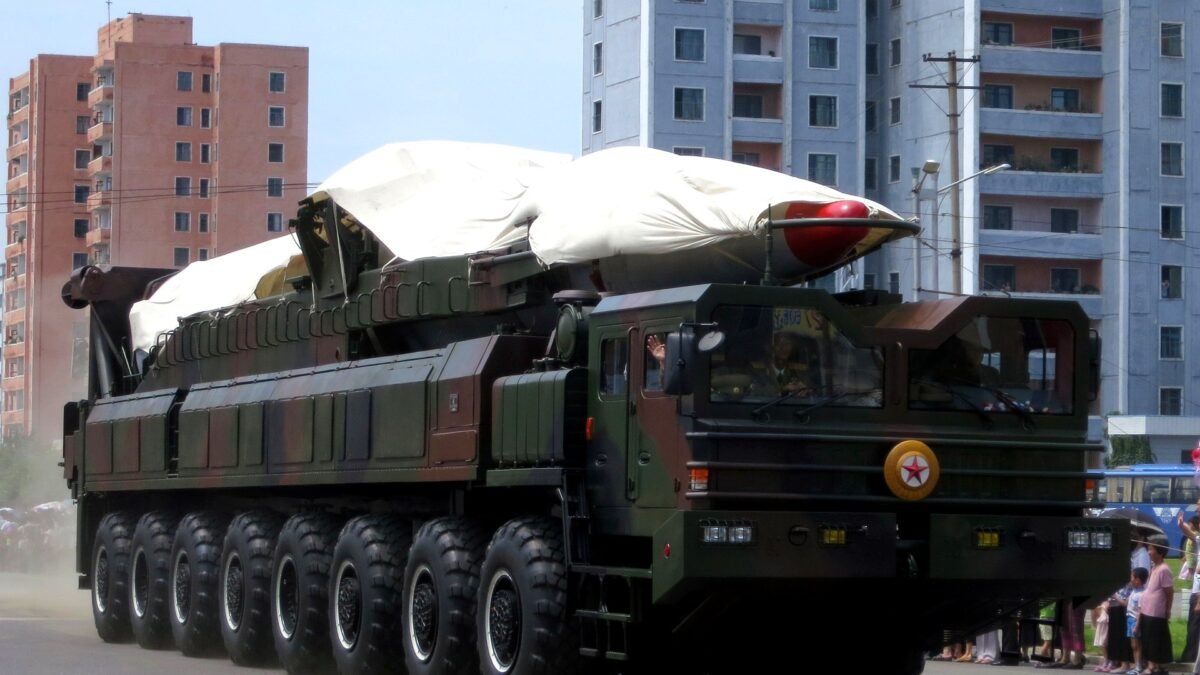
North Korea fired about 10 short-range ballistic missiles towards the sea off its east coast on Thursday, South Korea’s military said, in the latest display of force in a border dispute that has been building for more than five weeks.
According to Reuters, South Korea’s Joint Chiefs of Staff said the missiles were launched at about 12:30 p.m. local time (03:30 GMT) from an area around Wonsan, a port city on North Korea’s eastern coast. The missiles each flew about 250 kilometres (155 miles) before falling into the sea, according to the Associated Press, which cited the Joint Chiefs of Staff.
Japan’s Defence Ministry separately detected what it described as a possible ballistic missile launch, according to Yonhap News Agency, and said the object appeared to have fallen outside Japan’s Exclusive Economic Zone. Japan’s Coast Guard said earlier that the projectile could be a ballistic missile and had already fallen into the sea. According to reporting of the Japanese authorities’ account, no damage to vessels had been confirmed as of 12:55 p.m. local time.
South Korea’s military said it was strengthening surveillance and maintaining readiness in case of further launches, while sharing information closely with the United States and Japan. South Korea’s presidential National Security Office convened an emergency meeting to assess the security implications, and a presidential statement described the repeated launches as a “serious violation” of United Nations Security Council resolutions and urged Pyongyang to halt them.
North Korea had not, in the initial reporting, issued a public response to the launches. No damage or casualties were reported in the first accounts of the firings, which took place over the sea to the east of the Korean Peninsula, in waters also known as the Sea of Japan.
The launches were North Korea’s first ballistic missile firings in 17 days, according to South Korea’s military, following a round of launches on 12 October. They arrived six days after Seoul proposed military talks intended to reduce the risk of an accidental clash along the border, a proposal to which Pyongyang had not responded. They also came days before the end of October, the deadline Pyongyang itself set for having propaganda loudspeakers ready along the heavily fortified border.
What happened on Thursday
The sequence reported by Seoul was, on its face, straightforward. At about 12:30 p.m., South Korean sensors detected a salvo of short-range ballistic missiles rising from the Wonsan area and heading east over the sea. The Joint Chiefs of Staff said about 10 missiles were detected, each travelling roughly 250 kilometres. That distance is short by the standards of North Korea’s longer-range systems, but it is more than enough to cover targets across much of South Korea and the surrounding sea from a launch point on the east coast.
Reuters, in its first report of the launch, described a single projectile fired towards the sea, citing the Joint Chiefs of Staff, before fuller assessments put the number at around 10. The difference reflects how these events are typically reported: an initial detection, followed by analysis of radar and other tracking data that refines the count, the type of missile and the trajectory. The article therefore uses the fuller figure, “about 10”, as reported by the Associated Press and by Al Jazeera, both citing South Korea’s military, while noting that the precise number, type and trajectory of each missile remained under analysis.
Japan’s response followed the established pattern for a launch in its direction of interest. The Defence Ministry reported a suspected ballistic missile, the Coast Guard warned shipping to watch for fallen objects, and the Prime Minister’s Office issued instructions calling for maximum efforts to gather and analyse information and to update the public promptly. The assessment that the object fell outside Japan’s Exclusive Economic Zone, reported by Yonhap, meant that no Japanese territory or vessel was reported to have been directly affected.
In Seoul, the political response was swift and framed in legal as well as military terms. The presidential National Security Office met in emergency session, and the presidency’s statement invoked United Nations Security Council resolutions, which prohibit North Korea from conducting ballistic missile launches. The statement called on Pyongyang to stop what it described as repeated launches. South Korea’s military, for its part, emphasised continuity rather than alarm: surveillance stepped up, readiness maintained, and information shared in real time with Washington and Tokyo.
China, North Korea’s main ally and economic lifeline, struck a different note. According to the Associated Press, Chinese Foreign Ministry spokesperson Guo Jiakun said on Thursday that Beijing hoped all relevant nations would stay committed to a political settlement to resolve tensions on the Korean Peninsula and seek to promote regional peace. The comment came days after North Korean leader Kim Jong Un made a surprise weekend visit to China, a trip discussed in more detail below.
The landmine dispute behind the launches
The missile firings cannot be understood without the incident that has dominated inter-Korean relations since late September. On 21 September, two landmine explosions in the western sector of the Demilitarised Zone (DMZ) wounded three South Korean soldiers who were clearing a patrol route through thick vegetation. Two of the soldiers were seriously wounded; a third suffered minor injuries, according to reporting of the incident.
On 5 October, South Korea’s Joint Chiefs of Staff and the United States-led United Nations Command announced the findings of a joint investigation. They concluded that the blasts had been caused by North Korean antipersonnel mines that had been deliberately buried 3 to 10 centimetres underground, about 10 metres south of the Military Demarcation Line, the line that runs through the DMZ and divides the two Koreas. The investigators estimated that the mines had been laid about a year earlier, and they assessed the placement as a violation of the 1953 Armistice Agreement that halted the Korean War. Forensic work, according to reporting of the findings, detected TNT and thermosetting resin components and matched fragments to North Korean plastic mines recovered previously.
Seoul demanded an apology and the removal of the mines. South Korean troops cleared the minefield at the blast site, and officials warned that further clearance operations would follow if Pyongyang did not remove the devices itself. South Korea also said it would write to the United Nations Security Council, urging North Korea to take responsibility and apologise, according to Aju Press reporting of a Foreign Ministry briefing on 22 October.
Pyongyang rejected the findings outright. Kim Yo Jong, the sister of Kim Jong Un and a senior figure in the ruling Workers’ Party, called the preliminary findings a fabrication and described Seoul’s demand for an apology as despicable, according to Al Jazeera’s reporting. North Korea’s Foreign Ministry later called the final report a premeditated farce. On 25 October, according to Reuters reporting carried by syndicated outlets, North Korea said it had written to the Security Council accusing South Korea of fabricating the incident and endangering troops working to fortify the border. Its ambassador to the United Nations, Kim Song, warned that violations of North Korean sovereignty could trigger self-defence, and accused Seoul of using the incident to depict Pyongyang’s border construction as a military incursion.
Neither side has produced evidence that has persuaded the other, and the dispute has therefore become as much about credibility and narrative as about the mines themselves. Seoul points to a joint investigation conducted with the United Nations Command, with GPS measurements, forensic analysis and a third unexploded mine found nearby. Pyongyang points to what it calls Seoul’s shifting of blame and says the South fabricated the episode. For outside observers, the important fact is narrower: the two governments now disagree not only about who laid the mines, but about the basic sequence of events at the border, and there is no agreed channel through which that disagreement can be tested.
Loudspeakers, warning shots and a deadline
While the landmine dispute was unfolding, a second front in the same confrontation was opening along the border itself. On 21 October, Kim Yo Jong announced that North Korea would resume anti-South Korea propaganda loudspeaker broadcasts along the entire inter-Korean border by the end of October, according to the Korea JoongAng Daily. The following day, she said the loudspeakers would enter a “mission-ready state” within days. The move would reverse a signature gain of South Korean President Lee Jae Myung’s early months in office: Seoul suspended its own broadcasts and dismantled fixed loudspeakers last year as part of an effort to ease tensions, and Pyongyang’s speakers had been silent for about 16 months.
Kim Yo Jong tied the decision to what she described as repeated South Korean provocations, including warning broadcasts and warning shots fired at North Korean troops working near the border. North Korea has said its troops have been building tactical roads, fences and other fortifications near the Military Demarcation Line in recent years, work that Seoul says has repeatedly involved crossings south of the line. South Korea says it gives warning broadcasts and fires warning shots to make North Korean soldiers return north when they cross the line. Pyongyang has denied the alleged crossings and has warned of retaliation if provoked.
Last week, North Korea said it would also place new weapons systems on alert along the border in protest at the warning shots. During a visit to a South Korean border town earlier this week, Associated Press journalists saw North Korean artillery guns on the other side of the border that had not previously been visible. South Korea’s military, however, has played down the immediate significance of the deployments. A Joint Chiefs of Staff spokesperson, Jang Do-young, said the visible placement of older artillery systems appeared designed partly for public display, an assessment echoed by the Defence Ministry, which questioned the tactical value of positioning weapons where they could easily be observed.
As of Thursday, according to Aju Press reporting of South Korean government briefings, there had been no confirmed signs of North Korea resuming loudspeaker broadcasts or deploying the new response measures it had threatened. The Unification Ministry said it had not confirmed movements indicating a resumption of broadcasts or unusual activity in the border region, and the Joint Chiefs of Staff said loudspeaker-related activity remained at a routine maintenance level. The deadline, however, had not yet passed. The end of October was still two days away when the missiles were fired, and the question of whether broadcasts would actually begin remained open.
On 23 October, South Korea’s Defence Ministry proposed military talks with North Korea to discuss confirming the location of the Military Demarcation Line, restoring military communication lines and preventing unintended confrontations in border areas. The proposal followed the landmine explosion and the loudspeaker threats, and it was, in effect, an attempt to reopen a channel that has been closed for some time. North Korea had not responded to the proposal by the time of Thursday’s launches, according to the Associated Press and Al Jazeera.
The October pattern: testing, diplomacy and timing
Thursday’s salvo was not an isolated test. According to Reuters, Pyongyang has conducted missile tests on more than 10 occasions this year. The most recent previous round came on 12 October, when North Korea fired several short-range ballistic missiles from the Pyongyang area towards the East Sea. Some of those missiles travelled more than 900 kilometres, according to South Korea’s military, and North Korea later said through state media that the launch had tested a tactical ballistic missile. Analysts cited by the Seoul Economic Daily identified the system, on the basis of photographs of a five-axle launcher released by Pyongyang, as a Hwasong-11 variant carrying a warhead estimated at 2.5 tons. That identification is an analyst assessment, not a statement by either Korean government, and it is reported here as such.
The 12 October launches came a day after United States President Donald Trump suggested he might meet Kim Jong Un this year, according to reporting of the sequence, and four days after South Korea disclosed its first test launch of a domestically developed hypersonic glide vehicle. The Associated Press reported that North Korea has in recent weeks ramped up weapons tests in a likely bid to win greater concessions from the United States as Mr Trump has expressed a desire to restore diplomacy with Mr Kim. That framing, which the news agency attributed to the pattern of recent activity rather than to any statement by Pyongyang, is consistent with a long-established North Korean practice: testing new or improved systems at moments when diplomacy is in the air, in order to shape the terms on which any talks might take place.
Earlier in October, on 3 October, North Korea fired a ballistic missile from the Wonsan area that Pyongyang described as an intermediate-range strategic missile used to train troops to operate a hypersonic strategic weapon system, according to reporting of that launch. The Wonsan area is therefore not a new launch site; it is a familiar one, used repeatedly for firings into the East Sea. Thursday’s choice of Wonsan, and of short-range systems flying about 250 kilometres, suggests a message aimed primarily at Seoul and at the immediate border dispute, rather than a demonstration of the longer-range systems that would concern Washington and Tokyo most directly.
The diplomatic calendar around the launches adds a further layer. On Saturday 25 October, Kim Jong Un visited the Chinese border city of Dandong via a newly inaugurated bridge, to pay his respects at a memorial marking China’s support of North Korea during the 1950-53 Korean War, according to the Associated Press. It was his sixth visit to China as leader. At the memorial, Mr Kim said North Korea would firmly carry forward what he called the invincible friendship with China, and in a meeting with a senior Chinese official later that day he reaffirmed his resolve to develop bilateral cooperation. The visit followed years in which Mr Kim had prioritised ties with Russia, including sending troops and ammunition to support Moscow’s war against Ukraine, according to the Associated Press. The return to Beijing’s orbit, even briefly, is a reminder that Pyongyang’s manoeuvres are watched in at least three capitals at once.
South Korea’s Defence Minister, Kang Shin-cheol, was meanwhile expected to raise the landmine issue at a multilateral defence gathering in the Philippines, the ASEAN Defence Ministers’ Meeting-Plus, according to Aju Press. The timing of Thursday’s launches, on the day that issue was due to be put before an international audience, may be coincidence. It is nevertheless the kind of coincidence that diplomats in the region will notice, because it places Seoul’s complaint and Pyongyang’s answer in the same news cycle.
Analysis: Why It Matters
1. The border dispute now has a missile dimension
Until Thursday, the confrontation that began with the September landmine blasts had been conducted in statements, letters to the United Nations, fortification work and threats about loudspeakers. The missile salvo adds a kinetic element that is harder to dismiss as rhetoric. Short-range ballistic missiles fired into the sea are a familiar North Korean signalling tool, and no one was reported hurt. But they change the character of the dispute. A disagreement about mines and loudspeakers can be managed, however badly, through statements. A pattern of missile launches, each one a violation of Security Council resolutions in Seoul’s account, creates a rhythm of escalation that has its own momentum, and each new launch makes the next one easier to justify in Pyongyang and harder to ignore in Seoul.
2. The loudspeaker deadline is the more immediate test
Missiles are visible and countable. Loudspeakers, by contrast, are a test of daily life along the border, and their return would be felt in a different way. Propaganda broadcasts, if they resume along the entire border, would be audible in South Korean border communities and would put President Lee’s detente policy under direct strain. Mr Lee suspended the South’s broadcasts and removed its speakers as a deliberate gesture; a North Korean decision to switch its own speakers back on would be, in effect, a public judgement that the gesture had failed. The fact that no broadcasts had been confirmed by Thursday is significant, but the deadline has not yet expired, and the missile launches may be intended to keep Seoul guessing about what comes next rather than to settle the question.
3. The absence of a hotline is the structural danger
The most dangerous feature of the current confrontation is not any single weapon system. It is the absence of a reliable channel through which the two sides can clarify what is happening on the ground. Military communication lines are severed, the talks proposal of 23 October has gone unanswered, and the two governments disagree about the facts of the landmine incident itself. In that environment, a warning shot, a border crossing during fortification work, or a misread radar track can escalate before either side has a chance to correct a misunderstanding. The missile launches are, paradoxically, the least ambiguous part of the picture: they are announced by Seoul, tracked by Tokyo, and acknowledged, by silence, in Pyongyang. The border incidents that prompted them are far murkier, and murk is where accidents happen.
4. Pyongyang is speaking to Washington as well as to Seoul
The timing of the launches, days after Mr Kim’s visit to China and weeks after Mr Trump raised the prospect of a meeting, suggests an audience beyond the DMZ. North Korea has repeatedly used weapons tests to establish leverage before diplomatic engagement, demonstrating capabilities that any negotiation would then have to take into account. The short range of Thursday’s missiles, and their launch from a familiar site, suggest that the immediate message was regional. But the broader pattern, more than 10 rounds of tests this year, including longer-range firings on 12 October, is aimed at reminding Washington that Pyongyang’s arsenal is not static while diplomacy is discussed. The risk for Seoul is that it becomes a bystander in a conversation between Pyongyang and Washington about weapons that are, first and foremost, a threat to South Korea and Japan.
5. China’s role is quiet, but it is not neutral
Beijing’s statement on Thursday, calling for a political settlement and regional peace, was carefully worded and said nothing about the launches themselves. That restraint is itself informative. China is North Korea’s main economic lifeline and its most important diplomatic shield, and Mr Kim’s weekend visit to Dandong was a public demonstration of that relationship. Beijing does not want a crisis on the Korean Peninsula, particularly one that could draw in the United States, but it also does not want to be seen to be policing Pyongyang on Seoul’s behalf. The result is a familiar pattern: China urges calm, North Korea tests, and the region is left to manage the consequences. Whether Mr Kim’s visit produced any private understanding about restraint is unknown, and Thursday’s launches suggest that if such an understanding exists, it does not extend to a halt in testing.
What to Watch Next
- The loudspeaker deadline: whether North Korean propaganda broadcasts resume along the border by the end of October, as Kim Yo Jong announced, and how Seoul responds if they do. A resumption would mark the end of about 16 months of silence and a direct challenge to President Lee’s easing measures.
- Any answer to Seoul’s talks proposal: whether Pyongyang responds to the 23 October offer of military talks on the demarcation line, communication lines and accidental clashes. Continued silence would leave the border without a working channel for clarification.
- Further launches: whether South Korea’s military detects additional firings in the coming days, and whether they remain short-range and sea-bound or escalate in range, number or type. Seoul said it was maintaining readiness for further launches.
- The United Nations track: what follows from the competing letters to the Security Council, Seoul’s complaint about the landmine incident and Pyongyang’s accusation of fabrication, and whether the Council takes up either communication in a formal setting.
- The diplomatic calendar: whether the United States pursues renewed engagement with Pyongyang, and whether Mr Kim’s recent visit to China is followed by further high-level contact with Beijing or Moscow. Any meeting, or any explicit decision not to meet, will shape how Pyongyang calibrates its next tests.
Sources
- Reuters: North Korea fires projectile toward sea off east coast, South Korea military says
- Associated Press (via Military.com): North Korea Fires Missile Barrage Toward the Sea as Tensions with South Rise
- Al Jazeera: North Korea fires missiles as row over landmine blast intensifies
- Korea JoongAng Daily: The North vowed to resume its loudspeaker broadcasts. Will inter-Korean border tensions escalate again?
- Aju Press: South Korea to send letter to UN over DMZ landmine blast

About the Author — Abdul Mannan
Related Articles

Hungary Keeps Orban-Era US Nuclear Deal as Magyar Government Seeks a New Footing with Washington
Hungary's Magyar government has asked parliament to make legally binding a US civilian nuclear cooperation agreement signed under…

Flávio Bolsonaro Lands in Miami and Calls Himself Brazil’s ‘Elected President’ After Defying Passport Order
Flávio Bolsonaro arrived in Miami on Wednesday after losing Brazil's presidential runoff to Luiz Inácio Lula da Silva,…

Netanyahu Leads Partial Israel Count but Neither Bloc Reaches a Majority as Deadlock Deepens
Partial results put Netanyahu's bloc on 54 seats and Eisenkot's on 47, with Arab-led parties on 19 —…