
Paris Under Curfew: What France’s Worst Riots in Years Are Really Telling the World

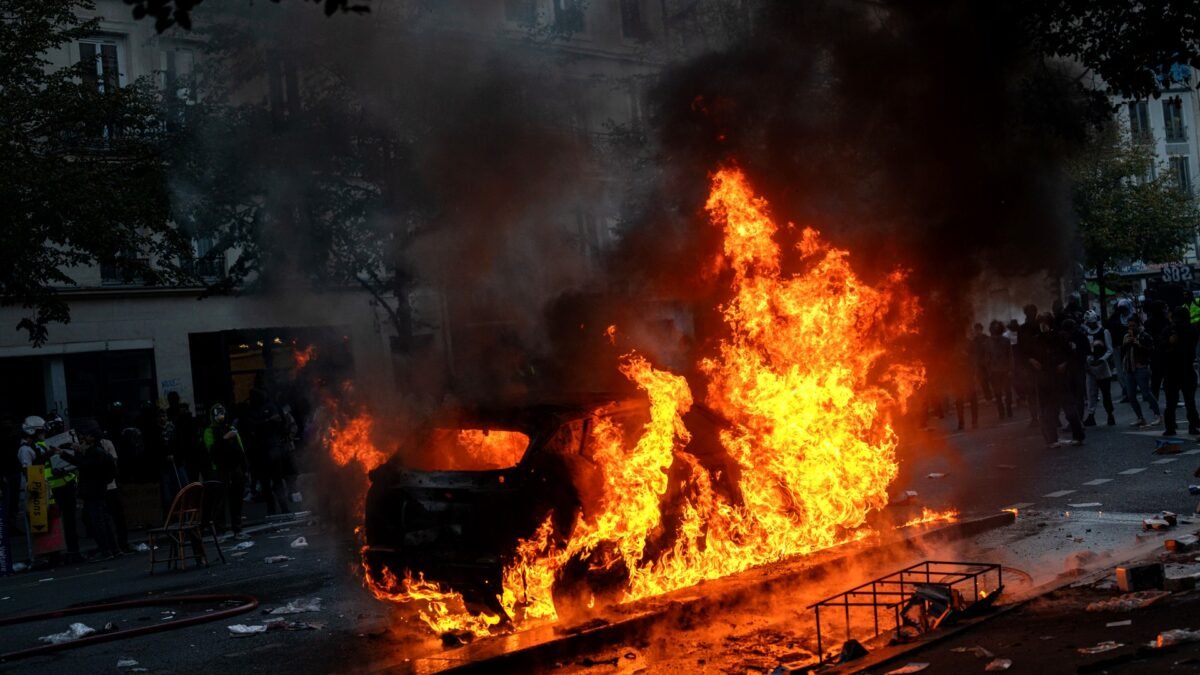
When Paris Tells Its Children to Stay Indoors After Dark
When was the last time the city of light ordered its own citizens to fear the night? On Monday evening, the French Republic — the nation that once exported the idea of liberty to the entire world — imposed curfews on its own capital. Place de la République, a square that literally carries the name of the Republic, was closed to human beings from 11 at night until 6 in the morning. Les Halles followed. Lyon, Marseille, Nice, Lille — one after another, the great cities of France were told what every occupied nation in history has been told: stay home after dark.
I have read history long enough to know that symbols are often the only honest journalists left in a crisis. And the symbol Paris offered the world this week could not be more honest: the Republic has put the Republic under curfew.
1789, 1968, 2005, 2018 — The Barricade Is France’s Second Parliament
To understand what is burning in France tonight, you must understand one thing about the French: they do not protest the way other nations protest. In France, the barricade is not an aberration. It is an institution. It is the country’s second parliament — unelected, ungovernable, and almost always telling the truth that the first parliament refuses to hear.
Go back to 1789, because history always demands we start there. What brought down the mightiest monarchy in Europe was not philosophy alone — it was bread prices, a bankrupt treasury, and a debt crisis the king could neither fix nor admit. Sound familiar? France today staggers under a weak economy and surging public debt, with a presidential election barely six months away, and the state’s first answer to its citizens has been, once again, to misunderstand them.
Then came May 1968 — and here the mirror grows almost frighteningly precise. It was students who lit the fuse: Nanterre, then the Sorbonne, then barricades in the Latin Quarter, and within weeks ten million workers on strike and a president, Charles de Gaulle, fleeing to a French military base in Germany. Students always begin it in France. They began it this time too.
2005 brought three weeks of fire in the banlieues, cars burning night after night, and a state of emergency declared by the government. 2018 brought the gilets jaunes — the yellow vests — rising, of all things, over fuel prices. And now, in the autumn of 2026, fuel protests and student protests have fused into a single conflagration, and the prime minister stands before cameras refusing to rule out — those exact words again — a state of emergency.
Study the rhythm, reader, because it never changes. First the state misunderstands the crowd. Then it underestimates it. Then it loses control of the streets. Then the interior minister offers his resignation, and the president refuses it. In 2026, that minister is Laurent Nuñez, who admitted on French radio that in some cities the police had “lost control” — “You couldn’t look shopkeepers in the eye,” he said, “after hundreds of shops had been looted and say we hadn’t lost control.” He offered to resign. Emmanuel Macron refused. In France, history does not repeat itself; it files the same paperwork.
What Actually Burned This Weekend
Strip away the philosophy for a moment and look at the ledger of three days, because the numbers are staggering by any honest measure. The unrest grew out of two streams that merged on 17 October: a fuel-price protest movement that began on 15 September with a resurgent yellow-vest call for mobilisation against the rising cost of living, and a student movement that began on 18 September over overcrowded classrooms, crumbling school buildings and staff shortages. What started in schools spread nationwide, drew in trade unions and ordinary citizens, and by Saturday had become, in the words of one report, some of the worst street violence France has seen in years.
On 17 October, the Interior Ministry counted some 550,000 marchers across the country, 110,000 of them in Paris; the CGT union claimed 800,000. Hundreds of thousands marched peacefully — that fact deserves to be said first, and loudly. But as night fell, groups of young people clashed with police, set fires and looted shops in Paris and other cities. By Sunday evening the arrest count had reached 2,397, including a record 855 in Paris alone. Around 1,500 stores were severely damaged. More than 1,500 fires involving vehicles and public equipment were reported. Some sixty buildings were damaged by fire. Over 500 first responders were injured. At least two people died.
And then there is Limoges. In Limoges, rioters burned the Hôtel de Ville — the town hall, a 19th-century monument of the Republic. Pause on that image for a moment, because it is the entire story in a single frame: in France, when the people lose faith, they do not burn just anything. They burn the house of the state itself.
On Monday came the answer: partial curfews. In Paris, movement was prohibited at Place de la République from 11 p.m. to 6 a.m., and around Les Halles from 10 p.m., with protests banned outright in the evening. Lyon banned gatherings from 6 to 9 p.m., then imposed curfew. Marseille banned all gatherings and demonstrations from midday to 8 p.m. In Nice, a curfew for minors. In the Nord department — Lille, Douai, Wattignies, Denain — curfews from 8 p.m. to 6 a.m. to protect businesses. Prime Minister Sébastien Lecornu, “fully resolved to restoring public order,” excluded a full Paris curfew as “out of the question” but left the state of emergency on the table: “if declaring a state of emergency was deemed necessary, we could do so.”
The Two Frances
Here is the question a serious column must ask, and must ask honestly: who exactly was in the streets? Because there were, in truth, two crowds, and confusing them is the oldest trick in the political playbook.
The first crowd is the one the cameras of the world should have honoured: schoolchildren — teenagers — protesting that their classrooms are overcrowded and their schools are falling apart, joined by workers and families protesting fuel prices and the cost of living. Nearly half a million people marched on Saturday in a country whose schools, the protesters say, the Republic has abandoned. There is something deeply moving, and deeply damning, in the fact that the most political act in France this year was begun by schoolchildren defending their right to learn in a decent building.
The second crowd is the one that came at nightfall: the looters who smashed the Chanel boutique in Le Marais, the arsonists who torched cars on Boulevard Voltaire, the “ultra-left militants” the interior minister blames. President Macron said “nothing justifies” the violence, and on that single sentence, the moralist in me stands with him without reservation — a burning car never fed a hungry child, and a looted shop never lowered the price of bread. Violence is not the continuation of protest; it is its betrayal.
But here is what the moralist must also say, and say plainly: condemning the fire does not extinguish the fuel. A state can arrest 2,397 people in a weekend — some 80 per cent of them now being prosecuted — and still not have arrested a single one of the causes. The curfew clears the square; it does not fill the classroom. The tear gas disperses the crowd; it does not lower the price at the pump.
A State That Cannot Look the Shopkeeper in the Eye
You, my reader — whether you read this in Karachi, in London, or in Lahore — ask yourself what it means when a government’s own minister confesses, on the record, that the state lost control of its own streets. Ask what it means when the mayors of France’s greatest cities publicly demand answers from their own government for its lack of preparation. The mayor of Paris blamed the state. The mayor of Marseille called the situation “almost insurrectional” and accused the government of “petty political manoeuvring.” Justice Minister Gérald Darmanin offered the epitaph of the whole affair: “There’s no good policing without good intelligence.”
Macron himself has now called for new policing tactics and an examination of the planning and intelligence failures that led the authorities to underestimate the violence. Read that sentence twice. The president of France admits his state did not see its own people coming. The most surveilled, most administered republic in Europe was surprised by its own schoolchildren.
And the unrest is already spilling across borders — clashes in Milan, protests in Belgium, Spain and Portugal, all over the same wound: the cost of living. The trade unions have called a new round of strikes and rallies for 5 November. This is not ending; it is intermission.
The Warning
So what is the verdict of this column? It is this: France is about to learn, six months before its presidential election, the lesson that every republic eventually learns — that the verdict of the street always arrives before the verdict of the ballot box, and it is always written in a language the palace cannot read until it is too late.
The curfew will be lifted. The square will reopen. The burned cars will be towed away and the Chanel boutique will repair its windows. But nothing in the ledger of causes will have changed: not the debt, not the fuel price, not the overcrowded classroom where a sixteen-year-old first learned that the Republic’s promises are printed on better paper than its schoolbooks.
Fire is the most honest of all political commentators. It does not lie, it does not spin, it does not hold press conferences. It simply shows a society what it is made of when the lights of the boulevards go out. In 1789 the fire said the monarchy was finished. In 1968 it said the old order was finished. Tonight, on Boulevard Voltaire, the fire is asking France a question, and no curfew — from 11 p.m. to 6 a.m., from Lille to Marseille — can answer it.
The question is the oldest one in the republican catechism: when your children march for their schools and your citizens cannot afford their fuel, do you send them the police — or do you finally listen? Paris has until the spring to decide. History is watching, as it always does, with a patience that governments mistake for forgiveness.
Sources & References
CNN — “Several French cities impose curfews after weekend of chaos,” 19 October 2026 (curfew zones and hours; arrests; injuries).
Reuters — “French prime minister calls for partial curfews after weekend riots,” 19 October 2026 (Lecornu statement; state of emergency not ruled out; election context).
The Daily Jagran — “France Protests: Night Curfews Imposed In Paris, Lille, Nice After Riots,” 20 October 2026 (2,400+ arrests; Saturday march figures; European spillover).
Wikipedia — “17 October riots” (origins in fuel and student protests; turnout figures; damage toll; Limoges Hôtel de Ville).
The British Banner — “France riots: Macron refused interior minister’s resignation,” 19 October 2026 (Nuñez resignation offer; “lost control” admission; Macron’s “nothing justifies” remark).
The Boston Report — “Paris and Nice Curfews: Zones, Hours and Riot Toll,” 19 October 2026 (Darmanin prosecution figures; mayors’ reactions; 5 November strike call).
Featured image: “Paris riots, 17 October 2026 — Burning car,” photograph by Jorge Jaramillo (JJxFile) / Wikimedia Commons, CC BY-SA 4.0.

About the Author — Abdul Mannan
Related Articles
The Great Fence: Why the World Is Banning Children From Social Media — and Why Gen Z Is Cheering
In one week, Türkiye banned under-15s from social media, Greece tabled its own ban, Britain launched a 5,000-child…

Sober October: The Month America Decided to Put the Glass Down
A fresh nationwide survey shows one in four Americans is giving up alcohol this October. From Prohibition's failure…