
Reform UK Falls Below 20% in a National Poll for the First Time in Two Years as Farage’s Crisis Deepens

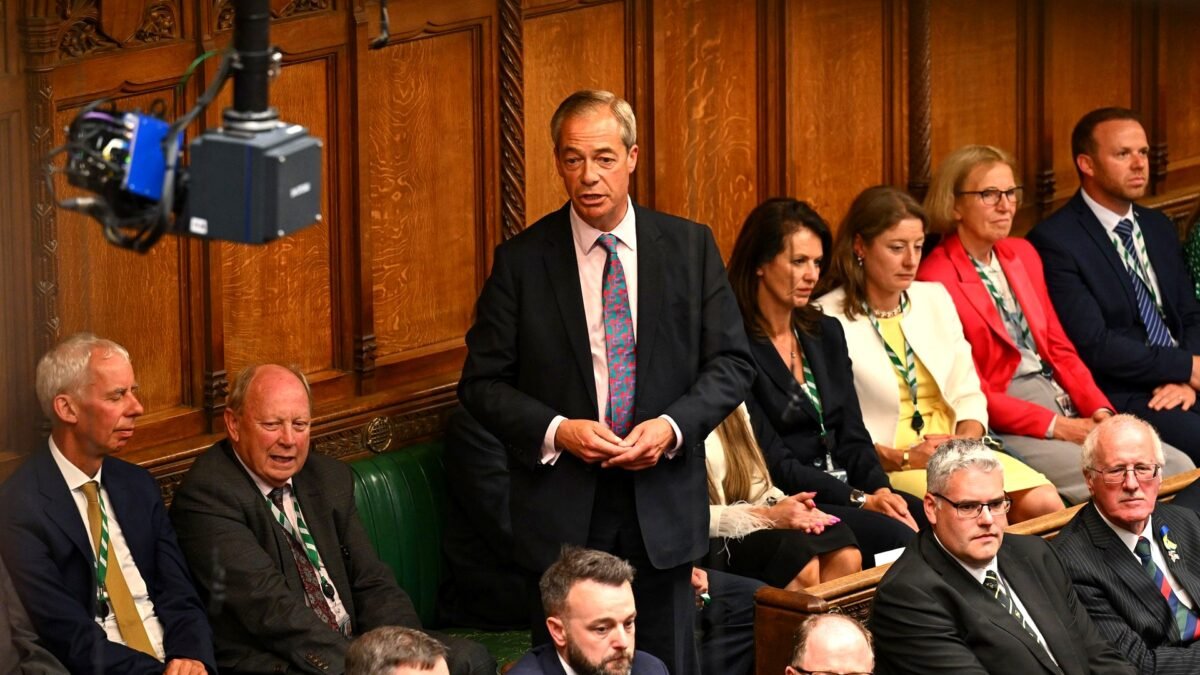
Reform UK has fallen below 20 per cent in a national opinion poll for the first time in more than two years, according to a new survey that lays bare the scale of Nigel Farage’s political crisis. The More in Common poll puts Reform on 19 per cent, the party’s first reading in the teens since October 2024, and leaves it ten points behind Labour and six points behind the Conservatives.
The survey, carried out between 13 and 15 November among more than 2,000 adults, is the latest in a run of polls pointing in the same direction. It is also the most symbolically damaging. For a party that led national voting intention for much of 2025 and peaked at 33 per cent in another More in Common poll in late October of that year, dropping into the teens marks the end of the period in which Reform could plausibly claim to be on course to form the next government. Labour leads the new poll on 29 per cent, up one point, with the Conservatives second on 25 per cent. The Liberal Democrats stand on 9 per cent and the Greens on 8 per cent.
The personal figures are, if anything, worse for Mr Farage than the party figures. His net approval rating has fallen to minus 34, the lowest score he has recorded in More in Common’s tracker. Green leader Zack Polanski, on minus 37, and Rupert Lowe, the leader of Restore Britain, on minus 22, also recorded their lowest scores in the tracker, while Liberal Democrat leader Ed Davey fell to his joint low on minus 14. Conservative leader Kemi Badenoch’s approval is down to net neutral, and Prime Minister Andy Burnham’s has fallen to plus 8. On gross approval, Mr Burnham leads on 40 per cent, followed by Ms Badenoch on 35 per cent, Mr Farage on 23 per cent, Mr Davey on 18 per cent, and Mr Polanski and Mr Lowe on 14 per cent each.
More in Common’s director, Luke Tryl, said Labour was at its joint highest score since the pollster resumed polling after the general election. “Reform has now declined 11 points since the aftermath of the local elections in May 2025, and the Conservatives are up six points,” he said, according to The Independent. He also cautioned that the week-to-week changes in the survey were within the margin of error, a reminder that a single poll is a snapshot rather than a verdict. But the direction of travel is now hard to dispute, because other pollsters are telling the same story.
The poll in full
The headline numbers from the More in Common survey, published on 18 November, are Labour 29 per cent, Conservatives 25 per cent, Reform UK 19 per cent, Liberal Democrats 9 per cent and Greens 8 per cent. Reform is down one point on the pollster’s previous survey, Labour up one, and the Conservatives unchanged. The poll’s fieldwork ran from 13 to 15 November, and its sample was of more than 2,000 adults across Great Britain.
The sequence of More in Common polls over the past month tells the story more clearly than any single reading. On 1 November the pollster had Reform on 22 per cent. A survey for The Daily Telegraph, with fieldwork from 6 to 9 November among 2,013 respondents, put Reform on 20 per cent. The latest survey, at 19 per cent, is the third consecutive fall. Labour, over the same period, has held steady at 28 to 29 per cent, while the Conservatives have climbed from 23 per cent to 25 per cent.
Other pollsters corroborate the picture. A Trajectory Partnership poll, with fieldwork from 3 to 12 November among 1,462 respondents, also put Reform on 19 per cent, down three points, with Labour on 29 per cent and the Conservatives on 21 per cent. A Lord Ashcroft poll conducted between 29 October and 2 November put Reform lower still, on 18 per cent, eight points behind the Conservatives on 26 per cent and thirteen behind Labour on 31 per cent. A seven-poll moving average maintained by PollCheck puts Labour on 28.6 per cent, the Conservatives on 22.7 per cent and Reform on 21.1 per cent, which suggests that Reform’s standing in the average has held up better than in the most recent individual polls, but the direction of the newest surveys is unmistakably downward.
That matters because of what the 20 per cent line represents. It is not a constitutional threshold and it wins or loses no seats by itself. But it is the level below which a party that spent a year presenting itself as the government-in-waiting starts to look like an ordinary opposition party again. Reform’s claim to be the coming force in British politics rested on polling in the high twenties and low thirties. At 19 per cent, it is a third party, and a third party that is now being overtaken on its own ground by a recovering Conservative Party.
The fall from the peak
To understand how far Reform has fallen, it is worth recalling where it stood a year ago. In late October 2025, a More in Common poll put the party on 33 per cent, its highest score in that tracker. At the same point last year it stood at 30 per cent, so the latest reading represents an eleven-point fall in twelve months. The decline has been steady rather than sudden: from the high twenties through the summer of 2026, to 22 per cent at the start of November, to 20 per cent, and now to 19 per cent.
The party’s rise had been one of the most remarkable stories in modern British politics. At the general election of July 2024, Reform won 14.3 per cent of the national vote but only five seats in the House of Commons, a result that reflected the unforgiving arithmetic of the first-past-the-post system, under which a party whose support is spread evenly across the country wins far fewer seats than its vote share might suggest. Mr Farage himself won his Clacton seat with 46.2 per cent of the vote, becoming an MP for the first time.
Then came the local elections of May 2025, the moment Reform stopped being a protest movement and became a governing force in parts of England. The party won 677 council seats, more than 40 per cent of those contested, and took control of ten councils, eight from the Conservatives and two from Labour, including Kent, Staffordshire, Durham, Derbyshire, Nottinghamshire, Lancashire and Lincolnshire. It won two mayoralties, in Greater Lincolnshire and in Hull and East Yorkshire, and its candidate Sarah Pochin overturned a Labour majority of more than 14,000 votes in Runcorn and Helsby by just six ballots. The projected national vote share from those elections was 31 per cent. For a few months, Reform looked unstoppable.
The reversal since then has been driven less by any single event than by an accumulation of controversies, internal rows and questions about the party’s fitness to govern. Each one, on its own, might have been survivable. Together, they have changed the way voters see the party, and they have changed the way voters see its leader most of all.
What went wrong for Reform
The most damaging of the controversies concerns money. Questions have been asked about a £5 million donation made to Mr Farage by the cryptocurrency billionaire Christopher Harborne, which went undeclared and is now under investigation by Parliament’s standards commissioner. Mr Farage resigned his Clacton seat in July 2026 amid the parliamentary investigation into his finances, triggering a by-election in which he stood again. In June 2026 he had also declared in the register of MPs’ interests that he had been paid £270,000 for advertising gold bullion. None of this has been found to be unlawful, and Mr Farage has denied wrongdoing, but the drip of revelations has fed a perception, captured in polling, that the Reform leader is less trusted than he once was.
Police are separately investigating Dan Jukes, the party’s former chief of staff, and James Orr, its former policy director, after Channel 4 reported that they may have been willing to accept illegal donations. An ITV documentary raised concerns about racism and misogyny in the party’s candidate selection process. Both stories cut against the image Mr Farage has tried to project of a professional, election-ready party, and both arrived at the moment when voters were beginning to judge Reform not as an insurgency but as a potential government.
Mr Farage has tried to repair the damage. Last week he brought in Angus McIntyre, a recently retired wing commander who worked with NATO and Ukraine, in what was widely read as an attempt to show that his party is not sympathetic to Russia. It was a significant appointment, and a deliberate one, but it has not arrested the slide in the polls.
Internal tensions have added to the problem. Zia Yusuf, the party’s home affairs spokesman, has made pointed remarks about leading former Conservatives who defected to Reform, including Suella Braverman and Robert Jenrick. “Top tip: if you meet someone and their title is ‘Right Honourable’, assume they are the most dishonourable person you have ever met,” Mr Yusuf said, in remarks that Ms Braverman later denied were aimed at her. He then doubled down, saying that former Tories who had jumped ship to Reform had been barred from shaping the party’s immigration and culture policies. “If you are in the category of being concerned about former Tories, none of the above are going to be involved in immigration policy or borders policy. There’s a reason why Nigel’s given me this brief and not them,” he said, according to The Independent.
The row matters because it goes to the heart of Reform’s dilemma. The party needs experienced former ministers to look like a government, but its own supporters distrust the very people it has recruited. Mr Yusuf’s intervention pleased the party’s base and embarrassed its defectors, and it left Mr Farage caught between the two.
There has also been a split on the right. Rupert Lowe, once one of Reform’s most prominent MPs, now leads Restore Britain, a rival party that is polling at 5 to 6 per cent. Every point Restore Britain takes comes, in the main, from voters who might otherwise have backed Reform, and Mr Lowe’s own net approval, at minus 22, is the lowest he has recorded in More in Common’s tracker. The right of British politics, which for a year looked as though it might unite behind Mr Farage, is now divided three ways, between the Conservatives, Reform and Restore Britain, and the Conservatives are the ones benefiting.
The other parties
The poll is as much a story about Labour’s recovery and the Conservatives’ revival as it is about Reform’s decline. Labour, on 29 per cent, is at its joint highest score since More in Common resumed polling after the general election, and Mr Burnham’s gross approval rating of 40 per cent puts him comfortably ahead of every other party leader. The Liberal Democrats, on 9 per cent, and the Greens, on 8 per cent, both appear to be struggling since Mr Burnham became prime minister, squeezed between a Labour Party that has recovered its confidence and a Conservative Party that has rediscovered its purpose.
The Conservatives, on 25 per cent, are six points ahead of Reform and back in second place, a position they had not held for much of the past year. Ms Badenoch’s net approval has fallen to neutral, which is hardly a triumph, but her gross approval of 35 per cent is the second highest of any leader in the survey. The Times, in its commentary on the poll, noted that the Conservatives had been floundering a year ago while Reform’s headquarters buzzed with talk of a turquoise wave carrying the party past 30 per cent, and that it is Reform that now appears to be sinking. The paper also reported YouGov findings that 67 per cent of voters view Mr Farage unfavourably, that 55 per cent “really” dislike him, and that 41 per cent of Reform voters themselves agree he is “sleazy”.
That last figure is the one that should worry Reform most. A leader can survive being disliked by his opponents. It is much harder to survive being distrusted by his own supporters. Research by Merlin Strategy, reported by The Times, found that the share of voters whose top hesitation about voting Reform is that Mr Farage would not make a good prime minister has risen from 30 per cent last year to 42 per cent now. Scarlett Maguire, the founder of Merlin Strategy, said it was hard to see a route back to the 30 per cent highs of last year that Reform would need to win an election. YouGov, in a separate measure reported by The Times, put Mr Farage’s net approval at minus 69 per cent.
Farage’s Brussels gambit
Mr Farage’s response to the crisis will come on Friday, when he launches a new pro-Brexit campaign in Brussels. The launch is deliberately timed to coincide with Mr Burnham signing the latest Brexit reset deal with the European Union, an agreement the prime minister hopes will be the launchpad for a much more radical overhaul of Britain’s relationship with the EU. Reform views the reset as the start of a slide back towards membership, and Mr Farage plainly intends to present himself as the only politician willing to defend the referendum result.
It is a familiar play, and it has worked for him before. Mr Farage built his career on Europe, and the referendum of 2016 remains his defining achievement. But the political landscape has changed. According to The Times, only 0.5 per cent of voters now say Europe is the most important issue facing the country. Mr Burnham, the paper argues, would never have risked raising EU rapprochement if Mr Farage had retained his potency. The prime minister is betting that voters care more about the price of food, the state of the NHS and the cost of energy than about the fine print of a food standards agreement.
There is also a risk in the Brussels trip itself. A campaign launch in the Belgian capital, aimed at a domestic audience, can easily look like a stunt, and it will take place on the same day that the prime minister is signing a deal that most voters will experience, if they notice it at all, as a modest easing of trade friction. Mr Farage needs the launch to change the subject from his party’s troubles to the government’s European policy. Whether it does so will be one of the first tests of whether Reform’s decline can be reversed, or whether it has further to run.
The context of the reset matters too. Mr Burnham has told MPs that the EU reset talks will “go down to the wire”, with tuition fees threatening the deal due to be signed at next week’s summit, and he has already declared that Brexit “has not worked” in a landmark speech ahead of the summit. The government’s position is that closer alignment with the EU is an economic necessity. Reform’s position is that it is a betrayal. The argument between them will define British politics for the rest of this parliament, and Friday will be its first set-piece confrontation.
Analysis: Why It Matters
The headline is a poll number, and poll numbers change. What makes this one worth more than a day’s attention is what it confirms about the shape of British politics after two years of upheaval. Reform’s fall below 20 per cent is not an isolated data point. It is the point at which a trend that has been visible for months becomes impossible to ignore, and it raises questions about the party, its leader and the government that none of them can avoid for much longer.
The 20 per cent line matters because of the electoral system
Britain’s first-past-the-post system punishes parties whose support is spread thinly, and it punishes them brutally. In 2024, Reform won 14.3 per cent of the vote and five seats, at a cost of roughly 800,000 votes per MP. At 30 per cent, with its vote concentrated in the right places, the party could plausibly have won dozens of seats, perhaps more than a hundred. At 19 per cent, that arithmetic collapses. The party’s own experience in May 2025 showed the other side of the coin: with 31 per cent of the projected national vote, it won 677 council seats, because in local elections its support was concentrated enough to win wards outright. Nationally, the same concentration is much harder to achieve, and at 19 per cent Reform would struggle to hold even the seats it already has. The 20 per cent line is psychological, but it is also a reasonable proxy for the point at which a party stops being a plausible challenger for power and becomes a pressure group with MPs.
Farage is now the problem, not the asset
For most of his career, Nigel Farage has been Reform’s greatest asset, a communicator of rare skill whose personal following exceeded his party’s. The polls now say the opposite. His net approval of minus 34 is eleven points worse than his party’s standing would suggest, and his gross approval of 23 per cent is barely half the prime minister’s. The Merlin Strategy finding, that 42 per cent of voters now cite doubts about Mr Farage as prime minister as their main reason for not voting Reform, up from 30 per cent a year ago, is the most damning number in the whole survey. Parties can replace policies, spokesmen and strategies. They cannot easily replace a leader whose name is the brand, and Mr Farage has built Reform so completely in his own image that there is no obvious successor and no obvious alternative. The controversies over donations, the police investigation into his former aides, the resignation and by-election in Clacton: each has chipped away at the trust that was his principal political capital. Trust, once lost, is the hardest thing in politics to rebuild, and Mr Farage has very little of it left to spend.
The right is splitting three ways, and the Conservatives are winning the split
A year ago, the story of the British right was consolidation: voters leaving the Conservatives for Reform, and Reform presenting itself as the new home of the right. Today the story is fragmentation. The Conservatives are back on 25 per cent, Reform is on 19 per cent, and Restore Britain is taking 5 to 6 per cent. Between them, the three parties command roughly half the electorate, but divided three ways they hand Labour a commanding advantage under first past the post. Ms Badenoch does not need to win the argument with Mr Farage outright. She needs only to hold her ground while Reform and Restore Britain divide the rest, and the polls suggest that is exactly what is happening. The danger for the Conservatives is complacency: at 25 per cent they are still well short of a winning position, and their own net approval figures are poor. But for the first time in two years, the momentum on the right is with them rather than against them.
Burnham’s reset gamble is working, for now
The poll is also a vindication, at least for now, of the prime minister’s strategy. Mr Burnham has bet that voters will reward a government that fixes the practical problems of Brexit rather than re-fighting the referendum, and that a closer relationship with the EU can be sold as common sense rather than betrayal. Labour’s joint-highest score since the election, and Mr Burnham’s 40 per cent gross approval, suggest the bet is paying off. The risk is that the reset becomes a symbol rather than a policy: if the deal signed on Friday is seen as the thin end of a wedge, Mr Farage’s Brussels campaign will have its opening. But the polling on Europe cuts against him. When only one voter in two hundred names Europe as the country’s most important issue, a campaign built on Europe alone is a campaign built on sand. Mr Burnham knows it, which is why he has been willing to raise the subject at all.
One poll is not a verdict, but the trend is
Every caveat that applies to polling applies here. Mr Tryl himself stressed that the week-to-week movements are within the margin of error, and a single survey can be an outlier. Reform’s supporters will point to the PollCheck average, which still has the party on 21.1 per cent, and to the fact that the party retains hundreds of councillors, ten councils and a parliamentary foothold. They are right to do so. But the trend across pollsters, across months and across measures, from voting intention to leader approval to the question of who would make a good prime minister, all points the same way. A party that peaked at 33 per cent a year ago and now polls at 19 per cent is a party in decline, whatever the margin of error on any single survey. The question is no longer whether Reform is falling. It is whether it can stop falling, and nothing in the latest poll suggests it yet knows how.
What to Watch Next
- Friday’s double event in Brussels and London. Mr Farage launches his pro-Brexit campaign in Brussels on the same day Mr Burnham signs the latest Brexit reset deal. Watch whether the launch dominates the news cycle or is drowned out by the signing, and whether Reform’s message lands beyond its own supporters.
- The next More in Common poll. The pollster surveys weekly, so the next reading will show quickly whether 19 per cent is a floor or another step down. A further fall would confirm the trend; a recovery would suggest the damage is containable.
- The standards commissioner’s ruling on the Harborne donation. The investigation into the undeclared £5 million donation from Christopher Harborne remains open. A finding against Mr Farage would deepen the trust problem; a clearance would give him something to fight back with.
- The police investigation into Dan Jukes and James Orr. The outcome of the investigation into Reform’s former chief of staff and former policy director, following Channel 4’s reporting, will shape how voters judge the party’s claim to be ready for government.
- Whether the Conservatives hold second place. The Tories are six points ahead of Reform, but their lead is recent and their own ratings are weak. Watch whether Ms Badenoch can consolidate the recovery or whether Reform claws its way back.
- Restore Britain’s trajectory. Rupert Lowe’s party is polling at 5 to 6 per cent. If it grows, it takes votes directly from Reform; if it fades, some of those voters may return. Either way, it is a measure of how far the right has fragmented.
- The EU reset summit. The deal due to be signed next week, and the tuition fees dispute that Mr Burnham has said could take the talks “down to the wire”, will set the terms of the argument Mr Farage wants to have. A smooth signing helps the prime minister; a messy one helps Reform.
Sources
- The Independent — Crisis for Nigel Farage as Reform UK drop below 20 per cent in a poll for first time in two years
- The British Eye — Reform UK falls below 20% in latest poll
- Reform Watch — Reform sinks to 19%, falling below 20% for first time in two years
- Trajectory Partnership — Optimism Index Opinion Polling, November 2026
- Mark Pack — Voting intention opinion poll scorecard
- The Times — Europe’s got nothing to fear from Farage

About the Author — Abdul Mannan
Related Articles
UK Energy Bills Set to Jump 26% to £2,166 in January as Inflation Hits a One-Year High of 3.6%
Cornwall Insight forecasts the Ofgem price cap will rise 26% to £2,166 a year in January — the…
MPs Pass Shabana Mahmood’s Immigration and Asylum Bill by 290 Votes to 94 Despite Labour Rebellion
MPs have passed Home Secretary Shabana Mahmood's Immigration and Asylum Bill by 290 votes to 94, despite a…

Britain to Send Ukraine More Than 1,000 Air Defence Missiles in £240m Winter Package as Allies Rush Patriot Interceptors
Britain will send Ukraine more than 1,000 air defence missiles and launchers in a £240 million winter package,…