
King Charles Leads Remembrance Sunday at the Cenotaph as Record Nine Former Prime Ministers Join Twelve Second World War Veterans

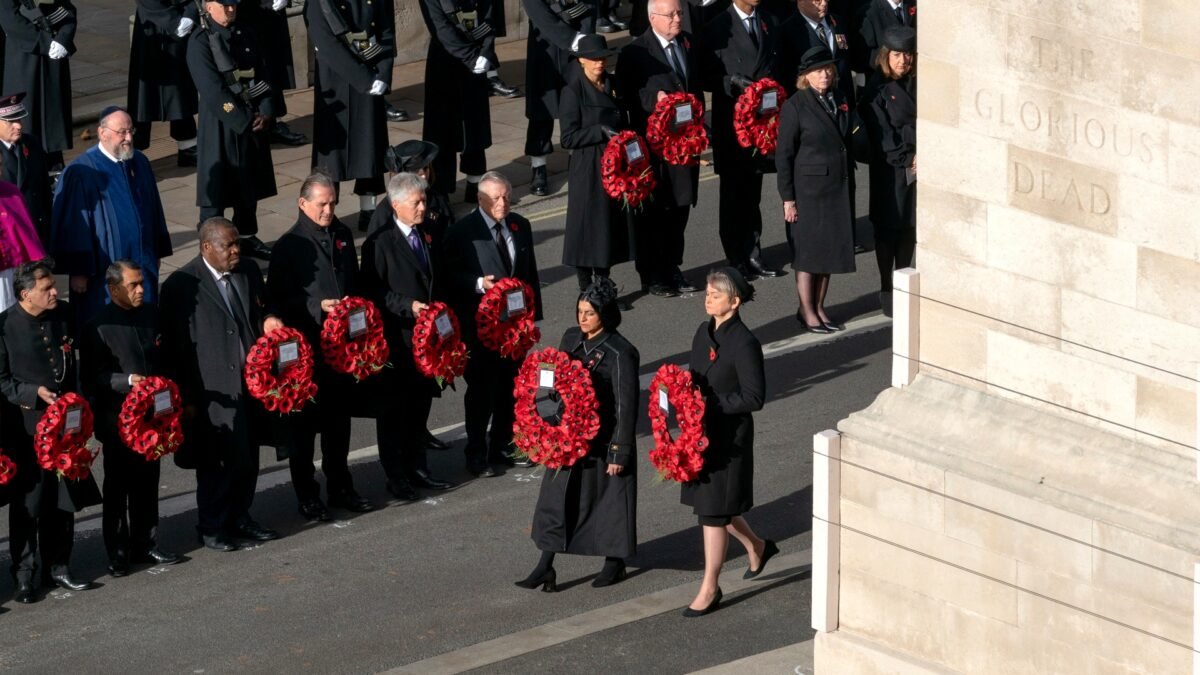
King Charles III led the nation in a two-minute silence at the Cenotaph in London on Remembrance Sunday, as Britain honoured its war dead in a service that carried an unusual weight of firsts and farewells. The King laid the first wreath at the Whitehall memorial on a stone-grey autumn morning, before around 10,000 veterans marched past in a parade organised by the Royal British Legion.
The ceremony, held on Sunday 8 November, brought together a record nine former prime ministers and a shrinking band of just twelve Second World War veterans — a contrast that, as The Guardian observed, may never be repeated. Prime Minister Andy Burnham attended for the first time as the occupant of 10 Downing Street, and the leader of Reform UK, Nigel Farage, laid a wreath for the first time after his party won enough seats in Parliament to qualify under a protocol dating back to 1984.
At 11:00 GMT, as the first strike of Big Ben echoed from the nearby Houses of Parliament, a gun fired by the King’s Troop Royal Horse Artillery from Horse Guards Parade marked the start of the silence. The Last Post was then sounded by buglers of the Royal Marines. The King, his eyes closed, stood before the monument in the uniform of a field marshal, wearing a long grey greatcoat, cap and sword.
A silence at eleven, a wreath of forty-one poppies
The King laid a wreath of red poppies that closely resembled one made for his grandfather, King George VI, according to The Times. The wreath carried 41 paper poppy petals mounted on an arrangement of black leaves, the Press Association reported, and bore a handwritten message from the King: “In everlasting remembrance”. After laying it, Charles stepped back from the monument and saluted.
He was followed by the Prince of Wales, wearing the black uniform of a lieutenant colonel of the Household Cavalry, and by the Duke of Edinburgh and the Princess Royal, who also laid wreaths. Queen Camilla and Catherine, Princess of Wales, watched from the central balcony of the Foreign, Commonwealth and Development Office above the Cenotaph, both dressed in black with red poppies on their lapels.
Behind them, the service was led in prayer by the Archbishop of Canterbury, Dame Sarah Mullally. Military chiefs, senior politicians, diplomats and faith leaders stood in Whitehall, watched by large crowds squeezed behind railings, the BBC reported. Among the flags flying from the roof of the Foreign Office building was the blue and yellow of Ukraine, raised when Russia invaded and now, four years later, visibly frayed — a quiet reminder, the BBC’s royal correspondent noted, of the length of that war and of the threats still facing Europe.
Politicians from across the spectrum laid wreaths alongside the King and the royal family. Alongside the Prime Minister, the Conservative leader Kemi Badenoch, the Liberal Democrat leader Sir Ed Davey, the Home Secretary Shabana Mahmood and the Commons Speaker Sir Lindsay Hoyle all laid wreaths, according to the Press Association.
One notable absence was Andrew Mountbatten-Windsor, who has not attended the service since 2019, The Times reported. The Duke of Sussex, meanwhile, was seen attending a Remembrance service in the market town of Brackley in Northamptonshire, according to the BBC.
Twelve veterans, nine prime ministers
The most affecting numbers of the day were the smallest ones. Just twelve veterans of the Second World War took part in the march-past, down from twenty last year. The Guardian, in its account of the service, pointed out that the twelve now outnumber the nine former prime ministers gathered beside them — a balance, it said, that may never be repeated.
Among the twelve was 103-year-old Annie Duplock, taking part for the first time. She had joined the Women’s Land Army in 1940 at the age of sixteen, having lied about her age, and worked on a farm in Leicestershire helping to feed a country at war. Speaking to the BBC before the service, she said: “I feel very honoured to be taking part in the parade and to represent the Land Girls. I’m very excited, although a little apprehensive as I don’t quite know what to expect.”
“I think it will be a very emotional day, bringing back memories of all those who didn’t return home,” she added. “It will be lovely to be there and remember them.”
Those who served in the Second World War are now, as the BBC put it, increasingly frail. The march-past itself reflected that reality: alongside the marching contingents were flotillas of disability scooters and families helping veterans in wheelchairs, and the oldest participant this year was aged 105. The parade ranged in age from eight to 105, The Times reported, and brought together more than 300 armed forces and civilian organisations — from the Royal Naval Association and the Royal Marines Association to Transport for London and the Royal National Lifeboat Institute — including bereaved military children. The Chelsea Pensioners, in their scarlet uniforms, marched past and laid wreaths of their own.
Standing close to the Cenotaph, meanwhile, were nine former prime ministers, the largest gathering of living former premiers ever assembled at the service: Sir John Major, Sir Tony Blair, Gordon Brown, Lord Cameron of Chipping Norton, Baroness May of Maidenhead, Boris Johnson, Liz Truss, Rishi Sunak and Sir Keir Starmer. The BBC noted that when Blair left Downing Street in 2007, only two former prime ministers were still alive — Major and Margaret Thatcher. The growth of that group to nine, every one of them present on Sunday, is a measure of how rapidly British politics has turned over its leaders in the past two decades.
Mark Atkinson, the director general of the Royal British Legion, which has organised the march-past since 1927, said: “As we come together on Remembrance Sunday, we pay tribute to all those who have served and sacrificed, from generations past to those still serving today.”
Burnham’s first Remembrance as prime minister
For Andy Burnham, this was a first of a different kind: his first Remembrance Sunday as prime minister, four months after he entered 10 Downing Street on 20 July. The Times described him pausing for a moment to look up at the Cenotaph towering above him before bowing his head in reflection as he laid his wreath.
Burnham said the annual event was a time to “reflect on the selflessness and courage it takes to commit your life to protecting others”, according to the BBC. The occasion also carried a practical pledge, announced ahead of the service. Burnham said he would write personally to councils across England on Armistice Day, 11 November, asking them to draw up specific plans on veteran homelessness and to ensure that any veteran sleeping rough is offered appropriate accommodation before Christmas. “No one who has served our country should be left to sleep rough on our streets,” he said, according to the Press Association. The government is also allocating £8.7 million to eight organisations across the United Kingdom through its Reducing Veteran Homelessness programme, and has urged veterans who are sleeping rough to call a UK-wide helpline, 0800 952 0774, which has already helped more than 1,250 veterans into housing.
Burnham’s presence at the head of the political wreath-laying marked a break with the recent past. Until July he was the mayor of Greater Manchester; his arrival in Downing Street followed a change of Labour leadership, and he has spent his first months in office examining options for a closer relationship with the European Union — including, he has said, the possibility of rejoining the single market, the customs union or even full membership in his lifetime. That debate, as events on Sunday showed, now follows him even to the Cenotaph.
Farage takes his place at the Cenotaph
The other first of the day belonged to Nigel Farage. For the first time, the leader of Reform UK had enough MPs in Parliament to qualify to lay a wreath alongside the leaders of the other major parties. Under a protocol dating back to 1984, a Westminster party must hold at least six seats to earn that right. Reform held five this time last year; Farage’s re-election as the MP for Clacton, together with three Conservatives defecting to his party, has taken its tally to eight.
The Times reported that Farage was granted a prime position on Whitehall and, during the service, sang along with gusto to the hymn. The Scottish National Party and Plaid Cymru, by contrast, lay a joint wreath under an agreement dating back to 2001, while Zack Polanski, the leader of the Green Party, watched from a balcony.
Farage’s presence at the Cenotaph is the most visible sign yet of how far Reform has travelled from the political margins into the ceremonial centre of British public life. A party that a few years ago was treated by the established parties as a protest movement now stands, wreath in hand, in the front rank of a national ritual. That is a matter of arithmetic — eight MPs, a protocol, a threshold crossed — but it is also a matter of symbolism, and the symbolism was not lost on anyone watching Whitehall on Sunday.
A standards inquiry hangs over the same day
Yet the same man who laid a wreath in the morning spent the day under a cloud of a different kind. Appearing on the BBC’s Sunday with Laura Kuenssberg programme, Farage was asked about the Parliamentary Commissioner for Standards’ investigation into a £5 million gift he received from the crypto billionaire Christopher Harborne, and whether he expected the commissioner to find against him.
According to the Press Association, Farage was interviewed by the commissioner, Daniel Greenberg, for around 30 minutes in September, as part of a probe into whether he should have declared the gift. Under Commons rules, new MPs are required to register any gifts worth more than £300 received in the previous 12 months, except where it “could not be reasonably thought by others” to relate to their political activities.
Farage declined to discuss the substance of the inquiry on air, telling Kuenssberg: “Under the rules of Parliament, if I even answer your question, I will receive a letter of rebuke from the standards commissioner.” Asked whether he expected the commissioner to find against him, he replied: “Do I think the establishment would find against me, the leader of an insurgent party? What a question to ask.”
The gift is one of the largest personal donations in recent British political history. Harborne is one of two crypto-billionaires who have donated £72 million to Reform, the Press Association reported — twin £36 million gifts from Ben Delo and Harborne that have reignited calls for a blanket cap on political donations, going further than legislation aimed at restricting donations from overseas sources. Harborne was based in Thailand, although in June he was reported to have registered to vote in Hampshire.
Reform has been preparing for an adverse finding for weeks, according to party sources cited in reports last month, and is said to be ready to challenge any negative conclusion through the formal appeals process. The commissioner’s report has not yet been delivered, and no finding has been made. If he were found to have broken the rules, Farage could face a sanction from the Commons, with suspension among the possibilities reported by the press. For now, the inquiry remains unresolved — but the fact that the leader laying a wreath at the Cenotaph on Sunday morning was, hours later, publicly anticipating a verdict against him was one of the day’s sharper ironies.
Farage has also changed his account of what the money was for. He first said it had been given to pay for his security for life; he later told The Sun’s Harry Cole that it was, in his words, “a reward for campaigning for Brexit for 27 years”, according to a report by the former Guardian editor Alan Rusbridger. Farage says he welcomes the investigation. His former ally Ben Habib has made further allegations about Farage and money on social media, which Farage denies; Farage says his lawyers have formally written to Habib.
The Erasmus row: remembrance and the Brexit debate
The other political argument of the day also began before the service, and it, too, was about Europe. On Saturday night, the Department for Culture, Media and Sport announced that the United Kingdom was rejoining the European Union’s Erasmus+ scheme for study and work, and linked the announcement to Remembrance Sunday. “As we mark Remembrance Sunday, Erasmus+ will give a new generation the chance to build connections across Europe,” the department said.
Culture Secretary Lisa Nandy, in the department’s statement, said: “As we remember the immense courage of those who served our country, we honour them by building the best opportunities for the next generation through closeness and collaboration with our allies.”
The Conservatives reacted angrily. Their chairman, Kevin Hollinrake, said: “Remembrance Sunday is a day for the nation to stand together in silence and honour those who gave everything for our country. It is not a day for a Labour minister to try to make an EU membership pitch.” He called on Nandy to withdraw her statement and apologise, the Press Association reported.
Nandy refused. Speaking on Sky News’ Sunday Morning programme, she said: “I strongly, strongly disagree, and it’s Remembrance Sunday, it’s not a time for politicking, and I’m actually kind of quite horrified that the chairman of the Conservative Party has chosen to do that.” She added that the Conservatives were “the only party that is talking about Brexit and the European Union today”, and insisted: “What we are announcing this weekend is that we’re going to widen the Erasmus scheme.”
Questioned on the BBC’s Sunday with Laura Kuenssberg programme, she stood by her remarks, saying: “There was a time where that wouldn’t have even raised an eyebrow as somehow political, it was just common sense — and it is common sense.” She said she could not see what was political about wanting young people “from every part of this country to understand the contribution that their grandparents” made.
The row is a small one, but it is revealing. The United Kingdom is paying £570 million to join the expanded Erasmus+ scheme, which the government said was secured at a 30 per cent discount, according to the BBC, with applications to open in due course. The scheme’s return is part of the wider reset of relations with the European Union that Burnham’s government is pursuing ahead of a summit in Brussels on 20 November, at which deals are expected on food and drink, carbon emissions and youth exchange. That the announcement of a student exchange scheme could be read, on Remembrance Sunday of all days, as a coded argument about Britain’s place in Europe shows how completely the Brexit debate still shadows British public life — and how even a day designed to stand above party politics cannot entirely escape it.
A service held across the country
While Whitehall drew the cameras, Remembrance events took place across the whole of the United Kingdom. In Edinburgh, Scotland’s First Minister John Swinney placed a wreath at the Stone of Remembrance outside the City Chambers. Veterans, military personnel and cadets marched through the centres of Manchester, Birmingham and Leeds, according to the BBC. A silent poppy drop was held as part of the Festival of Remembrance at Durham Cathedral, and wreaths were laid at Canterbury Cathedral.
The national service is broadcast live on the BBC, ITV and Sky News, and the government’s own announcement ahead of the day said around 10,000 veterans would take part in the Royal British Legion’s march past, with more than 300 armed forces and civilian organisations represented. The scale of the day — simultaneous services in every city and town, the same silence at the same hour — is part of what makes it Britain’s most widely shared civic ritual.
A monument built for the men with no grave
The Cenotaph itself has now stood at the centre of that ritual for more than a century. The word means “empty tomb” in Greek, and the monument was designed by the architect Sir Edwin Lutyens in a deliberately simple, austere style, with almost no decoration and no sense of triumphalism, the BBC reported. It was built as a focal point for honouring those who had fought and died in the First World War, including those who had no grave, and as a place to mourn for families who might never be able to visit war cemeteries overseas.
The structure first appeared in 1919 as a temporary monument of plaster and wood. It proved so popular with the public that it was replaced in 1920 with a permanent version in the same design, but in stone. It was opened at 11:00 on 11 November 1920 by King George V. His great-grandson Charles was there again on Sunday, 106 years later, to continue paying respect — laying a wreath modelled on the one his grandfather George VI had laid, before a monument that has outlasted the empire it was built to mourn, two world wars, and two dozen prime ministers and counting.
Analysis: Why It Matters
A ceremony that measures time in two directions
The lasting image of this Remembrance Sunday is a matter of simple arithmetic: twelve against nine. Twelve veterans of the Second World War, nine former prime ministers. One number falls every year — twenty veterans marched last year, twelve this year — and the other rises. The Guardian’s observation that the veterans may never again outnumber the former premiers is not a flourish; it is a forecast. Within a few years, in all likelihood, there will be no Second World War veterans left to march at all, while the ranks of former prime ministers will almost certainly keep growing.
That is what makes the service feel different now. For most of its history, Remembrance Sunday was a ceremony in which the people being remembered and the people doing the remembering belonged, broadly, to the same living memory. The veterans were the witnesses. As they disappear, the ceremony becomes something else: an act of imagination and inheritance rather than of direct recollection. The presence of Annie Duplock, 103 years old and marching for the first time, was moving precisely because it was so evidently one of the last such moments. The challenge for the Royal British Legion, and for the country, is to keep the day meaningful once the last witness has gone — and Sunday’s service, with its eight-year-old marchers and its bereaved military children, was already an answer of sorts: remembrance handed down, not merely remembered.
Reform’s arrival at the centre of the ritual
Nigel Farage laying a wreath is a small act with a large meaning. The Cenotaph ceremony is one of the few occasions in British public life where participation is governed by rules rather than by popularity: six MPs, a protocol from 1984, a place in the order of wreath-laying. Meeting that threshold is an objective, institutional fact, and it confers a kind of legitimacy that opinion polls and television appearances cannot. Reform is no longer asking to be let into the room; by the rules of the room, it is already there.
That matters because Farage’s politics have always depended on presenting himself as the outsider, the insurgent against an establishment that will not let him in. On Sunday he was, visibly, inside — singing the hymn, laying the wreath, standing where prime ministers stand. The tension between that image and his own account of himself as the leader of an “insurgent party” facing an establishment ranged against him is the central contradiction of his current position, and it was on full display in a single day: wreath-layer in the morning, anticipator of an adverse standards verdict by the afternoon.
Whether Reform’s new centrality survives the standards inquiry is an open question. A finding against its leader, and any sanction that followed, would not remove the party’s eight MPs or its place at the Cenotaph, but it would test the claim — implicit in Sunday’s ceremony — that Reform has become a normal, governing part of British politics rather than a protest that happens to have seats.
Burnham’s first Remembrance, and the Europe question
For Andy Burnham, the day was a study in the uses of a ceremony that is supposed to be above politics. His first Remembrance Sunday as prime minister gave him the images every new premier needs at the Cenotaph — the pause, the bowed head, the wreath — and he used the occasion to attach a practical promise to it, on accommodation for homeless veterans before Christmas. That is the traditional, safe use of the day: remembrance as a spur to a duty owed to the living.
But the day also showed how hard it is to keep remembrance above politics when the government itself is reopening the most divisive question in modern British history. The Erasmus row was not of Burnham’s making — it was his Culture Secretary’s announcement — but it was his government’s announcement, on his government’s watch, on the eve of a summit that his government has made the centrepiece of its foreign policy. Nandy’s defence, that linking European cooperation to wartime sacrifice was once “just common sense”, is a reasonable argument in its own terms; the Conservative counter-argument, that Remembrance Sunday is not the day for it, is also reasonable. The fact that both sides could plausibly claim to be defending the day’s dignity is the point. When a prime minister is examining whether Britain should rejoin the single market, the customs union or the European Union itself, every mention of Europe becomes a signal, and Remembrance Sunday — with its memories of a war fought alongside European allies — is the most loaded stage of all.
The King’s quiet continuity
Amid all this churn, the King supplied the one element of the day that has not changed. Charles III laid a wreath modelled on his grandfather’s, before a monument opened by his great-grandfather, at the same hour, in the same place, in the same silence. The monarchy’s role at the Cenotaph is to be the constant against which everything else is measured: prime ministers come and go — nine of them now stand in a row — while the sovereign remains.
That continuity is the ceremony’s real function. It is easy to be cynical about it, and the politics of the day gave plenty of material for cynicism. But the two-minute silence itself, as the BBC’s correspondent described it — the King with his eyes closed, the crowds in Whitehall stopped for their own thoughts, “a rare moment of calm in the capital” — is not a political act. It is the one moment in the British year when the whole country is asked to do nothing but think, at the same time, about the same thing. The fact that it still works, after 106 years, is the reason the rest of the ceremony matters.
Remembering while wars continue
This year’s service also carried a reminder that remembrance is not only about the past. The frayed Ukrainian flag above the Foreign Office, the wreaths laid for the dead of conflicts “dating back to the First World War” and continuing to the present, the veterans of more recent wars marching alongside the last of the Second World War generation — all of it pointed to the same uncomfortable fact: Britain remembers its war dead while wars are still being fought, in Ukraine and in the Gulf, in which British forces and British interests are directly engaged.
That is not a new condition — Remembrance Sunday has always been observed in the shadow of some current conflict — but it sharpens the day’s meaning. The poppy is a symbol of the dead, not of any particular war, and the ceremony’s claim is that the debt owed to the fallen is the same whatever the war. Whether the country still believes that, and whether it is prepared to go on paying it, is a question the service poses every year without answering. This year, with a war in the Gulf in its ninth month and a war in Ukraine in its fifth year, the question felt less abstract than usual.
What to Watch Next
- The standards commissioner’s report on Farage. No date has been given for Daniel Greenberg’s findings on the £5 million Harborne gift. Reform is preparing an appeal in case of an adverse verdict, and any sanction — suspension among the possibilities reported — would become a major test of the party’s standing and of Farage’s leadership.
- The 20 November EU-UK summit. The Erasmus+ announcement is part of a package of deals expected in Brussels, covering food and drink, carbon emissions and youth exchange. How far Burnham goes — and how his cabinet, including ministers who have publicly doubted a return to the European Union, reacts — will shape the reset.
- Erasmus+ applications. The government says the UK is paying £570 million to join the expanded scheme at a 30 per cent discount. When applications open, and how many young Britons take up places, will show whether the programme is the bridge to Europe its supporters claim or a symbolic gesture.
- Next year’s Remembrance Sunday. With twelve Second World War veterans marching this year, down from twenty last year, the Royal British Legion faces the near-certainty that the generation will soon be gone entirely. How the ceremony adapts — and whether it keeps its power without its witnesses — will be watched closely.
- Armistice Day on 11 November. The two-minute silence will be observed again on Wednesday at 11:00, marking 108 years since the Armistice, with services at the Cenotaph and across the country, and the poppy appeal continuing towards its annual total.
Sources
- BBC News — “King leads solemn Remembrance service at Cenotaph” (8 November 2026)
- The Times — “King Charles leads Remembrance Sunday service at Cenotaph” (8 November 2026)
- The Oldham Times (Press Association) — “King leads nation in honouring the fallen at Cenotaph on Remembrance Sunday” (8 November 2026)
- GOV.UK — “The King to lead nation in silence on Remembrance Sunday” (8 November 2026)
- Glasgow Times (Press Association) — “Farage suggests he believes investigation into £5m gift will find against him” (8 November 2026)
- BBC News — “Nandy rejects claims of politicising Remembrance Sunday after Erasmus row” (8 November 2026)
- Redhill and Reigate Life (Press Association) — “Burnham vows specific support to help homeless veterans off the streets” (7 November 2026)

About the Author — Abdul Mannan
Related Articles
Labour MPs Urge Burnham to Scrap Draft Conversion Practices Bill Over Fears Parents Could Face Jail
At least a dozen Labour MPs have told party whips they are unhappy with the draft Conversion Practices…
Russell Brand Jailed for Ten Years and Six Months for Rape and Sexual Assault
Russell Brand has been jailed for ten years and six months after a judge at Southwark Crown Court…
Russell Brand Jailed for Ten and a Half Years for Rape and Sexual Assaults as Judge Calls Him a ‘Sexual Predator’
Russell Brand has been jailed for ten years and six months for raping one woman and sexually assaulting…