
SpaceX Starship Reaches Orbit on Its Boldest Test Yet as Booster Explodes Over the Gulf

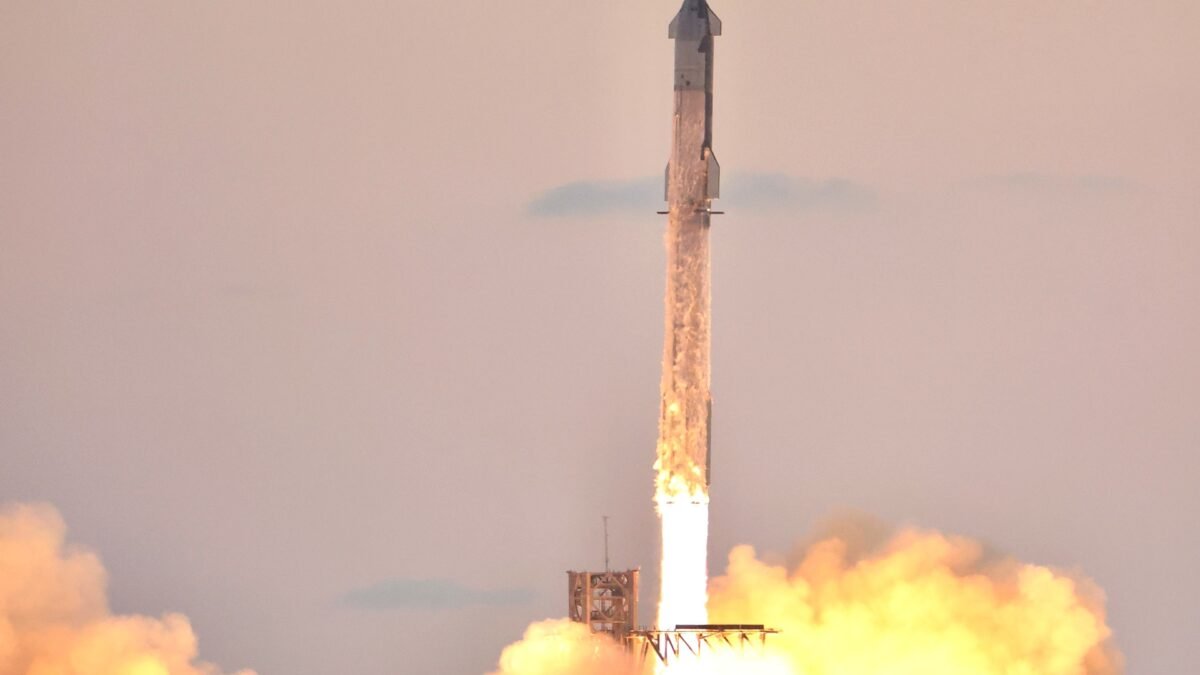
SpaceX’s Starship, the largest and most powerful rocket ever built, reached orbit on Friday on the boldest test flight of its career, but the mission’s dream of recovering both halves of the giant vehicle in a single day ended within minutes of launch, when the Super Heavy booster was diverted away from its launch tower and exploded over the Gulf of Mexico. As this article was published, the Starship spacecraft itself, Ship 42, was still circling the Earth, with the most daring part of the flight — an attempt to catch a returning orbital spacecraft in mid-air with the arms of its launch tower — still to come on Saturday afternoon in the United States.
The 407-foot (124-metre) vehicle lifted off from SpaceX’s Starbase complex in South Texas at 5:47 p.m. Eastern time on Friday, 13 November, according to SpaceX and reporting by the Associated Press and Reuters. Its 33 Raptor engines pushed the combined stack — the 236-foot (72-metre) Super Heavy booster below and the 171-foot (52-metre) Starship spacecraft above — clear of the launch tower and on its way to orbit in what the company had billed as the first attempt to catch both stages of the rocket back at the pad. The Federal Aviation Administration had issued the necessary launch licence only on Friday afternoon, hours before the flight, according to Scientific American.
Within minutes, the plan began to come apart. After the two stages separated, the booster was due to fly back to Starbase about six and a half minutes after liftoff and be plucked from the sky by the tower’s giant mechanical arms, a manoeuvre SpaceX has already pulled off three times. Instead, controllers diverted it to an offshore splashdown point in the Gulf of Mexico after trouble with some of its engines, and the booster exploded a short distance above the sea. “Well, that certainly isn’t the news that we had hoped to hear for today,” SpaceX launch commentator Kate Tice said on the company’s webcast, adding that the decision was in line with the many rigorous safety checks designed to protect the pad. SpaceX gave no explanation for what went wrong, according to the Associated Press, and Reuters reported that it was not immediately clear why the catch attempt was called off.
The loss of the booster meant the end of the “double catch” — the first time any rocket operator has tried to recover every piece of an orbital launch vehicle for reuse. But the spacecraft carried on. Ship 42 reached orbit about 27 minutes after launch, only the second time a Starship upper stage has made it to orbit at all, and it deployed all 26 of the next-generation Starlink satellites it was carrying within the first two hours of the flight, according to Reuters. The flight is planned to last about 22 hours, with the ship completing about 14 orbits at an altitude of around 275 kilometres (170 miles) before it attempts its own homecoming: a deorbit burn at about 3:21 p.m. Eastern time on Saturday, and a catch attempt at the Starbase tower at about 4:17 p.m. Eastern time, according to SpaceX’s published flight plan and reporting by Space.com. In Pakistan, that is about 2:17 a.m. on Sunday morning.
Nothing about that return is guaranteed. The catch will only be attempted if the ship’s systems check out through a series of go/no-go checkpoints built into the long coast through orbit, and if anything looks wrong, the ship can be diverted to a controlled splashdown in the Pacific Ocean instead, according to SpaceX’s flight plan. SpaceX has been clear that reaching orbit does not guarantee the catch goes ahead. For now, though, the second half of the experiment is still live — and it is the half that matters most.
What happened in the first seven minutes
The mission began the way every Starship flight begins: with the ignition of all 33 Raptor engines on the Super Heavy booster, a wall of fire that lifted the 40-storey stack off its launch mount at Starbase, the sprawling complex SpaceX has built near the United States–Mexico border in South Texas. The combined vehicle is the largest ever flown, and the roar of its departure could be watched from South Padre Island and from the roads around Boca Chica, where crowds gathered to see the 15th Starship test flight since the programme began in 2023.
The booster did its job. It burned for a little over two minutes, pushing the stack toward space, and then the two vehicles separated. Ship 42 lit all six of its own Raptor engines and kept climbing, while the booster turned itself around and began the journey home that was supposed to end with it hovering beside the launch tower and being caught by the tower’s mechanical arms, known as “chopsticks”.
That is where the plan broke. About six and a half minutes after liftoff, with the booster on its way back, controllers called off the catch. The booster was diverted to a point offshore, where it hovered briefly above the water and then exploded, according to Reuters. The Associated Press reported that the booster “fell into the Gulf of Mexico and exploded”, and that no explanation was provided for what went wrong. Scientific American reported that the diversion followed trouble with some of the booster’s engines.
The decision to wave off was not a failure of nerve. A catch attempt is only allowed when every automated safety check passes; if any parameter is off, the default is the ocean, not the tower. The launch tower is the most expensive and hardest-to-replace piece of equipment at Starbase, and a booster coming in wrong could destroy it and shut the site down for months. SpaceX’s commentator made that point on the webcast: the wave-off, however disappointing, was the safety system doing what it was built to do.
It was also a surprise. SpaceX had already caught the Super Heavy booster three times at Starbase, most recently in March 2025, according to Reuters, and Friday’s attempt was supposed to be routine enough to be the easy half of a double catch. That it failed — on the first attempt to catch the upgraded Version 3 booster, the production model designed for moon and Mars expeditions, according to the Associated Press — is a reminder that in this programme, nothing is routine yet.
The booster: a catch called off, then an explosion
The booster that was lost on Friday was Booster 22, the fourth of the new Block 3 generation of Super Heavy boosters to fly, and the first of that generation to attempt a tower catch. The Version 3 booster is longer and more powerful than the boosters that flew the earlier test flights, and it is the version SpaceX intends to use for the operational missions that will carry astronauts to the Moon and, eventually, people to Mars. Its loss is therefore more than the loss of a single piece of hardware: it is the loss of the first flight article of the vehicle SpaceX actually plans to fly for real.
What exactly went wrong is not yet known, and SpaceX has not said. Reporting on Friday evening was careful on this point: Reuters said it was “not immediately clear” why the catch went awry, and the Associated Press said no explanation was provided. Some specialist reporting suggested the booster detected a problem in its guidance system before the catch could happen, but SpaceX itself has offered nothing beyond the wave-off, and its engineering teams are now reviewing the booster’s telemetry to find out what triggered the abort. Until SpaceX speaks, the cause should be treated as unknown.
The explosion itself happened just above the sea. The booster was brought down for a controlled splashdown in the Gulf of Mexico and exploded moments before it reached the water, according to reporting of the webcast. Nobody was hurt, and there was no damage to the launch site, because the whole point of diverting offshore was to keep a possibly sick booster away from the tower. That is the trade-off built into the catch system: when in doubt, lose the booster and save the pad.
It is worth putting the loss in perspective. SpaceX routinely recovers the booster stages of its workhorse Falcon 9 rockets, flying them back to landing pads on land or to floating platforms at sea, and it has done so hundreds of times. The Super Heavy catch is a different order of difficulty: the booster is far larger, it comes back faster, and it has to be caught by arms on the tower rather than landed on legs. Three successful catches in, the system is still young, and Friday was a reminder that it can still say no.
Ship 42: in orbit, and still flying
While the booster was falling into the Gulf, the spacecraft was having a much better evening. Ship 42, the Starship upper stage, fired all six of its Raptor engines at stage separation, received the go-ahead for its orbital insertion burn, and reached low Earth orbit about 27 minutes after launch, at around 6:13 p.m. Eastern time. It was only the second time a Starship upper stage has reached orbit, after Flight 14 in September.
Shortly after reaching orbit, the ship began releasing its cargo: 26 of SpaceX’s most advanced Starlink satellites, the V3 generation, deployed over the course of about 42 minutes starting roughly 35 minutes into the flight, according to Space.com, with Reuters reporting that all 26 were released within the first two hours. That makes Flight 15 the second Starship mission to deliver a batch of operational Starlink satellites to orbit, and it makes the flight a revenue-generating mission for SpaceX’s satellite internet business as well as a test flight — a distinction the company has been keen to draw as Starship moves from pure experiment toward working vehicle.
The ship then settled into its long coast: about 22 hours in orbit, circling the Earth about 14 times at roughly 275 kilometres up, the longest time a Starship has ever spent in space. SpaceX’s plan is for the ship to fire a single Raptor engine for a deorbit burn at about 3:21 p.m. Eastern time on Saturday, then re-enter the atmosphere belly-first over the Pacific Ocean, steer with its four flaps through a series of small turns over sparsely populated parts of northern Mexico and southern Texas, pass north of South Padre Island, and make its final turn south over the Gulf toward the tower, where the mechanical arms will be waiting to catch it at about 4:17 p.m. Eastern time.
If that catch succeeds, it will be the first time any spacecraft of this size has been caught after returning from orbit, and the first ever round-trip flight of a vertically launched spacecraft into orbit and back to its precise point of departure, according to Reuters. No orbital-class rocket has ever done it. The Falcon 9’s boosters come back, but its upper stage is thrown away on every flight; the Space Shuttle’s orbiter came back to a runway, not to its launch pad. A Starship caught by its own tower after a day in orbit would be something genuinely new in the history of spaceflight.
It is also, by SpaceX’s own admission, far from certain. The ship has to survive re-entry — the most violent part of any spaceflight, when the vehicle plunges through the atmosphere at more than 17,000 miles per hour, or 20 times the speed of sound — and then fly itself, with no pilot on board, to a precise hover beside a steel tower. SpaceX has built several checkpoints into the coast phase, and if the ship’s systems do not check out, controllers can send it to a controlled splashdown in the Pacific instead. As of publication, the ship had passed its early checkpoints and was still flying normally, according to SpaceX’s webcast updates, but the catch itself will not be confirmed until the ship is actually in the arms.
Why this flight was different
Flight 15 was designed to be the most consequential Starship test yet, and the reason is simple: it was the first flight that tried to bring the whole rocket home. Every earlier flight had settled for less. The first full-scale test in 2023 ended with multiple engines failing to ignite and the tumbling rocket’s self-destruct system being activated. Later flights caught the booster but let the ship fall into the ocean. Flight 14, in September, was the first to reach orbit and deploy operational Starlink satellites, but SpaceX did not try to recover either stage. Flight 15 was the first to attempt both recoveries on the same flight — and the first to attempt a catch of the ship itself, after it had spent nearly a full day in space.
The goal behind all of this is full reusability, which SpaceX calls the “holy grail” of rocketry. A rocket that can be caught, refuelled and flown again — both stages, not just the booster — would slash the cost of getting to orbit, because the most expensive parts of the vehicle would no longer be thrown away after a single use. That is the economic argument that underpins everything SpaceX is trying to do with Starship: cheap, frequent access to space, at a scale no expendable rocket can match.
The scale of the ambition was on display in the words of Kiko Dontchev, SpaceX’s vice president of launch, who told a NASA technology summit at Florida’s Kennedy Space Center last week that scaled-up infrastructure, combined with full rocket reusability, is “how you go from zero launches to 10 to 100 to 1,000 to 10,000 to 100,000”. Elon Musk has said he expects to reach a pace of about one Starship launch a week by the first half of 2027, according to Reuters. That is a cadence no large rocket in history has ever approached, and it is only possible if the rocket comes back.
Flight 15 was also the first flight of the upgraded Version 3 vehicles — Booster 22 and Ship 42 are both third-generation hardware — and the first test flight to be flown under a launch licence that explicitly covers a return to the launch site. The Federal Aviation Administration issued the necessary licence on Friday afternoon, only hours before liftoff, according to Scientific American. The timing was tight enough that, as recently as Thursday morning, SpaceX’s own flight page still described the mission as “pending regulatory approval”.
The road here: fourteen flights of trial and error
Starship’s journey to Friday’s flight has been long, public and often fiery. The programme has flown 15 test flights since 2023, and the spacecraft portion of the previous 14 all ended up in the ocean, either by design at the end of the flight or by accident in a stream of flaming wreckage, as the Associated Press put it. The first full-scale test, in April 2023, saw multiple engines fail to ignite, the rocket tumble out of control, and its self-destruct system activated. Later flights exploded on ascent, broke apart on re-entry, or fell into the sea. Each failure was followed by a redesign, and each redesign by another flight.
The programme turned a corner in 2024, when the fifth test flight caught the Super Heavy booster with the tower’s arms for the first time, a feat that had never been attempted before and that many in the industry had said would not work. Two more booster catches followed. But the ship — the upper stage, the part that actually goes to orbit and would one day carry people — remained unrecovered. It was not until September 2026, on Flight 14, that a Starship upper stage reached orbit at all, and even that mission ended early: an engine issue forced SpaceX to bring the vehicle down in the Pacific Ocean after roughly three hours, against a planned ten-hour flight, and the ship splashed down intact before bursting into flames. Some of the rocket’s engines had shut down in mid-flight.
Reliability, particularly of the Raptor engines that power both stages, has been the programme’s recurring problem. SpaceX has had a series of issues with the engines in recent flights, according to CNN, and Friday’s booster abort — after trouble with some of its engines, according to Scientific American — fits that pattern. The Raptor is a new kind of engine, burning liquid methane and liquid oxygen at pressures no operational rocket engine has attempted before, and it has been the hardest part of Starship to get right.
That history is why Friday’s flight matters even with the booster lost. The ship reaching orbit, deploying its satellites and settling into a 22-hour coast is the second consecutive orbital flight for the upper stage, and the first time the programme has kept a ship in space long enough to attempt a return to the pad. The booster failure is a setback, but it is a setback of a kind the programme has absorbed many times before. The ship’s return, if it works, would be a first of a kind no other programme has achieved.
Analysis: Why It Matters
Half a success is still the most important half
It is tempting to call Flight 15 a failure, because the headline event — the double catch — did not happen. That would be the wrong reading. The booster was the easy half of the mission: SpaceX has caught it three times before, and it will catch it again. The ship was the hard half, the part that had never been attempted, and as of publication the ship is doing exactly what it is supposed to do: circling the Earth, healthy, with its satellites deployed and its return still ahead of it. If the ship is caught on Saturday afternoon, Friday’s flight will be remembered as the day Starship came home, not the day a booster exploded. The booster is replaceable hardware; the ship’s return is the programme.
There is a useful comparison close at hand. When the Falcon 9 was in development, SpaceX blew up booster after booster trying to land them on a barge at sea, and each explosion was treated in the press as a failure of the whole idea. Within a few years, landing a Falcon 9 booster had become so routine that nobody reported it at all. Starship is at the same stage of the same learning curve, except that the vehicle is four times as tall, the catch is done by a tower rather than legs, and the ship has to come back from orbit rather than from the edge of space. Judged against that difficulty, a flight that puts the ship in orbit and keeps it there for a day is progress, not failure.
The abort is the system working, not failing
The second thing Friday proved is that the safety system around the tower catch works. A catch attempt is only allowed when every automated check passes, and if any parameter is off, the default is the ocean. That is a deliberate design choice, and it is the right one: the launch tower is a one-of-a-kind structure, and a booster arriving at it in the wrong condition could put the whole site out of action for months. SpaceX chose to lose a booster rather than risk the tower, and that is exactly the decision the system was built to make.
This matters because the tower catch is the most dangerous part of the whole Starship concept, at least to SpaceX’s own infrastructure. A landing leg can fail and the rocket falls over on a pad; a tower catch that goes wrong can take the tower with it. The wave-off on Friday shows that SpaceX has built a system that would rather be embarrassed than reckless. For a programme that is often accused of moving too fast, that is a useful piece of evidence in the other direction — and it is evidence the Federal Aviation Administration, which licensed the flight only hours before launch, will have noted.
The catch is the whole programme in one manoeuvre
It is worth being clear about why the catch matters so much, because it can look like a stunt. It is not. The entire economic case for Starship rests on recovering both stages. The Falcon 9, for all its success, is still not fully reusable: its second stage is thrown away on every single flight, as Kiko Dontchev pointed out ahead of Friday’s launch. Starship is designed to catch both the first stage and the second stage, and only then does the arithmetic of cheap spaceflight work: a vehicle that can be refuelled and reflown in days, rather than built again from scratch over months.
That arithmetic is what makes everything else possible. A Starship that can fly once a week, as Musk has projected for the first half of 2027, could put into orbit in a month more mass than the entire global launch industry manages in a year. It could build the Starlink constellation in far larger batches than the Falcon 9 can manage, and it could launch the orbital data centres — the “Starmind” swarm of AI processing satellites that Musk has described as central to SpaceX’s future as a high-technology infrastructure provider — at a scale that would be impossible with expendable rockets. But none of that happens until the ship comes home. The catch is not the sideshow; it is the business model, performed in mid-air.
The Moon clock is now the real deadline
There is also a clock running that has nothing to do with SpaceX’s own ambitions. NASA is paying SpaceX billions of dollars to land Artemis astronauts on the Moon with Starships, and it expects to land humans on the Moon by 2028, according to Reuters — a date that many analysts and industry engineers already believe will slip. Before Starship can carry anyone to the lunar surface, it has to demonstrate capabilities it has not yet shown at all, the most important of which is transferring fuel between Starship tanker rockets in orbit, a complex manoeuvre without which a heavy lunar lander cannot carry enough propellant for the round trip to the Moon.
The schedule is tightening from the other direction as well. During next summer’s Artemis III mission, astronauts will practise docking their Orion capsule with Blue Origin’s Blue Moon lander and then with a Starship in orbit around the Earth, according to the Associated Press — a rehearsal for a Moon landing that could come as early as 2028. NASA expects to decide a year before the Artemis IV lunar landing, the first by astronauts in more than half a century, whether the moonwalkers will be carried to the surface by Musk’s Starship or by Jeff Bezos’s Blue Moon. NASA Administrator Jared Isaacman, writing on X after Starship reached orbit on Friday, said the agency was looking forward to “some of that on-orbit Starlink capability on Artemis III” — a small, telling sign that NASA is already planning around Starship as working infrastructure, not as a distant promise.
The competition is real, and it is good for the programme. Blue Origin is the other major player in the Artemis lander race, and its presence means Starship cannot afford to stall. But the competition also cuts the other way: if Starship’s development slips much further, NASA has a second option, and it has shown it is willing to use it. Friday’s flight, booster loss included, keeps Starship on the path. A failed ship return on Saturday would not end the programme, but it would make the 2028 date harder to defend.
Starship is becoming infrastructure, not just a rocket
The final thing Friday’s flight revealed is how far Starship has already moved beyond being a rocket. The flight carried 26 working Starlink satellites, the second operational payload the vehicle has delivered. It is the delivery system for a satellite internet constellation that is already one of the largest businesses in space, and it is the intended launch vehicle for a swarm of orbital data centres that Scientific American reports could number a million satellites. SpaceX has even disclosed plans for a proposed $24-billion gas-fired power plant and supercomputing complex at Starbase itself, and is seeking local tax incentives for the project, according to Scientific American — a sign that the company sees its Texas site as an industrial complex, not just a launch pad.
That expansion is already running into politics. The state’s governor-elect, Gina Hinojosa, campaigned against energy-intensive data centres and has pledged to pause new approvals until stronger protections are in place, according to Scientific American. The timing is awkward for SpaceX, which needs enormous amounts of power for the supercomputing complex it wants to build at the same site from which it launches its rockets. The rocket and the data centre are, in SpaceX’s vision, two halves of the same business: the rocket puts the computers in orbit, and the computers on the ground train the artificial intelligence that will run them. Whether Texas politics allows that vision to be built at Starbase, or forces it elsewhere, is now part of the Starship story — and it will be watched as closely as the flights themselves.
For now, the flight is not over. A spacecraft the size of a 17-storey building is circling the Earth, and on Saturday afternoon in the United States it will try to do something no spacecraft has ever done: come home to the exact spot it left, and be caught in mid-air by the tower that launched it. Whatever happens with the booster is already history. The ship is the story now.
What to Watch Next
- The ship’s return on Saturday afternoon. Ship 42 is due to fire its deorbit burn at about 3:21 p.m. Eastern time and attempt a tower catch at about 4:17 p.m. Eastern time on Saturday, 14 November — about 2:17 a.m. on Sunday in Pakistan. Watch whether SpaceX confirms the catch attempt is going ahead after its final go/no-go checkpoint, and whether the ship is caught, diverted to a Pacific splashdown, or lost on re-entry.
- SpaceX’s explanation for the booster abort. The company has not said what triggered the wave-off. Its review of the booster’s telemetry should establish whether the problem was in the engines, the guidance system, or the tower’s automated checks — and whether the fix is a quick one or a design change.
- The timing of Flight 16. If the ship is caught, SpaceX will want to fly again quickly to prove the recovery was not a one-off. If it is lost, the programme will need to show what went wrong before the next flight. Either way, the gap to the next launch will say a lot about how close Starship is to routine operations.
- The Artemis III docking rehearsal next summer. Astronauts are due to practise docking Orion with both Blue Moon and a Starship in Earth orbit. Whether Starship is ready for that rehearsal on schedule will be the first hard test of the 2028 Moon landing date.
- In-orbit refuelling. The demonstration of fuel transfer between Starship tankers in orbit — the capability a lunar mission cannot do without — remains unproven, and it is the milestone most likely to decide whether the Moon landing happens in 2028 or later.
- The Florida launch site. SpaceX plans to start launching Starships from Florida within a few months, which would take pressure off Starbase and put the vehicle within reach of NASA’s Kennedy Space Center infrastructure. Watch for the first Florida Starship launch date.
- The Texas power and data-centre fight. SpaceX’s proposed $24-billion gas-fired power plant and supercomputing complex at Starbase, and the new governor-elect’s pledge to pause approvals for energy-intensive data centres, will shape where the company’s ground infrastructure — and its orbital data-centre ambitions — can actually be built.
Sources
- Associated Press, “SpaceX’s Starship soars into orbit after booster explosion prevents an unprecedented double catch”, via Phys.org, 14 November 2026
- Reuters, “SpaceX launches 15th Starship flight with hopes of achieving first round trip”, 13 November 2026
- Scientific American, “Starship Flight 15 will put SpaceX’s moonshots to the test”, 13 November 2026
- The Hindu BusinessLine, “SpaceX launches Starship for historic attempt to catch entire rocket”, 14 November 2026
- CNN, “SpaceX is set to make an audacious grab for ‘holy grail’ of rocketry. Here are the risks”, 12 November 2026
- Starlust, “SpaceX launches Starship Flight 15: Booster catch called off, history still on the cards”, 14 November 2026

About the Author — Abdul Mannan
Related Articles
Google Puts Gemini 4 Hydrogen Into Search for Every User in Its Biggest Upgrade Yet
Google has rolled out Gemini 4 Hydrogen, its fast new AI model, to every Search user worldwide, calling…
Microsoft 365 Goes Dark Worldwide as Outlook, Teams and Copilot Fail in Ten-Hour Global Outage
Outlook, Teams and Copilot went down for millions of users across 74 countries on Thursday as Microsoft's own…

Webb Telescope Detects the ‘Forbidden’ Light of H3+ for the First Time Anywhere — Ending a 40-Year Hunt
After four decades of searching, the James Webb Space Telescope has caught the faint 'forbidden' rotational glow of…