
Steelers Release Aaron Rodgers After Explosive On-Air Attack on Coach Mike McCarthy

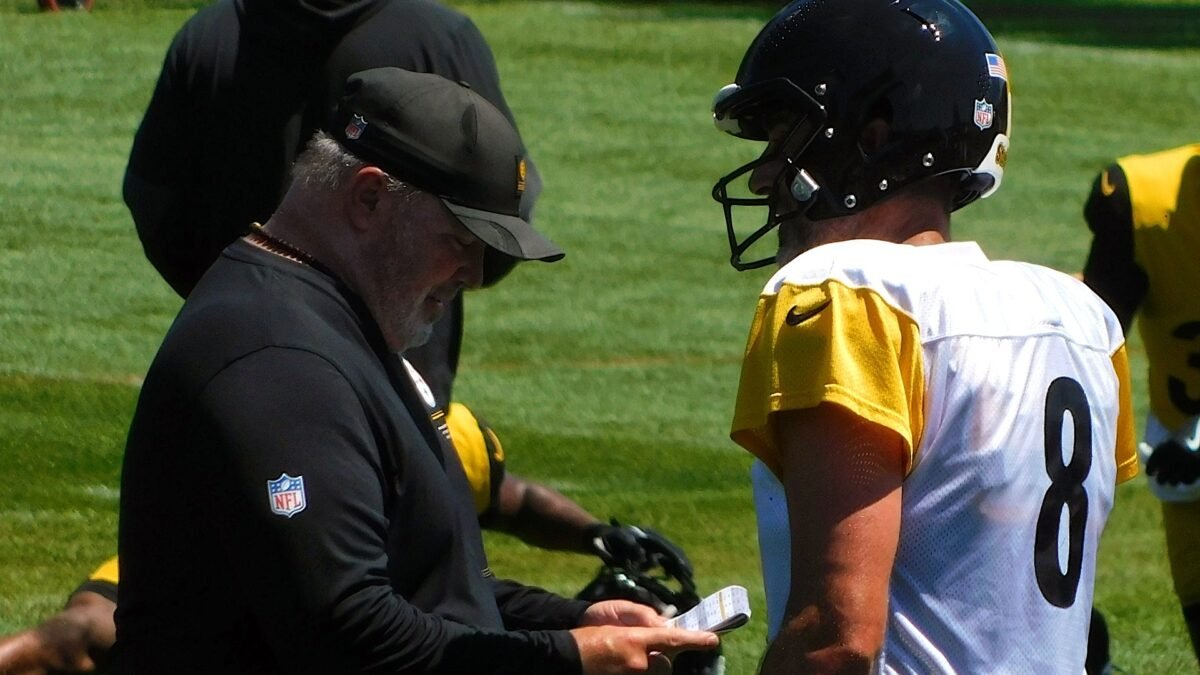
The Pittsburgh Steelers released Aaron Rodgers on Wednesday, cutting ties with the four-time NFL Most Valuable Player less than a day after benching him and only hours after he used a national television appearance to accuse head coach Mike McCarthy of sleeping through team meetings, skipping practices and calling the team by the wrong name in the locker room.
Rodgers, 42, had been told on Tuesday night that he would be inactive for Friday’s game against the Denver Broncos, with backup Mason Rudolph stepping in as the starter. On Wednesday, he appeared on ESPN’s “The Pat McAfee Show” and delivered one of the most extraordinary public attacks by a player on his own head coach in modern NFL history. Within hours, the Steelers announced his release.
“We have released QB Aaron Rodgers,” the team said in a post on X, according to Field Level Media. Rodgers is now available to be claimed off waivers by any team, and if he clears waivers he will become an unrestricted free agent.
Speaking on the McAfee show, Rodgers said he had no intention of returning to Pittsburgh. “I’m not going back to Pittsburgh,” he said. “That ship has sailed.”
The release ends one of the strangest and shortest reunions in recent NFL memory. Rodgers and McCarthy spent 13 seasons together with the Green Bay Packers, winning the Super Bowl to cap the 2010 season. Rodgers had recommended McCarthy for the Steelers’ head coaching job before he was hired in January, and then returned for one final season to play for the coach he had helped bring to Pittsburgh. Ten months later, the partnership has collapsed in public, in the middle of a season in which the Steelers remain in the play-off race.
What Rodgers said on the McAfee show
Rodgers used the appearance to describe, in detail, what he said had been happening inside the Steelers’ building for months. He began with the previous week, which he said summed up the season.
“Last Wednesday, we were in a quarterback meeting. Mike came in late, sat down and within 10 minutes began snoring,” Rodgers said, according to CNN. “Woke himself up, was rattling his papers, we all looked around. Five minutes later, you hear the snoring again and less than five minutes after that he walks out the room like nothing happened.”
Rodgers said McCarthy then missed an offensive meeting on Thursday, failed to show at a walkthrough on Friday, and missed a morning meeting on Saturday before the Steelers’ game in Philadelphia. He said McCarthy did not hold a team meeting on Saturday night either.
It was during Sunday’s game against the Philadelphia Eagles, Rodgers said, that McCarthy lost much of the team. At half-time, with the Steelers struggling, Rodgers said McCarthy broke up the offensive huddle by saying: “Alright, 1, 2, 3 Packers” — the name of his former team, not the one he now coaches.
“I think the nail in the coffin for so many of us was at halftime, towards the end of it … there’s some rambling or something and without even a heads up he says, ‘Alright, 1, 2, 3 Packers,'” Rodgers said. “That’s what he broke it down on in the locker room.”
The Steelers went on to lose that game 19-16, dropping their record to 6-4 and extending their losing run to two games.
Rodgers went further, saying McCarthy was “unwell” and should consider letting someone else lead the team. He said he had raised his concerns with McCarthy privately for months, “as a concerned friend about somebody who is unhealthy”, and that the problems went beyond a single week.
“We’ve had these conversations for months now and it began as a concerned friend about somebody who is unhealthy,” Rodgers said. “If you’re sleeping in meetings, you’re unhealthy, if you’re not coming to everything you should be coming to as a play caller.”
“How many quarterbacks around the league are dealing with the same type of stuff? I gave you one week, I could go week by week throughout the season on stuff that was going on.”
Rodgers also alleged that McCarthy was often behind on film study, even days before a game, and said he was not the only player who felt that way. “The entire team – offensively especially, really the entire team but offensively – they think that a change is needed because they see it,” he said.
He said he should be held accountable for vouching for McCarthy before he was hired. “Full circle, with the first coach when I was starting, back in his hometown, there’s no way he’s going to sleep through his dream job,” Rodgers said. McCarthy is a Pittsburgh native, and the Steelers job was widely seen as the one he had wanted for years.
Rodgers also revealed that he had given McCarthy an ultimatum on Monday: stop calling plays, or release him. He said he wanted to take control of the offence himself, a proposal McCarthy rejected. According to NFL Network, the team had even discussed using quarterbacks coach Tom Arth as an intermediary to relay plays to Rodgers. Rodgers said the word “benching” never came up in his meetings with McCarthy.
“What came up was: sleeping, habits, game plan, understanding what we’re doing, being able to call a play, being able to call a game without the game sheet,” Rodgers said.
“You’re going to release me? Cool. You’re going to deflect this thing and make it that you were trying to bench me and that I’m at home contemplating whether or not I’m going to accept a benching? Couldn’t be farther from the truth.”
McCarthy’s response
McCarthy addressed the accusations at a news conference later on Wednesday, hours after Rodgers’ appearance, and remained tight-lipped on many of the claims. He said he did not want to discuss personal conversations, but he confirmed that Rodgers had been released, confirmed that Rodgers had given him an ultimatum, and appeared to corroborate a couple of the quarterback’s claims.
The longtime head coach confirmed the ultimatum, though he would not specify what it was, describing it as “clearly out of his job description”. That aligns with Rodgers’ account that he had asked McCarthy to give up play-calling.
McCarthy also admitted to an “embarrassing” moment at half-time of the Eagles game, in line with Rodgers’ claim that he had said “1, 2, 3, Packers”.
“You know halftime was very emotional, and there was conversations prior to that embarrassing moment, but I just think, you know, we work a lot of hours, so definitely a difference of opinion from what I was told about the comments,” McCarthy said, defending his work ethic after Rodgers said he skipped meetings and fell asleep on other occasions.
McCarthy said he had held a meeting with the team’s leadership council, which he called a “very honest” one. “It was a meeting, very direct, very honest. I appreciated the opportunity to talk through numerous things that have been on their mind,” he said.
He pushed back on Rodgers’ claim that he had learned about the benching from tight end Pat Freiermuth and that nobody from the coaching staff or front office had reached out. “We were going through game plan meetings, but I know there was continuous efforts to reach Aaron, and I know there was communication with his agent,” McCarthy said.
He also said he held no grudge against Rodgers over the 63-year-old coach’s firing from Green Bay in 2018, and insisted he had the backing of the team going forward. “I know how to win, and that’s the facts,” McCarthy said. “This is a growth opportunity that I intend to take full advantage of.”
When asked whether the decision to cut Rodgers came after the television appearance, McCarthy said he could not pinpoint the exact timeline because he had been in and out of meetings all afternoon.
Sources back some of Rodgers’ claims
Multiple NFL sources corroborated several of Rodgers’ allegations, according to ESPN, which reported that the organisation intends to retain McCarthy despite the controversy. Among the claims corroborated by ESPN’s sources were that McCarthy fell asleep during meetings and mistakenly invoked his former team’s nickname at half-time of a game.
“It’s all true,” one source told ESPN, according to Reuters.
According to NFL Network and ESPN, McCarthy retains the support of Pittsburgh’s ownership and front office. The Associated Press also reported that a former NFL quarterback confirmed he had seen McCarthy asleep during a meeting at an earlier coaching stop, speaking on condition of anonymity because of the delicate nature of the topic. The report noted that speculation about McCarthy’s habits and commitment is nothing new.
There has been no public information on McCarthy’s health, and it was unclear what issues Rodgers was alluding to when he described the coach as “unwell”, according to CNN. McCarthy did not address the health claim directly in his news conference.
A locker room divided
Inside the Steelers’ facility, the fallout was immediate and visible. McCarthy walked through a crowd of reporters in the lobby after practice, most of them hunched over their phones listening to Rodgers’ interview, according to the Associated Press. Minutes later, players spoke in a subdued locker room, declining to get into specifics but not outright dismissing the accusations either.
Freiermuth, the tight end through whom Rodgers said he learned of the benching, was asked whether he was confident McCarthy could lead the team going forward. “I’m confident,” he said, adding little else.
Rudolph, who has developed a close friendship with Rodgers over the past 18 months, called him “nothing but the epitome of a first-class teammate”. Wide receiver Marquez Valdes-Scantling, who played alongside Rodgers and under McCarthy as a rookie in Green Bay in 2018, acknowledged there was general frustration about the team’s recent performances but added: “I didn’t think it was this.”
Rodgers said he felt it was his responsibility to raise the issues rather than leave it to younger players with less security. “I felt it was the right thing to bring up the issues to McCarthy as a longtime league star instead of putting it on others with fewer years, shaky roster positions or those who haven’t made 400 million dollars in the NFL,” he said. “Me? I don’t care, what are you going to do to me?”
How the reunion fell apart
The collapse is remarkable because of how deliberately the reunion was built. Rodgers first met with Pittsburgh as a free agent in March 2025, arriving at the team’s facility in a nondescript Chevrolet sedan, wearing a hat and sunglasses to deflect attention. He signed with the Steelers, who were looking for a quarterback to end a postseason victory drought that, according to the Associated Press, is nearing a decade.
Rodgers was effective if not spectacular in his first season in Pittsburgh, which ended with a blowout loss at home to Houston in the wild-card round of the play-offs. His future seemed uncertain until the Steelers hired McCarthy in January to replace Mike Tomlin, a job Rodgers played a hand in helping McCarthy land, though how big a hand is up for debate.
Rodgers opted to make one last run at a championship while reuniting with the coach he won a Super Bowl with in early 2011. He has said the 2026 season will be his last, and he turns 43 on 2 December. Any shot at a storybook ending is now gone, for Rodgers and perhaps for his now-former team.
On the field, Rodgers’ performance this season was a mixed bag. At times he hardly looked like the league’s oldest player, even outduelling Cincinnati star Joe Burrow in a victory over the Bengals in late September. At others, his MVP-winning prime looked a long way away. He has struggled to make an impact of late, often checking the ball down to running backs Jaylen Warren and Rico Dowdle or taking sacks behind an inconsistent offensive line when trying to push the ball downfield to a receiving group that has underperformed, particularly two-time Pro Bowler DK Metcalf. The Steelers rank in the bottom half of the NFL in scoring, total offense and passing yards.
The tension had been building in plain sight. Rodgers and McCarthy were caught on camera screaming at each other during a game earlier this season, with Rodgers frustrated by how the plays were coming into the huddle. McCarthy called Rodgers a two-worded expletive. Afterwards, McCarthy apologised for his use of language.
Rodgers also referenced a heated confrontation between the two in 2018 after a game against the Buffalo Bills, during their final season together in Green Bay before McCarthy was fired.
Why it matters
The Steelers’ decision to cut a future Hall of Famer mid-season is almost without precedent in NFL history, and it leaves the franchise in a strange position: still in the play-off race, but now led by a backup quarterback and a head coach whose authority has been publicly challenged by the most decorated player on the roster.
There is little precedent for replacing a future Hall of Famer and Super Bowl winner mid-season. Johnny Unitas, playing out his final days in a Chargers uniform, was benched for rookie Dan Fouts after four games in 1973. Joe Namath never played again after throwing four interceptions in a loss to Chicago during a late-career cameo for the Los Angeles Rams a month into the 1977 season. More recently, Denver replaced Peyton Manning with Brock Osweiler midway through 2015 even with the club sitting at 7-2, though Manning’s health was a contributing factor. Manning returned in the season finale and then served as a game manager in the play-offs as the Broncos’ dominant defence led the franchise to its third Super Bowl victory.
This is not that. The Steelers are 6-4, they hold the AFC’s final wild-card spot entering Friday’s home game against the Broncos, who are 8-2, but their next three games are against AFC West-leading Denver, surging Houston and AFC South leader Jacksonville. While they can probably withstand one loss or maybe two, three would be catastrophic for their play-off hopes. Pittsburgh is 2-4 on the road, where it figures to be when the play-offs start if the Steelers cannot track down Cincinnati for the AFC North title. And the team’s inconsistent play has offered little evidence that it is a legitimate threat to have an extended postseason stay.
The timing could hardly be worse. The Steelers host the Broncos on Friday, and Rudolph will start a game of real consequence with only days of preparation as the starter. Rudolph rescued Pittsburgh’s season in 2023 by coming off the bench in December and leading a surge to a play-off berth, briefly earning folk hero status, but the Steelers moved on from him immediately afterwards, bringing in Russell Wilson and Justin Fields in 2024 and then Rodgers in 2025. Now they are asking him to steady a team in turmoil.
“Does it put some of us in an awkward space? Yes,” Rudolph said. “But again, it’s just another sort of opportunity to overcome adversity.”
The episode also raises difficult questions for the Steelers’ ownership and front office. They hired McCarthy, at Rodgers’ urging, to replace Tomlin, the only head coach the franchise had known since 2007. Now, less than a year into his tenure, McCarthy has survived a public mutiny by the team’s most famous player — but at the cost of the season’s defining storyline becoming his own conduct rather than the team’s results. According to ESPN and NFL Network, the organisation intends to retain him, but his authority has been damaged in a way that will be hard to repair if results do not improve quickly.
For McCarthy, the next few weeks are a test of whether a coach can keep a locker room after the most public dressing-down of his career. His meeting with the leadership council was, by his own description, “very direct, very honest”. The players will now judge him on what happens on Friday night and in the weeks that follow, not on what was said in a news conference.
What happens next for Rodgers
What happens next to a player who has always leaned into doing things on his own terms is unclear. Pittsburgh was supposed to be his third and final NFL stop. Whether any quarterback-needy team will be willing to take on the considerable baggage Rodgers brings is anybody’s guess.
Rodgers seemed content on Tuesday, spending time in the locker room trading jokes with Rudolph and longtime defensive tackle Cam Heyward after addressing reporters. Barely eight hours later, he was no longer the starter. Shortly after that, he was no longer a Steeler.
He will now go through waivers, where any team can claim him and his contract. If he clears waivers, he will be an unrestricted free agent, free to sign anywhere. The question is whether any team wants him. A contender with an injured quarterback might see a four-time MVP, even at 42, as worth the risk. Others will look at the wreckage in Pittsburgh — the public attack on a head coach, the ultimatum over play-calling, the claim that he would not go back — and decide the cost is too high.
Rodgers has said this will be his final season, but the manner of his departure raises the question of whether he will now rethink that and try to play again this season with a different team. That remains to be seen. But what is clear is that he will not play another snap for Pittsburgh, and that the relationship between Rodgers and McCarthy, once one of the most successful partnerships in the NFL, is fractured again — this time, it seems, for good.
If this is the end of Rodgers’ career, it is an inglorious off-ramp for one of the greatest quarterbacks of his generation. He will still be enshrined in the Pro Football Hall of Fame. But the final chapter of his playing career will not be a Super Bowl run or a farewell tour. It will be a benching, a television interview, and a release notice on a Wednesday afternoon in November.
Analysis: a reunion built on nostalgia, broken by reality
The Rodgers-McCarthy reunion was always a gamble built on nostalgia. It paired a 42-year-old quarterback chasing one last championship with a 63-year-old coach chasing the job he had wanted since childhood, and it asked both men to pretend that 13 seasons together in Green Bay — including a Super Bowl, a firing, and years of reported friction — could simply be resumed as if nothing had changed.
For a while, it worked well enough. The Steelers won games, Rodgers made enough plays, and the story of the reunion was a pleasant one. But the structure of the relationship was fragile from the start. Rodgers had vouched for McCarthy to get the job, which meant McCarthy’s authority over his quarterback was compromised from day one. A head coach cannot easily discipline a player who helped hire him, and a quarterback who believes he installed the coach will always feel entitled to a say in how the team is run. When Rodgers told McCarthy to give up play-calling, he was acting on a logic the arrangement itself had created.
The deeper problem is that the Steelers tried to solve two problems at once — a decade-long play-off drought and a coaching transition after the Tomlin era — with a single nostalgic hire. McCarthy was supposed to bring stability and experience. Instead, his first season has become a case study in how quickly a locker room can turn when players lose faith in the coach’s preparation. Rodgers’ specific claims — sleeping in meetings, missing walkthroughs, being behind on film — are the kind of accusations that are almost impossible for a coach to survive unharmed, because they go to the most basic requirement of the job: being prepared.
It is worth noting what McCarthy did and did not deny. He did not deny the “1, 2, 3 Packers” moment; he called it “embarrassing”. He did not deny the ultimatum; he confirmed it. He disputed the claim that the team had not tried to reach Rodgers, and he defended his work ethic in general terms. The corroboration from multiple NFL sources, reported by ESPN, suggests that at least the core of Rodgers’ account is accurate. That matters, because it means this was not simply a disgruntled player lashing out. It was a player describing, in public, something other people inside the building had also seen.
The Steelers’ decision to back McCarthy and release Rodgers is, on its own terms, defensible. No team can allow a player to dictate who calls plays, and no coach can survive if his quarterback can publicly humiliate him and keep his job. But it is also a decision with real costs. The Steelers have traded away their most talented quarterback for a backup, in the middle of a play-off race, with the hardest stretch of their schedule ahead of them. If Rudolph struggles and the season collapses, the question will not be whether the Steelers were right to back their coach. It will be whether they hired the right coach in the first place.
For the NFL more broadly, the episode is a reminder of how the league’s power dynamics have shifted. Star quarterbacks now have platforms — weekly television appearances, huge social media followings, direct lines to the public — that let them prosecute a case against their own coach in real time. Rodgers did not need to ask for a trade or hold out. He went on television, told the world what he believed was happening inside the building, and forced the team to choose. The Steelers chose the coach. But the fact that the choice had to be made in public, on a Wednesday afternoon, tells you something about who really holds power in the modern NFL.
What to watch next is straightforward. First, whether Rodgers is claimed off waivers or signs with another team, and whether he reconsiders his plan to retire. Second, how the Steelers play on Friday against Denver, and whether Rudolph can steady a team that has just lived through one of the most chaotic weeks in franchise history. Third, whether McCarthy can rebuild his authority in the locker room, or whether the “very honest” meeting with the leadership council was the beginning of a longer reckoning. And finally, whether the Steelers’ ownership, having backed McCarthy in this fight, will still be backing him if the season ends in disappointment.
Sources
- CNN — Aaron Rodgers released by Steelers after going scorched earth on coach Mike McCarthy
- Reuters — Reports support Aaron Rodgers’ rant on Mike McCarthy: ‘It’s all true’
- Associated Press — Steelers cut Aaron Rodgers after the QB rips coach Mike McCarthy on TV
- NBC Sports Philadelphia — Steelers cut Aaron Rodgers after he blasts coach Mike McCarthy
- Field Level Media — Aaron Rodgers reportedly released by Steelers after ripping Mike McCarthy

About the Author — Abdul Mannan
Related Articles

Daniel Dubois to Defend WBO Heavyweight Title Against Joseph Parker in Manchester on 30 January
Daniel Dubois will defend his WBO heavyweight title against Joseph Parker at Manchester's Co-op Live arena on 30…

MLB Sues Players’ Union in Pre-Emptive Court Move to Shield December 1 Lockout From Antitrust Challenge
Major League Baseball sued its players' union in federal court on Wednesday, asking a judge to declare its…
Steelers Bench Aaron Rodgers for Mason Rudolph in Stunning Late-Night Move
The Pittsburgh Steelers have benched four-time NFL MVP Aaron Rodgers for Mason Rudolph ahead of Friday's game against…