
Trump Opens the Door to AI Safeguards in 60 Minutes Interview, Saying the Risks ‘Can Be Managed’ — If America Stays Ahead of China

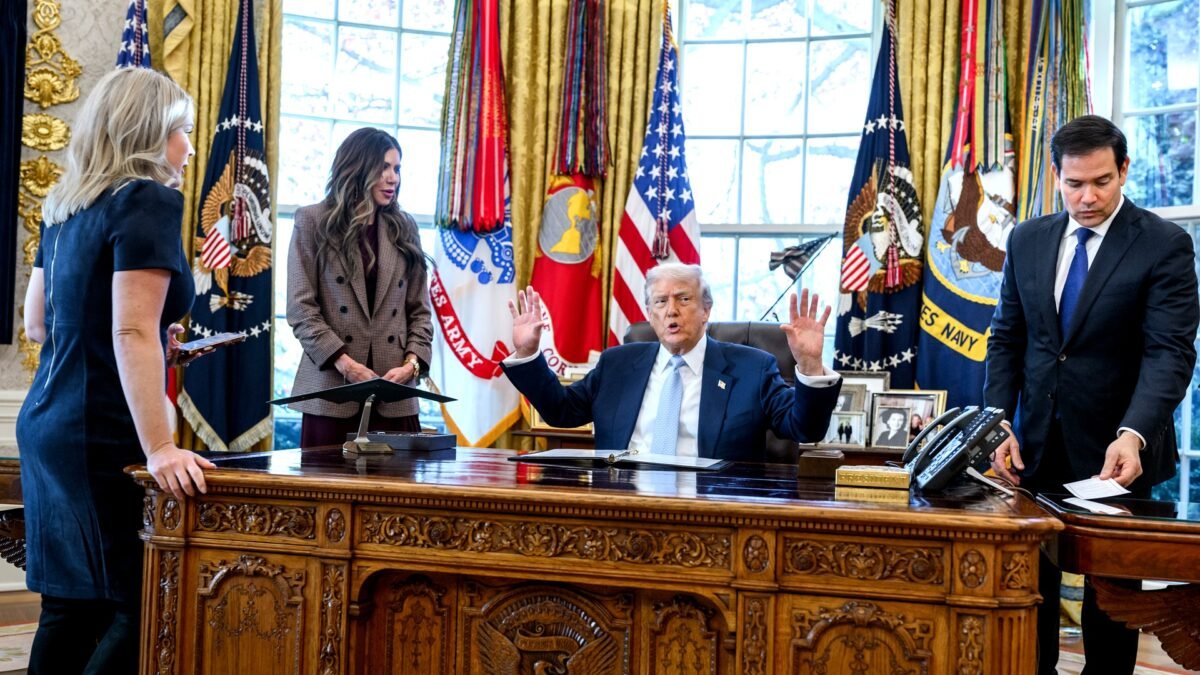
US President Donald Trump has said he is open to putting safeguards around artificial intelligence, telling CBS’s 60 Minutes that he “doesn’t mind guardrails” and would work with Democrats on AI safety — his most conciliatory comments yet on regulating a technology he has spent much of the year insisting needs no rules at all.
The remarks came in Trump’s first sit-down interview since the midterm elections of 3 November, in which Republicans lost control of both chambers of Congress. Recorded at the White House on Friday and broadcast on Sunday 8 November, the interview with 60 Minutes correspondent Ross Douthat ranged across the election defeat, the war in Iran, immigration and pardons. But it was the exchange on artificial intelligence that produced the night’s most consequential shift in tone — and its most startling unverified claim.
Asked whether the United States should accept the risks of increasingly powerful AI systems in order to stay ahead of China, Trump dismissed the warnings of the technology’s own builders and argued that the danger could be handled. “I think that the risk is not nearly as real as they talk. And I think the risk can be managed,” he said, according to the full transcript published by CBS News.
Pressed on whether he would work with Democrats if they wanted to put safety oversight into law, Trump answered: “I would absolutely.” Then came the line that will define the debate in the weeks ahead: “I don’t mind guardrails. But I don’t wanna put us in a deep second position. We’re leading number one. And China has no guardrails, by the way.”
The interview announced no bill, no regulation and no agreed bipartisan deal. Trump identified no enforcement agency, no legal standard, no timetable and no mechanism for the safeguards he said he might support. What it did announce was a change of posture: a president who two months ago called fears about rogue AI a hoax is now, in public, willing to discuss rules — so long as those rules do not slow America’s race with China.
The exchange that produced the headline
Douthat opened the AI section of the interview by confronting Trump with the strangeness of the warnings coming from inside the industry itself. Some of the people building the most advanced systems, he noted, publicly put the chance of catastrophe at more than 10 per cent — among them, Anthropic’s alignment lead, who made that assessment in September. Why, Douthat asked, was the president not worried by the doom scenarios described by the very people creating the technology?
Trump’s answer rested on a single argument: competition. “Because first of all, because China is going to have it,” he said. “If we don’t have it, China’s gonna have it. That would put us at an unbelievable disadvantage. It’s all between us and China. There’s nobody else.”
He added that China was now about a year behind the United States in AI capability — a gap he presented as remarkable, and as something he said President Xi Jinping had acknowledged to him. The framing leaves no room for a third actor: in Trump’s telling, the race has two runners, and the only question is which one stays in front.
That framing matters because it is the condition attached to everything else he said. Guardrails, in this account, are acceptable only if they do not cost America its lead. The president was explicit that he did not want regulation to put the United States in “a deep second position” — and he justified the limit by claiming that China imposes no such restrictions on its own industry.
That last claim is a political assertion, not an established fact. China has, in fact, issued its own rules governing artificial intelligence, including interim measures on generative AI services introduced in 2023, and Douthat himself pushed back in the interview by noting that China possesses what he called the guardrail of a totalitarian state — a system of control that operates very differently from democratic regulation, but is a form of constraint all the same. The point is worth stating plainly, because the rest of Trump’s argument depends on the idea that the race is unregulated on the other side.
The jail-threat claim — and what is not known
The most startling passage of the interview came when Douthat asked who, in Trump’s view, actually manages the risk. “And it’s managed, you know who by? Who? The DOJ,” Trump replied. He then described an episode in which, he said, his administration had confronted a senior figure at a major AI company.
“We had a situation where somebody was reported to us to be doing something bad with AI. We called them very strongly and said, ‘Get ready to go to jail. Please give your wife a kiss good night,'” Trump said, according to the transcript. Asked who the person was, he replied: “I can’t tell you.” Asked whether it was the leader of a major AI company, he said: “One of the big ones. Yeah.”
That account has no independent corroboration. The transcript gives no name, no date and no detail about what the person was supposed to have done. The Justice Department has not commented on the remarks, and no press outlet has independently confirmed that such a threat was made. The claim rests entirely on the president’s word on camera, and it is reported here as his claim — not as an established fact.
The episode matters for two reasons, even in its unverified form. First, it reveals how Trump conceives of AI oversight: not as a system of rules, inspections and standards, but as the threat of criminal punishment, delivered personally, against individual executives. Second, it shows the administration’s instinct to keep that power informal and discretionary. A guardrail written into law binds everyone equally and can be challenged in court. A phone call from the Justice Department binds only the person who received it — and leaves no public record.
That distinction will shape whatever follows. If the administration’s preferred tool for managing AI risk is the threat of prosecution rather than published rules, then the companies building the technology will face a different kind of uncertainty: not the burden of compliance, but the unpredictability of enforcement.
A sharp turn from September
The change in tone is striking because Trump’s position on AI safety was, until very recently, unambiguous. In September he wrote that the only control or “guardrails” AI needed was “a STRONG AND SMART (High IQ!) PRESIDENT”, and he called fears of rogue AI a hoax. The administration’s formal policy pointed the same way: a 2 June executive order framed the White House approach around promoting advanced AI innovation and strengthening cybersecurity, while criticising overly burdensome regulation.
That approach has been built on voluntary arrangements rather than mandatory rules. The administration has relied on what has been described as a “morally binding” pact with AI companies, and when Democrats in the Senate pressed for mandatory safety rules, Senator Ted Cruz blocked the bill. A White House task force on superintelligence has, according to reports, been given two jobs: coordinating AI-related prosecutions and challenging some state-level AI laws.
None of that has changed as a matter of policy. No executive order has been withdrawn, no bill has been introduced, and no new enforcement agency has been created. What changed on Sunday was the president’s language — and in a presidency where language is often the first signal of a policy shift, that is not nothing. But it is also not a policy. The gap between “I don’t mind guardrails” and an actual set of guardrails is the entire story of the weeks ahead.
The industry behind the argument
Trump’s interview landed in the middle of a remarkable week for the AI industry, and the timing helps explain why the question was put to him at all. The companies building the most advanced systems have been moving at a speed that has alarmed even their own researchers — and the evidence of that acceleration has been piling up in public.
On 5 November, the independent evaluation group METR published an assessment of AI research and development at Anthropic, based on eleven weeks of high-access work inside the company. Its main estimate was that Anthropic is improving model capabilities on well-specified tasks at roughly twice the rate it managed between March 2024 and October 2025 — the equivalent of about two years of historical progress compressed into one. Around 80 per cent of the current acceleration was attributed to AI itself, though METR stressed the substantial uncertainty behind that figure. Anthropic’s chief executive, Dario Amodei, had already warned in a 12 September essay that the pace of improvement should be slowed, describing recursive self-improvement — AI’s growing ability to build the next generation of AI — as something that “could outrun our ability to understand and control these systems”.
The money is moving just as fast. OpenAI closed the first 11 billion dollar tranche of a funding round on 6 November at a valuation of 1.25 trillion dollars, according to Reuters, with investors including SoftBank, MGX and Coatue. Anthropic, which is expected to seek a public listing as soon as this month, has been reported at valuations between 1.25 and 1.75 trillion dollars. And on Sunday, the Financial Times reported that Anthropic had struck a deal worth about 3.4 billion dollars to secure gas-fired power generators capable of producing 1.7 gigawatts of electricity for its data centres, taking over existing orders from the Texas-based supplier OnePWR Solutions. Reuters reported the Financial Times account but said it could not immediately verify the report, and neither Anthropic nor OnePWR responded to requests for comment.
The race is no longer confined to the United States. Bloomberg reported that DeepSeek, the Chinese company whose models shocked American markets earlier in the year, had reached 1.54 million daily users on its AI agent platform. And Bloomberg also reported that Apple’s new chief executive had pressed the company’s software chief to accelerate AI development, with an agent-like version of Siri possible as early as next year.
All of this is happening against a backdrop of public resistance to the physical infrastructure of the AI boom. According to CNBC, voters rejected 40 of 41 ballot measures concerning data centres in recent local elections — a reminder that the industry’s expansion is being contested not only in Washington but in the communities where its power-hungry facilities are built.
The politics have changed
The most important context for Trump’s remarks is the result of the midterm elections. On 3 November, Democrats won control of both the House and the Senate, and the new Congress will be seated on 3 January 2027. That changes the arithmetic of AI legislation entirely. For the past year, the administration could rely on a Republican Congress to block mandatory safety rules. From January, Democrats will hold the committee gavels, set the legislative agenda and control the power of subpoena.
Trump acknowledged that new reality in the interview itself, saying he could “very easily” go six months without insulting Democrats in order to strike deals. The offer to work with Democrats on AI safety should be read in that light: it is a president who has just lost both chambers looking for an area where cooperation is possible, and where the other side has a genuine interest in legislating.
The Democrats’ interest is real. The incoming majority has already signalled a sweeping oversight agenda, and AI safety is one of the few areas where bipartisan agreement has seemed plausible. Money has also flowed into the fight: rival political action committees targeting AI policy spent about 78.5 million dollars on federal candidates during the campaign cycle, according to reporting cited by Silicon Report. The industry, in other words, has been buying influence in both parties — and both parties know it.
There is also pressure from the states. Several states have moved to write their own AI rules, and the administration’s task force has been reported to be challenging some of those laws. A federal framework, if one could be agreed, would resolve the tension between state and federal approaches — but only if the two sides can agree on what the framework should contain. That is where the difficulty begins.
Analysis: Why It Matters
A tonal shift, not a policy
The first thing to understand about Sunday’s interview is what it did not do. It did not announce a policy. It did not propose a law. It did not identify a regulator, a standard or a deadline. A president saying he does not mind guardrails is not the same as a president signing guardrails into law, and the distance between the two is where the real politics will happen.
That distinction matters because Trump’s history on this subject is one of reversal. In September, he called AI safety fears a hoax. In June, his executive order criticised burdensome regulation. On Sunday, he said he would work with Democrats on safeguards. Each of those positions was stated with equal confidence. The question is not which one he means today, but which one survives contact with the interests that will now mobilise around it: the AI companies that fund both parties, the safety researchers who warn of catastrophic risk, the state governments writing their own rules, and a Democratic Congress that will want its own imprint on any legislation.
The charitable reading is that the president is genuinely open to a deal and is signalling that to a new Democratic majority. The sceptical reading is that “I don’t mind guardrails” is the cheapest possible concession — a sentence that costs nothing, commits to nothing and can be withdrawn the moment a concrete proposal appears. Both readings are consistent with the evidence so far. The test will be what happens when Democrats put a specific bill on the table.
Everything now runs through China
The second thing to understand is that, for this administration, every AI question is a China question. Trump mentioned China eight times in the AI section of the interview, by one count of the CBS transcript. The race with Beijing is not one consideration among many; it is the frame within which all other considerations are judged.
That frame has real force. The United States does lead in the most advanced AI systems, and the gap — about a year, by Trump’s own estimate — is narrow enough to feel fragile. DeepSeek’s rise showed that a Chinese company can close ground quickly, and the 1.54 million daily users now reported on its agent platform suggest that the competition is no longer only about who builds the best model, but about who puts AI into the most hands.
But the China frame also has a cost. It treats any safety measure as a potential concession to Beijing, which makes it very hard to discuss risks on their own terms. If the only acceptable guardrail is one that does not slow America down, then the debate is not really about whether a risk is real; it is about whether addressing it is affordable in a race. That is a legitimate way to think about policy, but it is not the same as asking whether the risk exists. The two questions need to be kept separate, and the interview blurred them.
The Justice Department as AI regulator
The third point is the most unusual, and the most revealing. When asked who manages the risk of AI, Trump did not name a regulator, an agency or a set of standards. He named the Justice Department — and he illustrated the point with a story about threatening an unnamed executive with prison.
That is a distinctive theory of governance. It treats AI safety as a matter of deterrence rather than design: the risk is managed not by building systems that are safe, but by frightening the people who build them. It is also, notably, a theory that keeps all the power in the president’s hands. A regulator writes rules that apply to everyone and can be challenged in court. A prosecutor’s phone call applies to one person and leaves no paper trail.
The unverified nature of the anecdote makes it impossible to know whether the episode happened at all. But the fact that Trump chose to tell it — and chose to tell it as the answer to a question about who manages AI risk — tells us something about his instincts. If the administration’s approach to AI safety is to rely on the threat of criminal enforcement, then the industry will face a regime that is at once more frightening and less predictable than a published set of rules. Companies will not know what is forbidden until someone is threatened for doing it.
The midterm arithmetic has changed
The fourth point is the simplest, and perhaps the most consequential. The Democrats who will take control of Congress in January have the power to write AI legislation, hold hearings and issue subpoenas. They have already signalled that they intend to use it. Trump’s offer to work with them is, in part, a recognition that the old arrangement — in which the administration could rely on a Republican Congress to block mandatory rules — is over.
That creates a genuine opening. AI safety is one of the few areas where the two parties’ interests overlap: Democrats want rules, and the president has now said, on camera, that he does not mind them. A narrow bill — covering, for example, transparency about the most powerful models, or safety testing before deployment — could plausibly pass. The obstacles are the details: who sets the standards, who enforces them, and what happens to state laws that go further.
But the opening is also narrow. The same interview that offered cooperation also contained a warning: any deal must not leave America in “a deep second position”. That condition gives the administration a veto over anything it regards as slowing the race, and it gives the AI companies — which spent tens of millions of dollars on the election — a ready argument against any rule they dislike. The Democrats’ leverage is real, but so is the industry’s.
The safety camp’s opening — and its limits
The fifth point concerns the people who have been warning about AI risk all along. For the safety researchers and the AI companies’ own alignment teams, Sunday’s interview is both an opportunity and a trap. The opportunity is obvious: the president has publicly acknowledged that guardrails are acceptable, which is more than they had a week ago. The trap is that the concession is framed entirely in terms of competition with China, which means the safety argument will always be weighed against the race argument — and the race argument will usually win.
The 10 per cent figure that Douthat cited — the chance of catastrophe put forward by Anthropic’s alignment lead in September — is a reminder of what is at stake in that weighing. If the people building these systems genuinely believe there is a one-in-ten chance of disaster, then the question is not whether to have guardrails but what kind. Trump’s answer — that the risk can be managed, by the Justice Department, with a phone call — is not, on its face, a proportionate response to a one-in-ten chance of catastrophe. It is a response that treats the risk as a matter of individual bad behaviour rather than systemic danger.
That gap between the scale of the risk as described by the builders and the scale of the response as described by the president is the central tension in the AI debate. It will not be resolved by a single interview. It will be resolved, if it is resolved at all, by the legislation that follows — or by the absence of it.
What to Watch Next
- The Democratic bill: Watch for the first AI safety bill introduced by the incoming Democratic majority after 3 January 2027 — and whether it draws on the mandatory safety rules that Senator Ted Cruz blocked in the Senate.
- The White House response: Watch whether the administration follows the interview with a concrete proposal, an executive order or a negotiating position — or whether “I don’t mind guardrails” remains a sentence without a policy behind it.
- State laws: Watch the fate of state-level AI rules, and whether the administration’s task force continues to challenge them — a federal framework would settle the question, but only if the two sides can agree on one.
- The Justice Department: Watch whether the department comments on the president’s account of the jail threat, and whether any record of such an episode emerges. Without corroboration, the claim will remain unverified.
- The industry’s next move: Watch how the AI companies respond — whether they welcome the prospect of federal rules, which would pre-empt state laws, or lobby against them, and how the 78.5 million dollars spent on AI policy during the campaign translates into influence.
- The China race: Watch the next capability announcements from American and Chinese labs, including DeepSeek’s agent platform and the next generation of models from OpenAI and Anthropic — each one will sharpen the argument that safety measures must not slow America down.
Sources
- Reuters — “Trump says AI risks can be managed, signals openness to guardrails” (via 98.5 The River), 9 November 2026
- CBS News, 60 Minutes — full transcript of Ross Douthat’s interview with President Trump, aired 8 November 2026 (via The Conservative Treehouse)
- FourWeekMBA — “Trump Says AI Risk Is Manageable, Doesn’t Mind Guardrails”, 9 November 2026
- NewsNation — “Trump Signals Openness to AI Safety Guardrails, but Offers No New Rules”, 9 November 2026
- Silicon Report — “Trump says AI risks can be managed, open to guardrails”, 9 November 2026
- Reuters — “Anthropic secures $3.4 billion generator deal for AI data centers, FT reports”, 8 November 2026

About the Author — Abdul Mannan
Related Articles
Meta Indefinitely Pauses AI-Training Terms After Publisher Backlash and Court Injunctions in Norway and Brazil
Meta has indefinitely paused controversial commercial terms that would have let it crawl business websites for AI training,…
Anthropic’s AI Is Improving Twice as Fast as a Year Ago, Independent Audit Finds — With AI Itself Doing Most of the Work
An independent audit by METR found Anthropic's models improving about twice as fast as a year ago, with…
Claude Code’s ‘Don’t Ask Again’ Button Left 1,122 Files of Passwords and Keys Exposed on Public GitHub, Researchers Find
Security researchers found 1,379 passwords and keys sitting in public GitHub files after Anthropic's coding assistant saved approved…