
Dana White Declines Trump’s Offer to Become White House Press Secretary, Source Says

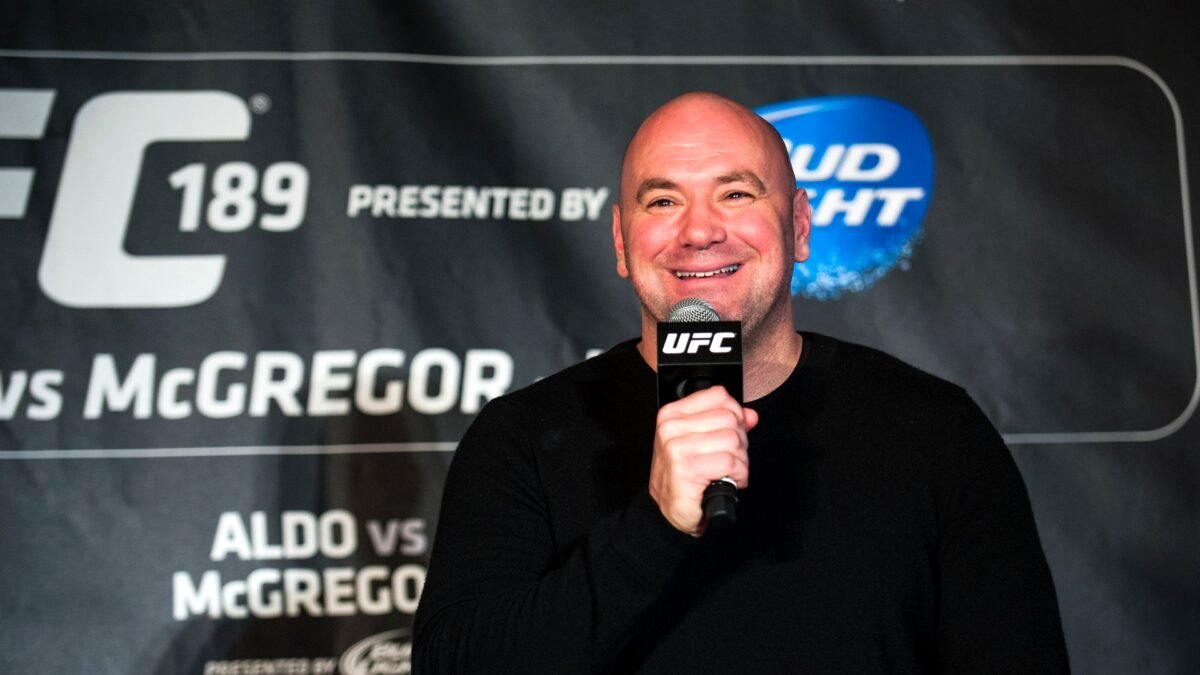
President Donald Trump offered the job of White House press secretary to Dana White, the chief executive of the Ultimate Fighting Championship, in a public social media post on Saturday — and within hours, a source familiar with the matter said White had turned the offer down, according to CNN.
Trump announced the offer on his Truth Social account on Saturday afternoon, describing White as a “violent Fighter and Warrior” and urging him to accept. “I am pleased to announce that the Great Dana White, a violent Fighter and Warrior, has been offered the job of Press Secretary of the United States,” Trump wrote. “We need these people to defend us against the Lunatic Left. Dana will be a Press Secretary like none other. Dana, please take the job!”
White, 57, has not commented publicly on the offer. He did, however, post a photograph of himself standing behind the lectern in the White House briefing room on his Instagram account, captioned “On to the next chapter”, shortly after Trump’s message appeared — a post that left it unclear whether he was accepting, joking along, or simply enjoying the moment. According to CNN, a source familiar with the matter said White declined the role, while one aide told reporters that Trump had been joking about the offer. The White House and the UFC have not formally commented, and CNN said it had reached out to both for comment.
The episode, whether serious or theatrical, has left one of the most visible jobs in American government still vacant — and it has arrived at a moment of unusual turbulence inside the Trump White House, just four days after voters handed Democrats control of both chambers of Congress in the midterm elections.
The offer — and the fighters Trump wanted with it
Trump’s post did not stop at White himself. The president said he had asked White to bring a team of mixed martial arts fighters with him as assistants, naming six of the sport’s biggest stars: Islam Makhachev, Khabib Nurmagomedov, Justin Gaethje, Daniel Cormier, Amanda Nunes and Kayla Harrison. “I have requested that he bring with him assistants, even though some are not from our Country,” Trump wrote, according to The Times.
Two of the fighters Trump named are Russian — Makhachev and Nurmagomedov — and one, Nunes, is Brazilian, according to AFP. The idea of foreign nationals serving as aides inside the White House communications operation immediately raised questions about vetting and security clearances, although no formal appointments were ever made and the proposal never advanced beyond the president’s post.
White House communications director Steven Cheung amplified the message on Saturday, reposting Trump’s announcement and adding: “Hell yeah! Do it, @DanaWhite!” — a response that, according to CNN, suggested at least some senior staff were treating the idea as a live possibility rather than a joke.
The post was published at 1:40 p.m. Eastern Time on Saturday, according to a timeline compiled by US Brief, and it spread rapidly across social media and news outlets. Within hours, the focus had shifted from whether Trump was serious to whether White would say yes — and then, just as quickly, to reports that he had already said no.
A podium that has been empty for three weeks
The press secretary’s job has been vacant since 16 October, when Katie Zacharia was pushed out after less than a week in the role, according to AFP and CNN. Zacharia began work on 12 October and was gone by 16 October after a single briefing, making her tenure the shortest of any White House press secretary in history, according to CNN. Trump had announced her selection on 9 October to succeed Karoline Leavitt.
Leavitt, who served as press secretary for a year and a half, left the role in August, saying she wanted to spend more time with her young family, according to CNN. She has since joined Fox News as a contributor. Her departure left Trump without the daily on-camera voice of his administration, and the search for a successor has now stretched past three weeks.
Asked on 23 October about finding another press secretary, Trump told reporters: “No, nothing much. We’re in no rush,” according to Fox News. That patience, if it ever existed, appears to have worn thin. The president told CBS News on Friday: “I’ll be doing maybe a few changes,” according to CNN — and the weekend brought two of them in quick succession.
If White had accepted, he would have become the seventh press secretary of Trump’s two terms, following Sean Spicer, Sarah Huckabee Sanders, Stephanie Grisham, Kayleigh McEnany, Leavitt and Zacharia. The job is one of the most exposed in Washington: the press secretary faces the White House press corps on camera, often daily, defending the president’s decisions in real time and under hostile questioning. It requires no Senate confirmation, which means a president can fill it with a social media post and a yes — but it also means the appointee’s every word becomes the administration’s official position within minutes.
A White House in the middle of a reshuffle
The Dana White offer came one day after Trump announced a far more consequential personnel change: the replacement of his chief of staff. On Friday, Trump said Susie Wiles, his longtime chief of staff, would leave the role and be replaced by Stephen Miller, the deputy chief of staff and one of his most hardline advisers. Miller takes over the job on Monday, according to CNN, and Trump has described him as “a great fighter”.
Several senior Department of Justice officials have also resigned in the wake of the midterm elections, according to The Times, including Harmeet Dhillon, who led the department’s civil rights division, and John Eisenberg, who led the national security division. The departures, taken together, point to a White House that is being rebuilt for confrontation rather than consolidation.
The context is the result of Tuesday’s midterm elections, in which Democrats handed Trump’s Republicans a heavy defeat and won control of both the House of Representatives and the Senate. The new Democratic majorities take their seats in January, and party leaders have promised robust investigations of the president and his senior officials.
According to AFP, the likely lines of inquiry include the Trump family’s business and cryptocurrency dealings, government contracts involving the billionaire Elon Musk, cuts to federal agencies, immigration enforcement, the conduct of the war with Iran, and the handling of files related to the notorious sex offender Jeffrey Epstein. Robert Garcia, the incoming chairman of the House Oversight Committee, wrote “Lawyer up” on X as the election results became clear, according to AFP.
Trump, however, has shown no sign of being chastened. On Saturday he ordered the Justice Department to investigate Democrats for what he called “extortion at the highest level” and called for prison terms, according to AFP. “The Democrats are going around threatening a lot of people,” Trump wrote, adding that he was ordering the Justice Department to “look into this criminal act”. He said that “imprisonment should be against these EXTORTIONISTS.”
The combative tone is familiar. After a smaller midterm defeat in 2018, Trump said his White House would assume “a war-like posture” against any investigations, according to AFP. He was subsequently impeached in 2019 and again in 2021. A third impeachment is possible in the new Congress, AFP reported, although Democratic Party leaders have not promised one — and removing a president requires a two-thirds vote in the Senate, far beyond the Democrats’ majority.
Trump and White: an old alliance
Dana White is not a random name from the world of sport. He is one of Trump’s oldest and most visible allies, and the two men have been friends for years. White appeared alongside Trump for his victory speech when he won re-election in November 2024, according to AFP, and he has spoken at the last three Republican National Conventions, according to CNN.
White has led the UFC since 2001, building it from a fringe spectacle into the largest and most successful mixed martial arts organisation in the world, according to AFP. Under his leadership the UFC became a global commercial force, and White himself became one of the most recognisable executives in American sport — blunt, combative and famously loyal to his allies.
That loyalty has been politically valuable. White helped the Republican Party make inroads with young male voters, a demographic that was central to Trump’s return to the White House, according to CNN. Trump himself has acknowledged the debt. “He introduced me to people I never heard of, young kids,” Trump said of White earlier this year, according to CNN. “I mean, I was being interviewed by 20-year-old kids. I’m saying, ‘Where the hell did you meet these people?’ They’re called influencers.”
The alliance has been on public display throughout the year. In June 2026, the UFC staged a fight on the White House South Lawn as part of the nation’s 250th anniversary celebrations, according to CNN and The Wrap. Trump has also attended UFC bouts in Miami, New York and New Jersey since winning his second term, according to AFP, and he has repeatedly tried to associate his political brand with the UFC’s popularity.
Yet the political value of that alliance has been tested in recent months. According to CNN, young men have begun slipping away from Trump, who has faced mounting criticism from some of the figures — such as the podcaster Joe Rogan — who helped introduce him to new audiences in 2024. Those efforts, CNN reported, did not pay off in the midterms, as the demographic shifted toward Democrats on Tuesday, helping the party win majorities in both chambers of Congress.
White himself has been cautious about formal politics. After the 2024 election, he told The New Yorker that he would never work on a presidential campaign again, according to Fox News. That statement, made two years ago, does not settle the question of whether he would take a White House job — but it does suggest that the man Trump publicly courted on Saturday has long been reluctant to trade the autonomy of running the UFC for a role inside a presidential administration.
Analysis: Why It Matters
A vacancy that has become a symbol
The press secretary’s podium has now been empty for more than three weeks, and the Dana White episode has turned a staffing gap into a story about how this White House governs. The press secretary is the administration’s daily voice — the person who stands before the cameras and explains, defends and occasionally concedes. Leaving the role unfilled for weeks is unusual for any presidency. Filling it, even hypothetically, with a cage-fighting promoter and a team of fighters sends a message about what the president values in that voice: loyalty, combativeness and showmanship over the traditional credentials of the briefing room.
That message may be deliberate. Trump has always treated the press secretary’s job as a performance as much as a function, and his most successful press secretaries have been those who understood the assignment as a daily televised contest. The question is whether a performance built for campaign rallies and pay-per-view audiences can survive the briefing room, where the questions are adversarial, the facts are checked in real time and the audience includes the reporters who will write the first draft of the administration’s history. White’s reported refusal may have spared both men that test — but the vacancy remains, and the longer it lasts, the more it looks like a choice rather than an accident.
Loyalty over experience — the Miller pattern
The White offer cannot be understood in isolation from the Miller appointment the day before. Together, the two moves sketch a clear pattern: as Trump’s final two years approach, and with a hostile Congress about to take its seats, he is surrounding himself with the people he trusts most, whatever their formal qualifications for the jobs in question. Miller, a hardline immigration adviser with no experience running a White House staff, is now chief of staff. White, a sports promoter with no experience in government communications, was offered the briefing room.
There is a logic to this. A president facing investigations, subpoenas and public hearings wants aides who will not hedge, leak or distance themselves when the pressure rises. Loyalty is a real asset in that environment, and Trump has always prized it above expertise. But loyalty has limits as a management strategy. The chief of staff must coordinate a government; the press secretary must command the facts of a dozen policy areas at a moment’s notice. A team chosen for combat may discover that the hardest fights in the next two years are not rhetorical but procedural — and that the people best equipped to win them are the ones who know how the system works.
The joke that was not only a joke
One of the most revealing details of the weekend is the disagreement over whether Trump was even serious. One aide told reporters that the president was joking. The White House communications director publicly cheered the idea on. Trump’s own post, with its capital letters and exclamation marks, reads as a performance — but it was published on the president’s official account, named a specific job, and listed specific appointees.
This ambiguity is not new. Trump has often used humour as a way of floating ideas that would be controversial if presented formally: the joke allows the proposal to be tested in public while preserving a retreat if it is rejected. The cost of that technique is that nobody — not the press, not the public, and sometimes not the president’s own staff — can be certain what is real. In this case the ambiguity may have served a purpose beyond the press secretary search: it dominated a news cycle that might otherwise have been filled with the midterm defeat, the Miller appointment and the Justice Department resignations. Whether that was the plan or a coincidence, the result was the same — a Saturday spent talking about Dana White rather than about a Democratic Congress.
Fighters in the briefing room: a vetting problem
The most concrete problem with Trump’s proposal was not its tone but its personnel. Bringing six mixed martial arts fighters into the White House as communications aides would have raised immediate questions about security clearances, conflicts of interest and the basic qualification of advising a president on matters of war, trade and public health. Two of the named fighters are Russian citizens, and one is Brazilian. None of them has held a government position. All of them have commercial interests tied to the UFC, a company White himself runs.
None of this means the idea was ever going to happen — and the fact that it was presented as a social media post rather than a formal nomination suggests it was never subjected to the vetting that a real appointment would require. But the episode illustrates a broader risk for the administration: when staffing ideas are announced before they are vetted, the White House ends up defending proposals that its own personnel system would never have approved. The press secretary’s office is not a ceremonial post. It is the place where the government’s words become its record, and the people who stand behind that lectern need to be able to answer for them.
What the refusal tells us about Trump’s second-term staffing
Perhaps the most significant fact of the weekend is the one that has received the least attention: White said no. A source familiar with the matter told CNN that he declined the offer, and his own history suggests the refusal was not a surprise. White told The New Yorker in 2024 that he would never work on a campaign again. He runs a global sports empire. A job that requires standing at a lectern and absorbing daily criticism on behalf of someone else’s decisions is, for a man in his position, a poor trade.
That refusal matters because it reveals the limits of Trump’s personal appeal as a recruiting tool. In his first term, the prestige of the White House was enough to attract ambitious outsiders. In his second, after the midterm defeat and with a Democratic Congress preparing investigations, the calculation has changed. The people Trump wants most — loyal, high-profile, independently successful — are also the people with the most to lose by joining an administration that is about to spend two years under subpoena. The press secretary vacancy may therefore be harder to fill than the president expected, not because the job is unattractive, but because the moment is.
What to Watch Next
- Who gets the job: The press secretary’s podium has been empty since 16 October. The next name Trump floats — and whether it is a career communicator or another celebrity ally — will say a great deal about how he intends to handle the next two years.
- White’s own words: White has not commented publicly beyond his Instagram post. Any statement from him, or from the UFC, about why he declined would clarify whether the refusal was about the job, the timing, or the politics.
- Miller’s first week: Stephen Miller takes over as chief of staff on Monday. His first days will show whether the reshuffle is a change of personnel or a change of strategy — and whether more departures follow.
- The Democratic investigations: The new Democratic majorities take control of the House and Senate in January. The first subpoenas and hearing schedules will set the terms of the confrontation Trump is preparing for — and will test whether his “war-like posture” is a strategy or a slogan.
- The Justice Department orders: Trump’s instruction to investigate Democrats for “extortion” will be watched closely by legal experts and by Congress. Whether the department acts, and how, will be one of the first tests of the post-midterm balance of power.
Sources
- CNN — UFC CEO Dana White declines Trump’s offer to become press secretary, source says
- AFP — Trump taps UFC boss as press secretary, urges criminal probes into Democrats
- The Times — Trump offers UFC chief Dana White press secretary job
- Truth Social — President Donald Trump’s post offering the press secretary role to Dana White, 7 November 2026
- Fox News — Trump says he offered UFC CEO Dana White press secretary job
- theScore — Report: Dana White declines Trump’s offer to be White House press secretary

About the Author — Abdul Mannan
Related Articles
Armed Man Arrested Near White House After Telling Secret Service He Came to Kill Trump
Secret Service officers arrested Ronny Yordrix Guanipa Chrinos near the White House on Thursday after finding three firearms…

US Treasury Cuts Crypto Exchange MEXC Off From the American Financial System Over $16 Billion in Alleged Illicit Flows
FinCEN has ordered American banks to stop moving money for MEXC Global, accusing the exchange of channelling at…
Judge Blocks Trump’s 250-Foot Triumphal Arch Within an Hour of Final Approval as President Declares Oval Office a National Monument
A federal judge halted construction of President Trump's 250-foot triumphal arch within an hour of its final approval,…