
Trump Rallies Supporters in Highland Heights, Backing Barr and Gallrein Ahead of Nov. 3 Midterms

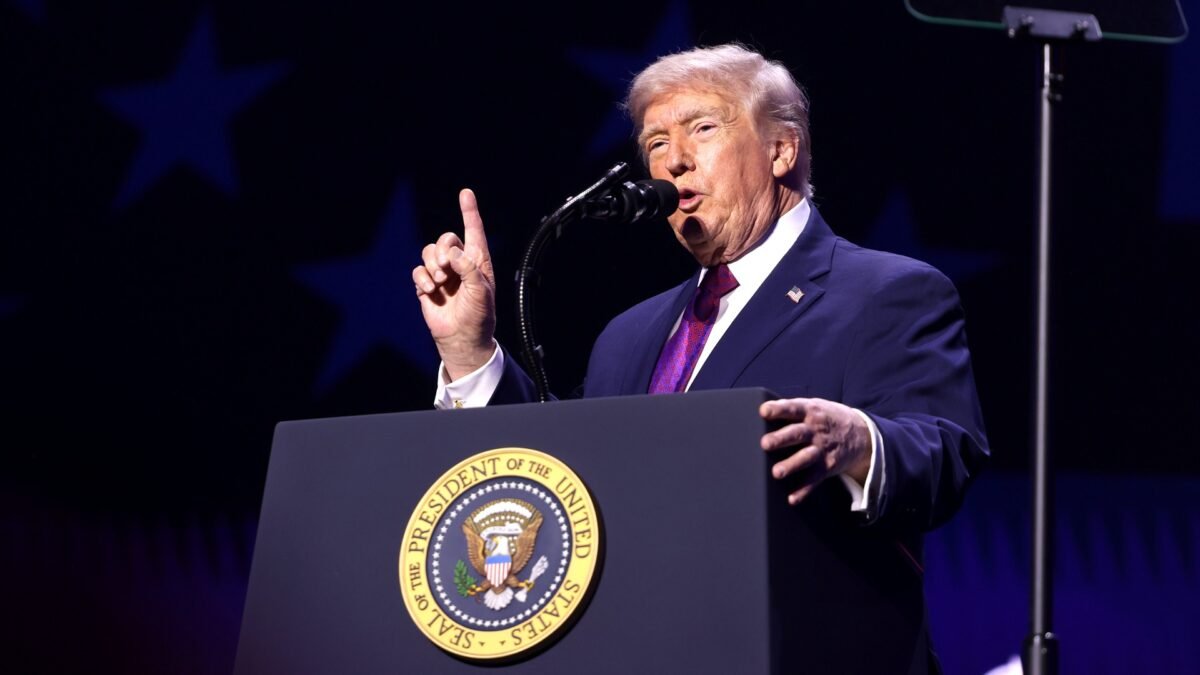
HIGHLAND HEIGHTS, Ky. — President Donald Trump brought his midterm-election “blitz” to Northern Kentucky on Saturday, October 17, 2026, addressing a crowd at Truist Arena on the Northern Kentucky University campus as Republicans fought to hold their narrow congressional majorities ahead of the November 3 vote, according to the Louisville Courier-Journal.
Doors opened at 10 a.m. ET, and Trump took the stage around 2 p.m., according to live reporting from the Cincinnati Enquirer. By 12:30 p.m., about 1,500 supporters were inside the arena, the Enquirer reported, braving a cold fall day with a high near 54 degrees and a morning low of 31 degrees.
The stop was Trump’s second visit to Kentucky this year, following a March 11 rally in Hebron, and his second appearance near Cincinnati this month after an October 3 rally at Butler High School in Vandalia, Ohio, according to the Courier-Journal. The Kentucky appearance was part of a multi-state tour the president is conducting in the campaign’s closing weeks.
The timing underscored the stakes as Republicans defend a 53-47 majority in the U.S. Senate and a slim 218-214 margin in the House of Representatives, figures cited by the New York Post in its coverage of the rally.
Before Trump spoke, the crowd heard from several Republican candidates positioned on the ballot’s upper tiers. U.S. Rep. Andy Barr, the GOP nominee for the Senate seat being vacated by retiring Sen. Mitch McConnell, addressed the audience as the heavy favorite against Democratic nominee Charles Booker, according to the Courier-Journal.
Barr’s candidacy carries the weight of a political era ending: McConnell’s retirement opens a seat he held for decades, and Barr won the GOP nomination with a boost from Trump’s endorsement just before the primary, the Courier-Journal reported. The Senate race is considered a likely Republican hold, but it marks the first time in a generation Kentucky has chosen a new senator without McConnell on the ballot.
Ed Gallrein, a former Navy SEAL and the Republican nominee in Kentucky’s 4th Congressional District, also spoke. Gallrein won the May primary by about 10 points over incumbent Rep. Thomas Massie after Trump threw his support behind the challenger, according to the Courier-Journal. Gallrein is a heavy favorite in the general election in the heavily Republican district.
Gallrein told the crowd that October 17 marked exactly one year since Trump met with him to encourage him to challenge Massie, the Courier-Journal reported. He described Election Day as a “no-fail mission” and framed the election as “the Communist Manifesto versus the Constitution,” while railing against what he called “lawlessness, open borders and Sharia law.”
Eric Conway, the Republican nominee in Ohio’s 1st Congressional District, addressed the crowd as well. Conway faces Democratic incumbent Rep. Greg Landsman in a race the Cook Political Report rates as “Likely Democratic,” according to the Courier-Journal. The rally’s location — just across the Ohio River from Cincinnati — put Conway’s battleground contest within reach of the day’s messaging.
Notably absent from the stage was Dr. Ralph Alvarado, the GOP nominee in Kentucky’s 6th Congressional District. Alvarado was campaigning in Montgomery County against Democratic nominee Zach Dembo, a former federal prosecutor backed by Gov. Andy Beshear, according to the Courier-Journal. The 6th District contest has tightened: both the Cook Political Report and the University of Virginia Center for Politics now rate it as “Leans Republican.”
In his remarks, Barr blamed Iran for higher gasoline prices, a reference to the war in Iran that began with U.S. military strikes in February 2026, according to the Courier-Journal. He also argued that former President John F. Kennedy would be “thrown out of the Democratic Party” today for not supporting socialist policies, the Courier-Journal reported — part of a broader Kentucky Republican effort to brand Democratic candidates as socialists.
Trump himself used the speech to revive one of his signature claims, telling the crowd that Mexico had effectively paid for border wall construction through trade penalties. “Mexico did pay. They pay massive tariffs, greater than the cost of the wall, and I like it that way,” Trump said, according to the Courier-Journal. The current tariff rate on Mexican goods stands at 25 percent.
That assertion was met with a factual counterpoint reported by the Courier-Journal citing Time magazine: during Trump’s first term, 458 miles of wall were built, most of it replacing existing barriers, with only 87 miles representing new construction where no wall had stood before.
A protester was removed from the arena as Trump began speaking. Trump responded with a taunt — “Take him back home to mom. Back to mom” — as the crowd booed, according to the Enquirer. Trump then claimed, without evidence, that protesters at his events were paid $250 to be there, the Enquirer reported.
Small groups of demonstrators also gathered outside the arena. At one point roughly a dozen protesters were visible, with about two dozen focused on gasoline prices, inflation and jobs, according to the Enquirer. NKU students had protested the rally on Friday, angry both about the visit and what they described as a lack of notification, according to the university’s student newspaper, The Northerner.
The crowd’s character reflected the atmosphere of a Trump rally at full theatrical tilt. Supporters wore “Bikers for Trump” vests and red visor wigs, and one man came dressed as “the wall,” the Enquirer reported. But not every attendee was a straight-party Republican: Dave Cope, a member of the Kentucky Bikers Association attending his third Trump rally, told the Enquirer he planned to vote for libertarian Jeremy Todd for Congress instead of Gallrein, saying he disliked that Trump had backed Gallrein over Massie.
The rally came as Trump’s standing in national polling touched new lows. His approval rating sat at 36 percent, a record low cited in the Enquirer’s reporting, while a Reuters/Ipsos survey measured it at 32 percent, a career low.
Democratic Gov. Andy Beshear, frequently mentioned as a possible 2028 presidential contender, offered a pointed response to the president’s Kentucky stop. Beshear said Trump campaigning in a state he won handily was “a troubling sign,” adding that “Republicans are in big trouble,” according to the Enquirer.
The New York Post noted the rally’s Ohio dimension: staged just across the river from a genuine battleground state, the event offered television-market exposure for Ohio Republicans. Former Sen. Sherrod Brown, a Democrat, is attempting to reclaim a Senate seat from Sen. Jon Husted, a Republican appointed to the post after Vice President JD Vance vacated it. Meanwhile, the Ohio governor’s race between Republican Vivek Ramaswamy and Democrat Dr. Amy Acton is considered competitive, the Post reported.
Kentucky itself is not considered a battleground in these midterms. The Senate seat and the 4th District are both rated “solid Republican” by the Cook Political Report. The 4th District spans 21 counties and is described as the state’s richest district, with a libertarian streak inherited in part from Massie’s brand of politics, yet reliably conservative since the 1960s, according to the Courier-Journal.
Logistics for the day reflected the scale of a presidential visit to a college campus: road and traffic closures were in place around NKU, and drivers faced I-75 construction in Cincinnati, the Enquirer reported. No rain fell on the cold October day.
Analysis: Why It Matters
The first question any strategist would ask about this rally is the obvious one: why is a president whose party holds both chambers spending a Saturday afternoon in a state his ticket already won comfortably, rather than in a district where the House majority will actually be decided? The answer says a great deal about how both parties now understand midterm combat. Trump does not travel to persuade undecided voters; he travels to manufacture turnout, dominate the news cycle, and project momentum. Highland Heights sits in the Cincinnati media market, which means the rally’s images and sound bites were broadcast directly into the Ohio battleground next door — a more efficient use of a Saturday than a stop in a genuinely competitive district that might have delivered a hostile reception.
The second reason this rally matters is that it was, in effect, a transfer ceremony for Kentucky Republican power. The Barr-versus-Booker Senate contest is the first Kentucky Senate election of the post-McConnell era, and the entire Highland Heights stage was arranged to signal what comes next: Trump’s endorsement is now the single most valuable currency in a Kentucky Republican primary, more decisive than seniority, incumbency, or libertarian credibility. Barr received that endorsement just before the primary and rode it to the nomination; Gallrein received it and ousted a sitting congressman by roughly ten points. For a state that defined establishment Republicanism for four decades, the message from Truist Arena was that the establishment has been formally retired along with McConnell.
Gallrein’s victory over Thomas Massie deserves closer attention than the final margin suggests, because it represents the clearest recent test of party loyalty against ideological pedigree. Kentucky’s 4th District is Massie’s political home — the district where his brand of libertarian-leaning conservatism was built and exported nationally. That Trump could install Gallrein there, in the heart of liberty-country Kentucky, demonstrates that the modern Republican primary electorate treats loyalty to Trump as the defining qualification, and treats even a well-known conservative record as secondary. The dissenting note from Dave Cope — a three-time rally attendee who will vote Libertarian because he resents the Massie ouster — shows the purge was not costless. The question for November is whether a bruised libertarian remnant stays home, votes third party, or falls in line, because in a midterm with a 218-214 House majority, even small turnout effects in safe seats add up nationally.
The economic subplot of the rally may prove more important than any endorsement. Trump’s claim that Mexico paid for the border wall through tariffs sits in obvious tension with the concerns of the protesters outside the arena, who were focused on gasoline prices, inflation and jobs, and with the Enquirer’s citation of record-low approval ratings. Barr’s decision to blame Iran for higher gas prices connects the administration’s February military strikes to the pain voters feel at the pump — an admission, in a sense, that foreign policy choices have domestic price tags. This is the central vulnerability of the Republican midterm case: tariffs can be framed as Mexico “paying,” but voters experience them, and inflation more broadly, as costs they pay themselves. Rallies energize the base; they do not lower prices.
The rally also previewed the geography of the final two weeks. Everything about the speaker lineup — Conway from Ohio’s 1st, the Ohio governor and Senate races looming across the river, the tightening KY-6 race between Alvarado and Dembo that kept Alvarado off the stage — suggests the real fights are adjacent to where Trump stood, not where he stood. KY-6’s shift to “Leans Republican” in two separate ratings is the kind of late movement that can foreshadow a wave or confirm a stalemate. Watch whether Trump returns to the region in the closing days, and for whom: a return trip for Conway or Alvarado would signal genuine Republican anxiety, while more safe-state rallies would signal a turnout-maximization strategy.
Finally, there is the matter of what a rally like this cannot do. With approval at 36 percent in one cited survey and 32 percent in another, Trump is campaigning for candidates who need his base but may not want his brand attached too closely in competitive races. Conway, running in a “Likely Democratic” district, appeared on the Highland Heights stage; Landsman, his opponent, will almost certainly use that footage. The rally was a show of strength staged for the cameras, the base, and the Ohio media market — but midterms are decided by voters who do not attend rallies, in places where the outcome is genuinely in doubt. The next two weeks will reveal whether Saturday’s energy was a leading indicator or a well-lit detour.
What to Watch Next
- Early-voting and turnout data in Ohio and Kentucky’s 6th District over the final two weeks, to test whether rally-driven enthusiasm is translating into ballots in the races that are actually competitive.
- The KY-6 contest between Ralph Alvarado and Zach Dembo: with both the Cook Political Report and the UVA Center for Politics rating it “Leans Republican” and tightening, any late polling movement there will signal whether Democrats have a genuine pickup opportunity.
- Ohio’s Senate race between Sherrod Brown and Jon Husted, and whether Brown’s attempt to reclaim the seat gains traction in the Cincinnati media market that Saturday’s rally blanketed.
- The Ohio governor’s race between Vivek Ramaswamy and Dr. Amy Acton, a competitive contest where national attention — and possibly more presidential visits — could still reshape the closing stretch.
- Economic indicators before November 3: gasoline prices, inflation readings, and fresh approval surveys will determine whether the tariff-and-security message heard at Truist Arena outweighs the cost-of-living concerns voiced by the protesters outside it.
Sources
- Louisville Courier-Journal — Trump midterm rally in Kentucky: live updates from NKU
- Cincinnati Enquirer — President Trump holds midterm rally in Highland Heights, Kentucky
- New York Post — Trump heading to Kentucky to rally supporters ahead of midterms
- Louisville Courier-Journal — Trump rally Kentucky: full livestream

About the Author — Abdul Mannan
Related Articles
Millions Expected as ‘No Kings: Vote Early’ Rallies Sweep All 50 States in Final Midterm Push
'No Kings: Vote Early' day of action brings 3,000+ rallies and marches to all 50 states on October…
‘It Wasn’t Me’: Trump Denies Ordering Starshield Slowdown for Ukraine as Zelenskyy Says Speeds Still Not Restored
Trump denied he ordered limits on Ukraine's Starshield service as a Reuters report said the slowdown order came…
Trump’s Press Secretary Katie Zacharia Out After Five Days Following Rocky Debut and Bar-Exam Controversy
Katie Zacharia's five-day tenure as White House press secretary has ended after a faltering debut briefing and questions…