
Trump Pardons Two Alaska Diesel Mechanics Onstage at Wasilla Rally, Turning Clemency Into Campaign Theater

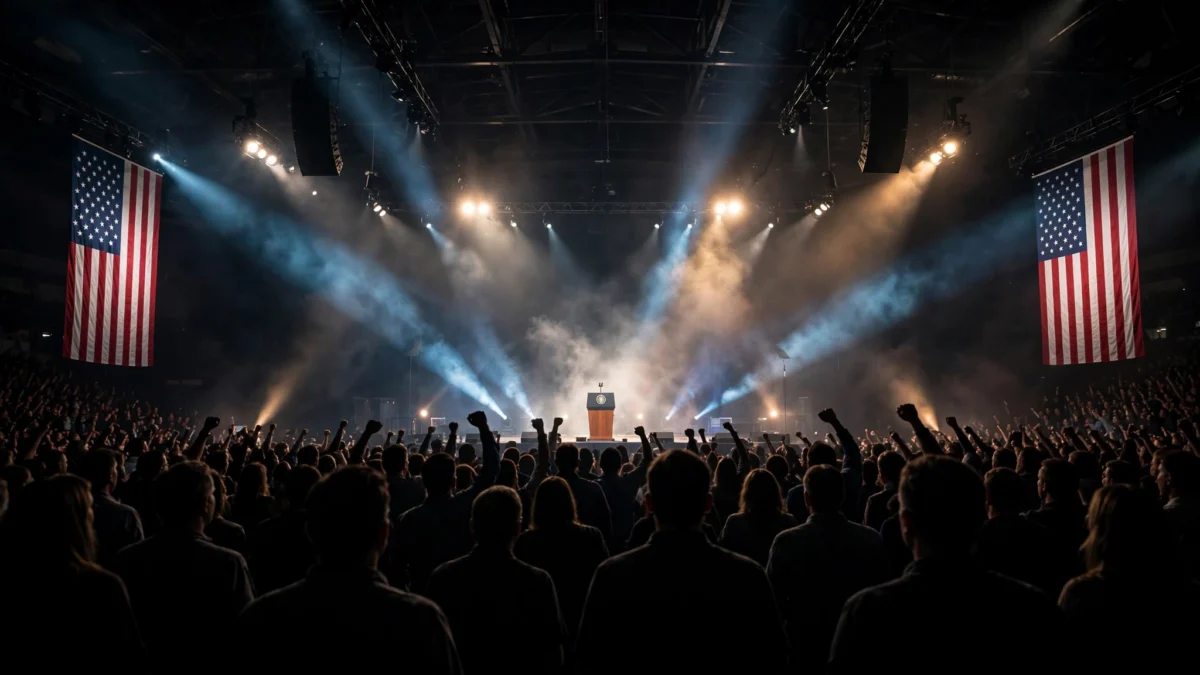
President Donald Trump turned the presidential pardon power into a made-for-television campaign moment on Tuesday night, signing unconditional pardons onstage at a rally in Wasilla, Alaska, for two diesel mechanics whose prosecution under former President Joe Biden’s administration he has framed as emblematic of federal overreach.
The two men, Zachary Czubak and Patrick Fleming, co-own an Anchorage diesel repair business called Arm Rippin Toys, according to USA Today, which reported that Trump identified the pair by name before beckoning an aide to bring the clemency documents to the podium. In front of a cheering crowd at the Curtis D. Menard Memorial Sports Center, Trump signed the papers, held one up for the audience, and handed them to the men — a spectacle of clemency that doubled as the evening’s political centerpiece.
The case behind the pardons began years before it reached the stage. According to the Biden-era Justice Department, Czubak and Fleming were among three co-owners of the Anchorage shop who pleaded guilty in 2022 to conspiracy to violate the Clean Air Act, the federal law that requires pollution-control equipment on vehicles. Court documents cited by the U.S. Attorney’s Office in Alaska say the shop removed federally required emissions-control equipment and tampered with monitoring devices on at least 37 diesel vehicles between July 2019 and September 2020, collecting roughly $100,000 for the work, prosecutors said.
None of the three men was sentenced to prison. Czubak and Fleming each received five years of probation, $66,000 fines, and community service, according to Newsmax, which cited the Justice Department’s sentencing records. The third co-owner, Michael Hanzuk, received a similar sentence with an additional period of home confinement, according to the Justice Department’s environmental crimes bulletin.
At the rally, Trump’s version of the story was narrower than the court record. He told supporters the men were prosecuted “because they fixed an engine” and said officials had wanted to jail them for a decade, according to USA Today. In reality, the conspiracy charge the men pleaded guilty to carried a maximum of five years in prison, and prosecutors said the modifications brought in about $100,000 while potentially increasing some tailpipe pollutants dramatically.
Speaking from the stage, one of the pardoned men described the toll of the prosecution on the owners and their families. “It really did destroy us,” he said. “It destroyed friendships. It destroyed families.” Trump, savoring the moment, told the crowd: “What an honor. I love doing this stuff.”
The pardons were the dramatic high point of a rally staged to support Republican Senator Dan Sullivan, who is seeking a third term against former Democratic Representative Mary Peltola, and Representative Nick Begich, who is defending Alaska’s lone House seat. The Nov. 3 midterm elections are now weeks away, and Alaska is one of the states that could help determine control of the Senate, according to the Cook Political Report, which rates the Sullivan–Peltola contest a toss-up.
Trump used the rally to touch on the issues he has made central to his Alaska appeal. He declared that every federal permit needed for the long-proposed 800-mile natural gas pipeline had been granted, telling the crowd that developers could begin work immediately. He also claimed that Taiwan had agreed to buy 30 percent of the pipeline’s gas over 20 years — a claim the Juneau Independent flagged as unverified, reporting that Taiwan had described only a non-binding plan whose specifics were still to be determined.
As he signed the pardons, Trump took a swipe at Biden, saying, according to Fox News, “So I’m going to sign this now, something that Joe Biden would be unable to do because he was unable to sign his signature,” a reference to the controversy over Biden’s reported use of an autopen for official signatures.
Trump said he was also “taking care of” a third person, and told the crowd he was giving “each one of the three an unconditional pardon.” Reporting differed on exactly whom he meant: Newsmax reported that the third co-owner, Hanzuk, had received a pardon in September, and Senator Sullivan’s office confirmed that Trump issued full pardons on Sept. 3 to Hanzuk and to Daniel Chase, owner of another diesel shop; Alaska News, meanwhile, reported that Trump had called up Mackenzie “Mac” Spurlock, a Wasilla mechanic pardoned earlier in the summer, as he made the announcement.
Analysis: Why It Matters
Presidential pardons are normally issued through a formal Justice Department process and announced with little fanfare. Trump’s onstage signing did the opposite — it fused an act of constitutional power with the rhythms of a campaign rally. The move was not just a legal favor to two men from Anchorage; it was a message to a much larger audience about how this presidency views federal environmental enforcement, and to whom it listens.
The pardon recipients belong to a corner of American industry that has long been in the crosshairs of regulators. The Environmental Protection Agency has spent years cracking down on so-called “diesel deletes” — the removal of emissions-control equipment from trucks — which its enforcement bulletins describe as a nationwide problem. The EPA’s own case files say disabling emissions systems can multiply some tailpipe pollutants by hundreds of times. For the agency, shops like Arm Rippin Toys are pollution cheats; for their supporters, they are small businesses serving working customers who want engines that run reliably and cheaply.
In Alaska, that tension has a physical dimension. Modern diesel engines depend on diesel exhaust fluid, which freezes at about 12 degrees Fahrenheit, and on mandated automatic shutoffs that can kill engine power when sensors fail. In a state where winter temperatures routinely plunge far below zero, a truck that shuts down on a remote highway is not an inconvenience — it is a safety hazard. Senator Sullivan has built a legislative vehicle around exactly this argument: his Cold Weather Diesel Reliability Act, which recently advanced in a Senate committee, would create a cold-weather exemption framework for diesel emissions equipment. Trump has now pardoned at least a dozen people convicted of similar violations, including nine he pardoned in July, according to Newsmax.
There is also a second, less obvious layer to the story: the pardons fit a pattern of clemency directed at figures whose offenses map onto Trump’s policy grievances. By casting the mechanics as victims of “overzealous” enforcement, Trump is not simply forgiving past conduct; he is legitimizing an argument that the underlying law itself was weaponized. That framing resonates far beyond Anchorage — it lands with diesel shop owners across the country facing similar prosecutions, and with a broader constituency that sees federal regulation as hostile to blue-collar work.
The timing matters too. With early voting set to begin in Alaska on Oct. 19 and the Senate race a toss-up, every element of the rally was calibrated to drive turnout. The pardons gave Trump’s visit a tangible, emotional payoff that a standard stump speech could not: two local men, forgiven, onstage, in front of neighbors. It is the kind of image that travels — and, from the campaign’s perspective, the kind that costs nothing.
Critics will see something else: a president using a unilateral constitutional power as a prop, erasing a lawful prosecution for its political value. The court record is not ambiguous — the men pleaded guilty to a conspiracy they admitted, and prosecutors documented a paid scheme to defeat pollution controls on dozens of vehicles. A pardon does not declare innocence; it forgives punishment. Whether forgiving a documented environmental offense serves justice or undermines it is the question the rally’s cheers were not asking.
The pipeline declaration deserves a separate note of caution. Trump’s claim that “every single permit” has been granted for the 800-mile project and that Taiwan has committed to a 30-percent purchase may excite markets and voters, but both assertions await independent confirmation. The Juneau Independent’s reporting that Taiwan described only a non-binding plan is a reminder that rally claims and signed contracts are different things — and that the truth of the pipeline’s prospects will be written in permitting dockets and purchase agreements, not in applause lines.
What to Watch Next
First, the Justice Department’s pardon paperwork. Onstage clemency makes for great television; the legal effect depends on the signed warrants being processed and published. Watch for the official pardon grants to appear in federal records.
Second, the emissions enforcement pipeline. If the administration continues pardoning diesel-delete convictions, EPA enforcement officials and career prosecutors will take note. Expect defense attorneys in pending Clean Air Act cases to cite the pardons as evidence of prosecutorial overreach.
Third, Sullivan’s Cold Weather Diesel Reliability Act. The bill advanced in committee with Sullivan’s pardon pitch as tailwind. Its progress in the full Senate — and whether it picks up bipartisan support — will show whether the pardon moment translates into law.
Fourth, the Alaska Senate race itself. Polls show Sullivan locked in a tight contest with Peltola. The rally was designed to energize the Republican base; the question is whether spectacle moves voters in a race this close.
Fifth, the pipeline. Trump’s claim of full permitting is now on the record. If federal agencies move to confirm it — or if gaps emerge — that will be the story that outlasts the applause in Wasilla.
Sources
- USA Today: “Trump pardons Alaskan mechanics from Biden-era emissions case” (Oct. 13, 2026)
- Newsmax: “Trump Pardons Alaska Mechanics in Clean Air Act Case” (Oct. 14, 2026)
- Fox News: “Trump signs pardons for Alaska diesel mechanics onstage during rally touting major energy deals”
- Alaska News: “Trump pardons two Anchorage diesel shop owners onstage at Wasilla campaign rally”
- U.S. EPA, Office of Criminal Enforcement Bulletin, Nov–Dec 2022 (primary record of the Arm Rippin Toys prosecution)
- U.S. Senate: “EPW Committee Advances Sullivan’s Cold Weather Diesel Reliability Act” (primary source on the legislative backdrop)
- Juneau Independent: “Trump touts Sullivan, makes inaccurate claim about Taiwan buying Alaska LNG at Wasilla rally”

About the Author — Abdul Mannan
Related Articles
Trump Asks U.S. Ambassador to Greece Kimberly Guilfoyle to Resign After Reports of Cash-for-Access Misconduct
The White House on Tuesday asked Kimberly Guilfoyle to resign as ambassador to Greece after Wall Street Journal…
Judge Blocks Trump’s White House Ban on CNN, MS NOW and Politico, Finding Likely First Amendment Violation
A federal judge has granted a preliminary injunction preserving White House access for CNN, MS NOW and Politico,…
Six Flags Shuts Nine Roller Coasters Nationwide After Fatal Fall at Georgia Park
One man died and four others were injured at Six Flags Over Georgia, prompting the company to close…