
US Evacuates Aircraft from RAF Mildenhall After Iran Threat as Two British Bases Raise Alert to Second-Highest Level

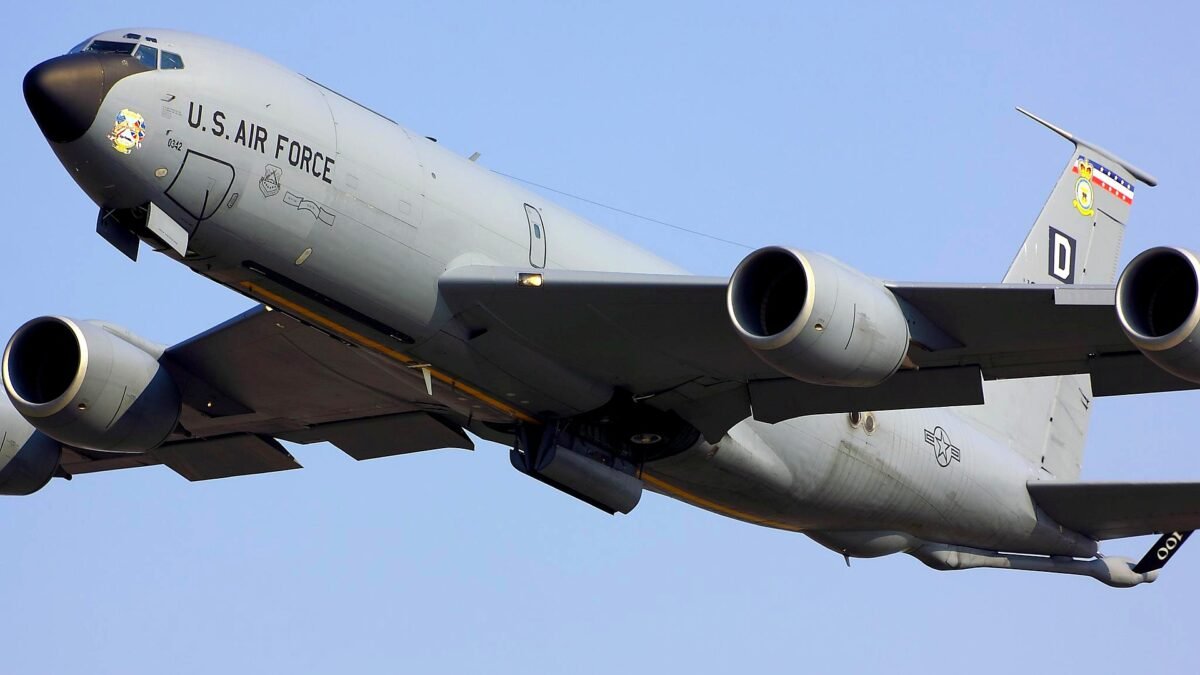
The United States moved military aircraft out of RAF Mildenhall in Suffolk on Monday after a threat linked to Iran, and raised the security alert at two American airbases in England to the second-highest level in the Pentagon’s system, according to reports published overnight.
Two American refuelling tankers that had been operating from Mildenhall diverted to Germany early on Monday morning, and several more tankers were moved to Germany and other locations later in the day, the Wall Street Journal reported, citing people familiar with the matter. Flight-tracking data showed that nine tankers and three Osprey tiltrotor aircraft left Mildenhall over the course of Monday, according to Sky News.
The precise nature of the threat has not been publicly established. American officials are still discussing whether it was an imminent danger or a more general warning, the Journal reported. No public evidence has established that Iran directed or carried out a specific operation against the base, and the United States Air Force has not confirmed that the aircraft movements were an evacuation prompted by Iran. What is not in doubt is that something unusual happened at Mildenhall on Monday, and that American commanders responded by dispersing aircraft and tightening security at two of their most important bases in Britain.
The security posture at RAF Mildenhall and at nearby RAF Lakenheath was raised to Force Protection Condition Charlie, the Journal reported, citing an American official familiar with the matter. FPCON Charlie is the second-highest defensive threat level in the United States Department of Defense system, and it is used when intelligence indicates that a form of terrorist action is likely. A United States official separately confirmed to The War Zone, a defence publication, that enhanced force protection measures were in effect at both installations.
“Enhanced force protection measures are in effect across RAF Lakenheath and RAF Mildenhall,” the official told The War Zone on Monday afternoon. “We constantly assess a variety of factors that determine what measures we institute or modify to protect our installations, our people and their families. We are working closely with our host nation counterparts to minimize impacts from enhanced force protection activities and ensure the safety of U.S. personnel, their families and the local community.”
The official declined to say what steps had been taken. “For operational security reasons, we do not discuss specific force protection measures,” the official added.
What moved, and where it went
The aircraft movements were first noticed not by a government announcement but by open-source flight trackers watching the skies over Suffolk. The account DefenceGeek, which monitors military aircraft movements through publicly available flight information, reported on Monday that a number of American Air Force assets at Mildenhall had made unannounced and unexpected movements to other locations, with several still in motion.
“Over the course of today, a number of US Air Force assets at RAF Mildenhall have made unannounced/unexpected movements to other locations, with several of those movements in motion presently,” DefenceGeek wrote on X. “The initial few this morning I assumed were due to heavy fog in the area, but other information is now suggesting something else. Several KC-135s have moved to Spangdahlem or Prestwick. CV-22Bs have moved from Mildenhall to Lakenheath. It remains unclear if there is an ongoing exercise or information of a potential threat (following the incident at RAF Fairford).”
According to Sky News, nine tankers and three Ospreys left Mildenhall late on Monday afternoon and into the evening. The tankers were all Boeing KC-135 Stratotankers. Most were moved to airbases in Germany and Spain, and one was moved to RAF Prestwick in Scotland. The three Ospreys moved to RAF Lakenheath, about fifteen miles from Mildenhall.
The departures took place against a background of continuing tanker movements toward the Middle East, as President Donald Trump continues to consider whether to resume strikes against Iran, The War Zone reported. That wider flow of aircraft makes it harder to read any single movement, but the pattern on Monday was distinct enough for flight trackers to flag it in real time, and for the Journal to report it as a response to a threat rather than routine business.
RAF Lakenheath also posted a notice on Facebook on Monday morning urging vigilance in spotting and reporting drones. “Our strongest security asset is an observant community,” the post read. “Staying vigilant and reporting suspicious activity, including unauthorized drone activity, helps protect our Airmen, families and mission. If you see something unusual on or around the Tri-Base area, report it to Security Forces.” It is unclear what connection, if any, the Lakenheath post has to the enhanced force protection status, The War Zone reported.
What the officials said, and did not say
The official responses on Monday and Tuesday were careful, and in some respects contradictory. A spokesman for Britain’s Ministry of Defence said: “We do not routinely comment on the activity of other nations. Aircraft and other assets move regularly according to operational requirements.”
A spokesman for the United States Air Force declined to provide details about the movement of assets, but said American aircraft rotate between installations and operating locations for a variety of reasons. United States Air Forces in Europe, the command that oversees American air operations in Europe and Africa, told The War Zone: “U.S. Air Force aircraft rotate between installations and operating locations for a variety of reasons including training and real world requirements. U.S. military aircraft are hosted in accordance with access, basing, and overflight agreements with our Allies and partners. Due to operations security, we will not provide further information on movement of assets.”
Cabinet minister Lucy Powell told Sky News on Tuesday morning that the security of military bases in Britain was kept under review. She said she could not comment on live operations, but added: “We’re constantly keeping the security of our bases under review and, as we’ve seen with other cases recently, we take firm and quick action where we need to.”
The gap between the public language and the reported facts is itself part of the story. The Journal’s sources described an evacuation prompted by a threat from Iran and a formal raising of the alert level. The official statements described routine rotation and declined to discuss specifics. Neither side has produced evidence that would settle the question, and the American authorities have not said how long the enhanced measures will remain in place.
Why Mildenhall matters
RAF Mildenhall is one of the most important American military installations in Europe. It is home to the 100th Air Refueling Wing, which operates KC-135 Stratotanker aircraft and is the only permanently based United States Air Force aerial refuelling wing in Europe. Its tankers provide fuel to American, NATO and partner aircraft across the European theatre, extending the reach of fighters and bombers that would otherwise be limited by their own range.
The base also hosts the 95th Reconnaissance Squadron, which operates RC-135V/W Rivet Joint intelligence-gathering aircraft. Those jets collect electronic signals and other information used to monitor military activity. Another major unit at Mildenhall is the 352nd Special Operations Wing, which operates MC-130J Commando II aircraft and CV-22B Osprey tiltrotors. Its missions include transporting special operations forces, conducting infiltration and extraction operations, and supporting aircraft in remote or hostile environments. The base also serves as a transit and support hub for American military aircraft moving between North America, Europe and other regions.
RAF Lakenheath, about fifteen miles away, is a frontline combat aviation base. It hosts the 48th Fighter Wing, equipped with F-15E Strike Eagle multirole fighters and F-35A Lightning II stealth aircraft. Its fighters regularly operate alongside the KC-135 tankers based at Mildenhall, including during training and deployments. The reported increase in security at both installations therefore affects two different but closely connected elements of American airpower in Europe: the aircraft that support long-range operations and the fighters that can carry them out.
That is why the movement of tankers out of Mildenhall is more than a local security story. Tankers are the enablers of everything else. A bomber or a fighter can only reach a distant target, stay on station, and return home if a tanker is waiting for it. Moving nine of them out of their home base at short notice is a decision with operational consequences, and it is not a decision commanders take lightly.
Fairford: the pattern that came before
The events at Mildenhall follow a security incident at another British airbase that has still not been fully explained. In late September, five men were arrested on suspicion of driving bomb-laden vans toward RAF Fairford in Gloucestershire. They were soon released on bail after no explosives were found, but two men were later arrested, one of whom was charged with assisting a foreign intelligence service which police earlier said they believed to be Iran, according to the BBC.
More detail emerged at a preliminary hearing for two of the men at Westminster magistrates’ court last month, according to The Times. The men arrived at RAF Fairford in vans carrying petrol under orders from a handler known to them as “Ali”, whom police believe was working on behalf of Iran, the hearing was told. One of the five men tasked with driving to the base called police in the early hours of 27 September after the organiser warned the group of a bomb in the vans, prosecutors told the court. Police attended, located three white vans and five men, and arrested them.
About a week after the September incident, American B-1B Lancer bombers that had been deployed to RAF Fairford since Operation Epic Fury returned to their home stations, a United States defence official confirmed to The War Zone at the time. The hasty movement was reportedly sparked by new Iranian threats against the base. Fairford had been used by American bombers to carry out strikes on Iran, and it is a regular host of strategic assets, including bombers and U-2 spy planes.
Prime Minister Andy Burnham said last month that the activity at RAF Fairford was likely to have been coordinated in Iran. Tehran’s ambassador to Britain has denied accusations that Iran was involved in any plot against the airbase. Iran’s Revolutionary Guards said in July that the Fairford base, and any other base used to launch attacks against Iran, were legitimate targets. President Trump told reporters outside the White House that “threats” led to the decision to remove the bombers, including B-1s, B-2s and B-52s, according to Sky News, although a spokesman for the Prime Minister insisted that the base remains secure.
It remains unclear whether the reported threat to Mildenhall is connected to the earlier incident at Fairford, or how long the enhanced security measures at Mildenhall and Lakenheath will remain in place. American and British authorities have not confirmed whether the heightened security, the aircraft relocations and the earlier incidents at Fairford are connected.
The wider war
The security scare in Suffolk is taking place against the background of a war that has now been running for more than eight months. The war between the United States and Iran began on 28 February 2026, and it has already redrawn the security map of the Middle East and, increasingly, of Europe. American bombers flying from Fairford were a central part of the major combat operations against Iran earlier this year, and the base’s role in those strikes is the reason it was named as a legitimate target by Iran’s Revolutionary Guards.
In October, the Director of National Intelligence, Jay Clayton, said Iran was in “advanced stages” of planning to target American personnel in the Middle East, explaining the rationale for a sudden evacuation of diplomats from regional posts, according to the Journal. The warning suggested that Tehran’s retaliation planning extended beyond the battlefield and beyond the region. Tehran has said its retaliation for any American attack on Iran would expand beyond the Middle East.
On Monday, Mr Trump held a surprise press conference after meeting Qatar’s prime minister, Mohammed bin Abdulrahman Al Thani, to discuss the diplomatic effort to resolve the conflict with Iran. The president told reporters he believes the Iran war “militarily is effectively over”, according to Sky News. He also said in a post on his Truth Social platform that America was “locked and loaded” but that the need for further strikes “seems to be quite unlikely”. Mr Trump had earlier said fresh American attacks on Iran were “highly unlikely” if talks made progress.
Trilateral talks between Russia, Ukraine and the United States are also scheduled in Abu Dhabi on Tuesday and Wednesday, and the diplomatic track on Iran has been running in parallel. The contrast between the president’s public confidence that the war is effectively over and the quiet dispersal of American aircraft from a base in Suffolk on the same day is striking, and it captures the uncertainty of the moment. The war may be militarily over in the president’s telling, but the threat picture that the war created has not gone away.
Nor is this the first time American bases in England have faced an unexplained threat from the air. In late November 2024, Lakenheath, Mildenhall and two other RAF bases hosting American forces experienced drone incursions, which The War Zone was the first to report. Those incidents were never fully explained either. The pattern of unexplained aerial activity around American bases in Britain is now a recurring feature of the security landscape, and each new incident revives questions that the previous one left unanswered.
Analysis: Why It Matters
A threat that reaches Britain
The most important fact in this story is the geography. The war with Iran is being fought in the Middle East, but its consequences are now being managed on the ground in Suffolk. Two American bases in England are operating under the second-highest alert level in the Pentagon’s system, aircraft have been dispersed to Germany, Spain and Scotland, and a British cabinet minister has been on television assuring the public that base security is under constant review. Whatever the precise nature of the threat to Mildenhall, it has already succeeded in one respect: it has forced the United States to treat its home in Britain as a front line.
That is a significant shift. For decades, American bases in Britain have been treated as secure rear areas, places where aircraft could be based, maintained and launched with the confidence that the host country was safe. The Fairford incident in September and the Mildenhall dispersal in November suggest that assumption no longer holds. If Iran, or anyone acting on its behalf, can credibly threaten an American base in Suffolk, then the distinction between the war zone and the home base has blurred, and the security burden on Britain has grown accordingly.
The second base in six weeks
The Mildenhall dispersal is the second time in about six weeks that the United States has moved aircraft out of a British base because of a suspected Iranian threat. The first was Fairford, where B-1 bombers were withdrawn after the arrest of five men near the base. The second is Mildenhall, where tankers were dispersed after a threat that officials are still discussing among themselves.
Two incidents do not make a campaign, and the authorities have been careful not to link them. But the repetition matters. A single incident can be treated as an anomaly. A second incident, at a different base, involving a different kind of aircraft, suggests a pattern of threat that American commanders are taking seriously enough to disrupt their own operations. The question now is whether there will be a third, and whether the pattern extends to other American installations in Europe.
It is also worth noting what kind of aircraft were moved. At Fairford, the aircraft were bombers, the visible instruments of American power. At Mildenhall, they were tankers, the quiet enablers without which bombers and fighters cannot operate at range. Moving tankers is a less dramatic gesture than moving bombers, but it is arguably a more consequential one, because it affects every other aircraft that depends on them. Whoever threatened Mildenhall, if that is what happened, chose a target whose disruption would ripple across the whole of American air operations in Europe.
Deterrence, or vulnerability?
There are two ways to read the American response, and they point in opposite directions. The first is that the dispersal worked: the threat was detected, the aircraft were moved, the alert level was raised, and nothing happened. On this reading, the system functioned as designed, and the movement of aircraft was a sign of a military that takes force protection seriously.
The second reading is less reassuring. If a threat, real or merely reported, can force the United States to disperse its tankers from their home base and raise the alert at two major installations, then the threat has already achieved a disruptive effect without a shot being fired. The cost of responding to a threat is not zero. Aircraft moved to Germany and Spain are aircraft that are not at Mildenhall. Crews, families and local communities around the bases live with the disruption. And every time the alert level goes up, the question is asked whether it will come down again, and what would justify bringing it down.
The truth probably contains elements of both readings. The dispersal was a prudent response to a credible concern, and it was also a reminder that the American presence in Britain is not invulnerable. The bases are valuable precisely because they are close to the action, and they are vulnerable for the same reason.
The fog of attribution
One of the most striking features of this story is how little has been confirmed. The Journal reports a threat from Iran, citing people familiar with the matter. The Air Force has not confirmed that the movements were an evacuation prompted by Iran. The Ministry of Defence has said only that aircraft move regularly according to operational requirements. The precise nature of the threat remains under discussion among American officials, and no public evidence has established that Iran directed a specific operation against Mildenhall.
This fog is not unusual in security stories, and it is not necessarily a sign that anyone is hiding something. Intelligence about a threat is often fragmentary, and governments are reluctant to reveal what they know for fear of revealing how they know it. But the fog has consequences. Without a clear account of what the threat was, the public cannot judge whether the response was proportionate, whether the danger has passed, or whether it is still present. And without a clear attribution, the political consequences are muted. A threat that cannot be attributed to anyone cannot easily be answered, and a government that cannot name the threat cannot easily rally support against it.
The Fairford case shows how slowly clarity arrives. The arrests happened in late September. It took weeks for the detail about the handler known as “Ali” and the vans carrying petrol to emerge in court, and the circumstances of the incident remain largely unexplained. The Mildenhall case may follow the same pattern, with the full picture emerging only gradually, if at all.
What the move does and does not mean
It is important to be clear about what the dispersal of aircraft from Mildenhall does not mean. It does not mean that an attack on the base was imminent, or that one was attempted. It does not mean that Iran ordered an attack on Mildenhall, or that the Fairford incident and the Mildenhall threat are connected. It does not mean that the war with Iran is escalating, or that American strikes are about to resume. Indeed, the president said on Monday that he believes the war is militarily effectively over, and that further strikes seem quite unlikely.
What it does mean is that the security environment around American forces in Europe has changed, and that the change is being felt in Britain. Bases that were once regarded as safe are now operating under enhanced protection. Aircraft are being moved as a precaution. A cabinet minister is discussing base security on morning television. And the public is learning about it first from flight trackers and newspaper reports rather than from official announcements.
That last point deserves attention. The Mildenhall story was broken by open-source flight tracking and by journalists, not by the governments involved. The official statements that followed were cautious to the point of opacity. In a democracy, the public has a legitimate interest in knowing when foreign threats affect military bases on its soil, and the gap between what is reported and what is officially confirmed is a gap that breeds speculation. The governments concerned would do well to close it, at least in part, by saying more about what happened at Mildenhall and what is being done to prevent a recurrence.
What to Watch Next
- Whether the aircraft return: The clearest signal of how seriously the threat is being taken will be whether the tankers and Ospreys moved out of Mildenhall return to the base in the coming days, or whether they stay dispersed. A quick return would suggest the threat was judged to have passed. A prolonged dispersal would suggest the opposite.
- The alert level at Mildenhall and Lakenheath: FPCON Charlie is the second-highest level in the Pentagon’s system. Whether it is lowered, maintained or raised further will tell the public more than any official statement about how the threat is being assessed.
- Any official confirmation of the threat: So far the account of an Iranian threat rests on the Journal’s sources. Any confirmation, denial or elaboration from the United States or British governments would be significant, and its absence would also be informative.
- The Fairford court proceedings: The preliminary hearing at Westminster magistrates’ court has already produced detail about the September incident, including the handler known as “Ali” and the vans carrying petrol. Further court proceedings may establish whether the Fairford plot was directed from Iran, and whether it has any connection to the events at Mildenhall.
- The Abu Dhabi talks: Trilateral talks are scheduled in Abu Dhabi on Tuesday and Wednesday. If they produce progress, the president’s statement that further strikes seem quite unlikely may hold, and the threat picture may ease. If they stall, the pressure for renewed military action will grow, and with it the risk of retaliation against American assets.
- Drone activity around British bases: RAF Lakenheath’s Facebook post urging vigilance about drones is a reminder that unexplained drone incursions have affected American bases in England before, most notably in November 2024. Any further sightings would add to the sense that the bases are under sustained scrutiny.
- Parliamentary scrutiny: The dispersal of American aircraft from a British base, and the raising of the alert level at two bases, are matters of legitimate public interest. Whether MPs press the government for a fuller account in the coming days will be a test of how seriously Westminster takes the security of the American presence in Britain.
Sources
- The Wall Street Journal — U.S. Aircraft Evacuated From Second U.K. Base Due to Iran Threat
- Reuters — US aircraft evacuated from second British base due to Iran threat, WSJ reports
- The Times — US aircraft evacuated from another RAF base ‘amid Iran threat’
- Sky News — US aircraft moved from RAF Mildenhall over reported threat from Iran
- The War Zone — Security Levels At U.S. Bases In England Raised Without Explanation
- Air Data News — US reportedly evacuates aircraft from British airbase amid Iranian threat

About the Author — Abdul Mannan
Related Articles

Labour MPs Urge Burnham to Scrap Draft Conversion Practices Bill Over Fears Parents Could Face Jail
At least a dozen Labour MPs have told party whips they are unhappy with the draft Conversion Practices…

Russell Brand Jailed for Ten Years and Six Months for Rape and Sexual Assault
Russell Brand has been jailed for ten years and six months after a judge at Southwark Crown Court…

Russell Brand Jailed for Ten and a Half Years for Rape and Sexual Assaults as Judge Calls Him a ‘Sexual Predator’
Russell Brand has been jailed for ten years and six months for raping one woman and sexually assaulting…