
Zelensky Ends Ukraine’s Energy-Strike Pause as Drones Set Fire to Russia’s Ryazan Refinery: “We’re Done”

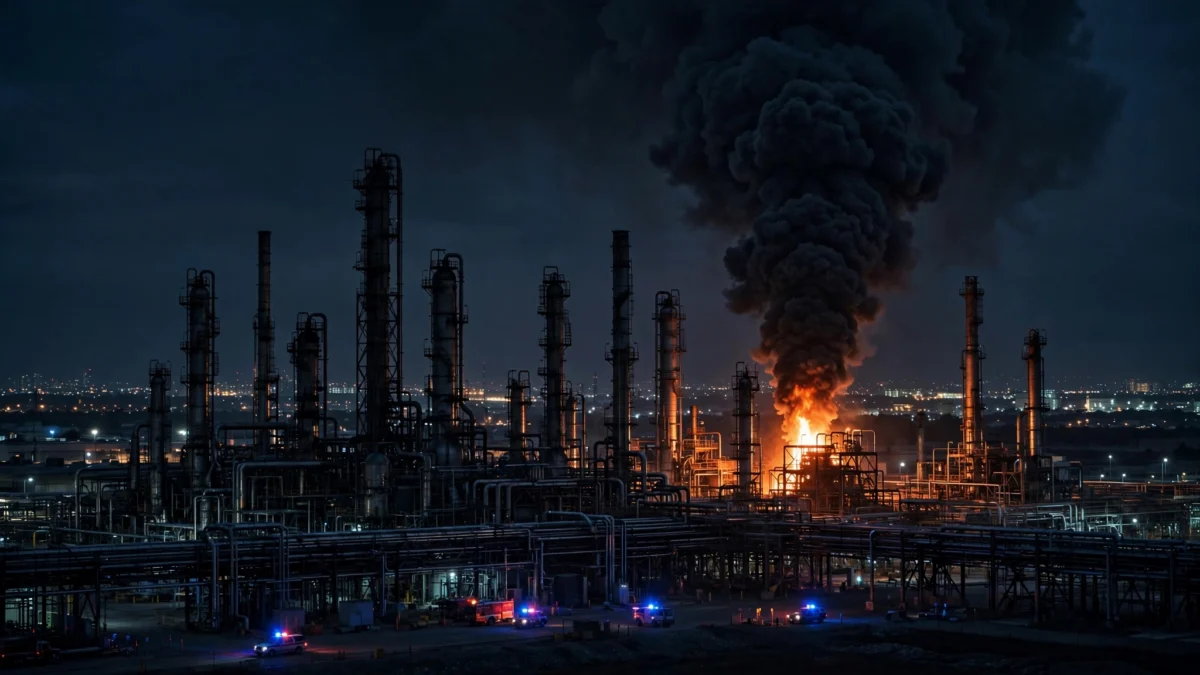
Ukraine has ended its brief pause on attacking Russian energy targets, striking an oil refinery in Russia’s Ryazan region overnight and setting it on fire, hours after President Volodymyr Zelenskyy told the Financial Times that a three-day restraint ordered to accommodate American wishes was over. “The block [on attacking refineries] is out. We’re done,” Zelenskyy was quoted as saying in the interview published Thursday.
The overnight drone attack hit the Rosneft-owned refinery in Ryazan, roughly 300 kilometres southeast of Moscow, according to Reuters. Ryazan regional governor Pavel Malkov said on Telegram that a large-scale Ukrainian drone attack had started a fire at the facility, that emergency services were working at the scene, and that the material damage was still being assessed. The Russian Defence Ministry said Ukraine had attempted a large-scale attack on the refinery overnight, while a senior Ukrainian official, speaking on condition of anonymity because he was not authorised to speak publicly, confirmed to the Associated Press that Ukraine had hit the facility.
It was the first Ukrainian attack on a Russian energy installation since U.S. President Donald Trump announced on Sunday that Russia and Ukraine had agreed to an “energy ceasefire,” a claim that surprised both sides and was never publicly confirmed by either government, according to Reuters. Malkov said a warehouse elsewhere in the region was damaged in the attacks and that schools and kindergartens in two districts had cancelled classes because of what he described as mass drone attacks.
The Ryazan refinery is a significant node in Russia’s fuel system: it accounts for almost 5 percent of the country’s total oil refining throughput and feeds Moscow with fuel, according to Reuters. It has been attacked by drones several times in recent months as Ukraine has spent much of the past year striking Russian refineries to cut revenue and fuel supplies supporting Moscow’s war effort.
Zelenskyy’s announcement to the Financial Times followed days of mounting Ukrainian frustration. Kyiv held its fire on Russian energy targets for three days to comply with Washington’s wishes, the Ukrainian president said, while Russian forces continued pounding Ukrainian cities. He told the newspaper that more than 600,000 Ukrainian homes were left without electricity after the latest wave of Russian strikes, and he complained that during the pause Ukraine was denied the usual American early-warning alerts on incoming Russian ballistic missiles while Starlink satellite communications used by the military degraded.
“It was not a technical problem; it was the will,” Zelenskyy told the Financial Times about the satellite restrictions, according to CNN. He also said Ukrainian military officials had been told directly by their American counterparts: “if you will not stop [the energy strikes], we will block intelligence.” A senior Ukrainian official confirmed to the AP that Ukraine had kept to the pause despite what the Ukrainian side described as Moscow’s failure to reciprocate. Zelenskyy said he felt betrayed by Trump, the AP reported, condemning the American president’s willingness to strike business deals with Moscow and his apparent admiration for Russian President Vladimir Putin.
The breakdown is a direct casualty of Trump’s announcement on Sunday, when he wrote on social media that both parties had agreed to halt energy strikes, calling the arrangement an “energy ceasefire.” The Kremlin responded that the scope of any such arrangement had never been determined, and Moscow never publicly confirmed a reciprocal pause, according to Reuters. On Wednesday, after a fresh wave of Russian strikes on Ukrainian energy facilities, Zelenskyy wrote on X that the attacks were “entirely deliberate and demonstrative in their scale,” adding that Russia had “never before shown such ostentatious disrespect toward the United States.”
Trump has pressed Kyiv hard to stop the refinery campaign, linking the strikes to rising fuel costs. Last week he announced a deal in which, he said, Putin had agreed to supply markets with Russian diesel — a move that drew bipartisan criticism and anger among European allies, according to CNN. A senior administration official told the Daily Caller that “the President has been clear that Ukraine must stop striking oil refineries,” adding: “These attacks are driving up costs for consumers in the United States and around the world, and they are not acceptable to President Trump.” Diesel averaged $6.32 a gallon nationally on Thursday, about 21 cents below the record set on September 22, according to the American Automobile Association.
Zelenskyy set a condition for any renewed restraint: additional Patriot interceptor systems from the United States, which he described to the Financial Times as the bare minimum. For now, though, Ukraine’s refinery campaign is back on.
The Context: A Ceasefire Announced, Never Agreed
To understand why the pause collapsed so quickly, it helps to retrace the week. On Sunday, Trump announced what he called an energy ceasefire between Russia and Ukraine, writing that “both parties have agreed.” The statement surprised officials in both Kyiv and Moscow. Zelenskyy supported the idea of a halt in principle, though he had not been informed in advance; Russia offered no direct comment and later said the arrangement’s scope was never determined. In other words, the ceasefire existed as an American announcement, not as a negotiated agreement — a ceasefire on paper, nowhere else.
Ukraine nevertheless acted as though it were real. For three days it held back its long-range drones from Russian refineries, a restraint Zelenskyy now describes as a good-faith gesture that bought nothing. Meanwhile, according to Kyiv, Russia kept hitting Ukrainian energy infrastructure without interruption: a Wednesday wave of strikes across Kyiv, the Kyiv region and Kharkiv left hundreds of thousands without power. The Ukrainian president said Wednesday that 600,000 people were without electricity — the kind of mid-winter pressure point Russia has used in every heating season since the full-scale invasion began.
What stung Kyiv most, however, was not the Russian strikes alone but what happened to American support during the pause. Zelenskyy told the Financial Times that Ukraine received no American early-warning alerts for incoming ballistic missiles and that military-grade Starlink service degraded — restrictions he said were a deliberate choice, not a technical failure. American officials, in his account, explicitly tied continued intelligence sharing to Kyiv’s restraint on energy strikes. Whether or not that linkage was formal policy, the message received in Kyiv was that restraint would be bought at the price of blindness — and that the price was paid even before restraint ended.
Analysis: Why It Matters
This episode lays bare a pattern that has defined Trump’s approach to the war since he returned to power: diplomacy by announcement. A ceasefire declared on social media, terms never negotiated, and both combatants left to guess what was expected of them. The result was the worst of both worlds — Ukraine absorbed three days of continued Russian strikes while voluntarily tying its own drones’ hands, and Washington got no ceasefire at all, only a fresh refinery fire and a further-degraded relationship with Kyiv.
It also exposes the fragility of Ukraine’s dependence on American infrastructure. Kyiv’s war effort runs on American eyes — early-warning data on incoming ballistic missiles and the Starlink/Starshield satellite network that carries battlefield communications. When access to those systems can be slowed or withdrawn as a pressure tactic, every strategic disagreement between Kyiv and Washington becomes an operational risk for Ukraine. Zelenskyy’s “we’re done” was not only about refineries; it was the sound of a president deciding that compliance had become more dangerous than defiance.
Then there is the diesel. Trump’s October 9 announcement of a diesel supply deal with Putin, and his repeated claim that Ukrainian refinery strikes are to blame for high American fuel prices, ties the war’s front lines to the politics of the gas station — and to the midterm elections less than three weeks away. That linkage is politically powerful, but it collides with military reality: Ukraine’s refinery campaign is one of its few tools for striking at the economic engine of Russia’s war, and Kyiv has shown it will not surrender that leverage for a ceasefire Moscow never signed.
Finally, the episode redraws the map of the relationship. Zelenskyy publicly accused the American president of admiration for Putin and of pursuing business deals with Moscow, language far sharper than Kyiv’s usual calibrated criticism. His condition for renewed restraint — more Patriot interceptors as “the bare minimum” — sets a price on cooperation that the White House has shown little appetite for paying. The friction that was visible in the Starlink dispute earlier this week has now hardened into an open political rift.
The war’s energy front, in short, is no longer a two-player game between Russia and Ukraine. It is a three-player game in which Washington is both referee and interested party — and this week the whistle was ignored by everyone.
What to Watch Next
- The damage at Ryazan. Governor Malkov said damage is still being assessed. The facility accounts for nearly 5 percent of Russia’s refining throughput — any extended outage would tighten domestic fuel supply further.
- The next wave of strikes. Ukraine has resumed its refinery campaign; Russia will almost certainly answer against Ukrainian energy infrastructure. The 600,000-without-power figure could grow as both sides escalate.
- Washington’s response. The White House said refinery strikes are “not acceptable to President Trump.” Whether that rhetoric translates into concrete pressure — on intelligence sharing or otherwise — will shape Kyiv’s calculus.
- The Patriot question. Zelenskyy named additional Patriot interceptors as his minimum price for renewed restraint. Watch whether the U.S. moves on that request or lets it sit.
- European allies. Britain, Poland and others have been alarmed by the Starlink restrictions and the diesel deal. Expect pressure from European capitals for Kyiv to keep its restraint — and counter-pressure on Washington to keep intelligence flowing.
Sources
- Reuters — Drone attack causes fire at Russia’s Ryazan refinery, regional governor says
- Associated Press — Ukraine abandons truce and attacks Russian oil refinery as Zelenskyy says he feels betrayed by Trump
- CNN — Zelensky says Ukraine will resume strikes on Russian refineries as frustration with Trump mounts

About the Author — Abdul Mannan
Related Articles

Colombia Opens Embassy in Jerusalem, Restoring Israel Ties Broken Under Petro
Colombia inaugurated its embassy in Jerusalem on Wednesday, becoming the tenth country to locate its mission in the…
Ukraine Accuses SpaceX of Throttling Starlink for Its Drones as Musk Points to the White House
Kyiv says Starshield drone speeds were throttled without warning during Russia's barrage; Elon Musk blames the US military…

Trump Says ‘Massive’ Oil, Gas and Mineral Exploration Is Set to Begin in Greenland; Nuuk Pushes Back
President Trump claimed 'massive' oil, gas and mineral exploration is set to begin in 'our new and beautiful…