
Trump Says ‘Massive’ Oil, Gas and Mineral Exploration Is Set to Begin in Greenland; Nuuk Pushes Back

Trump Announces “Massive” Greenland Exploration in Overnight Post, Offering No Timeline or Plan
U.S. President Donald Trump said “massive” oil, gas and mineral exploration is getting ready to begin in Greenland, reviving one of the most combustible geopolitical storylines of his second term and once again placing the Arctic island’s future at the center of a fight over sovereignty, security and the minerals that will power the next century.
The announcement came in the early hours of Wednesday, October 14, in a post on his Truth Social platform. According to the Associated Press, it followed a campaign event on Tuesday in Wasilla, Alaska, where Trump stumped for Republican Senator Dan Sullivan’s third-term re-election bid.
“Massive Oil, Gas, and Mineral Exploration is getting ready to begin in our new and beautiful Greenland!” Trump wrote, according to the AP and Reuters reports of the post.
Trump claimed in the post that unnamed experts believe the amount of easily available oil in Greenland is “far greater than that of almost any land, anywhere in the World,” and he tied the resource push directly to American and European security.
“Even more importantly, from a Security Purpose in the Defense and Offense of both the United States of America, and Europe, is second to none,” Trump wrote. “Any future attack on the United States will have to come across Greenland, where our Defense will routinely knock down drones, missiles, or any other form of weapon not yet even conceived.”
“It gives us time, location, and sightline, like nowhere else in the World!” he added, according to The Hill’s account of the post.
The president offered no timeline for the start of exploration, named no companies or projects, and described no approvals or permits that would back the claim. As of Wednesday morning, no White House statement had expanded on the post, according to the AP.
Nuuk: “Very Far Away” From Massive Exploration
Greenland’s government pushed back within hours. The island’s deputy mining minister, Jørgen Hammeken-Holm, told CNN that while “there are activities by US companies,” Greenland is “very far away from ‘massive’ exploration.”
“There are many smaller explorations underway but these could take years to become operational,” Hammeken-Holm told CNN, pointing to the practical realities that have defeated every serious attempt to extract Greenland’s resources for decades: an unforgiving Arctic climate, vast distances, and almost no supporting infrastructure.
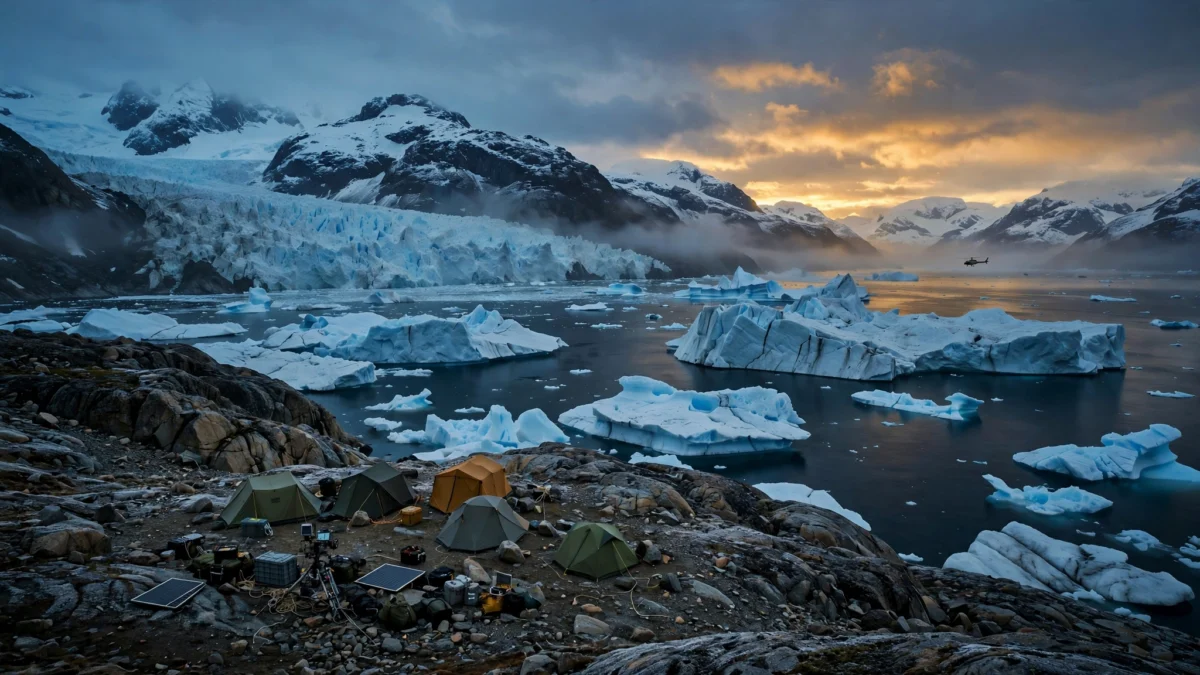
About 80 percent of the island is covered by a mile-thick polar ice sheet, according to CNN. Many of the deposits that excite prospectors sit in remote areas above the Arctic Circle, far from roads, ports or power.
The reaction from Nuuk underscored a persistent gap between Trump’s rhetoric about Greenland and what is actually happening on the ground. Naaja H. Nathanielsen, who represents Greenland in the Danish parliament, told Danish broadcaster TV2 that she believes Trump used the post to get attention, and that she does not attach significance to his calling the island “our Greenland,” according to the AP.
Representatives from Denmark’s Ministry of Foreign Affairs, Greenland’s prime minister and the island’s mining ministry did not immediately return requests for comment on Wednesday, the AP reported.
The September Security Deal That Preceded the Announcement
Trump’s post landed just three weeks after the United States, Denmark and Greenland signed a security agreement intended to cool the long-running confrontation over the island’s future. The deal was signed on September 22, 2026, on the sidelines of the United Nations General Assembly, with Trump shaking hands with Greenland’s Prime Minister Jens-Frederik Nielsen while Denmark’s Prime Minister Mette Frederiksen looked on, according to AP photographs of the event.
The agreement allows the United States to modernize and expand operations at Pituffik Space Base and to establish additional defense areas at Narsarsuaq and Mestersvig, while proposing further sites when required for the defense of Greenland, North America and NATO territory. It grants American aircraft, ships, forces and vehicles broad access between those areas and calls for stronger NATO planning, exercises and intelligence collection in the Arctic.
It also bars non-NATO states from establishing military installations or making investments in Greenland without the written agreement of the parties, and it includes provisions on resource extraction and “minerals cooperation” among the three governments, according to The Hill’s reporting on the text.
Crucially, the agreement begins with an explicit acknowledgment of Denmark’s sovereignty and of Greenlanders’ right to self-determination, according to CNN. Trump at the time claimed the deal gave the United States “permanent control” over Greenland’s security — a characterization that stood in tension with the document’s own language.
The pact does not grant the United States any special exploration rights, the AP noted, and it remains subject to further legislative steps: it is expected to undergo a second reading in Greenland’s parliament before a vote, with lawmakers expected to pass the legislation.
Danish security policy adviser Jacob Kaarsbo said Trump’s new comments suggested the September deal had not changed the president’s underlying intentions. “It is extremely dangerous to view this agreement between the Trump administration and Denmark as something that has altered Trump’s intentions,” Kaarsbo said, according to a report carried by Devdiscourse.
What Greenland Actually Holds — and What It Doesn’t
Geologists have long known that Greenland is resource-rich. The U.S. Geological Survey has identified major potential offshore deposits of oil and natural gas, and the island holds large deposits of rare earth minerals — the materials needed for computers, smartphones, batteries and the solar and wind technologies central to the energy transition, according to the AP.
China currently dominates the world’s supply of those critical minerals, and the Trump administration has made breaking Beijing’s chokehold on them a stated priority.
But the history of trying to turn Greenland’s geology into commerce is a history of failure. Oil exploration has been going on around the island since the 1970s, involving majors including ExxonMobil, Shell and Eni, according to OilPrice. None of those efforts has ever produced a major discovery, and no exploration campaign has ever progressed beyond the exploratory stage, the AP reported.
Greenland’s own government stopped issuing new oil and gas exploration licenses in 2021, citing environmental and climate concerns. Some previously issued licenses remain valid but require additional approvals before any drilling can proceed, according to Newscord’s reporting.
The government is currently reviewing whether a Texas firm, Greenland Energy, can use permits that predate the 2021 prohibition. The company said in August that it plans to drill for oil in 2027 in an untested basin on Greenland’s east coast, although it lacked its own permit to do so, according to Devdiscourse. The U.S. Greenland Energy Company has separately said it will fund 100 percent of the costs associated with up to two exploration wells designed to delineate the hydrocarbon potential of a project in the Jameson Land Basin, according to OilPrice — but the company postponed its planned drilling campaign until winter 2027 after project equipment was brought ashore without prior approval by Greenland’s government.
The Strategic Geography Behind the Words
Greenland’s location is the other half of Trump’s argument, and it is the half that explains why American presidents have coveted the island for generations. The island lies on the shortest route for missiles between Russia and the United States, a fact that made it central to Cold War defense planning and now to Trump’s proposed “Golden Dome” missile defense shield, according to Morningstar’s market coverage.
That strategic logic has survived every shift in American politics. What has changed is the manner of the pursuit. Since returning to the White House, Trump has repeatedly threatened to take control of Greenland, an autonomous territory of Denmark, angering European and NATO partners, according to CNN. The September security deal was supposed to settle those tensions; Trump’s Wednesday post, with its “our new and beautiful Greenland,” reopened them in a single sentence.
Markets noticed. Shares in 80 Mile PLC, an AIM-listed exploration and development company that describes itself as the “current custodian of the three largest commodity projects in Greenland,” rose 23 percent in London trading on Wednesday after Trump’s post, according to Morningstar. The company holds polymetallic assets in Greenland covering titanium, nickel, copper, lead, zinc and platinum group metals.
The AP also placed the announcement against domestic politics: rising energy prices are creating financial strain ahead of the midterm elections on November 3, and Trump’s comments Wednesday were likely aimed at addressing voters’ concerns before they head to the polls.
Analysis: Why It Matters
The announcement is a signal, not a plan
The first thing to notice about Wednesday’s post is what it does not contain. There is no start date. There is no named operator, no license, no basin, no port that will serve it, no pipeline that will carry anything away. The closest thing to a concrete project in the public record remains the Texas firm’s stalled plan to drill one well in winter 2027 — a plan that was postponed after the company moved equipment ashore without Greenland’s permission.
That is not how resource megaprojects begin. It is, however, exactly how political pressure campaigns begin: with a headline the size of a continent and details to be supplied later, if ever. The question for anyone watching Greenland is therefore not “when does drilling start” but “what is this post meant to change.” The answer looks like leverage — over Nuuk, over Copenhagen, and over the investment climate for anyone thinking about Arctic minerals while Washington is visibly interested.
Nuuk’s contradiction is the story
The most important line of Wednesday’s story did not come from the president. It came from Greenland’s deputy mining minister: “very far away from ‘massive’ exploration.”
That single sentence does more work than the entire Truth Social post, because it is anchored in facts that do not move with the news cycle. Roughly four-fifths of the island is ice. There is a moratorium on new oil and gas licenses. The one American company currently associated with a concrete drilling plan was pushed back to 2027 for procedural reasons. Exploration, in the words of the minister who actually signs the permits, means small, slow, multi-year work — not the “massive” campaign Trump described.
The contradiction also reveals something about the September security agreement. Nuuk and Copenhagen agreed to a framework that recognized their sovereignty in writing. Trump’s post behaves as though the signature changed the island’s legal status. It did not — and the Greenlandic parliament has not even finished voting on it. A post cannot amend Greenlandic licensing law, confer rights over a petroleum field, or replace the administrative decisions that exploration requires. Only Nuuk can do that, and Nuuk just said: not soon.
“Our Greenland” is the phrase that matters most
The resource claim will fade; the possessive will not. Greenland is a self-governing territory of Denmark, not a part of the United States, and its people have a recognized right to self-determination — a right the September agreement explicitly reaffirmed. When a sitting president calls it “our new and beautiful Greenland,” allies hear something different from resource policy. They hear the annexation threat returning through the side door, dressed in commercial language.
Nathanielsen’s dismissal — that she does not attach significance to the phrase — is itself a diplomatic strategy: refuse to let a social-media post become an international incident. But Kaarsbo’s warning cuts the other way: treating the September agreement as proof that Trump’s intentions changed, he argued, would be “extremely dangerous.” Both reactions can be true at once. That is what makes this story volatile rather than merely noisy.
The real stakes are the minerals, and China knows it
Strip away the theatre and the genuine strategic competition comes into focus. The world’s clean-energy transition runs on materials that are disproportionately controlled by China. Greenland’s rare earths — encased in rock, hard to extract, expensive to process — represent one of the few Western-controlled alternatives, however distant. The September agreement’s minerals-cooperation provisions were the substantive core of the deal; Trump’s post is, in a sense, the commercial volume turned all the way up.
That is why the market reaction matters. A 23 percent jump in 80 Mile is not a verdict on geology; it is a verdict on momentum. Investors are pricing in the possibility that American political attention will eventually clear the path that ice, distance and licensing law currently block. They may be right or wrong about the timeline, but they are right that the direction of travel is toward Greenland mattering more, not less, in the great-power competition for the Arctic.
The midterm calendar is part of the geology too
It is not an accident that this post arrived three weeks before the midterm elections, after an Alaska campaign event, against a backdrop of rising energy costs. “Massive” oil from the Arctic is a promise of abundance aimed at voters feeling the price at the pump. The AP’s reporting makes the connection explicit. Whether Greenland ever produces a barrel for the American market is almost beside the point for that audience: the image of vast reserves, available, American-adjacent, does the political work all by itself.
What to Watch Next
- The official response from Nuuk and Copenhagen. Neither Greenland’s prime minister nor Denmark’s Foreign Ministry had responded by Wednesday morning, according to the AP. Their language — dismissive, concerned, or silent — will signal whether this becomes a diplomatic incident or a one-day story.
- The Greenlandic parliament’s vote. The September security agreement still needs its second reading and a vote. If the deal sails through, it weakens the idea that Trump’s post has derailed the framework. If the debate turns hostile, the post will have cost something real.
- Any permit, anywhere. The test of the announcement is administrative, not rhetorical: does any company announce a new Greenland license, a funded drilling program, or a minerals offtake deal in the coming weeks? Watch the Jameson Land Basin and the east-coast basin first.
- The Greenland Energy review. The government’s decision on whether the Texas firm’s pre-2021 permits can be used will be the first concrete signal of how permissive Nuuk intends to be under its licensing moratorium.
- The Arctic’s other powers. Russia has expanded its military posture across the High North, and China has spent years pursuing influence over critical-mineral supply chains. Their reactions — and whether NATO’s Arctic posture shifts — will determine whether this stays a bilateral dispute or becomes an alliance one.
Sources
- CNN — “Greenland contradicts Trump’s claim that ‘massive’ oil and gas drilling is about to begin there” (October 14, 2026)
- Associated Press via WVLT — “Trump says oil, gas and mineral exploration in Greenland is set to begin. It’s not that simple” (October 14, 2026)
- USA Today (with Reuters) — “‘Massive’ resource exploration to start in Greenland, Trump says” (October 14, 2026)
- OilPrice.com — “Trump Announces ‘Massive’ Greenland Oil Exploration Plans” (October 14, 2026)

About the Author — Abdul Mannan
Related Articles
Kremlin Rejects Zelenskyy’s 60-Day Ceasefire for Ukraine Elections, Offers Halt Only on Election Day
Moscow has rejected Volodymyr Zelenskyy's offer to hold wartime elections during a 60-day ceasefire, insisting on a lasting…
Russia Launches Overnight Barrage on Ukraine’s Energy Grid, Leaving More Than 600,000 Without Power
Russia fired 39 ballistic missiles and more than 120 drones at Ukrainian energy sites overnight, leaving more than…
Nord Stream Trial Opens in Hamburg as Ukrainian Ex-Officer Denies Pipeline Sabotage Charges
A former Ukrainian officer has gone on trial in Hamburg over the 2022 explosions that ruptured the Nord…