
Google’s Willow Chip Cuts Magic-State Errors 40-Fold in Quantum Computing Breakthrough

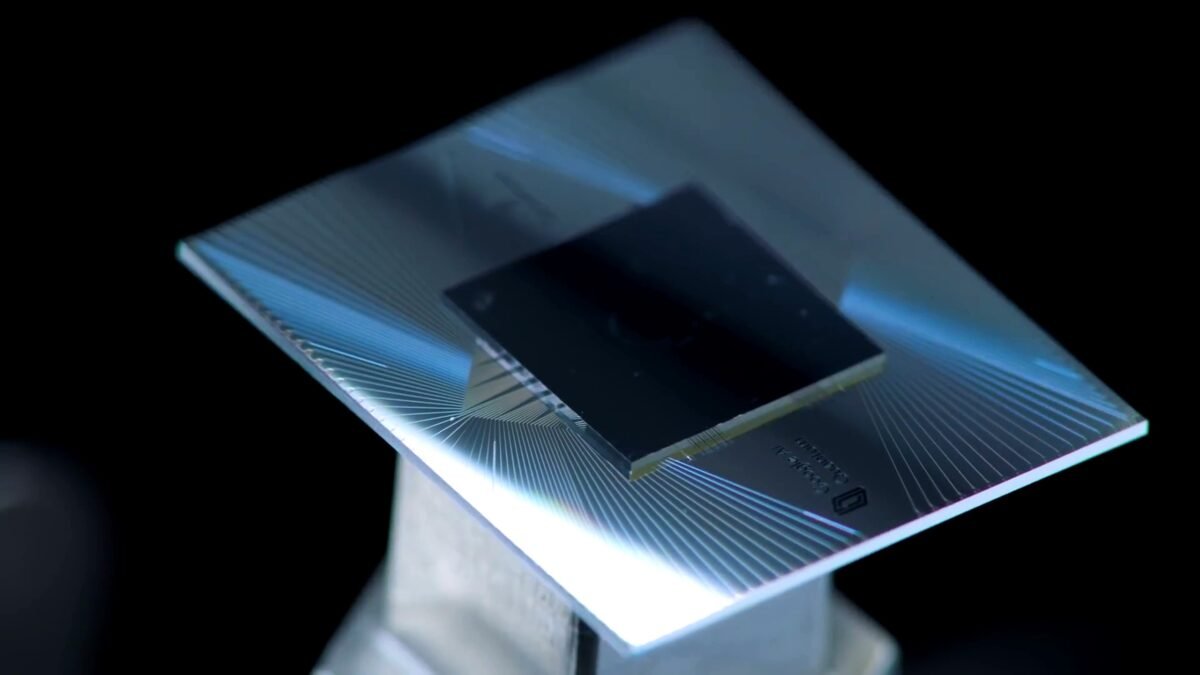
Google has announced what it calls a breakthrough in one of the most stubborn engineering problems in quantum computing, demonstrating a new method for preparing the fragile “magic states” that future machines will need with about 40 times fewer errors than before. The result, published on Thursday in the journal Science, is the first time the technique — dubbed “magic state cultivation” — has been shown working on real hardware, according to the company.
The experiment ran on Willow, Google’s 105-qubit superconducting quantum processor, and achieved T-type magic states with a record logical fidelity of 99.99 per cent, meaning an error rate of one in 10,000, according to Google Quantum AI’s announcement. The technique works like a filter: a noisy quantum state is injected into a small region of the chip, then subjected to rounds of carefully coordinated measurements that detect and discard flawed attempts, allowing the surviving state to be grown into a larger, cleaner encoding.
The finding matters because magic-state production has long been recognised as a crippling bottleneck on the road to practical quantum computers. Some estimates suggest that preparing high-quality, error-corrected magic states could consume up to 95 per cent of a quantum computer’s total capacity, leaving little room for actual calculation, according to Google’s researchers. Since magic states are consumed each time they are used and cannot be re-used, a working machine would need to produce them continuously.
“On Google Quantum AI’s Willow processor, our protocol achieved an extraordinary 40-fold reduction in errors relative to un-cultivated states,” the company said in its announcement, describing the work as “the first demonstration of a practical solution to one of quantum computing’s most severe resource bottlenecks.”
The cultivation idea itself was developed in 2024 by Google researchers Craig Gidney, Noah Shutty and Cody Jones, who took a concept from the literature, refined it, and argued it could yield an especially large reduction in magic-state cost. Until this week, it had been tested only in theory and simulation, according to the Quantum Computing Report’s account of the paper.
Turning theory into hardware took substantial engineering. Google research scientist Emma Rosenfeld initially encountered measurements that appeared to violate the laws of physics; after months of investigation, the team traced the anomaly to noise from drifting electrical equipment and temperature variation in the lab that was corrupting the benchmark itself, according to Google’s account. The team added extra control hardware to suppress the noise and invented a new benchmarking method that uses cultivation to measure its own performance, establishing what the company calls a new state-of-the-art in quantum metrology.
The team also demonstrated that purified states can be moved between two different error-correction schemes — grafting a state from a “distance-3 color code,” a newer correction method well suited to cultivation, into a “distance-5 surface code,” the more established scheme Google’s architecture relies on — showing that the technique integrates with the processor’s existing design.
A 20-year bottleneck, addressed on hardware
Researchers have understood the magic-state problem since 2004, when Bravyi and Kitaev introduced the concept of magic-state distillation and showed how special quantum states could enable the full set of operations — the non-Clifford gates — needed for universal quantum computation. For two decades the field has steadily chipped away at the cost, but traditional distillation protocols were projected to consume the vast majority of a machine’s physical qubit footprint, according to the Quantum Computing Report.
Cultivation departs from the distillation approach. Rather than cascading many rounds of factories that chew through enormous numbers of physical qubits, the technique starts small: a noisy candidate state is placed in a compact patch of the chip, measurements identify and throw out the flawed attempts, and the surviving state is grown into a more robust encoding. On Willow, about 8 per cent of attempts passed every check, according to reports of the paper’s data. The experiment used at most 54 of Willow’s 105 qubits.
Google says that if the method holds at larger scales, it could substantially reduce the size of the machine needed for practical tasks. The company has not given a timeline for commercially useful quantum computers, and it acknowledges that demonstrating cultivation at a larger scale remains necessary before it can support practical fault-tolerant computing.
Why the crypto world is watching
The announcement has drawn close attention from the cryptocurrency industry, because the same engineering advances that shrink a future quantum computer also tighten estimates of the machine that could threaten public-key cryptography. Google has said that a powerful enough quantum computer could, in theory, work out a wallet’s private key from its public key, and in March it estimated that under specific hardware assumptions such an attack might require fewer than 500,000 physical qubits.
According to CoinDesk’s analysis, the 40-fold figure does not make a Bitcoin attack 40 times cheaper: the experiment achieved about 1 in 10,000 fidelity among states that passed inspection, but one modelled attack would require roughly 500,000 reliable magic states per second — a scale orders of magnitude beyond what was demonstrated. The TFTC newsletter similarly noted that the achieved error rate is still about a million times too noisy for cracking Bitcoin’s elliptic-curve keys.
What the result does change, according to those analyses, is the cost of the single most expensive ingredient in every blueprint for a cryptographically relevant machine. Since Google’s earlier cost estimates for such attacks already assumed an efficient magic-state preparation scheme, the new result should not be read as a simple 40-fold discount on a Bitcoin attack — but as one more component of the machine that would eventually try it moving from theory to engineering practice.
Early wallets are the theoretical exposure point: some Satoshi-era wallets have had their public keys visible on the blockchain since they were mined, while wallets whose public keys remain undisclosed face different conditions, according to ChainCatcher’s summary of the discussion.
Google’s larger quantum roadmap
Willow, unveiled in December 2024, is the chip on which Google previously demonstrated quantum error correction below the surface-code threshold — the point at which adding more physical qubits reduces rather than increases the logical error rate. That result, also published in Nature-family journals, was hailed as a necessary milestone for any useful machine.
The company has framed its long-term goal as building a useful, error-corrected quantum computer capable of solving problems classical machines cannot — from drug discovery and materials science to optimisation and machine-learning workloads. The magic-state result removes one of the largest items from the cost ledger of that ambition, even as the remaining ledger — coherence, scale, speed, and integration — stays long.
Google is not alone in the chase. IBM, Amazon, Microsoft, IonQ and several Chinese research teams have announced their own roadmaps toward fault-tolerant machines, and the field as a whole has moved from demonstrations of “quantum supremacy” on narrowly chosen benchmarks toward the harder problem of building machines that do something useful.
Analysis: Why It Matters
Most quantum-computing headlines promise that the future is suddenly closer. This one is different: it is unusually precise about what changed, what did not, and how far remains. The 40-fold error reduction is real and peer-reviewed in Science; the 8-per-cent yield, the 54-qubit ceiling of the demonstration, and the absence of any timeline are equally real. The honesty of the caveats is itself notable in an industry fond of triumphalism.
The result’s deepest significance lies in efficiency, not speed. For two decades, every serious blueprint for a fault-tolerant machine has carried a staggering hidden line item: the overwhelming majority of its capacity devoted not to computing, but to manufacturing the magic states the computation consumes. If cultivation can genuinely collapse that line item, the machine needed for a useful task gets smaller, cheaper, and more buildable. That is the kind of unglamorous engineering step — cost accounting made physical — on which entire technology eras pivot.
There is also a methodological lesson in Emma Rosenfeld’s detour. Months of apparently physics-defying data turned out to be an artefact of the measurement apparatus, not a breakthrough. The team responded by building a benchmark that uses cultivation to measure itself, turning the instrument’s weakness into a feature. In quantum computing, where every result is a fight against noise at the edge of measurability, trustworthy measurement is half the battle — and this week’s paper is as much a metrology achievement as a physics one.
For the cryptocurrency industry, the sober reading is the right one. Nothing demonstrated this week can touch Bitcoin, and analysts agree the achieved fidelity is nowhere near attack scale. But the long-standing comfort of “millions of qubits away” rested on specific assumptions about how expensive magic states would be — and this paper just rewrote that assumption with hardware data. The quantum threat clock did not strike midnight; but one of its slowest-moving hands just twitched.
Finally, the code-switching demonstration deserves attention beyond the headline numbers. Showing that a purified state can be grafted from a color code into a surface code — that the new ingredient actually fits the existing architecture — is what separates a laboratory curiosity from a roadmap item. Google’s claim that cultivation is compatible with its hardware architecture is the part of the paper that moves this from interesting to deployable, whenever the scaling work catches up.
What to Watch Next
- The scaling demonstration. Google says larger-scale cultivation trials are the next hurdle. Watch for a paper showing the technique working across hundreds of qubits with yield improvements — that is the result that would move this from milestone to method.
- Independent replication. Peer review at Science is strong, but the field will want to see another lab or another chip reproduce the error-reduction figures before treating cultivation as the standard path.
- Google’s revised cost models. The company has previously published estimates of the machine needed to threaten cryptography. Watch for an updated “Q-day” estimate incorporating cultivation — how much smaller does the threat machine get?
- The colour-code frontier. The grafting protocol relies on distance-3 color codes feeding surface codes. Expect follow-up work pushing colour-code distances higher and testing whether cultivation scales within them.
- Rival responses. IBM, Amazon and Microsoft each have their own fault-tolerance roadmaps. Whether they adopt cultivation-like filtering or double down on distillation factories will say much about which architecture the industry converges on.
Sources

About the Author — Abdul Mannan
Related Articles

Apple’s First Foldable iPhone Duo Sells Out Within Hours as Preorders Open at $1,999
Apple's first foldable iPhone, the $1,999 iPhone Duo, opened preorders on October 16 and sold out within hours,…

Tesla Unveils Flying Second-Generation Roadster With Rocket Thrusters, Nine Years After the Promise
Tesla unveiled its redesigned second-generation Roadster at a SpaceX test site in Texas, demonstrating cold-gas thrusters that let…

Scientists Map a Distant Exoplanet’s True Egg-Shaped Atmosphere for the First Time
Using NASA's James Webb Space Telescope and a new "transmission strings" technique, a Cornell-led team has resolved the…