
Tesla Unveils Flying Second-Generation Roadster With Rocket Thrusters, Nine Years After the Promise

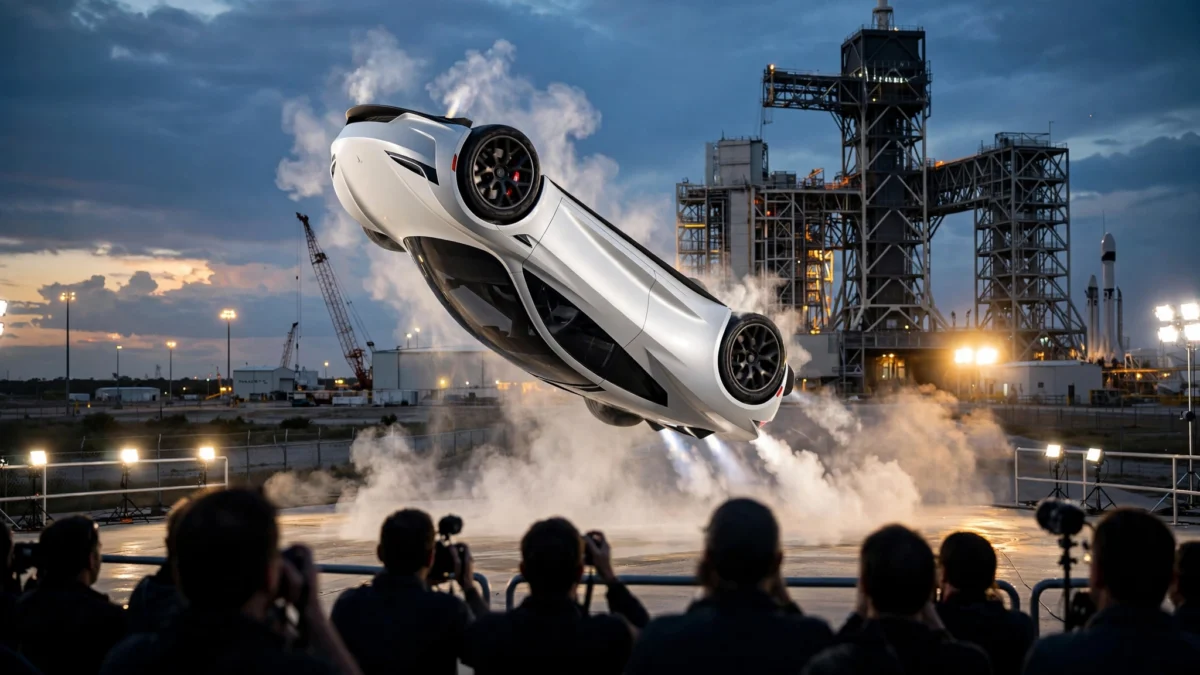
Nine years after it was promised, Tesla’s second-generation Roadster has finally arrived — and it left the ground. On Thursday night, October 15, at a SpaceX rocket test facility in McGregor, Texas, Elon Musk unveiled a completely redesigned Roadster and then demonstrated something no carmaker has ever demonstrated: the car flew.
The livestreamed event, which began at about 7:55 p.m. Central time, was staged outdoors at the SpaceX site where rocket engines are test-fired — an appropriate venue, because this Roadster is as much a SpaceX product as a Tesla one. Before a live audience and millions watching online, the car accelerated to 60 mph in roughly a second, drove up a curved, inverted ramp using a fan-based suction system, clung upside down to the surface, fired its cold-gas thrusters to spin through a barrel roll in mid-air, and landed safely back on the pavement. In a second demonstration, the Roadster used its thrusters to jump over a line-up of Tesla’s current models — a Cybercab, a Cybertruck, a Semi, a Model Y and a Model 3 — in a maneuver Tesla engineers called a “kick flip.” A final trick sent the car launching straight up from the ground for a corkscrew.
“Flying cars are real,” Musk declared on stage, in one of several lines that immediately went viral. “Well, it worked,” he said after the first successful flip, acknowledging that even Tesla was not certain the demonstration would go off without a hitch.
The Technology: Thrusters, Suction and Compressed Air
The secret to the Roadster’s acrobatics is a combination of two systems working together: fans mounted under the car that generate downforce through suction, and cold-gas thrusters developed in collaboration with SpaceX that use compressed air rather than any separate fuel.
According to Tesla engineering vice president Lars Moravy, who presented the car alongside Musk and design chief Franz von Holzhausen, the Roadster uses 10 thruster nozzles connected to 600 liters of compressed air to lift and spin the vehicle. Tesla says every usable void in the car is packed with carbon fiber overwrapped pressure vessels — COPVs, the same technology SpaceX uses to store high-pressure gas on its rockets. The more compressed gas the car carries, the longer it can sustain flight maneuvers.
Musk said the thrusters deliver 80 kilonewtons of thrust — an unusual unit for measuring automotive performance — and joked that the upper limit of the car’s acceleration would be around the point where g-forces cause the retina to detach. The fan system, meanwhile, generates more than 2 Gs of downforce, enough for the car to stick to a vertical surface or even a ceiling. In a live test at the event, the Roadster accelerated from 0 to 60 mph in 0.81 seconds, and video shown earlier in the evening displayed a run at roughly one second. Musk also floated a long-term target of reaching Mach 0.5 — about 383 mph — a figure that would more than halve the 1.9-second 0-60 time promised when the next-generation Roadster was first shown in 2017.
Three Versions, One That Can Fly
Tesla confirmed the Roadster will be offered in three configurations. The Performance version is a two-seater with active aerodynamics and the multi-mode suction system, aimed at road use, with a claimed 0-60 time under 1.6 seconds. The Thrust version adds rear-mounted cold-gas thrusters and is described as race-ready, with a claimed 0-60 under 0.9 seconds. The Rocket version — a single-seater with a full perimeter-mounted thruster setup for forward, upward and lateral movement — is the one that can actually fly, and it is invitation-only and not approved for public road use.
The redesigned car itself is a sharp departure from the svelte prototype shown in 2017. It wears an angular, Cybertruck-inspired design with a wedge profile, gullwing doors, a steering yoke in place of a conventional wheel, steer-by-wire, brake-by-wire and throttle-by-wire controls, seats moulded into the chassis, and an active rear wing. The SpaceX hardware is visible in plain sight: round ports low on the rear fascia are cold-gas thruster nozzles.
Production is scheduled to begin in 2028, according to Musk. US deposits are $50,000 for the Performance configuration and $250,000 for the Thrust version, with final pricing yet to be announced. The New York Post reported the redesigned car’s price as $200,000. Musk told the audience the Roadster would be “the actual car that’s on the roads,” insisting the flying prototype was close to production intent.
Nine Years Late — and a Company Transformed
The reveal lands nearly nine years after Tesla first showed the next-generation Roadster in 2017, when the car was originally promised for 2020. The delay is among the longest for any product Tesla has ever announced, and it unfolded as the company transformed around the car it kept postponing.
As Reuters noted ahead of the event, the Roadster reveal arrives amid a sharp shift in Tesla’s focus from manufacturing cars for human drivers to artificial-intelligence-led self-driving technology and robotics. This year, Tesla stopped selling its Model S and Model X vehicles to free up production space for its Optimus humanoid robots, and it launched the Cybercab — a two-seater robotaxi that comes without a steering wheel, pedals or mirrors.
That context gave Musk’s framing of the Roadster a valedictory quality. He called it “the best of the last of the human-driven cars” and said that, long-term, the Roadster would be the only manually driven car Tesla makes. “If you’re going to have only one manually driven car, let’s take it to the limits and way past the limits,” he told the crowd.
The original Roadster, introduced at Santa Monica Airport in July 2006 with production beginning in 2008, was built on a Lotus Elise–based chassis and is credited with changing the public perception that electric cars were slow or dull. Its early production versions reached 60 mph in about 4.6 seconds with a lithium-ion battery pack delivering more than 200 miles of range — numbers that look almost quaint next to the 2026 car’s claimed capabilities.
Analysis: Why It Matters
The Roadster reveal is best understood not as a product launch but as a piece of industrial theater — and one of unusual technical substance. Car launches typically traffic in design and acceleration figures. This one borrowed the venue, the hardware and the vocabulary of a rocket test. Staging the event at a SpaceX test site was not merely a visual flourish: it was the point. The thrusters are genuinely SpaceX-derived, the pressure vessels are genuinely rocket hardware, and the car is the first physical product of the Tesla-SpaceX collaboration Musk has been describing for years.
The engineering, however, raises questions that spectacle does not answer. Compressed-air cold-gas thrusters are elegant in one respect — they need no separate fuel and the air tank can be recharged — but they are, as observers noted during the livestream, deafeningly loud, and the back-blast of compressed air is violent enough that Tesla activated the thrusters only briefly near the audience. The company’s own product segmentation tells the real story: the one version that can fly is invitation-only and not road-legal. What customers can actually buy, whenever production begins in 2028, will be a very fast sports car with impressive downforce — which is not the same thing as the flying machine on stage.
There is also the matter of credibility, and Tesla’s history makes it unavoidable. The next-generation Roadster was promised for 2020. Six years passed without a production car, during which the company shipped Cybertrucks, launched a robotaxi program and pivoted its entire manufacturing strategy toward humanoid robots. Musk’s own candor on stage — that safety “had not been the top design priority” and that flying the car might not be “legal in all jurisdictions” — reads as charm, but it is also a legal firewall. Enthusiasm is doing a lot of work that engineering certification has not yet done.
Yet it would be a mistake to dismiss the Roadster as vaporware with better lighting. The demonstration was real: an unmanned car drove up a curved ramp, hung upside down, spun in the air and landed. Suction-based downforce of more than 2 Gs and 80 kilonewtons of vectorable thrust are genuine capabilities, and the claim that the car could “crush every track record that has ever existed” is at least plausible on the numbers presented. The Roadster is a technology demonstrator in the lineage of concept supercars — its job is to make the impossible visible, and on that metric the night was a success.
Finally, the timing of the reveal matters as much as its content. Tesla’s stock has been under pressure amid broader investor skepticism about AI valuations, and the company is asking shareholders to believe in a future of robotaxis and humanoid robots while its core car business faces intensifying competition. The Roadster is a halo: a reminder of the company’s founding mythology — fast, audacious, human-driven — at precisely the moment Tesla is pivoting away from human drivers. “The best of the last of the human-driven cars” is both a tagline and an epitaph. The car flew on Thursday night; whether Tesla’s car business does in the next decade is the question the show was designed to make you forget to ask.
What to Watch Next
- Final pricing and reservation numbers: With deposits set at $50,000 and $250,000 for the Performance and Thrust versions, the first hard measure of demand will be how many reservation holders convert when final pricing is announced.
- The 2028 production timeline: Tesla’s record on production deadlines is mixed, and the Roadster has already slipped from a 2020 target to 2028. Watch for factory allocation news and any statements about which line will build the car.
- Regulatory response: Musk himself flagged that the flying capability may not be “legal in all jurisdictions.” Aviation and highway safety regulators’ reaction to a thruster-equipped passenger car will set the bounds of what owners can actually do with it.
- The promised follow-up demonstration: Musk joked on stage that a future demo could see the Roadster jump the Snake River like Evel Knievel. Whether Tesla stages a second spectacle — and what it attempts — will show how much of Thursday was engineering and how much was showmanship.
- Technology transfer to other Tesla products: The suction downforce and compressed-air systems could appear, in milder form, in future performance models. Any hint of the Roadster’s technology migrating into the mainstream lineup would turn a halo project into a real R&D investment.
Sources

About the Author — Abdul Mannan
Related Articles
Scientists Map a Distant Exoplanet’s True Egg-Shaped Atmosphere for the First Time
Using NASA's James Webb Space Telescope and a new "transmission strings" technique, a Cornell-led team has resolved the…
NASA’s Perseverance Rover Sets Record for Longest Drive Ever on Another World
NASA's Perseverance rover has driven 28.10 miles on Mars, passing the record Opportunity needed 15 years to set…
James Webb Catches Water Clouds Thickening and Thinning on a Frigid World 7.5 Light-Years Away
Astronomers watching the coldest known brown dwarf with the James Webb Space Telescope recorded the first direct evidence…