
Yellow Vests Return as France Is Engulfed by Cost-of-Living Protests — 166 Arrested, Tear Gas in Paris

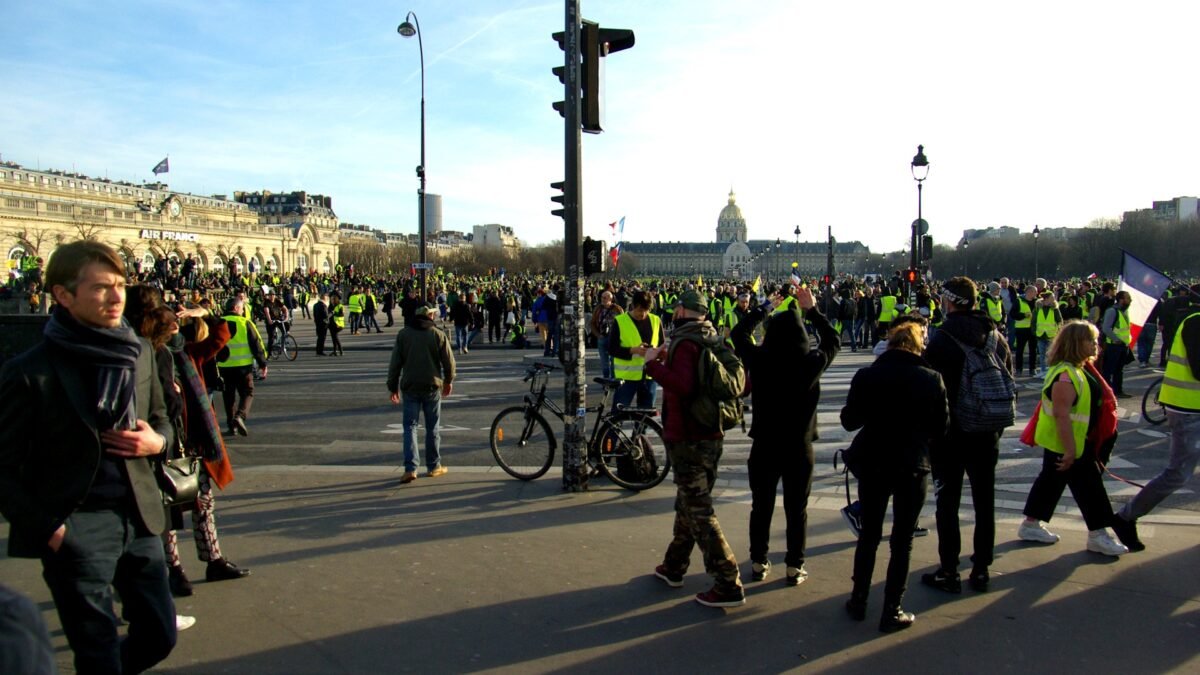
France engulfed by nationwide cost-of-living protests
Cars were set on fire, official buildings attacked and rioters clashed with police across France on Saturday as the country was engulfed in a nationwide day of action against the cost of living, according to The Times. The gilets jaunes — the yellow vests — returned to the streets in force, joining demonstrators angry at rising prices alongside school students who have been protesting for weeks against poor conditions in the country’s schools.
At least 170,000 people were expected to turn out on Saturday afternoon for official marches in Paris and other cities, including Marseille and Lyon, The Times reported. By midday, 166 people had been arrested — 100 of them in Paris alone — according to the interior ministry, many on suspicion of carrying weapons. At least 32,800 people were already involved in 140 demonstrations across the country by that point, some of them clashing with riot police.
More than 10,000 police officers were mobilised nationwide, including some 5,000 in Paris, amid warnings from Interior Minister Laurent Nunez that far-left groups might try to provoke clashes and that road blockades would not be tolerated. Earlier tallies had put the number of arrests in the Paris metropolitan area at 61 during preventive checks in the late morning, according to CNews, cited by Italian wire service LaPresse.
Clashes in Paris, Marseille and Lyon
In Paris, protesters began gathering in the morning at Place de Clichy in the northwest of the capital, before a march due to start at 2.30pm local time and proceed southeast towards Place de la Nation, The Times reported. Clouds of tear gas hung over the northern part of Place de la République, a traditional centre of protest that lies along the route, as police tried to disperse several hundred people who arrived early.
Riot police hit back at a group of young men, dressed in black and wearing balaclavas, who had been firing mortar fireworks and pelting officers with projectiles, according to The Times. Police also deployed water cannon trucks, drenching small groups of demonstrators. In the south of the square, by contrast, there was a carnival atmosphere as around 15,000 people, many carrying flags and banners, danced to samba music.
Authorities had banned demonstrations in several central areas of the capital, including near the Élysée Palace, Matignon and the Champs-Élysées, LaPresse reported. Students, who have been demanding a meeting with Prime Minister Sébastien Lecornu for days, emphasised the need to bring the protest to symbolic areas of the capital to increase political pressure and secure concrete responses on the cost-of-living issue.
In Marseille, where demonstrators were due to gather in the Old Port at 2pm, the first incidents occurred in the late morning, when rubbish bins were set on fire and shop windows smashed, according to The Times. Rioters also smashed the windows of a police station and threw smoke grenades inside. In Lyon, in Place Bellecour, masked protesters launched firecrackers and mortar fireworks at police, who responded with tear gas, while the Rhône prefecture reported police dispersing groups of demonstrators on the Guillotière bridge, at the Feyssine roundabout and near the Feyzin refinery, LaPresse reported.
A movement that began in the schools
The initial wave of protests began last month at high schools in Paris’ poor northern suburbs, where anger over teacher absences and shabby facilities quickly morphed into a nationwide movement against inequality, weak public spending and falling standards, Reuters reported. What started as student anger over overcrowded classrooms and dilapidated buildings has, within weeks, become the broadest challenge to the French government this year.
Saturday’s hundreds of demonstrations were called in part to commemorate the anniversary of the Yellow Vest protests that, according to Reuters, paralysed the country in 2019 — the movement that first made the high-visibility vest the symbol of French street politics. The coalition on the streets on Saturday brought together students, trade unionists, climate activists and the remnants of the original gilets jaunes movement, largely driven by social media mobilisation, LaPresse reported.
“We are fighting because the cost of living is too harsh, because the price of fuel is too high, because high school pupils are being violently attacked and hurt all over the country just for trying to protest and ask for more teachers and decent learning conditions,” said a 19-year-old protester in Paris who gave her name as Lola, quoted by The Independent.
Macron’s government in the “perma-crisis”
The protests come at a difficult time for France, as President Emmanuel Macron enters the final stretch of his presidency, leaving behind a polarised electorate and a fragmented domestic political situation, Reuters reported. Investors have been ditching French debt, driving borrowing costs to their highest levels in more than two decades, underlining the country’s long struggle to get its public finances in order.
Prime Minister Lecornu said on Thursday that authorities feared unrest during the weekend’s protests, Reuters reported. “This is a moment of fatigue in the country,” he said. “We are in an atmosphere of perma-crisis: wars, inflation, and issues surrounding purchasing power.” Lecornu also acknowledged that the students’ grievances were legitimate, while arguing that the wave of demonstrations no longer resembles a student movement but “a movement of urban violence.”
The government blames the hard-left France Unbowed (LFI) party for inflaming the protests, an accusation LFI denies, Reuters reported. Opposition chief Jordan Bardella, whose far-right National Rally leads in the polls ahead of next year’s presidential election, said he expected violence. “I’m extremely concerned,” he said during a visit to the Paris car show. “It will be a day of chaos for France.”
Policing tactics under scrutiny
The police response to weeks of demonstrations has drawn growing criticism. The Independent reported a grisly list of injuries among demonstrators, including one teenager who had his hand blown off after picking up a stun grenade. Reuters documented 28 cases of injuries suffered due to police force, of which 15 are among those under investigation by the IGPN, the police inspectorate. They involve the use of rubber bullets, stun grenades, tear gas, batons and charges on horseback.
Interior Minister Nunez has paused the use of stun grenades pending an investigation into the case of the 15-year-old in Lens, according to Reuters. He said in a radio interview that about 200 students had been injured, but that it was very rarely the result of police action. “Our primary role is, of course, to protect high school students,” he said. Authorities have also said that around 700 police officers have been injured, schools burned or ransacked, and teachers and members of the public attacked, with 6,877 people arrested, mostly minors.
Analysis: Why It Matters
First, this is the yellow vests’ second act — and it matters because the symbol has returned with a broader base. The 2018–2019 gilets jaunes revolt began over a fuel tax and became the defining street revolt of Macron’s presidency. Saturday’s coalition is wider: students, unions, climate activists and the original vest-wearers marching together against the same enemy — a cost-of-living crisis that no longer needs a fuel tax to ignite. Movements with shared symbols have longer memories than governments do.
Second, the speed of the escalation is the story within the story. Six weeks ago this was about teacher shortages in the northern suburbs of Paris. By Saturday it was 170,000 people expected on the streets of three major cities, bins burning in Marseille, a police station’s windows smashed, and mortar fireworks traded for tear gas in Lyon. France has a long tradition of school protests becoming proxies for general social anger — but the conversion rate this autumn has been unusually fast, because the underlying grievances about purchasing power were already fully loaded.
Third, Lecornu’s “perma-crisis” admission is a political tell. A prime minister who publicly describes his country as being in an atmosphere of permanent crisis — wars, inflation, purchasing-power pain — is not managing a moment; he is managing expectations. With borrowing costs at two-decade highs and a public debt crisis the government cannot spend its way out of, the street’s demands for more teachers, better services and lower prices collide directly with the treasury’s arithmetic.
Fourth, the policing question has become inseparable from the politics. France stands out in Europe for its use of “less lethal” weapons such as rubber bullets and stun grenades in public-order policing, and the injury ledger — 28 documented cases, a teenager who lost a hand, eyes injured — has put the tactics themselves on trial. Every further confrontation now carries the risk of producing the next symbol of police violence, which is exactly how street movements gain their martyrs and their momentum.
Fifth, the timing is electoral dynamite. With Macron in the final stretch of his presidency and next year’s presidential election already shaping up around a National Rally that leads the polls, every Saturday of unrest is a campaign video for the extremes — Bardella’s right warning of chaos, LFI’s left organising in the streets. Lecornu’s government, blamed from both flanks, is governing a country where the bond market, the classroom and the street are all signalling at once.
What to Watch Next
- The final turnout and arrest figures from Saturday evening, when Paris marches traditionally produce the day’s sharpest confrontations.
- Whether the government announces concrete concessions to the students’ education demands — or doubles down on the security framing.
- The IGPN investigation into police use of stun grenades and the political fallout from further injury cases.
- France’s borrowing costs and the budget debate in parliament, where the debt crisis meets street pressure head-on.
- Whether Saturday becomes a one-off day of action or the start of a sustained autumn of demonstrations as the 2027 election approaches.
Sources
- Reuters — “Students, trade unions, yellow vests set to protest across France” (17 Oct 2026)
- The Times — “France protests: students and cost of living riots collide” (17 Oct 2026)
- The Independent (via EuropeSays) — “Dozens arrested in Paris as tens of thousands expected to protest across France” (17 Oct 2026)
- LaPresse — “France: protests against the high cost of living, 61 arrests in Paris and tensions in other cities” (17 Oct 2026)

About the Author — Abdul Mannan
Related Articles
Youth Protests Escalate in Albania as Thousands Demand PM Edi Rama Resign
Thousands of young Albanians marched through Tirana this week demanding Prime Minister Edi Rama resign, as the leaderless…
Trump Waives Most of the Lindsey O. Graham Sanctions Law, Shelving Russia Tariffs Two Days Before They Took Effect
President Trump signed an executive order Friday waiving most of the Lindsey O. Graham Sanctioning Russia and Iran…
Putin Declares New ‘Security Zone’ Inside Ukraine Non-Negotiable as Moscow Widens Its Territorial Claims
Putin, in military uniform at a command post, said the 660km zone — 70% already under Russian control…