
Hamas Widens Search for Hostage Remains as Egypt Sends Excavators; Trump Sets 48-Hour Watch

Hamas has expanded its search for the remains of Israeli hostages buried in the Gaza Strip, the group announced on Sunday, a day after Egypt deployed a team of experts and heavy equipment into the territory to help recover the bodies — as United States President Donald Trump warned that he was “watching very closely” and demanded Hamas return more bodies within the next 48 hours.
The development puts the grimmest part of the United States-brokered ceasefire — the return of the dead — at the centre of efforts to keep the fragile truce alive. Under the ceasefire, which took effect on 10 October, Hamas is expected to hand over the remains of all Israeli hostages as soon as possible, while Israel has agreed to return 15 bodies of Palestinians for every Israeli body recovered, according to the Associated Press.
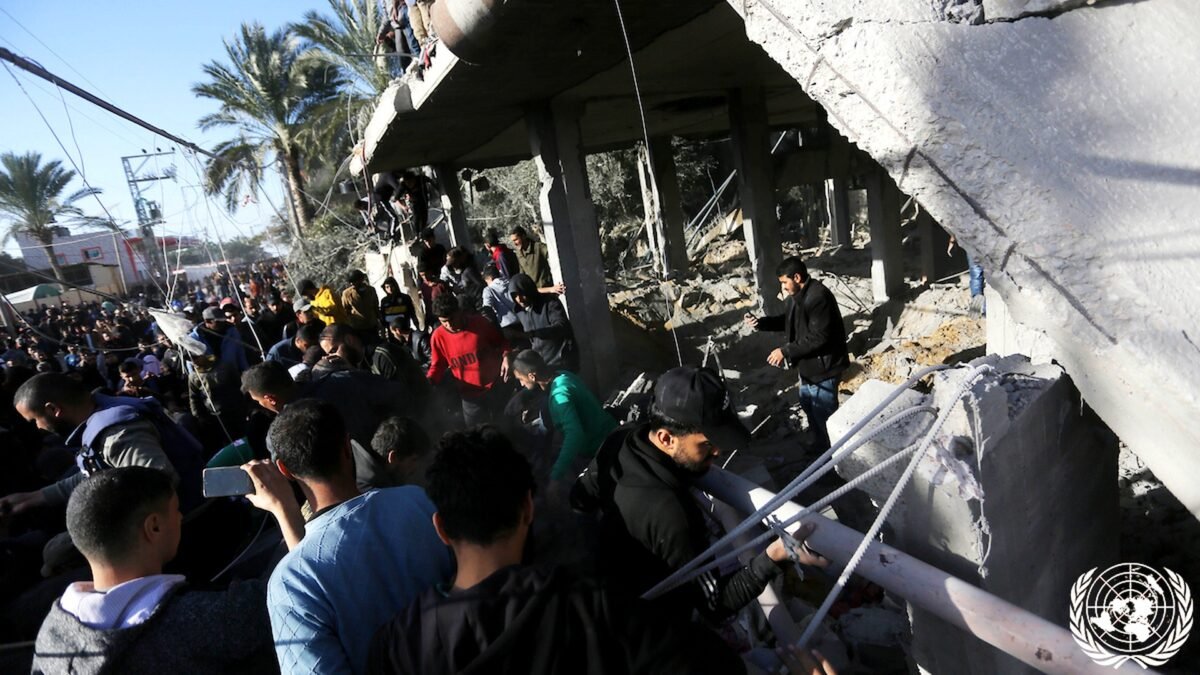
Children and residents watched on Sunday as Egyptian machinery clawed through the sand near badly damaged buildings in the southern city of Khan Younis, the AP reported, part of an international effort to retrieve bodies from under the ruins of more than two years of war.
The urgency is plain in the numbers. Hamas has returned the remains of 15 hostages but has not handed over any for five days, according to the AP. Hamas’s chief in Gaza, Khalil al-Hayya, said the group had begun searching new areas for the bodies of the 13 hostages that remain, according to comments shared by the group on Sunday. Israel, for its part, has returned the bodies of 195 Palestinians, many of them unidentified.
Egypt’s machinery rolls into Gaza
The Egyptian team entered Gaza on Saturday carrying an excavator and bulldozers, two Egyptian officials told the AP on condition of anonymity because they were not authorised to speak to the media. Their deployment is part of a push by international mediators to shore up the ceasefire, which has held despite repeated strains.
The equipment matters because Gaza’s own machinery was largely destroyed in the war. Hamas has repeatedly said its efforts to retrieve the remains face severe challenges because of the scale of the destruction — a claim its negotiators have pressed with mediators. Al-Hayya told an Egyptian media outlet last week that the massive destruction had buried the bodies deep underground, according to The Gazette’s account of the AP report.
Children and onlookers gathering around the Egyptian machines in Khan Younis offered a small window onto the scale of the task: a city of flattened buildings and churned earth where locating a single grave can take days. International media have been barred from Gaza aside from brief visits accompanied by Israel’s military, and Israel said on Sunday that the restriction had not changed, according to the AP.
Trump’s 48-hour warning
On Saturday, Trump posted on social media that he was “watching very closely” to ensure Hamas returns more bodies within the next 48 hours.
“Some of the bodies are hard to reach, but others they can return now and, for some reason, they are not,” he wrote, according to the AP.
The warning fits a pattern: Trump has repeatedly used public deadlines to pressure Hamas since brokering the deal, and Israeli officials have echoed the pressure. Prime Minister Benjamin Netanyahu has said Israel “will not compromise” on the return of the hostages’ bodies, and Defence Minister Israel Katz has said he instructed the military to prepare plans in case the war resumes, according to reporting by the BBC cited by the News Point app.
Hamas says it is working to close the file. The group’s armed wing has said the remaining bodies “require significant efforts and specialised equipment to search for and retrieve,” and that it is making a great effort to bring the matter to an end — while also urging mediators to increase the flow of aid into Gaza, expedite the opening of the Rafah border crossing with Egypt, and begin work on reconstruction, according to the same reports.
Strikes continue despite the truce
The ceasefire has not meant quiet. Israeli forces struck the central Nuseirat refugee camp in Gaza on Saturday night — the second time in a week — according to Awda Hospital, as reported by The Gazette. Each side has accused the other of violations since the guns nominally fell silent.
Separately, The Media Line reported that efforts are underway to remove the last group of Hamas fighters trapped in the Israeli-held Rafah area under a proposal that would see them surrender their weapons in exchange for safe passage to other parts of the enclave. Egyptian mediators have advanced the plan as a means of preserving the ceasefire, and under the proposal the fighters would hand over their weapons to Egyptian authorities and disclose the locations of remaining tunnel systems, which would then be destroyed, officials familiar with the negotiations said. Both Israel and Hamas have yet to formally accept the terms.
The Rafah enclave remains one of the most volatile areas of the truce. The Media Line reported that officials believe roughly 200 Hamas fighters remain in hiding there, some of whom may not know the ceasefire is still in effect — and that two attacks on Israeli troops in the area last week killed three soldiers and prompted retaliatory fire that left dozens of Palestinians dead.
A deal whose easy part is over
The exchanges so far have been the comparatively simple chapter of the agreement. All 20 living Israeli hostages were freed, and around 2,000 Palestinian prisoners and detainees were released by Israel in return. The remains are harder — physically, because they lie under rubble in areas neither side fully controls, and politically, because every coffin handed over is being read as a test of whether the ceasefire survives.
The pace of the returns has already been used as leverage over the living. Earlier in the week, Israeli public broadcaster Kan reported that Israel had halved the flow of aid into Gaza and held off opening the Rafah crossing, blaming Hamas for delays in returning bodies — then reversed course after more remains were handed over, with 600 aid trucks reportedly dispatched to the Strip. The crossing, mediators say, is Israel’s primary leverage over Hamas, and its opening has been tied explicitly to the return of the last remains.
Beyond the bodies lie the questions the ceasefire was always going to reach eventually: the disarming of Hamas, the postwar governance of a famine-stricken Gaza, and the deployment of an international stabilisation force. The AP noted that the United Nations and its partners continue to urge Israel to allow in more humanitarian aid — a reminder that the truce’s humanitarian promises remain only partly kept.
Analysis: Why It Matters
There is something deliberately inverted about this phase of the Gaza ceasefire. In most wars, the living are the hard part of a prisoner exchange and the dead follow as a formality. Here the living came home in a single day, and it is the dead who now hold the truce hostage. That inversion is worth taking seriously, because it tells you what this ceasefire actually is: not a peace agreement but a sequence of tests, each one harder than the last, and the bodies are the current test.
The arithmetic of the exchange — 15 Palestinian bodies for every Israeli one, 15 of 28 returned, 13 still missing — matters less than what the arithmetic is doing. Every handover is a small, public proof that Hamas can still deliver on its commitments, and every delay is ammunition for those in Israel who argue the group cannot or will not. The five-day gap that prompted Trump’s Saturday warning is the kind of interval that, in this context, is not just a delay but an event: it becomes evidence in an argument about whether the deal is working at all.
Consider the two competing stories about why the bodies are slow to come. Hamas says the destruction makes recovery genuinely difficult — bulldozers are needed precisely because buildings are gone and the dead are buried under them, a claim that now has the visible corroboration of Egyptian excavators digging through the sand in Khan Younis. Israel and the United States say some of the bodies could be returned now and are being withheld, which is why Trump drew a 48-hour line. Both things can be true at once: the rubble is real, and so is the leverage. That is what makes this phase so volatile — the same facts feed both the humanitarian explanation and the bad-faith one.
Egypt’s role deserves attention because it is quietly the most important development of the weekend. Cairo is not just mediating from hotel rooms anymore; it has put machinery and personnel on the ground, inside Gaza, digging. That is a mediator crossing a line from diplomacy into physical involvement, and it does two things at once: it removes Hamas’s equipment excuse, and it gives the ceasefire’s guarantors a direct stake in the outcome. If the bodies still do not come now that the excavators are there, the pressure on Hamas becomes much harder to deflect. The Rafah fighters’ disarmament proposal, also advanced by Egyptian mediators, shows the same pattern — Cairo trying to solve the ceasefire’s problems with concrete, on-the-ground arrangements rather than communiqués.
Finally, watch how the body issue is already being priced into everything else. The Rafah crossing — the one route in and out of Gaza that does not run through Israel — opens or stays shut depending on the pace of returns. Aid flows rise and fall with it. Disarmament talks, postwar governance, the stabilisation force: all of it is queued behind the dead. The bodies are not a side issue of the ceasefire; for now, they are the ceasefire, condensed into its most unforgiving form. What happens in Khan Younis over the next 48 hours will tell the mediators more about the deal’s survival than any statement from any capital.
What to Watch Next
- The 48-hour clock: Trump’s Saturday warning sets up Monday as the first real checkpoint. If more bodies are returned, the pressure eases; if not, expect renewed threats and possibly concrete Israeli retaliation — Katz has already said military plans are being drawn up.
- The Egyptian dig: Whether the excavators in Khan Younis actually recover remains this week will determine whether the “destruction” explanation holds or the “withholding” accusation hardens into policy.
- Rafah crossing: Israeli media have tied the crossing’s opening directly to the pace of body returns. A reopening would be the first tangible dividend of compliance — and a signal the truce is deepening rather than stalling.
- The Rafah fighters: The Egyptian-brokered proposal for ~200 trapped Hamas fighters to disarm for safe passage is the first practical test of the disarmament phase. Acceptance or rejection will preview how phase two goes.
- Aid flows: The UN and its partners are still pressing Israel to allow more humanitarian aid in. Watch whether truck numbers hold at the levels Kan reported, or slide back as leverage over the next dispute.
Sources
- Associated Press (via Press Democrat): “Hamas expanding search for hostages’ remains”
- The Gazette (AP): “Hamas expands search for bodies of Israeli hostages in Gaza”
- The Media Line: “Talks Underway for Rafah Fighters To Disarm in Exchange for Safe Passage”
- News Point (citing BBC): “Hamas claims it cannot locate remaining hostage dead unaided”

About the Author — Abdul Mannan
Related Articles

Masked Israeli Settlers Attack European Diplomatic Delegation in West Bank Village of Taybeh
European diplomats from Belgium, France and Poland came under attack by masked Israeli settlers in Taybeh on Saturday…

Trump Rules Out Nuclear Strike on Iran but Says US May Target Fortified ‘Pickaxe Mountain’ Nuclear Site
In a Newsmax interview, Trump said he "wouldn't use nuclear" against Iran, clarified the MOAB is conventional, and…
Missiles Strike Aden Airport as Saudi-Led Coalition Intercepts Ballistic Missile Aimed at Yanbu Oil Hub
Two missiles landed on Aden International Airport's grounds on Friday as the Saudi-led coalition said it intercepted a…