
Trump Signs Executive Order Creating NIH Women’s Health Division, White House Task Force Led by Melania Trump

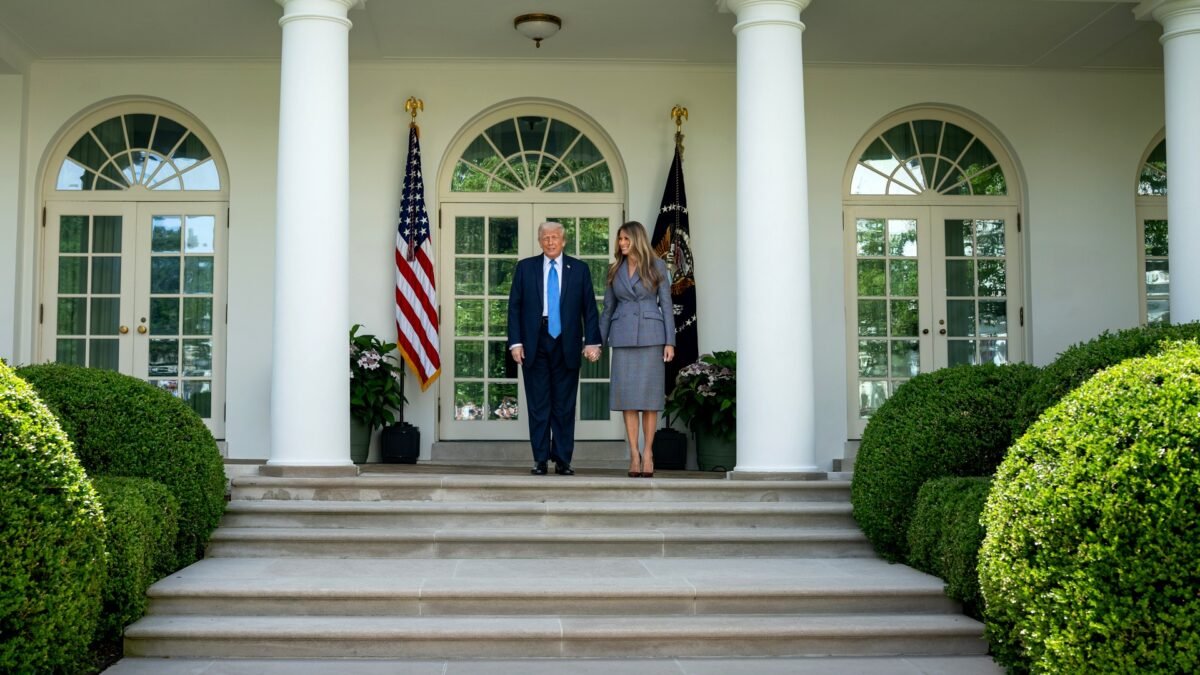
WASHINGTON, D.C. — President Donald Trump signed an executive order on Monday creating a dedicated Women’s Health Division inside the National Institutes of Health and a new White House Women’s Health Task Force, in a Rose Garden ceremony led by First Lady Melania Trump, according to USA Today and the New York Post.
The order establishes a new structural foothold for women’s health inside the federal government’s medical research establishment, and places the first lady’s imprint squarely on it: the White House said she drove the initiative from idea to signing ceremony, and she was standing beside the president as both of them put pen to paper.
“This is a transformative moment for women in America. Beginning today, we will change the reality of women’s health,” the first lady said during her speech at the ceremony, according to the New York Post. She said the initiative would establish “a new standard for women’s health in America.”
Trump credited his wife for conceiving the plan, telling the audience it existed because she had pushed for it. He praised what he called her “extraordinary leadership and skills” and said she would “help improve the health of our nation’s women and girls.”
“These are mothers, daughters, sisters, wives, and under the Trump administration, we’re going to get them the care and support that they need and deserve,” the president said, according to the New York Post.
Under the order, the Department of Health and Human Services has 90 days to establish the new NIH division, according to reporting on the directive. The White House Women’s Health Task Force will be co-chaired by White House chief of staff Susie Wiles and Health and Human Services Secretary Robert F. Kennedy Jr., according to USA Today and the New York Post.
The task force was scheduled to hold its first meeting on Monday afternoon in the Roosevelt Room at the White House, the New York Post reported.
The ceremony drew a crowd of cabinet officials, agency heads and governors. Among those present were Second Lady Usha Vance, Agriculture Secretary Brooke Rollins, Centers for Medicare and Medicaid Services Administrator Dr. Mehmet Oz, Environmental Protection Agency Administrator Lee Zeldin, Arkansas Governor Sarah Huckabee Sanders, surgeon general nominee Nicole Saphier, Jennifer Hegseth and Cheryl Hines, according to the New York Post. The first lady also signed the executive order document herself alongside the president — a ceremonial gesture with no formal legal weight.
According to a White House document obtained by USA Today, the order directs the administration to channel research funding toward diseases that affect women disproportionately, to use artificial intelligence to accelerate medical discovery, to speed the journey of new therapies from laboratory to patient, to keep care affordable, and to expand education around women’s health.
Melania Trump pressed the administration for months
The Rose Garden event was the public culmination of a months-long behind-the-scenes campaign by the first lady. USA Today reported, citing a White House document and its own exclusive reporting, that Melania Trump arranged a series of working sessions inside the East Wing with physicians and other experts from the public and private sectors, and met with officials from Health and Human Services to design the task force.
In her speech, the first lady framed the initiative around women at every stage of life. “Our mission must serve women at every stage of life, from young girls just starting out to mothers dealing with a complex range of responsibilities, to mature women who deserve to have vitality, dignity, and independence,” she said, according to USA Today.
“In 2026, medical advances can do more than just prolong life. It should give women the freedom to live life to its fullest — to pursue our dreams, experience love, discover, create, travel, and lead,” she added.
The choice of co-chairs is notable. Wiles announced in September that she is free from breast cancer, after receiving a diagnosis in March and continuing in her demanding role throughout treatment, according to the New York Post. Her presence at the head of the task force gives the initiative a direct line to the president’s office — the chief of staff co-chairing a health task force is a rare arrangement, and a signal of where the issue sits in the White House hierarchy.
What the order does — and what it doesn’t
The new Women’s Health Division will not replace the NIH Office of Research on Women’s Health, which has operated since 1990, according to USA Today. Instead, the new division carries a broader mandate: coordinating agencies across the federal government to accelerate scientific discoveries and improve health care for women and girls.
That distinction matters. The existing office was formally established under the NIH Revitalization Act of 1993, landmark legislation that codified the inclusion of women in federally funded research. More than three decades later, a 2025 report from the National Academies of Sciences, Engineering, and Medicine concluded that many questions about women’s health remain unaddressed, women’s health research “remains underfunded,” and breakthroughs have lagged — partly because of a persistent failure to prioritize and fund research into conditions specific to, more common among, or affecting women differently than men.
The report called for augmented funding paired with greater accountability, rigorous oversight, agency-wide prioritization, and integration of women’s health research across the NIH’s institutes, centers and offices. The executive order signed Monday does not itself appropriate money — how much financial backing will be allocated to research, fast-tracking therapeutics or lowering costs for patients remains undetermined, according to reporting on the directive. The money question is the one that will decide how much of this initiative is structure and how much is substance.
Analysis: Why It Matters
A structural move in a field defined by funding gaps
The most consequential thing about Monday’s order is where it places women’s health: inside the NIH’s standing machinery, not in a temporary commission that can be quietly shelved. A division is harder to dissolve than a task force, and the 90-day clock for HHS to stand it up creates a near-term accountability moment — the department will have to produce an actual plan, with names, budgets and reporting lines, within three months.
But the National Academies’ blunt 2025 assessment is the right baseline for judging what comes next. Thirty years after Congress mandated the inclusion of women in clinical research, the field’s own scientists concluded that underfunding, weak oversight and scattered accountability have left the job half done. A new division that merely re-labels existing programs would change little; one that moves money — toward, say, women’s-specific Alzheimer’s research, which accounts for only about 12 percent of federal Alzheimer’s funding according to the Women’s Health Access Matters report cited by Northwestern University — would change a great deal. Watch the budget lines, not the org chart.
The first lady as policy driver
First ladies have championed causes for decades, but the paper trail USA Today obtained — East Wing working sessions with physicians, direct meetings with HHS officials, a push that “culminated” in the executive order — suggests something more hands-on than the traditional awareness campaign. Melania Trump has kept an unusually low public profile in this second term; choosing women’s health as her defining initiative, and physically leading the signing event, converts that rarity of appearances into significance when she does appear. The political logic is straightforward: this is an issue where her personal credibility with the president is an asset no cabinet secretary can match, and where the administration can speak to voters — particularly women — in a register that isn’t about tariffs or foreign wars.
The chief-of-staff signal
Susie Wiles co-chairing the task force is arguably the most interesting governance detail in the whole package. Chiefs of staff do not typically run health policy bodies; their currency is time and access. Her appointment tells the agencies involved — HHS, CMS, NIH, EPA — that this initiative has the West Wing’s attention in a concrete way. Combined with her own public experience with breast cancer, it also gives the task force a human face that advocacy groups will find hard to ignore. The risk, mirrored in every White House-led policy effort, is that the task force becomes a vehicle for announcements rather than implementation. Its first Roosevelt Room meeting will offer an early read: if it produces workstreams with deadlines, it’s real; if it produces a group photograph, it’s not.
AI, “cures” and the hype gap
The order’s embrace of artificial intelligence to accelerate discovery is the part most likely to be oversold. AI can genuinely speed drug discovery and mine clinical data for sex-specific patterns that human researchers miss — but only where the underlying data is good. If women remain underrepresented in the datasets, or if sex-based differences in trial data go unanalyzed, AI will simply reproduce the blind spots of the old system at higher speed. The order’s parallel commitment to funding research into disproportionately female conditions is therefore the more important of the two: better data first, then better tools. Without it, the AI promise is marketing.
Timing: fifteen days to the midterms
No major domestic policy announcement happens in a vacuum on October 19, with the midterm elections scheduled for Tuesday, November 3 — fifteen days away. Women’s health is terrain where the administration has faced political headwinds, and a high-profile, first-lady-led initiative arrives precisely when the White House is assembling its closing argument to voters. None of this diminishes the policy itself; a good initiative launched at a useful moment is still a good initiative. But it does mean the follow-through will be watched through two lenses at once — as health policy and as campaign strategy — and the administration’s seriousness will be measured by what still exists on November 4 and beyond.
What to Watch Next
- The HHS 90-day plan: The order gives Health and Human Services three months to establish the NIH division. The first concrete test is whether that plan names leadership, funding and reporting lines — or arrives as an outline.
- The Roosevelt Room readout: The task force’s first meeting was scheduled for Monday afternoon. Who gets assigned what, and on what timeline, will show whether this is a working body or a ceremonial one.
- The money: Executive orders do not appropriate funds. Watch for budget requests, reprogrammed NIH dollars and any new funding lines dedicated to women’s-specific research — that is where the order succeeds or stalls.
- Coordination with the existing office: The 1990-era Office of Research on Women’s Health stays in place. Avoiding duplication — and avoiding turf battles between the new division and the old office — will be a quiet but decisive test of competence.
- Accountability metrics: The National Academies called for rigorous oversight and agency-wide prioritization of women’s health research. Whether the new division adopts measurable targets — funding shares, trial-inclusion benchmarks, timelines for specific disease areas — will determine if “a new standard for women’s health in America” is a slogan or a program.
Sources
- USA Today — “Melania Trump pushed Trump on women’s health overhaul” (exclusive)
- New York Post — “Donald Trump signs executive order creating NIH task force as Melania unveils ‘new standard for women’s health in America'”
- National Academies of Sciences, Engineering, and Medicine — “A New Vision for Women’s Health Research” (2025)

About the Author — Abdul Mannan
Related Articles
Trump Defends Russia Sanctions Freeze as Peace-Talk Tactic, Says Zelenskyy ‘Doesn’t Want to End This War’
Donald Trump used Sunday Truth Social posts to defend suspending new Russia sanctions as a way to keep…
Trump Gives Netanyahu ‘Complete and Total Endorsement’ Days Before Israel’s 27 October Election
President Donald Trump on Sunday gave Benjamin Netanyahu a 'Complete and Total Endorsement' ahead of Israel's 27 October…

Two Killed, 11 Hurt as Pickup Truck Drives Through Youth Soccer Game in Wichita
A 34-year-old woman drove a pickup truck through a youth soccer game at Wichita's Stryker Sports Complex on…