
Two Men Re-Arrested in RAF Fairford Plot Investigation as UK Police Say Iranian State Involvement ‘Highly Likely’

The announcement
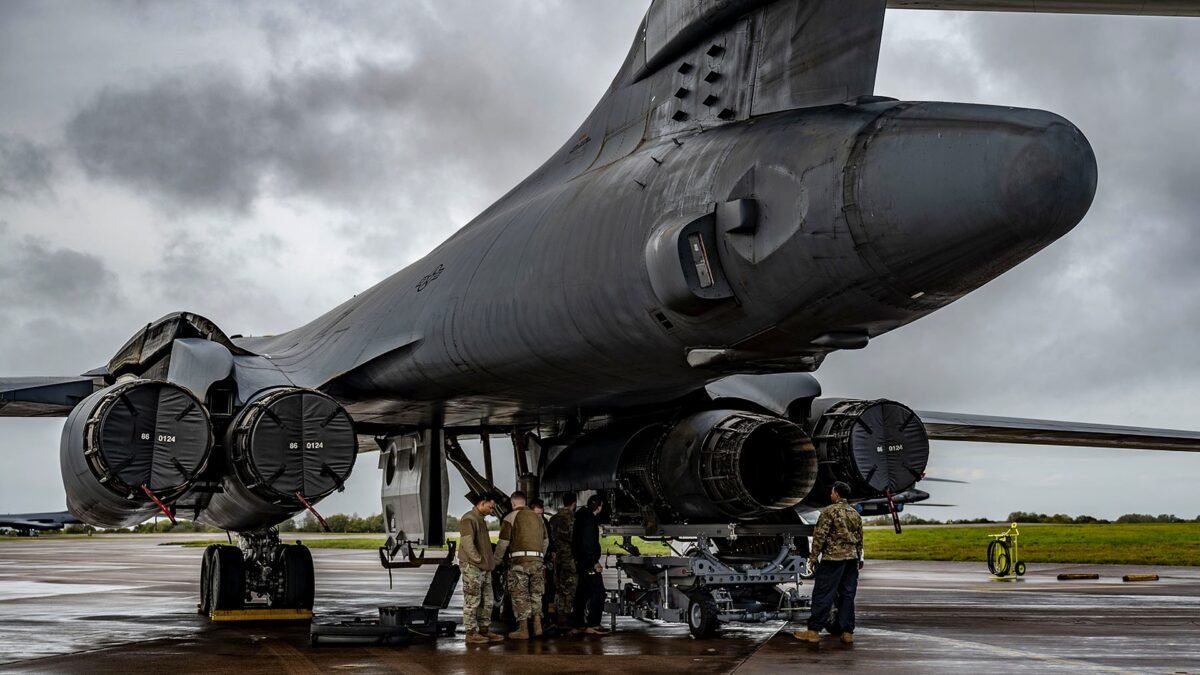
British counter-terrorism police have re-arrested two men on suspicion of assisting Iran’s foreign intelligence service in connection with the suspected plot against RAF Fairford, the English airbase long used by United States Air Force bombers. The arrests, announced on Tuesday, mark a sharp escalation in an investigation that has already forced Washington to withdraw an entire squadron of B-1 bombers from the Gloucestershire base.
Counter Terrorism Policing said a 24-year-old British national and a 25-year-old dual British-Iranian national were detained under the National Security Act, on suspicion of offences under Section 3 of the legislation — assisting a foreign intelligence service. The two men were first arrested last month and in early October respectively, then released on bail while detectives continued gathering evidence.
“So far seven men have been arrested in connection with our investigation,” Assistant Commissioner Laurence Taylor, the head of National Counter Terrorism Policing in the UK, said in a statement reported by CNN. “As a result of the ongoing efforts of our officers, earlier today two of those men were re-arrested for offences relating to Section 3 of the National Security Act — assisting a foreign intelligence service.”
“This is very much a live investigation, and our evidence gathering continues, but at this time our position remains the same; we consider it highly likely that there is Iranian state involvement,” Taylor added, according to the Associated Press. The five other men arrested in connection with the case remain on police bail. Police have not released the names of any of the suspects, and no one has yet been charged.
From terrorism suspicion to espionage offences
The re-arrests represent a fundamental shift in how the authorities are treating the case. When five men were first detained on 27 September near the perimeter of RAF Fairford, they were held on suspicion of offences under explosives legislation and of preparing a terrorist act. They were released on bail within days after investigators established that the substance found in drums in their three vans was petrol rather than a viable explosive.
The decision to re-arrest two of the suspects under the National Security Act — rather than under terrorism legislation — signals that detectives believe they have found evidence of a state sponsor behind the operation. Section 3 of the 2023 Act criminalises engaging in conduct intended to materially assist a foreign intelligence service in carrying out UK-related activities, and carries a maximum sentence of 14 years in prison. The law, which replaced parts of the century-old Official Secrets Acts, was designed precisely for the kind of suspected state-directed activity that police are now describing.
According to The Times, detectives have spent the weeks since September examining the suspects’ electronic devices and combing through their contacts. The newspaper reported that the re-arrests under fresh espionage offences suggest investigators may have found specific evidence directly linking the men to Tehran. The 24-year-old British national was part of the group initially detained near the base in the early hours of 27 September; the 25-year-old dual national was first arrested on 1 October in London. Both men live in the borough of Westminster, according to The Times.
What happened at Fairford on 27 September
The incident that started it all remains remarkable for how much it revealed and how little it proved. At around 1am on Sunday 27 September, three vans were reported travelling towards RAF Fairford. Armed police, including Ministry of Defence officers, intercepted five men aged between 23 and 25 — all British nationals from London — some 300 metres from the base’s perimeter. A major incident was declared, a 400-metre cordon was set up, and around 85 households in the surrounding villages were evacuated while Army bomb-disposal experts examined the vehicles.
One curious detail, reported by The Times, is that one of the men appears to have called 999 himself. Investigators later confirmed that petrol had been recovered from the vans, but no improvised explosive devices were found. The five men were released on bail on 28 September in what police described as an investigative decision grounded in strategy — a standard technique that keeps suspects under restriction while the evidence trail is followed. A sixth man, the dual British-Iranian national, was arrested in Westminster on 1 October and likewise bailed.
RAF Fairford is no ordinary target. The base in the Gloucestershire Cotswolds hosts the United States Air Force’s 501st Combat Support Wing and has been used throughout 2026 as a staging post for B-1B Lancer bomber operations. During this year’s US-Iran war, bombers flying from Fairford carried out strikes against Iranian targets — a fact that made the base, in Tehran’s own words, a legitimate target. In July, Iran’s Islamic Revolutionary Guard Corps publicly named Fairford as such, weeks before the September incident.
London and Washington point at Tehran
The political fallout has been building for weeks. Earlier this month, Prime Minister Andy Burnham said the suspected plot at RAF Fairford was “almost certainly” directed by Iran’s Islamic Revolutionary Guard Corps. US President Donald Trump told reporters at the time that the United States had worked with Britain on the case and that the men arrested had been planning to do “big damage” to the base. Secretary of State Marco Rubio said the incident clearly involved a foreign actor, though he did not name a country.
Iran has firmly and repeatedly rejected the accusations. Tehran’s embassy in London has categorically denied any involvement, and Iranian officials have said that bases used to attack Iranian territory are legitimate targets while denying any role in the Fairford operation. According to the Associated Press, Iran has previously acknowledged that it considers any base used to strike its territory fair game — a statement of doctrine that London reads very differently from an alibi.
The stakes were underlined at the start of October when the United States withdrew all of its B-1 bombers from RAF Fairford. At least ten of the twelve aircraft — including some that had arrived on rotation less than a week earlier — flew out of the base on 4 October. The Wall Street Journal first reported the departure, and a Pentagon official later confirmed the redeployment to home stations in the United States. The New York Times reported, citing two US officials, that the withdrawal followed new threats about an Iran-backed plot against the installation, though the Pentagon did not publicly confirm the reason.
Analysis: Why It Matters
The charge is the story, not just the arrest
Arresting someone on suspicion of terrorism is dramatic; re-arresting them on suspicion of assisting a foreign intelligence service is forensic. The distinction matters enormously. Terrorism offences describe what police thought the men might do. Section 3 of the National Security Act describes who police think the men were working for — and it requires a theory of the evidence, not just the act. Police do not dust off a three-year-old espionage statute unless the digital and human evidence has pointed their way. The re-arrests tell us that weeks of combing through phones, contacts and financial trails have produced something that fits the shape of state sponsorship rather than lone-wolf fanaticism. That is a prosecutorial escalation dressed as a procedural one, and it is why Assistant Commissioner Taylor’s “highly likely” language — the same formulation once used over Salisbury — carries the weight of a formal position, not a hunch.
A quiet Cotswold lane has become a front line
There is something jarring about the geography of this case. Fairford is market-town England — a stone village of Cotswold cottages within earshot of a runway that can launch intercontinental bombers. For decades that arrangement survived on a fiction of distance: the base was British soil with an American tenant, and whatever happened beyond the wire stayed out of mind. The 2026 war with Iran ended that fiction. Once B-1 bombers flew from Fairford to strike Iranian targets, the base became, by Tehran’s declared doctrine, a legitimate military target — and by Britain’s, a front line. The re-arrests are the moment that front line came into focus: not as a theoretical risk assessed in Whitehall, but as an alleged Iranian intelligence operation on a Gloucestershire lane in the small hours of a September night. The war may be fought in the Persian Gulf, but its shadow now falls on English villages.
The decoy question will not go away
The strangest fact of the whole affair remains the one first reported by The Times: that one of the men called 999 himself, and that three vans containing petrol — not explosives — were driven within 300 metres of a guarded American bomber base in the early hours. Investigators have reportedly considered the possibility that the September operation was a surveillance run, a “dry run” to test response times, or even a deliberate decoy designed to be stopped — a stunt to send a message rather than to cause damage. The re-arrests do not answer that question; if anything, they deepen it. Espionage charges suggest the men were part of something organised and directed, which makes the apparent amateurism of the September incident — masked men, petrol drums, a self-reported emergency call — harder to square with a serious sabotage attempt. Either the operation was genuinely clumsy, or its clumsiness was the point: a demonstration that Iran’s reach extends to the wire of an American bomber base, executed by people deniable enough to be bailed and re-arrested. British intelligence will be asking, privately, what the real operation looked like.
When bombers move, words become policy
The hasty departure of the B-1s on 4 October may turn out to be the most consequential fact in this story. Twelve intercontinental bombers do not redeploy across the Atlantic on a whim; moving them is expensive, operationally disruptive and — crucially — visible. The United States withdrew its most potent conventional strike asset from the very base Iran had threatened, days after five men were arrested outside it. Washington declined to say why, but the timing made the message unavoidable: the threat was taken seriously at the highest operational level. The re-arrests now supply the British end of that logic. Between the American withdrawal and the British espionage arrests, a picture emerges of two allies who have independently concluded that this was a state-backed operation — one responding with force posture, the other with the criminal law. That convergence is itself a form of deterrence, and Tehran will have noticed.
“Highly likely” is a sentence, not a guess
There is a temptation to read “highly likely” as hedging — as the police refusing to commit. In British state-threats cases it is the opposite: a calibrated, lawyer-approved formulation that commits the institution without prejudicing a prosecution. It was the phrase used after the Salisbury poisonings, and its reappearance here is deliberate. It tells Tehran that Britain attributes the operation to Iran while keeping the evidential door open for what comes next. What comes next is the hard part. Charging two men under Section 3 would be among the first high-profile uses of the National Security Act’s foreign-intelligence provisions — a test case for a statute Parliament wrote for exactly this era of deniable, outsourced state aggression. The courtroom, if it ever gets there, will have to decide what “materially assisting” looks like when the assistance runs through young men in vans rather than spies with dead drops. That is new law for a new kind of war.
What to Watch Next
- Charges or further bail? The re-arrests put the clock back on detention. Whether the Crown Prosecution Service authorises charges under Section 3 — and when — will determine whether this becomes a landmark espionage trial or another long-running investigation that fades into bail extensions.
- The five still on bail. Five other men remain under investigation on police bail. Any further arrests, or a decision to release them without charge, will signal how wide the alleged network is — and whether the two re-arrested men were the operation’s core or merely its most exposed edge.
- Diplomatic fallout with Tehran. Britain and Iran already expelled diplomats’ patience earlier this month when Tehran summoned the British ambassador in protest. A formal attribution of state involvement could trigger sanctions, further expulsions, or the proscription-style measures ministers have so far held in reserve.
- RAF Fairford’s future posture. The B-1s have gone home; whether they return, and under what force-protection arrangements, will tell us how seriously both allies rate the continuing threat. Expect quiet reinforcement long before any public announcement.
- The wider pattern. British officials have spoken for two years about Iran hiring local criminals and young men online for attacks across Europe. If prosecutors can connect the Fairford suspects to that model in court, this case becomes the template for a dozen future ones — and the reason the National Security Act exists.
Sources
- CNN — Two men rearrested on suspicion of assisting Iran’s intelligence service in RAF Fairford incident
- Associated Press (via Military.com) — 2 Men Rearrested in UK on Suspicion of Assisting Iran Over Suspected Plot at a US-Run Air Base
- The Times — Two suspects in RAF Fairford plot re-arrested for ‘helping Iran’
- National Security Act 2023, Part 1 (Section 3: Assisting a foreign intelligence service) — legislation.gov.uk

About the Author — Abdul Mannan
Related Articles

Covid Inquiry Finds UK Care Home Residents Were ‘Sacrificed’ as Virus ‘Spread Like Wildfire’
Baroness Hallett's sixth report finds care homes were an 'afterthought' as protecting the NHS was prioritised, rejecting Matt…
UK Unemployment Falls to 4.7% in Pre-Budget Boost, but Job Vacancies Sink to Five-Year Low
Official figures show the UK jobless rate fell to 4.7% in the three months to August, but vacancies…
Burnham Vows to End ‘Rip-Off’ Parking Charges as Sweeping New Driver Rights Go Before Parliament
Drivers across England, Scotland and Wales are set for the biggest shake-up of private car park rules in…