
Chemical Tank Blast in Toledo Forces Hundreds to Evacuate as Hazardous Release Spills Into Michigan

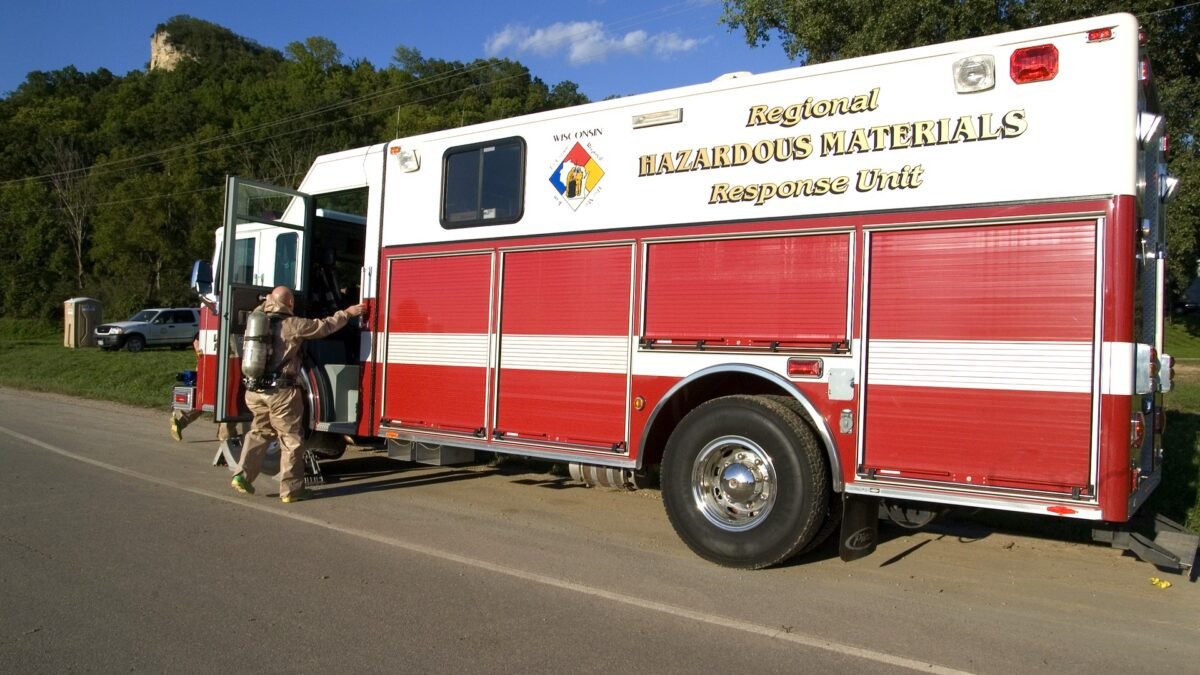
Hundreds of residents in northern Toledo, Ohio, spent Wednesday away from their homes after an explosion and hazardous chemical release at a trucking terminal forced a one-mile evacuation zone and a three-mile shelter-in-place order that stretched across the state line into Michigan, according to the City of Toledo.
The release began at about 9:30 p.m. on Tuesday, October 20, at the MC Tank Terminal on Progress Avenue, Toledo Mayor Wade Kapszukiewicz said at a Wednesday morning news conference, the Akron Beacon Journal reported. Toledo Fire & Rescue ordered everyone within a one-mile radius of 1266 Progress Avenue to evacuate at 10:48 p.m. — roughly 983 residents — and expanded precautions at 4:24 a.m. Wednesday, ordering everyone within a three-mile radius to shelter in place, according to the city’s incident page.
The chemical involved is glycidyl methacrylate, an industrial chemical used to improve certain plastics, paints and coatings, MC Tank Transport Inc. said in a statement. It escaped from a 5,500-gallon tank after an error occurred while the material was being transferred, the Ohio Environmental Protection Agency said in a statement reported by the Beacon Journal.
A release that refused to be contained
By Wednesday afternoon the release was still ongoing, and officials disclosed that efforts to stop it had failed. “Attempts by the fire department to contain the release were not successful,” a U.S. Environmental Protection Agency update said, according to the Beacon Journal. “The tank has been compromised and the chemical within the tank is completing a reaction. The city determined that the safest course of action is to let the reaction complete.”
Officials said at a 1 p.m. news conference it could take another six to 16 hours for the reaction to finish, Toledo station 13abc reported. The mayor said the tank carried an explosion risk within 12 hours of the original incident, which meant first responders and hazmat teams could not approach it until 9:30 a.m. Wednesday — a full 12 hours after the blast.
One first responder was injured: a Lucas County sheriff’s deputy who responded to the scene and drove himself to a hospital, the mayor said at the morning press conference, according to Toledo station WTOL 11. The Beacon Journal reported it was the only known injury.
The chemical and its risks
Glycidyl methacrylate is stored as a colourless liquid with a fruity odour, according to the National Center for Biotechnology Information, USA Today reported. City officials describe it as an irritant: exposure can cause burning of the eyes, nose, mouth and skin, while overexposure can bring on headache, dizziness, extreme tiredness, nausea and vomiting. The chemical is most toxic in liquid form — contact can cause first-degree burns and severe eye damage, the NCBI says — and officials told a Wednesday news conference it is carcinogenic with long-term exposure, though they said there was no immediate danger associated with this release, Fox Weather reported.
The mayor drew a careful line between perception and hazard, telling residents that beyond the evacuation and shelter zones they might taste “something unnatural” in the air. “There is a difference, though, between an annoying or unpleasant taste in your mouth or smell, and a dangerous or toxic amount of exposure,” he said, according to USA Today. “There are levels of exposure to something like this.”
An emergency that crossed a state line
The incident did not respect Ohio’s borders. Residents in Bedford Township, Temperance and Erie Township in neighbouring Michigan were told to shelter in place on Wednesday morning, the Detroit Free Press reported, while the evacuation zone itself was restricted to Ohio.
Schools closed on both sides of the line: Toledo Public Schools and Washington Local Schools in Ohio cancelled classes for Wednesday, the Columbus Dispatch reported, while in Michigan the Bedford Public School District, Mason Consolidated Schools and the Whitman campus of Monroe County Community College shut down, along with the Bedford Township Veterans Center, according to the Monroe News.
The city opened Shoreland Elementary School as a temporary shelter and stationed the American Red Cross and TARTA buses at the Meijer parking lot off East Alexis Road for displaced families. Neighbourhoods including the Raintree Village mobile home park and the Alexis Addition fell inside the evacuation zone. Enterprise Boulevard was closed between Stickney Avenue and Benore Road, and nearby railroad operations were halted, local reports said.
The company behind the terminal
MC Tank Transport Inc., based in West Chester, Ohio, specialises in liquid bulk transport and operates eight terminals and three container depots across the Midwest and Southeast, handling products including caustic soda, sulphuric acid and hydrochloric acid. The company confirmed in a statement that equipment associated with its operations was involved in the incident and urged residents to follow official instructions, Fox Weather reported.
MC Tank is a subsidiary of The Kenan Advantage Group, which acquired the company on March 31, 2025, and describes itself as North America’s largest tank truck transporter and logistics provider. The parent company, headquartered in North Canton, Ohio, was itself the subject of acquisition news this week: OMERS Private Equity signed an agreement to buy it from Goldman Sachs Capital Partners and Centerbridge Partners, industry publications reported.
Analysis: Why It Matters
Ohio has been here before
Any hazardous release in Ohio lands in a landscape still shaped by February 2023, when a Norfolk Southern train derailed in East Palestine and authorities carried out a controlled burn of vinyl chloride to avert a catastrophic explosion. The Toledo incident is not the same event — a trucking terminal transfer error rather than a rail derailment — but it revives the same uneasy question residents of the region have asked ever since: how much volatile chemistry moves quietly through ordinary neighbourhoods, and who watches the points where it changes hands?
Terminals like the one on Progress Avenue are the unglamorous middle of the chemical supply chain. They are not refineries or manufacturing plants; they are waystations where liquids pause between journeys. That very ordinariness is the point. MC Tank moves chemicals as a routine business, and the Ohio EPA’s description — an error during transfer — suggests the release began not with an exotic failure but with the most familiar kind of human mistake. When regulators eventually reconstruct the sequence, their findings will matter far beyond one address in north Toledo, because thousands of such transfers happen daily across America’s industrial belts.
The honesty of “let the reaction complete”
There is something bracing about an official statement that says, in effect: we cannot fix this, so we are going to wait. The EPA’s acknowledgement that containment attempts failed and the city’s decision to let the chemical finish its reaction represents a particular kind of emergency-management discipline — the willingness to choose patience over action when action risks making things worse. Firefighters kept their distance for 12 hours because approaching the tank risked triggering the very explosion they feared. That restraint is worth noting precisely because it runs against the instinct to be seen doing something. Toledo’s leaders will be judged not only on the outcome but on whether residents believe that waiting was a plan rather than an admission of helplessness. The mayor’s repeated phrase — acting “out of an abundance of caution” — is doing heavy lifting in that regard.
An emergency does not check maps
The plume drifted toward Michigan, and the response had to follow it across a state line. That sounds simple, but emergency coordination between states involves different agencies, alert systems and chains of command. On Wednesday morning it worked: Lucas County’s emergency management alerts reached Monroe County, Michigan, school districts on both sides closed, and the shelter-in-place order covered Temperance and Erie Township without apparent dispute over jurisdiction. The episode is a small case study in how modern hazmat incidents are inherently regional events. The chemicals that move through America’s logistics networks do not carry state loyalty, and neither does the air above them. Emergency planners in every border region will watch the Toledo playbook for what to copy — and for what went wrong.
Communication through the fog
Officials faced a complication that was almost poetic: dense fog settled over Toledo, and residents could not tell the chemical release from ordinary weather. “You can’t tell fog from the release by looking, so please don’t rely on how the air looks,” the fire department warned. That warning, and the mayor’s distinction between an unpleasant smell and a toxic exposure, captures the central communication challenge of chemical incidents: the public’s senses are unreliable instruments, and officials must ask people to act on information rather than instinct. The city published an interactive map of the zones and detailed symptom guidance early — headache, dizziness, nausea, and the instruction to shower and rinse affected skin. In the hours when rumours thrive, that specificity is the difference between an orderly evacuation and a panicked one.
New ownership, old questions
MC Tank has been part of the Kenan Advantage Group for barely 19 months, and the parent company itself is changing hands this month. Ownership changes do not cause accidents, and nothing in the public record yet connects this release to corporate restructuring. But investigators will inevitably ask whether terminal procedures, staffing and safety culture held steady through the acquisition. The Kenan Advantage Group is the country’s largest tank truck operator; an incident on its watch will draw the attention of regulators and plaintiff lawyers alike. The question of how a 5,500-gallon tank of a flammable industrial chemical ends up in an uncontrolled reaction during a routine transfer is one that the Ohio EPA, the federal EPA and quite possibly Congress will want answered in detail.
What to watch next
- The reaction timeline. Officials estimated six to 16 more hours for the chemical reaction to complete as of Wednesday afternoon. Until it finishes and air monitoring confirms the all-clear, the evacuation and shelter orders hold.
- Air-quality data. The EPA is monitoring the air and supporting incident command. The published results — what was detected, where, and at what levels — will determine whether this becomes a days-long disruption or a weeks-long health question.
- The cause investigation. An “error” during transfer is the beginning of an explanation, not the end of one. Expect scrutiny of equipment maintenance, transfer procedures and staffing at the terminal.
- Cross-state after-action. Ohio and Michigan agencies will review how the joint response worked. If it worked well, it becomes a model; if gaps emerge, border communities elsewhere will want to know.
- The corporate fallout. With Kenan Advantage Group itself mid-acquisition, the company’s response — compensation for displaced residents, cooperation with regulators, changes to terminal protocols — will be watched as a signal of how seriously America’s largest liquid bulk transporter takes the incident.
Sources
- City of Toledo — Hazardous Materials Evacuation and Shelter-in-Place (official incident page)
- Akron Beacon Journal — Toledo chemical spill releases glycidyl methacrylate
- USA Today — What to know about hazardous material released by Ohio chemical spill
- Detroit Free Press — Toledo chemical release closes multiple Michigan schools

About the Author — Abdul Mannan
Related Articles

Elon Musk Backs Possible Tesla–SpaceX Merger Worth $3.5 Trillion as Both Boards Launch Reviews
Elon Musk told investors that Tesla and SpaceX have each formed special committees of independent directors to study…

Trump Launches $25 Million Fraud Whistleblower Programme Offering Cash Bounties to Tipsters
President Donald Trump has announced a $25 million Justice Department programme paying cash rewards — up to $30,000…

Florida Prepares to Execute 77-Year-Old Vietnam Veteran for 1986 Killing of Sheriff’s Deputy
Florida is set to execute William Reaves Jr., 77, by lethal injection at 6 p.m. Tuesday for the…