
Trump Praises Rally-Goers Who Struck Hecklers at Chaotic South Carolina Midterm Event

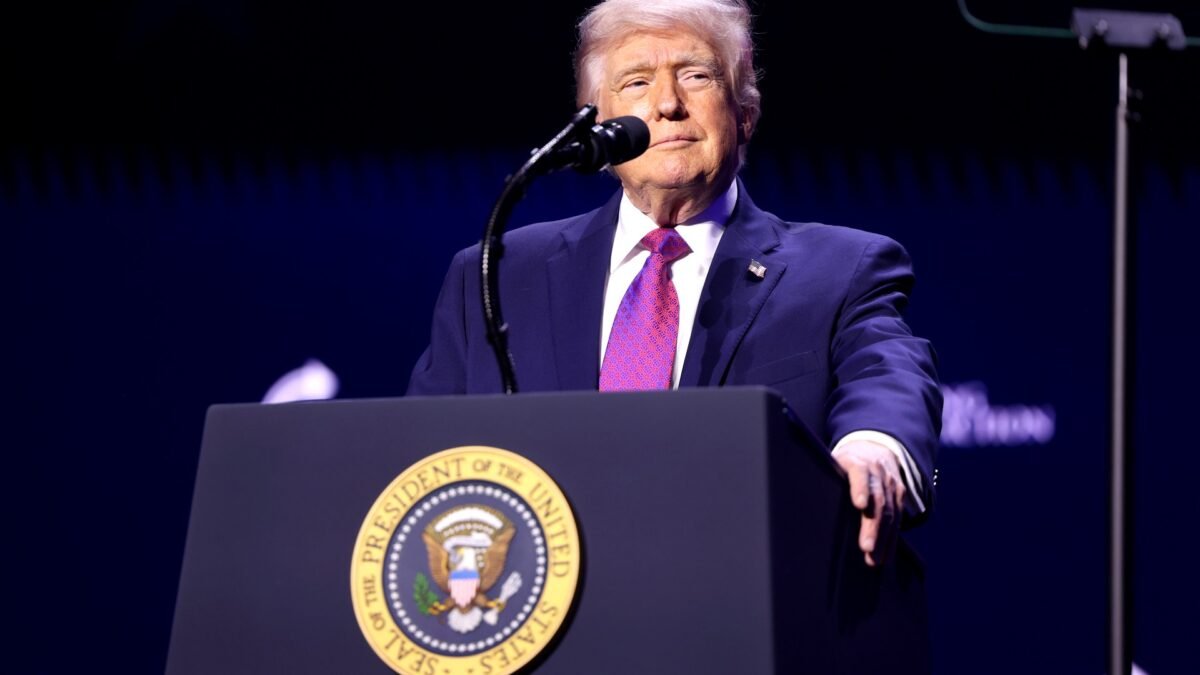
President Donald Trump cheered from the stage as two of his supporters physically struck hecklers during a chaotic midterm campaign rally at Clemson University in South Carolina on Wednesday night, openly praising the men who lashed out and comparing one of them to the heavyweight boxing champion Evander Holyfield.
The rally, held at the T. Ed Garrison Arena in Pendleton for Republican Senate candidate Darline Graham, was interrupted again and again by demonstrators. A White House pool report cited by The Guardian counted at least nine hecklers during the evening, while the New York Post put the figure at at least 12. Each time a protester was removed, security officers escorted them out of the arena as the crowd chanted “USA.”
Two of those removals turned physical, and both were captured on camera. In the first, a protester near the stage was struck by an older rally-goer and then taken away by sheriff’s deputies. In the second, an attendee followed a demonstrator who was being led away by security and appeared to slap the protester on the head.
Trump did not condemn either incident. From the podium, he reacted with undisguised enthusiasm.
“Wow, man, I loved that,” he told the crowd, according to The Guardian‘s live coverage, which was picked up widely, including by CBS News. “That was incredible. Wow. That was unbelievable. Is everybody OK?”
He then demanded to know who had struck the protester. “Who’s the guy that threw that punch?” he asked. “You reminded me of Evander, the real deal Holyfield,” he added, referring to the former heavyweight champion, who was in the audience at the rally.
“You gotta give them credit. It takes courage to do that at a Trump rally,” he said. “He got whacked.”
The president went on to say of hecklers generally: “They don’t realise it’s really dangerous to do that.” He repeated his familiar claim that the demonstrators were “paid protesters,” telling the crowd they were paid $250 each to disrupt his events, before adding that they would go home to be “assaulted by their Trump-loving parents.”
Among the interruptions, at least one heckler yelled “traitor” and another shouted “release the Epstein files” as she was led away, according to the New York Post.
It remained unclear late on Wednesday whether either of the attendees who struck protesters had been arrested, the Post reported. No charges had been announced by the local authorities in the hours after the rally ended.
The race that brought Trump to South Carolina
Trump travelled to South Carolina to campaign for Graham, who is running for a full six-year term in a race that has proved unexpectedly competitive. Graham was appointed to the seat by Governor Henry McMaster after her brother, the late Senator Lindsey Graham, died suddenly of a heart ailment in July. She subsequently won a special primary to take the seat on the ballot.
She now faces the Democrat Annie Andrews, a paediatrician, in the election on 3 November. Polling has the contest far closer than South Carolina politics would normally allow. A Rasmussen Reports survey of 837 likely voters taken 5 to 8 October had Graham ahead 49 per cent to 45 per cent, with a three-point margin of error. An InsiderAdvantage poll released earlier in October put her at 46 per cent to 45 per cent, a statistical tie. A Trafalgar Group poll had her ahead by a single point, well within its margin of error.
That is striking because Trump carried South Carolina by nearly 18 percentage points in the 2024 presidential election, according to Reuters. Non-partisan analysts still rate the state likely or leaning Republican, but the closeness of the contest has drawn heavy outside attention, with super PACs shifting resources to defend what was long considered a safe seat.
The rally came at a personally complicated moment for Graham, as Reuters reported on Wednesday ahead of the event. Trump last week waived sanctions on Russia that her late brother had championed. Graham, otherwise supportive of the president, has said publicly that she disagrees with him on the move. “Personally, I would choose to put the pressure on Russia to end the war and get gas prices down,” she told the Associated Press at the weekend. “I don’t trust Putin, and I don’t trust Russia.”
Trump, for his part, has been pressing Ukraine rather than Russia to make concessions. “Ukraine has to want to settle this war,” he said at the White House on Tuesday. “We want (Ukrainian President Volodymyr) Zelenskiy to make a deal.”
A pattern, not an isolated evening
Wednesday’s scuffles were not the first time this week that a Trump campaign stop has turned confrontational. On Tuesday night, the president’s rally in Greenville, North Carolina, held at Pitt-Greenville Airport for Republican Senate candidate Michael Whatley, was repeatedly interrupted by hecklers. Video from that event appeared to show a protester being struck by someone in the crowd as he was led out, according to reporting on the incident.
The run of disruptions has come as Trump has intensified his travel in the final stretch before the 3 November midterms. The New York Post noted that the chaotic scenes at Clemson were reminiscent of the turbulent rallies of Trump’s 2016 presidential campaign, when physical confrontations between supporters and protesters became a recurring feature.
Analysis: Why It Matters
What happened at Clemson on Wednesday night was not an accident caught on tape. It was a president, standing at a podium with the seal of his office nearby, watching violence unfold in his own audience and choosing to applaud it. That distinction is what makes this evening matter beyond the arena walls.
1. A campaign defending its own fortress
The most telling fact about Wednesday night may not be the punches but the location. South Carolina is not a swing state. Trump won it by nearly 18 points two years ago, and it has not sent a Democrat to the Senate seat in question since 1964, when Strom Thurmond switched parties. A president spending a Wednesday evening there, two weeks out, is a president defending territory his party once took for granted. The energy inside the Garrison Arena was the energy of a party that knows the map has tilted against it: polling that shows Graham only a few points ahead of Andrews has turned a coronation into a contest, and the volume of the evening’s confrontations reflects the tension of a race the White House cannot afford to lose.
2. Violence, repackaged as spectacle
There is a long tradition in American politics of presidential candidates deploring violence at their events, however selective that deploring may be. What Trump did on Wednesday was the opposite: he narrated a brawl as though he were calling a boxing match, complete with a comparison to a boxing legend sitting in the crowd. By rewarding the man who struck a protester with public praise, he turned violence from something to be regretted into something to be earned. The practical consequence is obvious. Thousands of people at his rallies now know, from the most authoritative possible source, that striking a heckler is a path to the president’s favour. Whatever one’s view of the hecklers’ tactics, that incentive structure makes future confrontations more likely, not less, and places an extra burden on security, local police, and the Secret Service at the remaining stops on the campaign trail.
3. The “paid protester” alibi
Trump’s repeated claim that his hecklers are paid $250 each deserves to be noted for what it is: a claim made without evidence, used to justify whatever follows. By framing the demonstrators as mercenaries rather than citizens exercising the right to protest, he supplies his supporters with a moral licence to treat them as fair game. It is a pattern that has run through his rhetoric for years, but it landed differently on Wednesday night because the physical consequences followed in real time. The line between describing protesters as paid disruptors and sanctioning physical responses to them has always been thin; on Wednesday, it was crossed in both directions at once.
4. The Graham paradox
The awkward backdrop to the evening was the woman standing to benefit from it. Graham disagrees with the president on Russia sanctions, openly and on the record, yet her political survival now depends on Trump’s willingness to rally her voters. That contradiction tells a broader story about the 2026 Republican coalition: dissent is permitted, but it must be contained, and proximity to Trump remains the price of admission. The fact that the rally ended with the crowd chanting approval for a brawl rather than absorbing the nuances of the Russia dispute suggests which currency matters most in this campaign.
5. Thirteen days to Election Day
With the midterms thirteen days away, every rally is both a persuasion tool and a stress test. The scuffles at Clemson will almost certainly harden the lines of an already polarised electorate. For Trump’s supporters, the evening offered confirmation that their champion fights alongside them, literally. For his opponents, the footage of a president applauding an assault will become instant campaign material. The question is what the undecided remainder of the electorate makes of it — and whether the images from Pendleton travel beyond the arena into the quiet, private moment of a voting booth.
What to Watch Next
- Arrests and charges: Local sheriff’s deputies removed at least one of the protesters and took away the scene of one assault. Whether either of the two attendees who struck protesters faces arrest or charges will be the first hard fact to watch.
- The South Carolina polls: Graham’s narrow lead has held for weeks. Any new surveys in the days after the rally will show whether Wednesday’s chaos — or the attention it draws — moves the needle in either direction.
- The remaining rally calendar: Trump’s campaign stops have been drawing hecklers from state to state. Whether security and crowd-control arrangements change before his next event will indicate how seriously the campaign takes the risk of repetition.
- Condemnation, or silence: Reaction from Republican leaders in South Carolina and from the Andrews campaign will test whether Wednesday’s events carry a political cost. Silence, too, will be a signal.
- The “paid protesters” claim: Trump has made the $250-a-head allegation repeatedly without producing evidence. Whether any targeted group pushes back legally, or whether the claim simply becomes accepted campaign lore, will say something about the information environment of this election.
Sources
- New York Post — Trump’s South Carolina rally turns into royal rumble with hecklers getting ‘whacked’ by MAGA supporters (21 October 2026)
- Reuters — Trump to rally for Graham in tight South Carolina Senate race amid Russia rift (21 October 2026)
- Mandatory — Donald Trump has brutal 4-word reaction to protester getting punched during rally, citing CBS News (22 October 2026)

About the Author — Abdul Mannan
Related Articles
Democrats Sue Trump Administration Over Voter-Roll Pressure in Pre-Midterm Court Battle
Democratic leaders and election groups have sued the Trump administration in federal court, seeking to stop federal pressure…
Trump Unveils $8 Billion Diesel Aid for Farmers and Loans Emergency Heating Oil in Pre-Midterm Fuel Push
With diesel prices at record highs two weeks before the midterm elections, the Trump administration has unveiled $8…
Chemical Tank Blast in Toledo Forces Hundreds to Evacuate as Hazardous Release Spills Into Michigan
A chemical tank blast at an MC Tank terminal in northern Toledo forced a one-mile evacuation and a…