
France Deploys 70,000 Police as Half a Million Protesters Take to the Streets

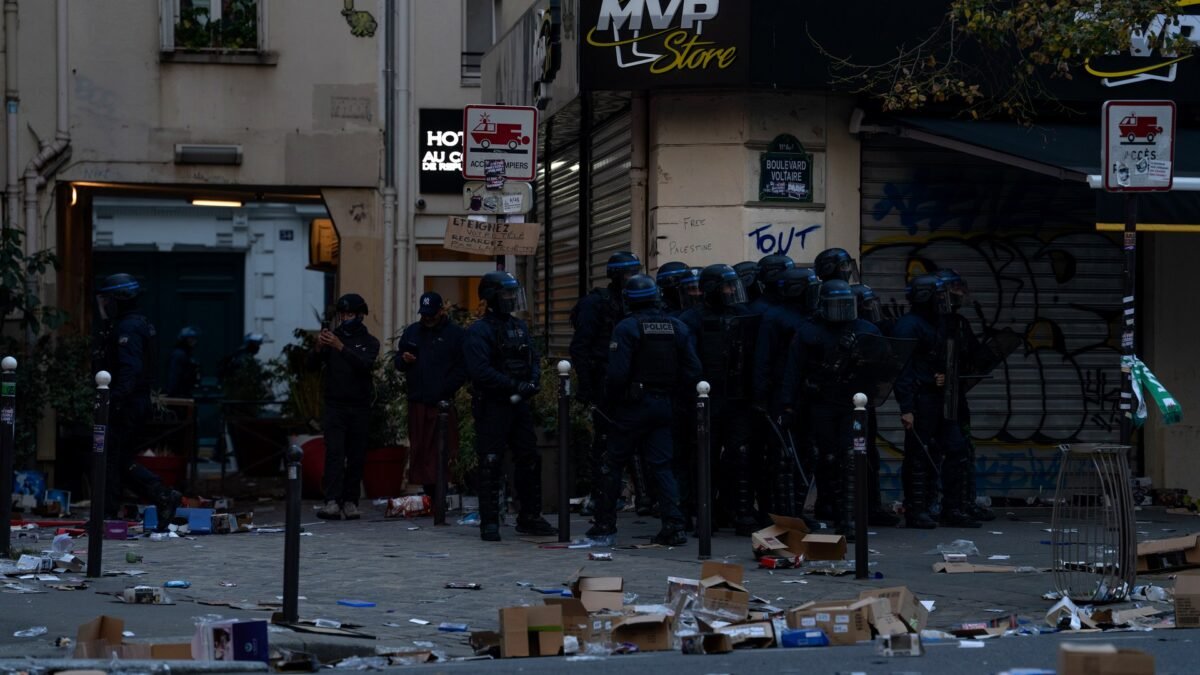
France is bracing for one of the largest protest days in its recent history, with some 70,000 police officers deployed across the country, overnight curfews extended in Paris and several cities, and major museums and cultural events closed as a new national day of demonstrations unfolds on Saturday, 24 October. The security mobilisation follows a week of violent unrest that authorities themselves have described as the country’s worst street violence in years, according to reporting by the BBC, Le Monde and AFP.
The protests, which began last month as student demonstrations over school conditions and have since broadened into a nationwide movement against the high cost of living, are expected to draw up to half a million people onto the streets, according to The Sun, which has described Saturday as a day of potential chaos for authorities. President Emmanuel Macron has said that only demonstrations organised by trade unions will be permitted on Saturday, with prefects instructed to ban other protests wherever possible, AFP reported.
“For the coming days, and in particular Saturday, the general recommendation is that there should be no demonstrations,” Macron said on Thursday after a meeting with intelligence chiefs and ministers, according to AFP. “Those who want to continue to demonstrate, when they are trade union organisations, will have alternative routes proposed by the prefects. When they’re not union organisations, wherever possible, they’ll be banned.”
Interior Minister Jean-Didier Berger said law enforcement numbers would be 20 per cent higher than last weekend, according to BBC reporting, after Prime Minister Sébastien Lecornu promised a “massive” police deployment ahead of the demonstrations, as reported by CBS News.
A Nation Under Security Lockdown
The restrictions announced for Saturday amount to the most extensive security clampdown on public assembly France has seen in recent years. In Paris, a partial overnight curfew covering Place de la République and the Les Halles shopping district, running from 23:00 to 06:00, has been extended until Monday, the BBC reported. Several Yellow Vest marches in the capital have been prohibited, while a CGT-backed union march from Place de la Bastille to Place de la Nation was authorised, according to Le Monde. The Sun reported, citing Le Parisien, that Paris police changed the approved route at the last minute, moving it from the Bastille-to-Nation march to a route from Porte d’Italie to Porte de Vincennes, a decision a police union described as adding “fuel to the fire”.
In Marseille, France’s second-largest city, all demonstrations were banned for Saturday, and a curfew that had applied to minors in the city centre was extended to the entire adult population, Le Monde reported. Public transport in Marseille will be suspended from 5am Saturday to 5am Sunday, according to AFP reporting. In Lyon, regional authorities imposed a blanket ban on demonstrations on Saturday and a city-centre curfew, while similar restrictions were announced in Nice, Toulon, Rouen, Grenoble and Montpellier, the BBC reported.
Authorities in Orléans are preparing for possible unrest around the annual congress of Marine Le Pen’s far-right National Rally, where counter-demonstrations have been announced by left-wing and anti-racist groups, according to The Sun. The annual congress is expected to become a flashpoint in a weekend already stretched by the scale of the mobilisation.
The scale of the shutdown is also visible in the capital’s cultural life. The Louvre, the Musée d’Orsay and the Musée Picasso are scheduled to close on Saturday, and the Art Basel Paris fair will remain shut throughout the weekend, Reuters reported. Shopkeepers across Paris have barricaded storefronts, according to The Sun, with memories of last weekend’s looting still fresh.
The pressure on police resources is already reshaping the country’s sporting calendar. Paris Saint-Germain’s Ligue 1 match against Olympique Lyonnais, scheduled for Sunday, has been postponed to Monday, 26 October at 8:30 p.m. at the Parc des Princes under a police order, because police and security resources are stretched thin by the protests and France’s first-ever NFL game, Fox News reported, citing the club’s statement. That game — the New Orleans Saints against the Pittsburgh Steelers — remains on track for Sunday in Paris, according to a league spokesman quoted by Fox News.
What Happened on 17 October
Saturday’s mobilisation is a direct sequel to the protests of 17 October, which drew more than half a million people demonstrating against the surging cost of living and degenerated into the country’s worst street violence in years, according to reporting by theleaders-online. Demonstrators set fires, stormed public buildings, smashed shop windows and clashed with police in Paris and other cities. In Limoges, the historic town hall was burned after individuals forced entry into the building, according to AFP photographs reported by The Sun. At least 2,500 people have been arrested across France since the disorder broke out, the BBC reported.
It was, according to The Hindu, France’s most violent unrest in years. In Paris, demonstrators gathered around Place de la République amid tear gas; cars and shared bicycles were set on fire on Boulevard Voltaire and extinguished by the Paris Fire Brigade, while shops were looted, as documented in contemporary photographs of the unrest.
The government has acknowledged that it was caught off guard. According to CBS News, the Interior Ministry admitted that authorities had underestimated the unrest and lost control in some cities during the 17 October demonstrations. That admission, coming days before the next national protest day, explains the scale of the current mobilisation: 70,000 officers, curfews in several cities, and an unprecedented peacetime set of bans on demonstrations.
Roots of the Protests
The movement now shaking France did not begin with the cost of living. According to CBS News, it started in mid-September, when high school students and teachers in Paris’s suburbs demanded action on overcrowded classrooms, deteriorating school buildings and teacher shortages. The student protests continued for four weeks before the 17 October rallies.
The movement has since expanded to include trade unions and Yellow Vest activists, broadening into a nationwide campaign against rising living costs and declining public services, CBS News reported. The CGT labour union, students and activists from the gilets jaunes movement — whose demonstrations against social injustice shook France in 2018 and 2019 — are all expected to join Saturday’s protests, according to The Hindu.
On Thursday, a student protest organised in Paris went ahead after an emergency court injunction overturned a police ban, with hundreds attending, according to theleaders-online. “The authorities are trying to make a distinction between ‘good’ and ‘bad’ protesters,” a university student leader, Coppelia Moreau, told journalists. “What we are seeing is a government that doesn’t want any demonstrations at all. That goes against the right to demonstrate.”
The Government’s Gamble
Macron’s response to the crisis has been two-pronged: security and outreach. After chairing a security council meeting, the president said the priority was a return to calm. Government spokesperson Maud Bregeon told reporters on Thursday: “The priority is the restoration of public order. Without public order, there can be no calm, constructive, or open discussion about the demands” of student organisations, according to Le Monde.
Macron has blamed the worst of last week’s violence on what he described as “political and even seditious acts” organised by far-left groups aiming to bring down the Republic, the BBC reported. He is due to chair a defence council meeting of key ministers on Friday to decide “the next steps” for the new nationwide demonstrations, AFP reported. The president also met high school students and their representatives at the Élysée Palace on Friday afternoon, according to reporting by The Independent, in an attempt at direct engagement with the students who started the movement.
Prime Minister Lecornu is due to meet school, student, teacher, union and employer organisations on Monday, AFP reported — a signal that the government is preparing a negotiating track alongside the security operation.
But the strategy of banning demonstrations while promising dialogue has drawn sharp criticism. “It’s not for the president to decide who can legitimately request to protest,” Marylise Léon, general secretary of the CFDT union, told TF1, as reported by The Independent. She argued that banning demonstrations would do little to restore calm and called instead for concrete government proposals addressing the grievances driving public anger. The Ligue des droits de l’homme (LDH), one of France’s leading civil liberties groups, has also strongly criticised the restrictions, Le Monde reported.
Analysis: Why It Matters
Curfews versus the right to protest
France is living through a genuine civil liberties stress test. A nighttime curfew over parts of Paris, the banning of all demonstrations in Marseille and Lyon, the extension of a minors’ curfew to the entire adult population of France’s second-largest city — these are measures more familiar from states of emergency than from peacetime policing. The prefects who impose them must satisfy legal tests of necessity and proportionality, and their decisions are subject to review by administrative courts, as EU Today noted in its analysis. Thursday’s student protest, which went ahead only after a court overturned the police ban, shows the courts are already policing the limits of police power. The question that will define the coming weeks is whether the exceptional measures of this weekend become the normal management of dissent — or whether the courts and the public push back.
The Yellow Vest spectre
The authorities’ decision to prohibit several Yellow Vest marches in Paris is the clearest sign that the government fears a replay of 2018 and 2019. The gilets jaunes movement, born of fuel-tax anger, grew into the most sustained challenge of Macron’s first presidency — and it was born of exactly the same grievance now on the streets: the cost of living. The difference this time is the coalition. Students, teachers, the CGT, the Yellow Vests: each brings a different constituency, and each has a different reason to distrust the government’s offer of “alternative routes”. If the student movement and the Yellow Vests converge on 24 October in the numbers organisers expect, the government will face something it has not faced before — a protest movement that spans generations and ideologies.
Macron’s tightrope, six months from an election
With presidential elections six months away, candidates jockeying to succeed Macron are already arguing that the authorities are incapable or unwilling to calm the situation, according to theleaders-online. The president’s dilemma is acute: he must project control to reassure a frightened public and anxious shopkeepers, while avoiding the kind of confrontation that would hand his opponents — including the National Rally meeting this weekend in Orléans — a powerful weapon. His distinction between “legitimate” union protests and “illegitimate” others is politically legible but legally and morally contested, as the CFDT and the LDH have made clear. If Saturday passes calmly, the government will claim vindication. If it does not, the question of who lost control — again — will be asked loudly, and not only by the opposition.
The Orléans flashpoint
The National Rally’s annual congress in Orléans adds a volatile ingredient to an already tense weekend. With left-wing and anti-racist groups announcing counter-demonstrations and authorities fearing a confrontation, the risk is that the day’s narrative shifts from cost-of-living anger to a left-versus-right clash — precisely the outcome the government says it wants to avoid. How the prefectures handle Orléans will be read as a measure of whether the bans are genuinely about public safety or, as the CFDT suggests, about deciding who is allowed to protest.
An economy under pressure
Beneath the politics lies a simple arithmetic that no curfew can fix. The protests began with school buildings and have grown into a revolt against the cost of living — a grievance that neither 70,000 officers nor a Monday meeting can settle on its own. France’s public finances are under strain, and the government’s room for fiscal generosity is limited. The Lecornu meeting on Monday with unions, students and employers will be watched for whether it produces concrete proposals or merely process. Marylise Léon’s demand — “concrete government proposals addressing the grievances driving public anger” — is the bar by which the government’s outreach will be judged.
What to Watch Next
- Saturday’s turnout and its aftermath: Whether the day passes peacefully or reproduces the violence of 17 October will determine the government’s credibility for the weeks ahead.
- The courts: Administrative courts have already overturned at least one police ban this week. Further challenges to the Marseille and Lyon bans could reshape what prefects are allowed to do.
- Macron’s Friday defence council: “Additional decisions” promised for the weekend could tighten or recalibrate the security posture — and the rhetoric.
- Monday’s Lecornu meeting: The meeting with student, union, teacher and employer organisations is the government’s main negotiating track. Concrete proposals, or their absence, will set the tone for the next protest day.
- Orléans: Whether the National Rally congress and its counter-demonstrations produce confrontation will test the prefectures’ claim that the bans are about safety, not politics.
Sources
- Le Monde — “Bans on protests rain down across France, raising concerns for the rule of law”
- The Online Brief (tob.news), reporting BBC and AFP coverage — “Macron tightens curbs on France protests”
- Today News Brief, reporting AFP and BBC coverage — “Macron: only union marches allowed in France on Saturday”
- Devdiscourse, reporting CBS News and ANI — “French govt extends curfews amid nationwide protests over rising living costs”
- The Sun — “France braces for chaos with half a million protesters to hit streets”
- Fox News — “France’s top soccer team obeys police order to move Sunday match”

About the Author — Abdul Mannan
Related Articles
Magnitude-7.0 Earthquake Hits Tibet’s Nagqu, Killing 16 as Rescue Teams Battle Cold and Aftershocks
A magnitude-7.0 earthquake struck northern Tibet late on Thursday night, killing at least 16 people and injuring 65,…

Iran Has Drawn Up Detailed Plans to Hit Gulf Undersea Internet Cables if War Resumes, Reuters Reports
Iran has told Reuters it has detailed plans to target undersea communications cables in the Gulf if the…
‘We Are Winning’: 150,000 Student Supporters Fill Belgrade Days Before Serbia’s Crunch Election
Around 150,000 supporters of Serbia's student-led movement rallied in central Belgrade ahead of Sunday's parliamentary election, seeking to…