
Brewers Survive Ninth-Inning Scare to Edge Rays 3-2 in World Series Opener

MILWAUKEE: The Milwaukee Brewers survived a heart-stopping ninth inning to beat the Tampa Bay Rays 3-2 on Friday night in Game 1 of the World Series, taking a 1-0 lead in a Fall Classic that is guaranteed to crown a first-time champion.
With two outs in the ninth and the tying run standing at third base, Brewers closer Trevor Megill struck out Jonny DeLuca to end a rally that had briefly looked like it would rewrite the ending of the night, according to Reuters. Moments earlier, the Rays had overturned what appeared to be a game-ending double play on replay review, scored a run, and loaded the pressure onto a sellout crowd at American Family Field that had been celebrating Milwaukee’s first World Series game since 1982.
It was, in the end, a fitting start to a series between the two best regular-season teams in baseball: tense, low-scoring, decided by inches on the basepaths and by a single swing in the seventh inning.
A ninth inning that nearly turned the game upside down
Megill entered the ninth with Milwaukee ahead 3-1 and immediately found trouble, according to Reuters. Jonathan Aranda and Chandler Simpson reached on consecutive one-out singles, and pinch runner Jorge Mateo and Simpson then pulled off a double steal to put two runners in scoring position. Junior Caminero walked to load the bases, and the Rays were suddenly one swing from turning the game around.
Liam Hicks then hit a grounder that looked for all the world like the final out. Second baseman Brice Turang flipped to shortstop Cooper Pratt for the force, and the Brewers began shaking hands as fireworks went off above the ballpark. But Tampa Bay challenged, and the replay showed that Pratt’s foot had come off the bag a fraction too early on Turang’s throw. Hicks was safe at first on the fielder’s choice in the official ruling, Mateo scored to make it 3-2, and the tying and winning runs were left standing on second and third.
Megill, however, held his nerve. He struck out DeLuca to finish the game and record his fifth save in five postseason opportunities, according to Reuters. It was the kind of escape that will be replayed for years in Milwaukee if this series ends the way the Brewers hope it will, and the kind of near-miss that will haunt Tampa Bay if it does not.
How the Brewers built their lead
Milwaukee had led from the very first inning, and the opening frame set the tone for the whole evening. Jackson Chourio singled on the first pitch of the game, and Christian Yelich followed with a triple to right-centre that glanced off DeLuca’s glove as he dived for the catch, according to Reuters. William Contreras then drove Yelich home with a single to left, and before many in the crowd had settled into their seats, the Brewers were 2-0 up.
The Rays answered in the fourth. Aranda drew a leadoff walk, advanced to third when centre fielder Garrett Mitchell misplayed Caminero’s 112.7 mph drive into a double, and scored on Hicks’s groundout, according to Reuters. That made it 2-1, and for three innings the game stayed there, a pitchers’ duel punctuated by defensive plays rather than rallies.
Contreras, in particular, kept Tampa Bay’s running game in check. He threw out two would-be base stealers, according to NBC Sports, and the Rays’ aggression on the bases repeatedly ran into Milwaukee’s defence. Tampa Bay finished 0-for-6 with runners in scoring position, according to Sports Illustrated, a statistic that tells much of the story of the night: the Rays created chances, but the Brewers kept closing the door.
The decisive run came in the seventh. Steven Matz walked Pratt, who moved up on a groundout and then scored on Chourio’s two-out single down the right-field line against Kevin Kelly, according to Reuters. It was Chourio’s second hit of the night, and it turned out to be the run Milwaukee needed.
Misiorowski sets the tone at 103.5 mph
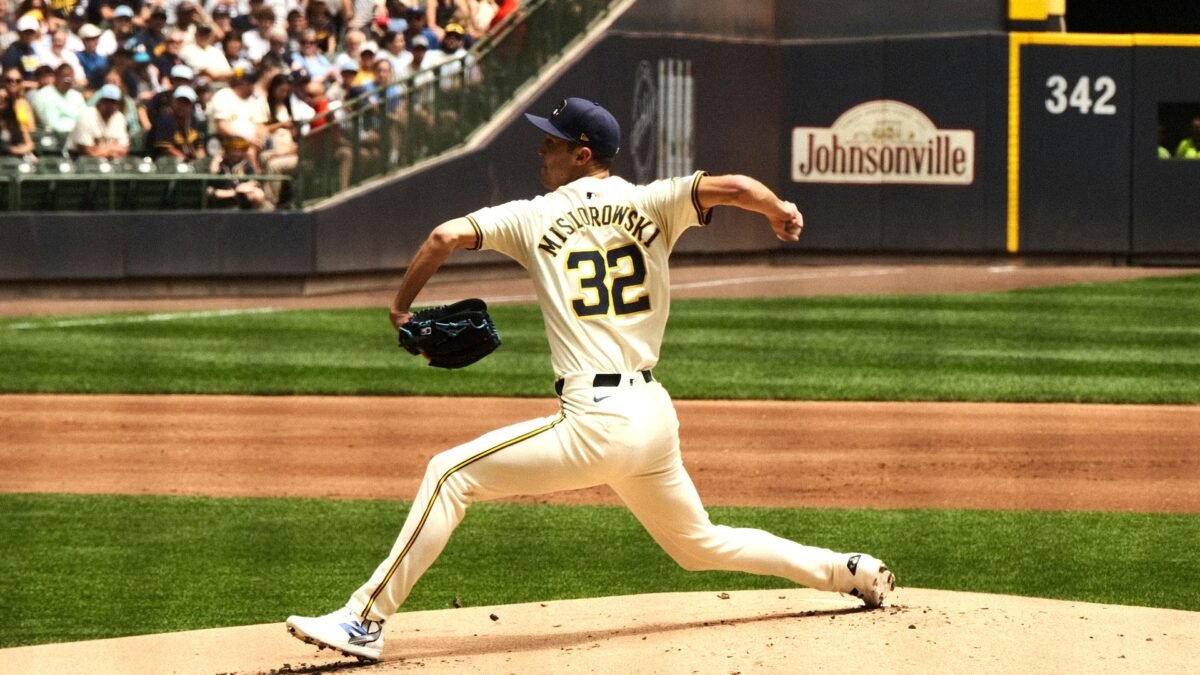
The Brewers’ starter, Jacob Misiorowski, gave up one run on four hits over five innings, striking out three and walking one in a 78-pitch outing, according to Reuters. The numbers alone do not capture how he announced himself to the World Series stage: his very first pitch of the game was clocked at 103.5 mph, the fastest pitch ever recorded in World Series history, according to Reuters.
Misiorowski arrived at this stage as one of the dominant pitchers of the season. His 1.80 earned run average and 252 strikeouts both led the major leagues during the regular season, according to Reuters, and he is the favourite for the National League Cy Young Award. Yet he had not completed five innings in any of his earlier postseason starts, which made Friday’s five gritty innings feel like a breakthrough in itself.
Behind him, Abner Uribe and Aaron Ashby combined for three scoreless innings, striking out five between them, according to Reuters. It was the formula Milwaukee has ridden all season: a powerful starter, a deep and hard-throwing bullpen, and a defence that turns potential rallies into outs.
For Tampa Bay, Nick Martinez took the loss. He allowed two runs on five hits over five innings, striking out five and walking none, according to Reuters. Martinez got the start only because the Rays held back their ace, Drew Rasmussen, for Game 2 to give him an extra day of rest, a decision that will come under fresh scrutiny now that the series opener has slipped away.
Two teams, one first championship
Whatever happens from here, this World Series will end with a franchise celebrating its first championship. It is the first World Series since 1980, when the Philadelphia Phillies beat the Kansas City Royals in six games, to feature two teams that have never won a title, according to NBC Sports.
Milwaukee’s wait has been the longer and more painful of the two. The Brewers’ only previous World Series appearance came in 1982, when they lost a seven-game series, according to Reuters. For 44 years, generations of Brewers fans have waited for a return to this stage, and Friday night was the first World Series game played in Milwaukee since that 1982 defeat.
Tampa Bay, by contrast, is on its third trip to the World Series, having reached the Fall Classic in 2008 and 2020 without winning it, according to Fox 13 Tampa Bay. The Rays won 98 games this season, the best record in the American League, after sweeping the New York Yankees in the division series and beating the Cleveland Guardians in six games in the championship series.
Milwaukee’s road was, if anything, more emphatic. The Brewers won a franchise-record 103 games in the regular season, the best record in baseball, according to Reuters. They beat the San Diego Padres in four games in the division series and then swept the two-time defending champion Los Angeles Dodgers in the championship series, clinching their first National League pennant since 1982.
The contrast with last year’s World Series could hardly be sharper. Reuters noted before the series that the 2025 Fall Classic paired the heavy-spending Dodgers with the Toronto Blue Jays, while this year’s matchup pairs two of baseball’s smallest markets and smallest spenders. On Forbes’ 2026 team valuations, Milwaukee ranked 21st at 1.9 billion dollars and Tampa Bay three places below at 1.7 billion dollars, according to Reuters. The Brewers and Rays are, in other words, proof that a championship can be built rather than bought.
Analysis: Why It Matters
Game 1 was won on the margins, and that favours Milwaukee
Look past the scoreline and this was not a game decided by star power alone. It was decided by a glove deflecting a triple, a foot sliding off a base by inches, a catcher throwing out runners, and a seventh-inning single down the line. In a series between two teams this evenly matched, those margins are the series. Milwaukee won nearly all of them on Friday, and that is a worrying sign for Tampa Bay, because the Brewers’ style of baseball is built precisely for winning tight games: they pitch, they defend, and they manufacture just enough runs. A blowout would have told us little. A 3-2 win built on defence and nerve tells us a great deal.
The ninth inning will linger longer than the final score
There is a psychological weight to the way a game ends, and Friday’s ending will sit differently in the two clubhouses. For Milwaukee, surviving a bases-loaded scare in the ninth, after the fireworks had already gone off, is the kind of shared experience that hardens a team. For Tampa Bay, coming within one strikeout of tying the game, after having a double play overturned in their favour, and still falling short, is the kind of near-miss that can either galvanise a side or drain it. Which of those it becomes may be decided as early as Saturday night. If the Rays win Game 2, the ninth inning becomes a footnote about resilience. If they lose it, it becomes the moment the series slipped away.
Misiorowski’s night changes the shape of the series
Before Friday, the fair question about Jacob Misiorowski was whether his electric regular season would translate to October. He had not lasted five innings in a postseason start, and the World Series stage has swallowed more talented pitchers than him. His answer was a 103.5 mph opening statement and five innings of one-run baseball. That matters beyond Game 1, because if Milwaukee can count on its ace for genuine length, its bullpen stays fresher for the rest of the series, and its path to four wins becomes much more manageable. The Rays, meanwhile, must now solve a pitcher who throws harder than anyone in World Series history and who has just proved he can do it under the brightest lights.
This is a triumph for how small-market teams are built
Baseball’s modern story is often told as a tale of payrolls, with the richest clubs buying their way to October. The Brewers and the Rays tell a different story, and it is one worth celebrating. Both clubs develop young talent, trust unheralded players, build deep bullpens, and find value where richer teams do not look. Milwaukee’s roster is full of players other teams passed over or undervalued; Tampa Bay’s is the product of one of the sharpest player-development systems in the sport. Whoever wins this series, their championship will stand as evidence that smart beats rich, at least sometimes, and that is a message with resonance far beyond Milwaukee and Tampa Bay.
One game does not win a series, but it does change the maths
It is tempting to overstate the importance of a single game in a best-of-seven series, and the Rays have every reason to insist that they are one win from levelling matters. That is true, but it understates what Milwaukee has gained. The Brewers now need three wins from six games, with home advantage still in their pocket for the deciding games if the series goes the distance. Tampa Bay, meanwhile, must now win at least one game in Milwaukee simply to avoid returning home already trailing, and must win four of the remaining six against the best team in baseball. The series is far from over. But the road back is now steeper for the Rays than it was at first pitch on Friday.
What to Watch Next
- Game 2 on Saturday night: Drew Rasmussen, who won 16 games with a 2.67 earned run average this season, starts for Tampa Bay against Logan Henderson for Milwaukee at American Family Field, with first pitch scheduled for 8 p.m. Eastern Time, according to USA Today. Rasmussen, a former Brewers draft pick, was held back from Game 1 for extra rest; Game 2 is where that gamble is judged.
- Tampa Bay’s approach on the bases: The Rays were aggressive in Game 1 and paid for it, with runners thrown out and rallies cut short. Whether manager Kevin Cash reins in that aggression or doubles down will be one of the tactical stories of Game 2.
- Milwaukee’s bullpen workload: Uribe, Ashby and Megill were all needed on Friday. How manager Pat Murphy manages that group over a long series, and whether his starters can give him more length, will shape the middle games.
- The return to Tampa Bay: Games 3 and 4 move to the Rays’ home ballpark. If Tampa Bay can split in Milwaukee, the series becomes a genuine contest; if Milwaukee takes both home games, the Rays face the near-impossible task of winning four of five.
- The history at stake: One of these franchises will end a drought that has lasted decades. Every game from here carries that weight, and the longer the series goes, the heavier it will feel in both cities.
Sources
- Reuters: Brewers survive harrowing 9th to edge Rays in World Series opener
- Reuters: Brewers and Rays clash with first World Series title at stake
- NBC Sports: Brewers withstand Rays’ comeback attempt to win 3-2 in Game 1 of World Series
- USA Today: Brewers-Rays World Series highlights, analysis and takeaways from wild Game 1 finish

About the Author — Abdul Mannan
Related Articles
Harry Brook’s Record 202 in Vain as Sri Lanka Chase 430 to Stun England
Harry Brook's record-breaking 202 off 116 balls was not enough as Sri Lanka pulled off the second-highest ODI…
LeBron James Dismisses Trump’s National Anthem Criticism: ‘Slow News Day at the Office’
LeBron James refused to be drawn into a feud with Donald Trump over his national-anthem warm-up movements, smiling…
South Africa Thrash Australia by an Innings and 31 Runs at Gqeberha to Level Test Series
Kagiso Rabada took four for 77 on the final day as South Africa bowled Australia out for 295…