
Student List Wins Serbia Election as Vučić Concedes, Ending 14 Years of SNS Rule

Serbia’s student-led opposition has won a snap parliamentary election, according to preliminary projections, after President Aleksandar Vučić conceded defeat on Sunday night and ended his party’s 14-year hold on power. The result, if confirmed by the official count, would turn one of Europe’s most durable protest movements into a governing majority — and close a chapter in Serbian politics that began with a deadly railway disaster almost two years ago.
“It is clear that we have lost these elections, the Student List has won,” Vučić told supporters at his party’s election-night event, according to Reuters. He said that, on the basis of a sample of results, the Student List would take between 135 and 140 seats in the 250-member National Assembly, while his own camp would take around 105. “We still do not have final results,” he added — a qualification that matters, because the official count had not been completed when he spoke.
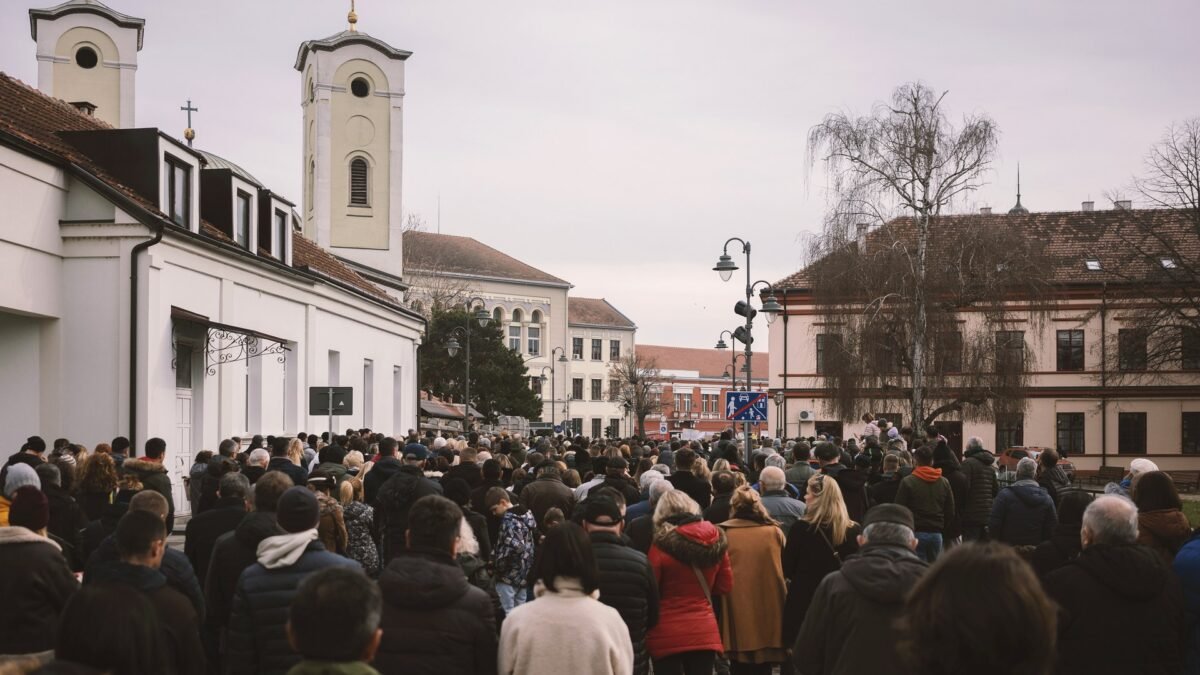
The concession came only about an hour and a half after polls closed, according to CNN, and it set off celebrations in Belgrade and other cities. Supporters of the Student List flooded into the streets, sounding car horns and chanting, as the scale of the upset became clear. The vote had been expected to be close. Instead, the early projections pointed to a decisive victory for a movement that did not exist as a political force two years ago.
Serbia’s 6.4 million voters were electing lawmakers to the 250-seat parliament. A party or list needs 126 seats for an outright majority. On Vučić’s own estimate, the Student List clears that bar comfortably. Independent projections told a similar story: the Centre for Free Elections and Democracy (CeSID) and Ipsos put the Student List on 52 per cent of the vote and 138 seats, against 39.3 per cent and 104 seats for Vučić’s list, according to reports of the projection. Another monitor, CRTA, put the Student List on 51.47 per cent and Vučić’s “United Serbia” coalition on 40.42 per cent. Minority lists, which operate under different rules, were expected to take the remaining handful of seats.
The margin surprised even seasoned observers. A poll published on 22 October, commissioned by Vučić’s own list, had put his camp ahead at 47.4 per cent against 40 per cent for the students. Pre-election surveys from other organisations had shown the two sides within a few points of each other. The result therefore represents not just a win for the opposition, but a sharp late swing — or, at least, a failure of polling to capture the scale of mobilisation on election day.
How the night unfolded
Voting took place on Sunday, 25 October, in a snap election that Vučić himself had called in September. He had resigned the presidency the previous month in order to lead his party’s campaign for the premiership, having served two near-full terms as president and being unable to seek a third. The contest was, in effect, a referendum on his leadership: the man who had dominated Serbian politics since becoming prime minister in 2014, and president in 2017, asking voters to return him in a new role.
Turnout was unusually high. By 7pm, monitors put participation at around 68 per cent, already well above the 58.77 per cent recorded in the previous parliamentary election in 2023, and on course for one of the highest turnouts in years. CNN reported that monitors predicted total turnout could reach around 70 per cent, a level unseen in Serbia since 2000. Long queues formed at polling stations in Serbia and abroad, and some members of the diaspora were made to vote in the middle of the night because voting hours were tied to Serbian time.
The day was not without tension. Police in anti-riot gear cordoned off an area in central Belgrade around the election commission headquarters, according to CNN, and special police vehicles were visible near a park where Vučić’s loyalists have camped for more than a year. Large groups of black-clad men had gathered at various points in the city. Independent monitors reported dozens of irregularities during the day, including the photographing of ballots — a practice that can suggest pressure on voters — and attempted vote buying. International and local monitors had already warned before the vote that the campaign had been marked by detentions, near-total government control over much of the media, and reports of surveillance and cyberattacks against activists.
As results began to emerge, the mood shifted quickly. At the Student List headquarters in Belgrade, candidates described by Reuters as little-known experts, lawyers, professors, actors and farmers hugged and cheered in near disbelief. Chemistry professor Radomir Saicic, a candidate for the list who has been tipped as a possible future president, told reporters: “Tonight is a victory of courage over fear, and of faith that Serbia can and must be different.” On the streets, one reveller, Nebojsa Cosic, waving a flag, declared: “The people have won! The people defeated a dictator! The people will lead Serbia!” Reuters also quoted Milica, a law student, saying: “That is the best thing that happened in my life. We will now breathe freely.”
Vučić’s own address struck a very different note. He thanked his followers and said he was proud of everything his government had done, but he blamed Serbia’s independent media and alleged interference by unnamed European countries and an “American deep state” for the loss. He said he would not flee the country, telling supporters: “No one is going to run away. We’ll protect everyone from their harassment.” He also said he would not appeal against the result in the courts, in order to avoid, as he put it, unrest and clashes in the streets. And he referred again to the allegation that police had used a sound cannon against protesters last year, saying he was waiting for his opponents to pursue him over it.
A movement born from a disaster
To understand why this election mattered so much, it is necessary to go back to 1 November 2024, when a concrete canopy collapsed at the newly renovated railway station in Novi Sad, Serbia’s second city, killing 16 people. The disaster became a symbol, for a growing number of Serbs, of something larger: a system in which large public works were carried out without proper accountability, in which contracts and responsibility were opaque, and in which, as protesters put it, nobody was ever held to account.
Students led the response. What began as demands for answers about Novi Sad widened into a sustained campaign against corruption, cronyism and what the movement described as creeping authoritarianism. For almost two years, students marched, cycled and walked across the country, reaching voters in rural areas that had traditionally supported Vučić. They were vilified in much of the pro-government media and denounced by Vučić himself as a foreign-led attempt to unseat him. But they kept growing, drawing in teachers, farmers, lawyers, doctors and pensioners, and building a following that cut across Serbia’s usual political divides.
The movement’s defining organisational choice was to stay leaderless. When it decided to contest the election, it did not put students themselves on the ballot. Instead, the Student List — formally, “Student List – Students Win” — fielded 250 candidates drawn from professional and civic life: experts, athletes, farmers and artists, united less by a party programme than by a shared demand for institutions free from political pressure. That choice was deliberate. It was meant to answer Vučić’s one-man rule with a collective alternative, and to restore, in the movement’s own language, a sense of community and solidarity.
The campaign’s closing rally illustrated the scale of what the movement had become. On Thursday, 22 October, supporters packed Belgrade’s central Slavija Square for an event billed as “Victory Calling”, filling several blocks of surrounding streets. Candidates promised, from 26 October, a judiciary and prosecution service free from political pressure, and education and healthcare equally available to all. “Serbia deserves freedom, justice and responsibility,” actor and candidate Tihomir Stanić told the crowd, according to reports of the rally. At the end, the candidates walked across the stage holding copies of Serbia’s constitution.
Vučić, for his part, held his own closing rally the same day at a sports hall in New Belgrade. He retained considerable support: admirers viewed him, in CNN’s summary of his appeal, as a capable leader who could steer Serbia through global uncertainty, and his government could point to a period of strong economic growth. But the Novi Sad disaster had eroded that standing in a way that earlier controversies had not, and the student movement proved a far tougher opponent than the fractured opposition parties Vučić had routinely outplayed in the past.
What the numbers say — and what they do not
It is important to be precise about the status of Sunday’s result. Vučić conceded on the basis of a sample, not a certified count. The projections from CeSID-Ipsos and CRTA are estimates from samples of polling stations, not the final allocation of seats. Serbia’s Republic Electoral Commission had not confirmed the final results when the concession was made, and early official figures covered only a small fraction of polling stations. Readers should therefore treat the seat numbers — 135 to 140 for the Student List, around 105 for Vučić’s camp — as the best available picture on election night, not as the final certified outcome.
That distinction does not diminish the political fact of the concession. A sitting president who stepped down to fight an election, and who had never lost a national vote in more than a decade, publicly accepted that his side had lost and that the Student List had won. The Council of Europe’s secretary-general, Alain Berset, welcomed what he called Vučić’s acceptance of the result and commitment to a peaceful democratic transition. That acceptance is, in itself, a significant guardrail against a contested aftermath.
At the same time, the gap between the projections and the final count will be watched closely. If the official results confirm a Student List majority, the movement will face the immediate task of forming a government — choosing a prime minister, agreeing a programme, and holding together a list of 250 people who were selected precisely because they were not career politicians. If the final count narrows the margin, questions about irregularities reported on election day — ballot photographing, attempted vote buying, and the uneven media environment — are likely to return to the foreground.
The previous parliamentary election, in 2023, was followed by opposition protests alleging fraud. Local elections earlier this year, in ten municipalities, saw violent attacks on journalists and activists, according to CNN. Serbia is a candidate for membership of the European Union, and the conduct of this vote was closely watched in Brussels. The monitors’ findings, and the electoral commission’s handling of any complaints, will therefore matter as much as the headline seat count in the days ahead.
Reaction at home and abroad
European leaders were quick to congratulate the winners. Ursula von der Leyen, the head of the European Commission, wrote on X that the people of Serbia had turned out in record numbers to shape their country’s future. “Congratulations to the Student List on its victory in the parliamentary elections,” she wrote, according to Reuters. “We stand ready to support reforms on the rule of law, media freedom, the fight against corruption and strong democratic institutions, and to work together to advance Serbia’s future in the European Union.”
Marta Kos, the European Commissioner for Enlargement, said Serbia had “raised its voice” after nearly two years of protests for democracy, the rule of law and the fight against corruption, and noted that citizens had turned out in historic numbers. Berset, for the Council of Europe, congratulated the Student List and said the Council stood ready to work with Serbia’s democratically elected leadership to strengthen human rights, democracy and the rule of law. Montenegro’s prime minister, Milojko Spajic, said the events in Serbia were a vivid reminder that the will of the people and their right to freely decide their future were the foundation of every democratic change.
Hungary’s prime minister, Peter Magyar, said he had spoken by telephone with the Student List’s leaders to congratulate them and had assured them of Hungary’s support. He added, according to Reuters, that he was delighted to hear how much strength his own victory in April had given the Serbian students during their struggle. The parallel was noted more widely: CNN observed that the student victory echoed the recent electoral defeat in Hungary of a Vučić ally, Viktor Orbán, after 16 years, in a contest where youth participation also played a decisive role.
The result also carries a signal for Moscow. Vučić had been endorsed by Russian President Vladimir Putin, according to CNN, and had maintained a close relationship with Russia even as Serbia pursued EU membership. A government led by a pro-European student movement would be expected to tilt Belgrade more clearly towards Brussels, though the Student List’s own foreign-policy positions — on Kosovo, on relations with Russia, and on the pace of EU accession — have yet to be tested in office. Russia’s response, and the response of other regional governments, will be an early indicator of how far the political shift extends beyond Serbia’s borders.
Analysis: Why It Matters
1. A protest movement has become a parliament
The most remarkable feature of this result is not that an incumbent lost, but who beat him. Opposition parties lose elections in democracies all the time; protest movements rarely convert street power into a parliamentary majority in a single leap. The Student List did so by refusing the usual rules of Serbian opposition politics. It had no single leader for Vučić to attack, no party history for his media to excavate, and no programme narrow enough to be caricatured. Its candidates were, by design, ordinary professionals lending their names to a civic demand: institutions that work, contracts that can be examined, and a state that answers for its failures. That model worked as a campaign. Whether it works as a government is a different question, and the movement’s lack of a traditional party machine — its greatest asset in the election — could become its greatest weakness in office, when discipline, compromise and patronage management matter more than moral clarity.
2. Novi Sad changed what Serbian politics is about
Before November 2024, Serbian elections were fought mainly over living standards, foreign policy orientation, and Vučić’s personal authority. The canopy collapse reframed the argument around a simpler and more corrosive question: who is responsible when the state fails? Sixteen deaths at a public building gave an abstract complaint about corruption a human face and a date. The students’ genius was to keep returning to that question — in silent vigils, in marches, in the demand for documents — rather than allowing the debate to drift back to the familiar terrain of party rivalry. Vučić’s government, which had survived many scandals, could not survive a story in which the state itself was the suspect. Any future Serbian government should read that lesson carefully: infrastructure, procurement and accountability are no longer technical issues. They are the issues on which governments now stand or fall.
3. Turnout defeated the polling — and the machine
The scale of the surprise deserves attention. Polls days before the vote showed a close race, with one survey commissioned by Vučić’s camp putting him ahead. The result suggests either a very late swing or a systematic polling failure, most plausibly driven by voters who had not voted before. Turnout approaching 70 per cent, with long queues and heavy diaspora participation, points to mobilisation beyond the usual electorate: young people, first-time voters, and citizens who had previously stayed home because they believed the outcome was predetermined. That is a familiar pattern in breakthrough elections, from Hungary earlier this year to other youth-driven contests across Europe. It also carries a warning for incumbents everywhere: a large, motivated pool of non-voters is a risk that opinion polls, which weight for past voting behaviour, systematically understate.
4. Europe gains a test case — and a responsibility
Brussels welcomed the result warmly, and understandably so: a pro-European, reform-minded government in Belgrade would unblock a relationship that has been strained for years by democratic backsliding, media pressure and unresolved tensions with Kosovo. But that welcome now creates an obligation. If the EU offers the new government only warm words, while accession talks remain frozen and investment remains conditional on reforms that take years, disillusionment could follow quickly. Conversely, if Brussels moves too fast, it risks being seen to reward a government before it has proved its democratic credentials in office. The right balance — concrete support for judicial reform, media freedom and anti-corruption institutions, tied to verifiable steps rather than promises — will determine whether Sunday’s result becomes a turning point for Serbia’s European path or merely a change of faces.
5. The concession matters as much as the victory
In an era when defeated incumbents increasingly refuse to accept results, Vučić’s concession — however grudging, and however laced with blame for the media and foreign interference — deserves to be recorded plainly. He said his side had lost, he said he would not appeal to the courts to avoid unrest, and he said he would not flee. Those three statements, taken together, removed the most dangerous fuel from a volatile night. They do not erase the irregularities reported by monitors, nor the media environment in which the campaign was fought. But they gave Serbia something it might easily have lacked on Sunday night: a shared, public acknowledgement of the outcome. The Student List’s first task is to protect that acknowledgement by insisting on a transparent official count, even where the final numbers are less flattering than the projections.
What to Watch Next
- The official count: whether Serbia’s Republic Electoral Commission confirms a Student List majority, and how it handles complaints about ballot photographing, attempted vote buying and other irregularities reported by monitors.
- Government formation: who the Student List nominates as prime minister, how its 250 disparate candidates agree a programme, and whether Vučić’s party cooperates with a transfer of power or retreats into opposition.
- Vučić’s next move: whether he remains a political force as party leader, seeks another office, or fades from frontline politics after his concession and his pledge not to appeal.
- The European response: whether Brussels follows its congratulatory statements with concrete steps on accession talks, rule-of-law support and investment, and how the new government handles Kosovo and relations with Russia.
- The accountability agenda: whether the new parliament delivers on its central promise — a judiciary and prosecution service free from political pressure, and a full accounting for the Novi Sad disaster — or whether governing dilutes the movement that won the election.
Sources
- Reuters — Serbia’s Vucic concedes defeat to student-led movement in parliamentary election
- CNN — Serbia’s leader concedes defeat to student-led movement in seismic political shift
- Reuters — Reactions to election victory of Serbia’s Student List
- Reuters — Belgrade in rapture as Serbian students topple Vucic in historic election

About the Author — Abdul Mannan
Related Articles
Lula Wins Fourth Term as Brazil Re-elects Him in Runoff Comeback Over Flávio Bolsonaro
Brazil's electoral authority has declared Luiz Inácio Lula da Silva re-elected, defeating Senator Flávio Bolsonaro in a runoff…
Trump Says US Warships Could Stop Off Cuba on the Way Back From Iran as Rubio Urges Cubans to Work With the CIA
President Donald Trump has revived the prospect of US military pressure on Cuba, telling a Florida rally that…
Hundreds of Thousands March Across France for a Second Weekend as Evening Clashes Flare in Paris
Around 410,000 people joined largely peaceful protests across France on Saturday, with evening clashes in Paris and Marseille,…