
Smugglers Open a New Front in the Netherlands as First Dutch Small-Boat Launch Leaves 38 Migrants Adrift in the Channel

People smugglers have launched a small boat carrying migrants to Britain from the Netherlands for the first time, in a shift that has forced Dutch ministers, British MPs and border officials to confront a Channel crossings map that is stretching far beyond its old centre of gravity around Calais.
The boat, carrying 38 migrants, was found drifting without an engine off Cadzand, on the Dutch coast near the Belgian border, on Saturday 31 October. Prosecutors have since confirmed that the vessel entered the water from Dutch territory, according to the BBC, and two men are being questioned on suspicion of people smuggling.
The discovery has been treated in London and The Hague as more than a one-off incident. Dover MP Mike Tapp said smugglers would keep adapting as launch sites in northern France came under heavier pressure, warning that the gangs would find “new launch locations and methods”. Dutch Deputy Prime Minister Bart van den Brink, who is also the Netherlands’ minister for asylum and migration, called it “highly disturbing” that such an incident had happened in Dutch waters, and said it was the first time the problem had reached the Netherlands.
The episode arrives at a paradoxical moment in the politics of the Channel. Overall crossings are down sharply this year, with the lowest number of summer arrivals since 2020, according to the UK government. Yet the Dutch launch shows that the smuggling networks behind the crossings are not disappearing. They are moving, and the map of the problem is getting wider.
Found adrift off Cadzand
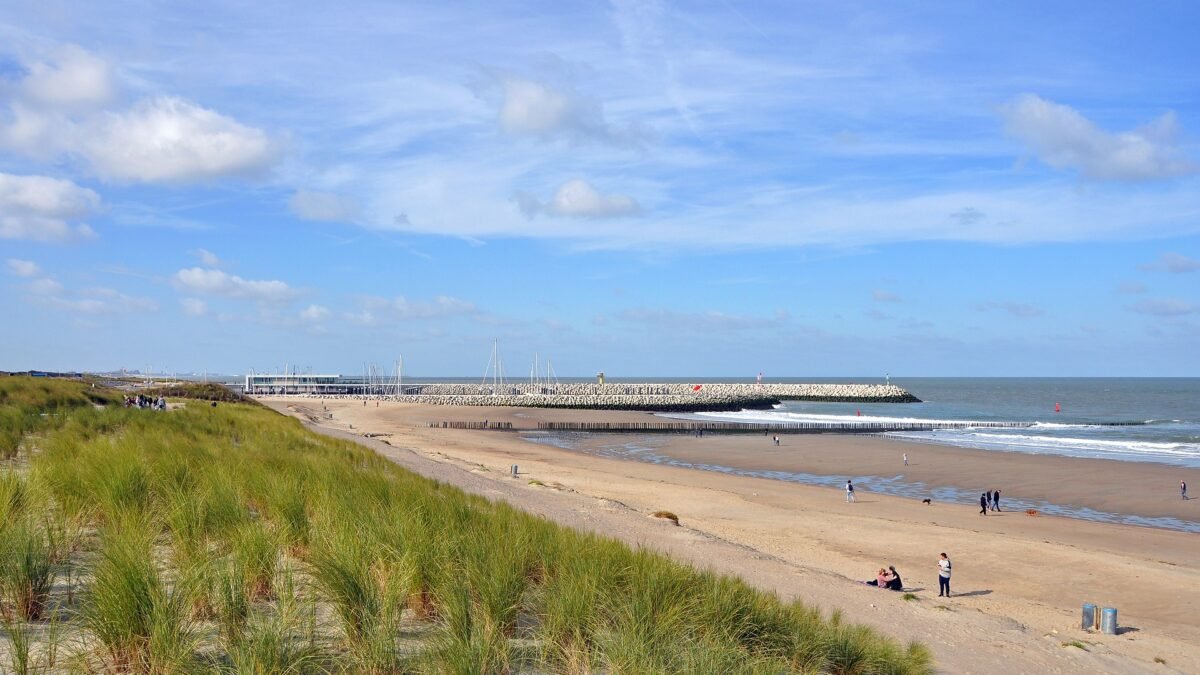
The vessel was discovered by the Royal Netherlands Marechaussee, the Dutch military police service, near Cadzand, a small coastal town in the province of Zeeland, close to where the Dutch coast meets Belgium. The inflatable boat had lost its engine and was left drifting in cold weather, in what Dutch rescuers described as a very dangerous situation.
Bastiaan van Blokland, from the Netherlands Red Cross, told the BBC the crossing was “unusual” and that it “didn’t look safe at all”. He said the situation had been dire for the people on board. “The situation definitely was dire, 38 people on a boat with legs dangling out of the boat, in the cold weather, without an engine,” he said. “We were surprised that this situation occurred, we are not very familiar with these kind of movements and we will be alert for the future.”
Crews were still searching for the boat’s missing engine off the Cadzand coast on Thursday 5 November, days after the rescue, according to reporting of the investigation. Prosecutors confirmed that the vessel had entered the water from Dutch territory, a finding that turned what might have been treated as another French-coast incident into a first for the Netherlands.
Two men are still being questioned on suspicion of people smuggling, police said. No further details about the men, or about where exactly on the Dutch coast the boat was launched, have been released, and the investigation into the network behind the crossing is continuing.
The 38 people on board were rescued. Their nationalities have not been disclosed. What is known is that they were put to sea in a small inflatable boat, of the kind that has become the standard vessel for Channel crossings, and that the boat lost power before it had travelled far from the Dutch shore.
The reaction in London and The Hague
Mike Tapp, the Labour MP for Dover and Deal, said the Dutch launch showed that disruption of the gangs’ operations in northern France was pushing them to look elsewhere. “As launch disruptions grow, the criminal gangs will adapt and a part of that will be finding new launch locations and methods,” he said. “That means our operational efforts must also be agile. We have seen a significant reduction in crossings this year, but we still have a long way to go.”
In The Hague, the reaction was one of alarm that the problem had arrived on Dutch shores at all. Bart van den Brink, the Dutch deputy prime minister and asylum and migration minister, told Dutch news outlet RTL that the incident was “highly disturbing”. “This problem was situated around Calais for a long time and moved up north in the direction of Belgium,” he said. “But now for the first time in the Netherlands we see this occurring.” He said the relevant Dutch authorities would be brought together to “see what we can learn from this”.
Former director general of the UK Border Force Tony Smith said the incident was part of a clear pattern. “It is clear that the human smugglers operating in Europe continue to try new routes to bring illegal entrants to the UK,” he said. “In recent months we have seen launches from the Normandy beaches, Belgium and now as far afield as the Netherlands rather than across the short straits to Dover under the original model. It is important that the Border Security Command adapt its operations to cope with this ever expanding challenge.”
A Home Office spokesperson said joint work with international partners had prevented more than 50,000 crossing attempts and led to the seizure of 1,100 boats and engines since the election. “But we must go further,” the spokesperson said. “That’s why we are boosting the number of officers on the ground in France and removing the pull factors drawing people here through illegal and dangerous routes.”
A map that keeps widening
For most of the eight years since small-boat crossings began in earnest, the geography of the problem was simple. The boats launched from the beaches around Calais and Dunkirk in northern France, crossed the narrowest part of the Channel, and aimed for the Kent coast around Dover. The short crossing, about 21 miles at its narrowest, was the route’s defining feature, and the French coastline around Calais was its centre.
That map has been widening for some time. This year, crossings have already been attempted along a much broader stretch of coast, from Belgium to Normandy, according to the BBC. Boats have set off from the Normandy beaches, far to the west of Calais, and from the Belgian coast, to the north-east. One vessel spent more than 30 hours at sea after setting off from Cherbourg, a journey far longer and more dangerous than the short hop from Calais to Dover.
The Dutch launch extends that widening further still. Cadzand sits roughly 100 miles north-east of Calais along the coast, and a crossing from there to the English coast is a substantially longer and more exposed voyage than the traditional route. The fact that smugglers were prepared to attempt it, with 38 people packed into a small inflatable boat, underlines how far the networks are willing to go to find a launch point that enforcement has not yet reached.
Federal Belgian police have suggested that the shift northwards has been driven by French enforcement activity, according to the BBC. As French police have disrupted launches around Calais and Dunkirk, the gangs have moved along the coast in search of quieter beaches. The Dutch incident suggests that logic has now carried them across a national border.
The British and French response has also been widening. Nearly 1,050 French officers are now supporting UK-France efforts to stop crossings, with an additional new surge team bolstering operations on the western beaches, according to officials cited by the BBC. In October, the Home Secretary signed a deal with the Belgian interior minister enabling police in both countries to exchange intelligence more quickly to disrupt and dismantle organised criminal networks, including those involved in migrant smuggling.
The question now is whether the Netherlands will be drawn into the same framework. Van den Brink’s promise to bring the relevant Dutch authorities together suggests that The Hague is treating the incident as the start of a new front rather than an isolated case. Police officials in the Netherlands described the small-boat rescue as rare, but there have been a small number of cases in recent years in which smugglers were caught trying to use yachts to smuggle migrants into the UK from the Dutch coast.
The numbers behind the fall
The Dutch launch comes in a year in which the headline numbers have moved decisively in the government’s favour. Home Office figures put the number of people detected crossing the Channel in small boats at 21,869 between 1 January and 30 October 2026, according to reporting of the department’s data. That is 41 per cent fewer than the 36,954 recorded over the same period in 2025. The total had risen to 22,605 by 5 November, according to a tracker of the Home Office weekly release.
The government says this year has seen the lowest number of summer arrivals, the period when journeys often rise in part because of warmer weather, since 2020. With just over two months of the year to go, and with crossings typically lower during late autumn and winter, the data suggests the total number of crossings in 2026 is unlikely to surpass the figure for 2025, when 41,472 people crossed, the second-highest annual total on record.
The fall has not been smooth. Crossings stopped entirely for three weeks in October as stormy weather made the Channel impassable, with no arrivals recorded between 8 and 28 October. When the weather cleared, the crossings resumed at pace. More than 1,600 people landed in the UK in four days, with 263 arriving on Thursday 29 October, 671 on Friday 30 October, 259 on Saturday 31 October and 477 on Sunday 1 November, according to Home Office figures reported at the time.
The longer view shows how far the numbers have fallen from their peak, and how far they still have to go to return to anything like the levels of the early years. In 2018, when the small-boat route first emerged at significant scale, 299 people were recorded arriving this way. The figure rose to 1,843 in 2019, 8,462 in 2020 and 28,526 in 2021, before reaching a record 45,755 in 2022. Arrivals fell to 29,437 in 2023, then rose again to 36,816 in 2024 and 41,472 in 2025, according to the Home Office time series.
More than 200,000 people have now crossed the Channel in small boats since 2018, according to the House of Commons Library, which puts the total at around 205,000 by June 2026. The boats themselves have grown larger and more crowded. There was an average of seven migrants per boat in 2018, rising to 41 in 2022, 62 in 2025 and 64 so far in 2026, according to The Times. The Dutch boat, with 38 people aboard, was smaller than the current average, but it was still carrying far more people than the vessels of the early years.
The politics of the numbers is contested. GB News reported that more than 10,000 people had crossed the Channel in small boats since Andy Burnham became prime minister on 20 July, reaching 10,139 by 1 November, an average of about 97 a day. The same analysis put crossings down 39 per cent on the same point in 2025 and said the year was on course for the fewest arrivals since 2021. Shadow home secretary Chris Philp responded to the four-day surge at the end of October by saying: “The boats keep coming, the smugglers keep operating and Labour keeps making excuses.”
Eight years of small boats
The small-boat route barely existed before 2018. For years, the main way people reached Britain without authorisation was hidden in lorries, or by other routes through ports and the Channel Tunnel. The first small boats were a novelty. Within four years, they had become the main way people reached Britain to claim asylum.
The growth was rapid and sustained. From 299 arrivals in 2018, the annual total multiplied almost every year until it peaked in 2022. The fall in 2023, to 29,437, was followed by two years of increase, and 2025, with 41,472 arrivals, was the second-highest year on record. Small-boat arrivals made up 41 per cent of all people applying for asylum in the UK in 2025, according to the Migration Observatory at the University of Oxford, a similar share to the preceding four years. The total number of people claiming asylum in the UK reached 101,000 in 2025, close to the record level of 2024.
The people making the crossing have come from a relatively small number of countries. From 2018 to 2025, nationals of six countries accounted for 65 per cent of all arrivals: Iran, at 16 per cent, Afghanistan, at 14 per cent, Iraq, at 10 per cent, Eritrea, at 10 per cent, Albania, at 8 per cent, and Syria, at 8 per cent, according to the Migration Observatory. Eritrea was the top country of origin in 2025, with more than twice as many arrivals as in 2024.
The human cost has been severe. There were 24 confirmed deaths related to Channel crossings in 2025, down from 73 the year before, according to the Migration Observatory. A total of 162 people have died in connection with Channel crossings since the route emerged. The Dutch incident, in which 38 people were left adrift without an engine in cold weather, is a reminder of how narrow the margin between rescue and disaster can be.
Successive governments have tried a succession of measures: deals with France, new laws, new enforcement bodies, and, in November 2025, significant reforms to the asylum system aimed at deterring people from coming to the UK. The Border Security Command, the body now charged with leading the enforcement effort, was set up to treat the crossings as an organised-crime problem rather than simply a border problem. Its task, as Tony Smith put it, is to adapt as fast as the gangs do.
Analysis: Why It Matters
Geography is the gangs’ best weapon
The most important fact about the Dutch launch is not that it happened, but where it happened. Cadzand is not a natural launch point for a crossing to Britain. It is far from the Kent coast, exposed to the open North Sea and the Channel, and a long way from the established smuggling infrastructure of northern France. That the gangs used it anyway tells us something important about how they operate. They are not tied to a place. They are tied to an opportunity, and they will move wherever enforcement is thinnest.
This is the central problem for every government that has tried to stop the crossings. Enforcement is place-based. Police patrol beaches, watch ports, and disrupt launches in a particular stretch of coast. The gangs are not place-based. They are networks, and networks move. Every time one stretch of coast is closed down, the pressure shifts somewhere else, and the map gets a little wider. Calais gave way to Dunkirk, Dunkirk to Belgium, Belgium to Normandy, and now Normandy to the Netherlands. Each move makes the crossing longer, more dangerous and harder to police, but it does not stop the crossings.
Displacement, not defeat
The second lesson is about how to read the falling numbers. Crossings in 2026 are down by more than 40 per cent on the same period in 2025, and the summer saw the lowest arrivals since 2020. That is a real achievement, and it reflects a combination of enforcement, weather and policy. But the Dutch launch is a reminder that a falling total and a defeated network are not the same thing.
Displacement is the classic outcome of enforcement against a mobile criminal trade. When the police close one route, the trade does not vanish. It finds another route, and the new route is often worse: longer, more dangerous, and harder to detect. The 30-hour voyage from Cherbourg, the launches from Belgium, and now the Dutch launch all point in the same direction. The gangs are absorbing the pressure and adapting, exactly as Mike Tapp warned. A government that measures success only by the headline total risks missing the shift underneath it.
The Netherlands is now a stakeholder
The third consequence is diplomatic. Until last Saturday, the Netherlands was a bystander to the small-boats problem. It had no launch sites, no rescues and no political stake in the enforcement effort. That has changed in a single incident. The Dutch deputy prime minister has now had to answer for a boat launched from his own country’s coast, and the Dutch authorities are now part of the conversation about how to stop the next one.
This matters because the enforcement effort depends on co-operation between the countries along the coast. The deal with Belgium in October, which allows faster intelligence sharing between British and Belgian police, is a model for what may now be needed with the Netherlands. But every new country added to the effort adds complexity, and every new stretch of coast that must be watched stretches the available resources a little thinner. The Dutch launch does not just widen the map of the problem. It widens the map of the solution, and that is a harder thing to manage.
The politics of a falling number
The fourth point is political, and it cuts both ways. For the Burnham government, the fall in crossings is the strongest evidence that its approach is working, and it will point to the 41 per cent reduction and the lowest summer arrivals since 2020 as proof. For its critics, the Dutch launch and the four-day surge of more than 1,600 arrivals at the end of October are proof that the problem is not solved, only moved.
Both claims have something to them, and that is what makes the politics of the crossings so difficult. The government can reasonably say the numbers are down. Its critics can reasonably say the gangs are still operating. The 10,000 arrivals since Burnham took office in July, reported by GB News, is a number that will be quoted back at the government for as long as the crossings continue. The Dutch launch gives the critics a new example, and it gives the government a new problem to explain.
The winter test
The final point is about timing. Crossings typically fall in late autumn and winter, as the weather worsens and the sea becomes more dangerous. The three-week pause in October, when storms stopped all crossings, showed how much the route depends on the weather. The winter months should therefore bring a further fall in arrivals, and the government will hope to end the year with the lowest total since 2021.
But winter also makes the crossings that do happen more dangerous, and it makes the longer routes from Belgium, Normandy and now the Netherlands more perilous still. A boat that loses its engine off Cadzand in October is a rescue. The same boat in January, in worse weather and colder water, could be a tragedy. The test of the winter is not only whether the numbers fall, but whether the enforcement effort can keep pace with a trade that is now operating from a longer, more exposed coastline.
What to Watch Next
- The Dutch investigation: whether the two men questioned on suspicion of people smuggling are charged, and what the investigation reveals about the network behind the launch, including how the boat and its passengers reached the Dutch coast.
- Whether the Netherlands becomes a regular launch point: whether more boats are detected launching from the Dutch coast in the coming weeks, or whether the Cadzand incident remains a one-off, will show whether the gangs have found a new base or were simply testing a route.
- The Dutch response: what measures the Dutch authorities announce after their review, and whether the Netherlands joins the intelligence-sharing arrangements Britain has already struck with France and Belgium.
- The Border Security Command’s adaptation: how the British enforcement effort adjusts to a threat that now stretches from Normandy to the Netherlands, and whether its resources and partnerships can keep pace with the widening map.
- The winter numbers: whether the 2026 total stays on course for the lowest figure since 2021, and whether the longer, more dangerous routes from further afield produce a rise in rescues, or worse, as the weather deteriorates.
Sources
- BBC News — Dutch small boat launch shows smugglers adapting, says Dover MP
- EuropeSays — Migrant boat carrying 38 launching from Netherlands shows smugglers using new tactics, former immigration minister warns
- Opera News — Migrants rescued in Dutch waters as 1,600 reach UK
- House of Commons Library — Statistics on small boat Channel crossings
- Migration Observatory, University of Oxford — People crossing the English Channel in small boats
- BritainPost — Dover MP says smugglers are adapting after Dutch launch

About the Author — Abdul Mannan
Related Articles
Tube Drivers to Stage Eight Days of Strikes Over Christmas as RMT Rejects TfL’s Four-Day Week Plan
London Underground drivers will stage eight 24-hour strikes between 26 November and 25 February, including walkouts on 17…

Thomas Markle, Father of the Duchess of Sussex, Arrested by FBI on Federal Child Sexual Abuse Material Charge
Thomas Markle, 82, the estranged father of Meghan, Duchess of Sussex, has been arrested in Florida and charged…

Met Chief Warns Policing Is ‘Heading for Failure’ Without Biggest Overhaul in 50 Years
Metropolitan Police Commissioner Sir Mark Rowley has warned that policing in England and Wales is 'heading for failure'…