
Met Chief Warns Policing Is ‘Heading for Failure’ Without Biggest Overhaul in 50 Years

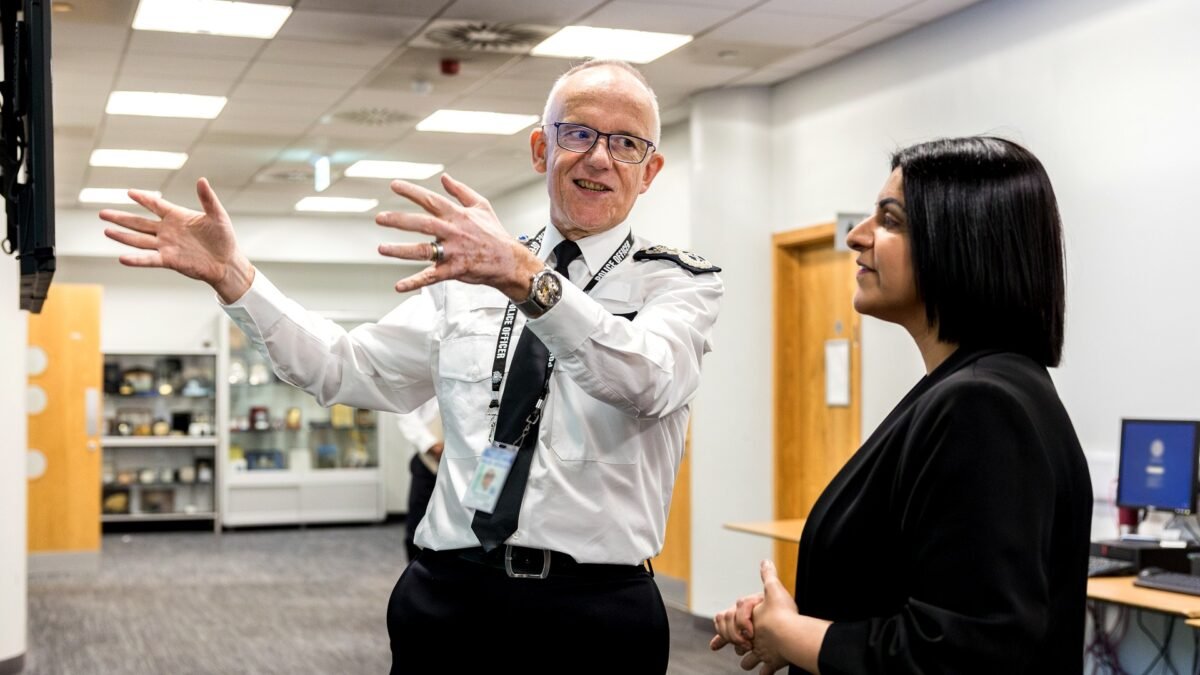
Britain’s most senior police officer has warned that policing in England and Wales is heading for failure unless it undergoes the biggest overhaul in more than half a century, calling for the 43-force system to be swept away and replaced by eight to ten regional forces backed by a new National Police Service.
Sir Mark Rowley, the Commissioner of the Metropolitan Police, delivered the stark warning in a major speech in Manchester on Friday, telling an audience of fellow chief constables, politicians and policymakers that the choice facing the country was between what he called the third great revolution in British policing and “the inevitable decline and fewer bobbies on the beat”.
“I believe this is a choice between the third greatest revolution in British policing or the inevitable decline and fewer bobbies on the beat,” Sir Mark said, according to the Metropolitan Police’s account of the speech. “The real danger is not change. The real danger is standing still.”
His intervention is the most forceful public backing yet from a serving police chief for the government’s radical reform programme, and it lands as Home Secretary Shabana Mahmood’s plans for restructuring the service move from white paper to legislation. In January, Mahmood published a 106-page white paper, “From Local to National: A New Model for Policing”, and the government committed in the King’s Speech to introduce a Police Reform Bill to put its proposals into law.
Sir Mark’s message was blunt: criminals have modernised faster than the institutions built to stop them. Organised crime groups, fraud networks, cyber criminals, online child abusers and hostile states now operate across regional, national and international borders, he argued, while policing remains organised around structures designed for a different age. “We have 43 overstretched forces trying to do too much, with too little,” he said. “The model is creaking.”
The figures he laid out paint a picture of a service under severe strain. Positive outcomes nationally — cases in which a crime is solved with a charge, caution or another formal outcome — are now less than half what they were twelve years ago, according to the Metropolitan Police. Public confidence has fallen by nine per cent. Just 11 per cent of people report seeing an officer or community support officer on foot patrol each week, down from 39 per cent in 2011. Even the best-performing force in the country solves only 22 per cent of crimes, and only 58 per cent of its public say it does a good job or better.
Speaking on BBC Breakfast before the speech, Sir Mark said crime had changed enormously over the years while policing remained largely organised as it was 60 years ago. Asked what would happen if the reforms were not put in place, he replied simply: “the risk is failure”. The BBC reported that he warned the system was “heading for failure” without change.
A three-tier model to replace 43 forces
At the heart of Sir Mark’s proposal is a simpler three-tier structure. At the top would sit a single National Police Service, leading the response to serious and organised crime and terrorism. Beneath it would be eight to ten regional police forces, replacing the current 43. At the base would be hundreds of local policing commands, rooted in neighbourhoods and focused on everyday crime.
“We have to move from today’s fragmented, bureaucratic, top heavy spaghetti model,” he said in the speech, the full text of which was published after the event. “This simpler structure must deliver five things.”
Those five tests, as he set them out, were stronger local policing, a leaner service with better technology, stronger partnerships at every level, clear national leadership, and targeted investment. Each local command, he argued, would sit inside one of the regional forces, giving neighbourhood officers direct access to the specialist skills they increasingly need — digital and communications specialists who can examine devices, financial investigators who can trace money across borders, surveillance teams, undercover officers and firearms specialists. “Local policing at the heart,” he said. “The strength of a bigger force behind it.”
The national tier would take charge of the most complex threats. Sir Mark said it should provide clear national leadership for fraud and cybercrime, replacing what he described as fragmented responsibilities split between the National Crime Agency and the City of London Police. It would also equip regional forces with the best technology and lead a coordinated response to organised crime and terrorism.
On partnerships, he proposed that mayors should set priorities for regional forces, shaping the response around the needs of their areas, and that police, prosecutors, courts and probation should work across common geographical boundaries, overseen by a mayoral board for each region. These partnerships, he said, must have the authority to resolve problems and deliver a joined-up service, “going much further than today’s local criminal justice boards”.
And on money, he was explicit that reform alone is not enough. “Continued disinvestment in policing is dangerous,” he said. “Reform is essential, but it cannot substitute for investment.” He called for police funding to return to at least 0.9 per cent of GDP, the level it stood at in 2010 before falling to around 0.7 per cent — a drop he put at more than £3 billion in today’s money.
The funding squeeze behind the warning
The financial case Sir Mark presented was as striking as the structural one. Last year, he said, police forces used £276 million from their reserves simply to balance their budgets, and borrowed more than £630 million to fund capital programmes. With 77 per cent of expenditure committed to officer and staff pay, the scope to invest in better tools, technology and training is already narrow.
Of the £2 billion spent on technology each year, he said, 97 per cent goes on simply maintaining legacy systems — “the product of long-term under investment”, in his words. “This is maintaining the past. Not building the future.” It took policing thirteen years to roll out body-worn video, he noted, and just 0.02 per cent of central expenditure goes into leadership development after decades of cost-cutting to protect the front line.
Britain, he added, now has fewer police officers per head than France, Germany, Italy or Spain — “fewer than most of Europe”. The service employs 148,000 officers and 89,000 staff, and Sir Mark was at pains to praise them, describing the greatest strength of British policing as its people rather than its structures, technology or governance. “The reason policing succeeds as often as it does is because of them,” he said. But, he argued, they are carrying a burden that should be carried by the system itself. “Policing has become very good at absorbing pressure. Very good at absorbing risk. Very good at accepting growing demand. And very good at quietly finding a way or pretending everything is working.”
Unlike the NHS, he pointed out, policing has no equivalent of published waiting lists to point to its shortcomings. “The NHS publishes waiting lists to point to its shortcomings,” he said. “Policing has no equivalent. So, I want to be frank today. Despite our incredible people the service we provide is often not what it should be, and is at serious risk of degrading further.”
Crime has gone global while policing stayed local
The core of Sir Mark’s argument is a mismatch between the criminal and the system built to stop him. The victim, he said, remains local. Increasingly, the threat does not. “Children are groomed by predators on another continent. Fraudsters steal a victim’s life savings without ever entering the country. Organised crime groups launder money through our local high streets, while directing operations from hundreds of miles away.”
He gave three examples to show why that matters. The first was the criminal economy behind Britain’s high streets: the vape shop, the nail bar and the second-hand phone shop. Many are legitimate businesses, he said, but some provide cover for organised crime — money laundering, counterfeit goods imported through international supply chains, stolen property, large-scale fraud and the exploitation of trafficked workers. The National Crime Agency estimates that at least £1 billion of criminal cash is laundered through high street businesses every year, according to the speech.
The second was the industrialisation of child abuse and the sexual exploitation of women and children. A generation ago, Sir Mark said, these offences were viewed primarily through a local lens — one offender harming one victim within the same community. Today, he argued, online networks can facilitate and encourage sexual offending on an industrial scale, citing the Pelicot case in France, which exposed how online networks coordinated drug-facilitated sexual assaults. More than 92,000 referrals were made by online platforms last year, he said, and online-facilitated offending now accounts for close to half of all recorded child sexual abuse offences. Reports of child sexual extortion, in which young people are blackmailed using intimate images, increased by 127 per cent in a single year.
The third was the acceleration of drug supply and violence through new technology. Twenty years ago, he said, forensic scientists routinely encountered around 30 different drugs. Today the figure is more than 300. Global criminal networks supply illegal firearms using encrypted communications, 3D-printed firearms present a growing threat, teenagers can buy prohibited zombie knives through platforms such as Snapchat and have them delivered to their homes, and cryptocurrency helps conceal and transfer the profits.
The scale of the change, he said, is stark. Fraud now accounts for around 45 per cent of all Crime Survey offences, with more than four million offences committed against the public every year. Cybercrime represents around one in ten crimes. At least 59,000 people are involved in serious and organised crime in the UK, costing the economy at least £47 billion a year.
Yet too much of policing, he argued, remains organised around boundaries too small to sustain the specialist support modern investigations require. Eight forces, he said, carried out no basic undercover operations in the last year — a fact he said raised a serious question about whether those tactics are available wherever they are needed. “We cannot ask local officers to confront international criminal networks without the strength of a wider service behind them,” he said. “This is not a choice between neighbourhood policing and specialist capability. Strong local policing needs both. Reform must deliver both.”
When small forces are overwhelmed
Sir Mark pointed to cases in which the strain on the system has become visible. “Look at Cleveland. Look at Kent and Hampshire. Look at the disorder following Southport,” he said. In each case, he said, dedicated officers rose to the challenge, “but the strain on the system was visible”. Serious incidents, he argued, do not only occur where the capability exists to tackle them, and forces can find themselves “bent out of shape, or even overwhelmed, very quickly”.
In too many forces, he said, local officers cannot easily access the support they need when they need it. Critical capabilities sit elsewhere, requiring negotiation and coordination rather than simply calling on colleagues. “And so, communities feel the consequences,” he said — reduced officer visibility, stretched services, and many victims waiting too long for justice.
He also drew a comparison with the NHS, arguing that Britain would never expect dozens of separate hospital services to provide every specialist capability independently, and that public safety should be organised in the same way. Every community, he said, deserves access to the same specialist expertise and resources, regardless of where they live.
The incoherence of the current national landscape was another target. He described “an incoherent national landscape of the NPCC, College of Policing, National Crime Agency and Counter Terrorism Policing”, alongside a patchwork of critical national services hosted by individual forces — helicopters in West Yorkshire, ballistics intelligence in the West Midlands, the Vehicle Crime Intelligence Service in Hampshire. Forces, he said, are so hollowed out that policing now relies on nine regional and many bilateral collaborations to provide capabilities such as major crime investigation and armed policing.
The inefficiency, he argued, is measurable. Across the 43 forces, the share of the workforce in support functions varies sharply, from around 9 to 12 per cent in the largest forces to more than 15 per cent in some others. “Scale buys efficiency and keeps more resources on the frontline,” he said. “These functions are essential. But we do not need to replicate them across 43 separate forces. This inefficiency is costing us thousands of posts which could be reinvested in local policing.”
Moving to a simpler model, he said, could free up resources for thousands more crimefighters — and the 43 forces, with 86 legally separate decision makers between them, cannot deliver modern technology as effectively as one empowered national service working with a small number of regional forces.
Backing the Home Secretary’s blueprint
Sir Mark’s speech was not a lone initiative. It was a deliberate endorsement of the reform programme already set in motion by the Home Secretary, and it came as the government awaits a review led by former Metropolitan Police Commissioner Lord Hogan-Howe, which is expected to shape the final shape of the changes.
Mahmood’s white paper, published in January, proposed significantly reducing the number of police forces by merging existing forces into larger regional organisations, and merging the National Crime Agency, the College of Policing and the National Police Chiefs’ Council into a new National Police Service, led by a chief constable called the National Police Commissioner. The service would lead on serious and organised crime and counter-terrorism. The House of Commons Library, in a briefing on the proposals, said the changes would represent the biggest reform to policing structures in England and Wales since the 1960s and 1970s, when Parliament legislated to merge the old patchwork of forces into the current 43-force model.
Mahmood told Parliament when she announced the white paper that it represented “the most significant changes to policing in this country in nearly 200 years”. She had already announced, in November 2025, that elected Police and Crime Commissioners would be abolished, with their powers transferring to mayors and local authorities by 2028. The white paper also promised 13,000 additional officers, a national centre for AI in policing, and £140 million of investment in police technology, including £115 million over three years to scale AI and automation across all 43 forces.
The precise number and nature of each new force was left to a review due to report to the Home Secretary in the summer, and ministers have conceded that the majority of mergers would happen in the next parliament. In an interview with The Times ahead of the speech, Sir Mark acknowledged the scale of the task. “You’re not going to merge forces in six months — that’s never going to be realistic,” he said. But he warned that delay carries its own price: “Policing will slowly degrade if we don’t get on with setting it up to succeed for the challenges of now. We are more financially squeezed, we’ve got lots of things to be proud of, but we’re not delivering for the public.”
The Times reported that Sir Mark described the current model as “badly designed and engineered” for dealing with crime today, and that he highlighted broken high streets riven with vape shops, some of which he said were involved in the drug trade and money laundering, firearms moving around the world, the black market trade in banned weapons such as zombie knives, and nail bars and barbershops linked to people trafficking.
The Home Office has defended the reform programme. A spokesperson said the current model “has not changed since the 1960s and is no longer fit for purpose”. But the proposals are not without critics. The Association of Police and Crime Commissioners has questioned whether merging forces is the best way to improve policing, and police and crime commissioners — whose roles are themselves due to be abolished — have inevitably opposed mergers that would end their posts.
Two revolutions, and a third on the table
Sir Mark framed his argument in history, reaching back to the founding of modern policing. The first great revolution, he said, came in 1829, when Sir Robert Peel established the Metropolitan Police as Britain was being transformed by the Industrial Revolution. Peel, he noted, created a new model to tackle what he described as the “increased mechanical ingenuity of the age, by which the committing of crimes was aided and the means of detection lessened” — a quote Sir Mark said resonates today.
The second came in the 1960s, when crime was becoming more complex and communities more connected, and 117 small local forces could no longer meet the demands of a changing Britain. Forces merged, capabilities were brought together, and policing adapted once again. The Royal Commission on policing in 1960 criticised the inefficiency of the patchwork system, and the Police Act 1964 cut the number of forces to 47 in England and Wales. The Local Government Act 1972 then refined police boundaries to align with reorganised counties, creating the 43 territorial forces that exist today.
“Neither reform was driven by ideology,” Sir Mark said. “Both were driven by pragmatism and the necessity to put communities first. The world had changed. So policing needed to as well.”
It is a history that also carries a warning for reformers. Amalgamation has been attempted before and abandoned. In early 2006, under Tony Blair’s Labour government, Home Secretary Charles Clarke proposed reducing the number of forces to around 25 regional forces, citing economies of scale, particularly for counter-terrorism and serious crime. The plan was dropped in the face of opposition. The more recent precedent for a large-scale merger is Scotland, which merged its eight forces in April 2013 to create Police Scotland, and Northern Ireland, where the Police Service of Northern Ireland replaced the Royal Ulster Constabulary in 2001 as part of the Good Friday Agreement reforms.
Sir Mark’s answer to that history was to insist that the moment is comparable to the two earlier turning points. “Today, we face a moment every bit as significant,” he said. “Not because of industrialisation. Not because of urbanisation. But because we see on our streets and in our homes the impact of globalisation, technology, and connectivity.”
He closed with a warning about the cost of choosing incremental action instead of radical reform: fewer officers in neighbourhoods, unprotected high streets, an increasingly overstretched and frustrated workforce, less focus on prevention, victims being let down, an inability to quash disorder, and communities unprotected from changing threats. “Let me be clear,” he said. “We’d be choosing the degradation of policing. Or we can act now — putting communities first.”
Analysis: Why It Matters
1. The country’s top police officer has put his authority behind a revolution
Speeches by Metropolitan Police Commissioners are rarely this blunt, and they are rarely delivered outside London. Sir Mark Rowley chose Manchester, alongside four other chief constables, precisely because the story he wanted to tell was not a London story. By declaring that policing “will fail” without reform, he has spent a large part of his personal authority on a cause that will make him enemies — above all among the police and crime commissioners whose posts would disappear and the chief constables whose forces would be absorbed. That is the point. A warning this stark from the head of the country’s largest force is designed to make it politically harder for ministers to retreat to incremental change, and harder for opponents of mergers to present the status quo as a viable option. It also binds Rowley himself to the outcome: if the reforms stall, his own diagnosis will be quoted back at him.
2. The diagnosis is about structure, not effort — and that changes the debate
Rowley’s most important move was to separate the quality of the people from the quality of the system. He praised the 148,000 officers and 89,000 staff in glowing terms, then argued that their professionalism is being used to disguise a broken model — that policing has become “very good at quietly finding a way or pretending everything is working”. That framing matters because it neutralises the most common defence of the status quo, which is to point to dedicated officers and local successes. It also reframes the public’s experience — fewer officers on the street, crimes going unsolved, victims waiting — not as a failure of effort but as the predictable output of a structure designed for a world that no longer exists. Once the debate is about structure, the question is no longer whether the police are trying hard enough, but whether 43 separate forces, each buying its own technology and running its own support functions, can ever be an efficient way to fight crime that ignores force boundaries entirely.
3. Fraud has quietly become the crime that defines the mismatch
Buried in the speech is a statistic that explains why the old model is failing more than any other: fraud now accounts for around 45 per cent of all Crime Survey offences, with more than four million offences a year, and cybercrime represents around one in ten crimes. These are crimes that are, by definition, borderless. A fraudster can empty a pensioner’s savings from another continent without ever entering the country, and the victim’s local force — which may have no financial investigators, no digital forensics capacity and no undercover capability of its own — is expected to respond. The speech’s revelation that eight forces carried out no basic undercover operations in the last year is a measure of how thin specialist capability has become at the local level. The National Police Service is, in effect, an admission that the most common crimes in Britain today cannot be policed locally at all, and that the division of labour between neighbourhood policing and national capability needs to be redrawn from scratch.
4. The money argument cuts both ways
Rowley’s call to restore police funding to at least 0.9 per cent of GDP is the most politically charged part of the speech, because it puts a price on reform that the government has not yet agreed to pay. His argument is that restructuring without investment would be a false economy: merging forces frees up posts and removes duplication, but it cannot conjure the technology, training and leadership development that decades of underinvestment have stripped away. The figures he cited — 97 per cent of a £2 billion technology budget spent merely maintaining legacy systems, thirteen years to roll out body-worn video — are designed to show that the service is paying a heavy price for past savings. The risk for the government is that opponents of the reforms will seize on the funding demand to argue that the real problem is money, not structure, and that the billions mergers would cost in reorganisation could simply be spent on more officers. Rowley’s answer, embedded in the speech, is that the two are inseparable: a service designed for the future would ensure that money delivers the greatest possible protection for the public, while pouring money into the current structure would preserve its inefficiencies.
5. The hardest fight is not about crime — it is about who loses power
The history Rowley invoked is instructive precisely because the last attempt to merge forces failed. Charles Clarke’s 2006 plan to cut the number of forces to around 25 collapsed under opposition from police authorities and local politicians who saw mergers as a loss of local control. The same forces are arrayed today: police and crime commissioners who would lose their roles, chief constables who would lose their commands, and local politicians who fear that a regional force headquartered elsewhere will neglect their patch. Rowley tried to answer that fear directly, insisting that reform must deliver stronger local policing, not weaker — hundreds of local commands, mayors setting regional priorities, and neighbourhood teams backed by regional muscle. But the promise that bigger forces will mean better local policing is exactly what sceptics doubt, and it is the promise on which the whole programme will be judged. The Association of Police and Crime Commissioners has already questioned whether mergers are the best route, and the test will come when the Hogan-Howe review reports and the government has to name which forces merge, where the new headquarters sit, and who is in charge. Those decisions, more than any speech, will decide whether the third revolution happens — or joins the 2006 plan on the shelf.
What to Watch Next
- The Hogan-Howe review: The government-commissioned review led by former Commissioner Lord Hogan-Howe, which Sir Mark said the service is awaiting, will shape the final design of the reforms, including the precise number and boundaries of the new regional forces.
- The Police Reform Bill: The government committed in the King’s Speech to introduce legislation to implement the white paper’s proposals. The timing and content of the bill will show how much of the January blueprint survives contact with Parliament.
- Which forces merge first: Ministers have conceded that most mergers would happen in the next parliament. Watch for early voluntary mergers and for the review’s recommendations on the first wave of regional forces.
- The funding decision: Sir Mark has called for police funding to return to at least 0.9 per cent of GDP. Whether the Treasury agrees — and in which spending review — will determine whether the reforms are resourced or merely restructured.
- Local accountability: The abolition of police and crime commissioners in 2028 and their replacement by mayoral boards and Policing and Crime Boards will be tested in practice. The key question is whether communities feel more, or less, able to hold their police to account once their force is part of a much larger region.
Sources
- Metropolitan Police — Commissioner to warn policing is heading for failure without biggest overhaul in 50 years
- The Times — Mark Rowley backs merging police into eight super-forces
- House of Commons Library — Policing in the UK: Current structures and proposals for reform
- The Oldham Times — Met Commissioner Sir Mark Rowley to warn policing must reform or decline
- London Streets — Met Commissioner: policing faces failure without reform
- Tower Hamlets Crime Watch — Sir Mark Rowley: The cost of standing still is that criminals will win (full speech text)

About the Author — Abdul Mannan
Related Articles
Andrew Mountbatten-Windsor Made £2,000 a Month Sub-letting Cottages at His Rent-Free Royal Lodge, MPs Reveal
MPs say the Crown Estate failed to learn lessons from the Royal Lodge lease after it emerged Andrew…
Britain to Force Employers to Reveal Salaries in Job Adverts in ‘Say What You Pay’ Law
Britain will make it a legal requirement for employers to publish salaries in job adverts, Prime Minister Andy…
Bank of England Raises Interest Rates to 4% in First Hike in Over Three Years as Energy-Driven Inflation Heads Towards 5%
The Bank of England has raised interest rates to 4% for the first time in more than three…