
US Launches ‘Task Force Iron Gate’ to Choke Iran’s Land Routes as Aircraft Disables Cargo Ship in Gulf of Oman

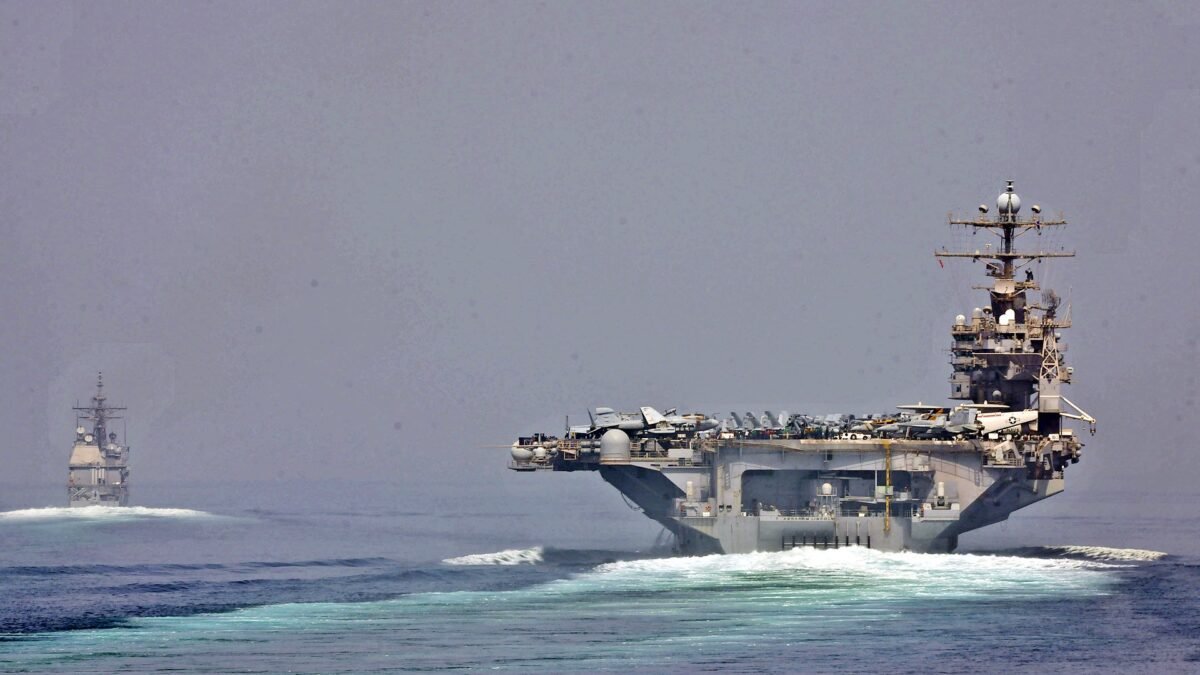
The United States has opened a new front in its months-long economic campaign against Iran, announcing a dedicated military task force to choke off the land and Caspian Sea routes Tehran can still use to move weapons, sanctioned goods and money — hours after an American warplane fired on a cargo ship that tried to run the naval blockade in the Gulf of Oman.
United States Central Command, known as CENTCOM, said on Saturday that it had established Task Force Iron Gate, a small team of about 20 civilian and military personnel based in Tampa, Florida, to stop Iran from using its land borders and the Caspian Sea to transport advanced weapons and other restricted materials. The announcement extends a naval blockade of Iranian ports that American forces have enforced since July, and it lands at a moment when the war between the United States and Iran is simultaneously escalating on the water and inching toward negotiation through Qatari mediators.
“The establishment of Task Force Iron Gate reinforces the success of our ironclad blockade against Iran at sea,” Admiral Brad Cooper, the commander of CENTCOM, said in a statement, according to Al Jazeera. The admiral added that closer work with other American government agencies would “further constrain Iran’s ability to finance terrorism, rebuild weapons factories, and replenish their military,” the command said.
The task force will coordinate with other United States government agencies on “preventing the movement of advanced weapons systems, dual-use technologies, sanctioned materials, and illegal revenue streams across Iran’s land borders and the Caspian Sea”, CENTCOM said. A graphic released with the announcement highlighted Iran’s borders with Türkiye, Afghanistan, Turkmenistan and Pakistan, according to reports of the command’s statement, although CENTCOM did not name specific crossings or say which neighbouring countries the effort would focus on.
The same day, CENTCOM said separately that an American military aircraft had disabled a commercial cargo vessel in the Gulf of Oman. The St. Kitts-flagged M/V Huda had visited an Iranian port and then tried to leave regional waters, the command said. After the crew ignored repeated warnings and tried to break the blockade several times, a United States military aircraft fired precision munitions at the ship’s stern, disabling it, after American forces had directed the crew to abandon the targeted spaces. CENTCOM did not say what cargo the Huda was carrying or whether anyone aboard was hurt.
Reuters, which reported the incident on Saturday, said the vessel had tried to depart regional waters after visiting an Iranian port and that the American plane fired on its stern after United States forces told the crew to move away from the area that would be hit. The command said enforcement actions since July had resulted in American forces redirecting 147 commercial vessels that complied with orders, and disabling five merchant ships that refused to comply.
CENTCOM also said its naval blockade had prevented Iran from exporting more than $25 billion in crude oil in recent months. That figure is the command’s own estimate and has not been independently verified.
A blockade that now reaches inland
The new task force is, on paper, a modest operation: about 20 people working from a headquarters in Florida, thousands of kilometres from the borders they are meant to close. Its brief, however, is enormous. Iran shares land borders with seven countries — Iraq, Türkiye, Armenia, Azerbaijan, Turkmenistan, Afghanistan and Pakistan — stretching roughly 5,900 kilometres, plus about 740 kilometres of Caspian Sea coastline. Dozens of official crossings handle the traffic, alongside hundreds of informal routes that smugglers have worked for generations.
That gap between the size of the team and the size of the task is the first thing analysts noticed. Michael Mulroy, a former United States deputy assistant defence secretary for the Middle East, told Al Jazeera that the task force’s role would be to find out where “weapons systems are coming in, how they could potentially be cut off”, and how “Iran is transporting its energy”. He added that if President Donald Trump orders an escalation of the war, it will probably take the form of attacks on “a series of targets” focused on economic and infrastructure sites.
“Unlike Operation Epic Fury, which primarily focuses on military targets, I think these targets will be focused on economic and infrastructure targets, as part of this comprehensive plan to cut the regime off from its ability to fight and ability to fund itself,” Mulroy told Al Jazeera.
Operation Epic Fury is the name of the American-led air campaign that opened the war in late February 2026, alongside Israel’s Operation Roaring Lion. The war began on 28 February with sweeping strikes on Iranian military and nuclear sites, and the death of Iran’s supreme leader, Ayatollah Ali Khamenei, in the opening hours. In the months since, the conflict has settled into a grinding pattern: American and Israeli strikes on Iranian military infrastructure, Iranian missile and drone attacks on Israel and on American bases and shipping across the Gulf, a United States naval blockade of Iranian ports, and Iran’s closure of the Strait of Hormuz, the narrow waterway through which about a fifth of the world’s seaborne oil once passed.
The blockade, enforced since July, covers all Iranian ports on the Gulf and the Gulf of Oman, with the stated exception of humanitarian aid. Iran, for its part, has demanded the lifting of the blockade as a condition for reopening the Strait of Hormuz. The new task force is Washington’s answer to the obvious weakness in a sea-only blockade: cargo that cannot sail can still travel by road, by rail, or across the Caspian Sea to Russia and Central Asia.
That logic points directly at Iran’s northern neighbours. Russia is the most important of them. On Thursday, Mohsen Rezaei, the secretary of Iran’s Supreme National Security Council, met President Vladimir Putin inside the Kremlin, carrying a letter from Iran’s leadership, and emerged talking about “post-war” security and gas pipelines running from Russia into Iran. Two days later, CENTCOM announced a task force aimed squarely at the routes that would carry such trade.
The Huda: the fifth ship disabled
The disabling of the M/V Huda was the fifth time since July that American forces have fired on a merchant vessel that refused to comply with the blockade, according to CENTCOM. The command said the ship’s crew ignored repeated warnings and made several attempts to break through. The aircraft that fired on it used precision munitions aimed at the stern, after the crew had been told to abandon the spaces that would be hit.
The episode fits a pattern that has become routine in the Gulf of Oman and the Strait of Hormuz. American forces have redirected 147 commercial vessels that complied with the blockade’s orders, CENTCOM said, and disabled five that did not. What is new is the context: the Huda was disabled on the same day Washington announced it was taking the pressure campaign inland, and the two announcements were clearly meant to be read together — the sea is closed, and now the land routes are being watched too.
Neither CENTCOM nor any other American agency has said what the Huda was carrying, where exactly it was headed, or whether anyone was injured when the munitions struck its stern. Those gaps matter. A blockade that fires on civilian-crewed merchant ships invites questions about proportionality and about the line between enforcement and escalation, and the answers depend on facts that Washington has not yet published.
Saturday’s other explosions
The task force announcement and the Huda incident were not the only developments on Saturday. Iran’s official news agency, IRNA, reported the sound of two explosions on Qeshm Island, in the Strait of Hormuz, and “several explosions” in the cities of Jask, Sirik and Bandar Abbas, according to Al Jazeera. The reports came a day after President Trump confirmed that American forces had carried out new strikes on Qeshm Island on Friday, while downplaying them as “minor”.
“We do minor strikes… we knocked it out in about 15 minutes, maybe five,” Mr Trump said on Friday evening, describing the destruction of a newly built Iranian anti-aircraft device on the island. It was the second American strike on Qeshm in five days; the first, on Monday, followed the firing of a missile from the island toward an American aircraft. Iranian media reported two explosions in the Suza area of the island on Friday, and the precise relationship between the reported impacts and the American operation has not been independently established.
Iran’s Islamic Revolutionary Guard Corps Navy reported on Saturday that two oil tankers had struck mines near the Strait of Hormuz. Iranian state television, citing the navy, said the tankers had passed through an “unsafe” part of the strait with their navigation systems switched off and had “suffered severe damage and stopped after hitting sea mines”. Washington has previously said mines in the strait have been cleared, and the claim could not be independently verified.
The shipping toll in and around the strait remains severe. A weekly report from the United Kingdom Maritime Trade Operations centre recorded at least 11 ships attacked in or around Hormuz in the week ending 6 November, three of which sank. Western military intelligence cited in earlier reporting counted 88 projectile strikes since hostilities resumed in early July, and the International Maritime Organization has recorded 129 incidents and 25 seafarer fatalities since the conflict began. Transits through the strait are running about 65 per cent below their pre-conflict level, with 170 outbound and 155 inbound transits in the latest week counted.
Oil prices have fallen sharply as the war has dragged on and global demand has weakened, with Brent crude near $99 a barrel on Friday, down more than $20 over the previous week. The fall reflects a market that has, for now, priced in the disruption — but a widening of the conflict to land routes and Caspian shipping could test that calm.
Talks continue as the pressure grows
The escalation is unfolding alongside an active diplomatic track. Qatar is mediating talks between Washington and Tehran, and Qatar’s foreign ministry spokesman, Majed al-Ansari, said on Saturday that reports the talks had failed were false. “Promoting such false claims serves only those seeking to prolong the war and destabilise the region,” he said. American officials have said Iran is reviewing Qatari proposals on its nuclear programme, and there is, in the words of one report, a “glint of openness”.
According to a report in The Guardian cited by the New York Post, the latest Qatari proposal would see the United States lift the blockade in the Strait of Hormuz and release some frozen Iranian assets, while Iran would allow inspectors from the International Atomic Energy Agency to return to its bombed-out nuclear sites. President Trump said on Friday that Tehran still wants a deal. “We’re dealing with them now. They want to make a deal,” he said, adding that he believed “a lot of progress” had been made.
Iran’s foreign minister, Abbas Araghchi, has said he held talks with 12 foreign ministers in 48 hours, including those of Oman, Qatar, Saudi Arabia and Pakistan, and has set out seven demands for reopening the Strait of Hormuz. On Saturday, the spokesman of the Revolutionary Guard, Brigadier General Hossein Mohebbi, announced that Iran had lifted the self-imposed limit of about 2,000 kilometres on the range of its ballistic missiles, a restriction dating to a 2017 order from Ayatollah Khamenei. “This restriction has been lifted for us,” General Mohebbi said at a press conference in Tehran, adding that Iran must demonstrate its capabilities in practice, not merely in statements.
The missile announcement followed an order from Iran’s leadership for an immediate response to any attack, without geographical limits, and an updated list of American and Israeli targets. It also followed the visit by Mr Rezaei to Moscow on Thursday, carrying a message from Tehran to President Putin.
Not everyone in Washington welcomes the new pressure. Joe Kent, a former director of the National Counterterrorism Center, publicly disagreed with the task force announcement within hours of its release, posting on X that it would only escalate tensions and undermine the peace talks. “The Iranians have made it clear that they won’t accept negotiations while under threat of escalation,” he wrote. “Iranian leadership has stated there will either be war or there will be peace, but they will not sit idly by and wait for the next attack & they won’t tolerate being slowly strangled by sanctions.” He called the announcement “brash provocation”.
Mr Trump, for his part, has kept the threat of a wider offensive open. On Thursday he said the United States might have to “destroy the rest of Iran”, and American officials have said thousands of United States air and naval personnel are positioned to resume major combat operations. The Houthis, Iran’s allies in Yemen, fired a cruise missile toward Riyadh on Friday that Saudi Arabia said it intercepted, and have been running their own blockade of Saudi shipping in the Red Sea since July.
Analysis: Why It Matters
1. A sea blockade only works if the land is closed too
The logic of Task Force Iron Gate is simple, and it is the logic of every blockade in history. A siege fails the moment the besieged find another road. For months, the American naval blockade has squeezed Iran’s oil exports by sea, and CENTCOM claims it has kept more than $25 billion of crude from reaching the market. But Iran is not an island. It has seven land neighbours, a long Caspian coastline, and centuries of practice in moving goods across borders that no government fully controls. If weapons, dual-use technology and revenue can travel by truck through Iraq or Turkmenistan, by rail through Türkiye, or by ship across the Caspian to Russia, then the sea blockade is a wall with an open back door. Iron Gate is Washington’s attempt to close that door, and its announcement is an admission that the door has been open all along.
2. Twenty people cannot police 5,900 kilometres of border
The most striking number in the CENTCOM announcement is not $25 billion. It is 20 — the approximate size of the new task force. Twenty civilian and military staff, based in Tampa, Florida, are to “monitor, detect, and disrupt” illicit movements across nearly 6,000 kilometres of land border and 740 kilometres of Caspian coast, through countries whose governments range from wary partners to open adversaries of Washington. That is not a force; it is a coordination cell. Its real work will be intelligence, sanctions designations, law-enforcement cooperation and diplomacy with transit states — the unglamorous machinery of economic warfare, not soldiers at border posts. The task force will only matter if the agencies it coordinates — Treasury, State, Justice and the intelligence community — follow through with designations, seizures and pressure on banks and shippers. The announcement alone changes nothing on the ground; it is a signal of intent, and its test will come in the months ahead, when it must show results against smuggling networks that have survived decades of sanctions.
3. The Huda is the message, not the task force
If Iron Gate is a signal, the disabling of the M/V Huda is the punctuation. Firing precision munitions at a civilian-crewed merchant ship is a deliberate, visible act, and doing it on the same day as the task force announcement was no coincidence. Washington is telling shippers, insurers and flag states that the blockade is not a paper exercise: vessels that ignore warnings will be shot at, and the fifth such incident since July is meant to make the sixth unnecessary. But the tactic carries risks. Every strike on a merchant vessel is a test of the legal and political basis of the blockade, and every unanswered question — what was the cargo, was anyone hurt, how close did the crew come to harm — is a vulnerability. The more often the United States fires on civilian ships, the more it invites the argument that the blockade has become a war on commerce itself, and the more it gives Tehran a grievance to take to the world’s capitals.
4. Escalation and negotiation are running in parallel
The strangest feature of this war is how comfortably escalation and diplomacy coexist. On the same Saturday that CENTCOM announced a new task force and disabled a ship, Qatar’s mediator insisted the talks had not failed, and the outline of a possible deal — blockade lifted, frozen assets released, nuclear inspectors returned — was being reported in the press. Mr Trump says Tehran wants a deal and that progress has been made. Iran says it will not negotiate under threat of escalation. Both things can be true at once: pressure is the negotiating tactic, and the negotiation is the reason for the pressure. The danger is that the two tracks collide. Mr Kent’s warning — that Iran will not “sit idly by and wait for the next attack” while being “slowly strangled by sanctions” — captures the risk precisely. Each new measure, each new strike, narrows the space for a deal, and the lifting of Iran’s missile-range limit on the same day shows Tehran is answering pressure with pressure of its own. The window for diplomacy is open, but it is narrowing, and the task force announcement may have narrowed it further.
5. The neighbours are now part of the war
The quietest consequence of Task Force Iron Gate is also the most far-reaching: it drags Iran’s neighbours into the conflict. The CENTCOM graphic singled out Türkiye, Afghanistan, Turkmenistan and Pakistan — four countries with very different relationships with Washington and with Tehran, and very different appetites for being used as instruments of an American blockade. Pakistan, which has already been drawn into the diplomacy through its foreign minister’s talks with Mr Araghchi, now faces a direct question about what crosses its border with Iran. Türkiye, a NATO ally with its own deep trade ties to Tehran, will be asked to police routes it has long tolerated. Turkmenistan and Afghanistan are harder still. Every one of these states will have to weigh American pressure against Iranian retaliation, and Tehran has already warned, through Mr Rezaei, that any country taking part in imposing economic restrictions on Iran “will be regarded as an enemy”. A task force of 20 people in Tampa cannot enforce a blockade across their territory. Only their governments can — and only if they choose to.
What to Watch Next
- Iran’s formal response to Iron Gate. Tehran has not yet issued a direct public response to the task force. Whether it treats the announcement as a provocation, a negotiating lever, or a pretext for retaliation against shipping or Gulf infrastructure will set the tone for the coming week.
- The Huda’s cargo and crew. CENTCOM has not disclosed what the disabled vessel was carrying or whether anyone aboard was hurt. Those details, if they emerge, will determine whether the incident is remembered as routine enforcement or as an escalation.
- The Qatari proposal. The reported outline — the blockade lifted and frozen assets released in exchange for the return of nuclear inspectors — is the clearest path to de-escalation on the table. Watch for any public confirmation from Washington, Tehran or Doha.
- Oil and shipping through Hormuz. Brent crude was near $99 on Friday after a steep weekly fall. Any sign that the land-route campaign is biting, or that Iran is retaliating against tankers, will move prices and insurance rates fast.
- Whether Iron Gate produces results. The task force’s test is not its announcement but its first seizures, designations or interdictions on land. If months pass with nothing to show, the announcement will look like theatre; if it disrupts a major shipment, the war’s geography will have changed.
Sources
- Al Jazeera — “US launches task force to disrupt Iran’s land-based supply routes”
- Reuters — “US military says it disabled cargo vessel in Gulf of Oman”
- Washington Examiner — “CENTCOM announces task force to blockade Iranian ground transit routes”
- New York Post — “Trump confirms fresh US strikes on Iran defenses as talks turn to nuke inspectors”
- Europe Says — “US launches Task Force Iron Gate to choke Iran’s land, Caspian routes”
- Geopolitiki — “CENTCOM launches Task Force Iron Gate to cut Iran’s land and Caspian smuggling routes” (CENTCOM statement via DVIDS)

About the Author — Abdul Mannan
Related Articles
Trump Confirms New ‘Minor’ US Strikes on Iran’s Qeshm Island as Tehran Lifts Its Missile-Range Limit and Talks Continue
President Donald Trump has confirmed fresh limited US strikes on Iran's Qeshm Island — the second in five…

Gunman Kills Six in Random Shooting in Krakow’s Main Market Square as Police Officer Fights for Life
Six people were killed and 15 injured after a gunman opened fire at random in Krakow's Main Market…
New Zealand Election Ends in Deadlock as Luxon’s Coalition Clings to a One-Seat Lead and Weeks of Talks Loom
New Zealand's general election ended in a knife-edge deadlock, with Christopher Luxon's governing coalition clinging to a one-seat…