
Russia’s Weekend Barrage Leaves 850,000 Ukrainians Without Power as Winter Nears — and Rescuers Are Struck Again at Komyshuvakha

Russian attacks on Ukraine’s energy system left consumers without electricity in twelve regions on Monday, as the bombardment that blacked out hundreds of thousands of people over the weekend continued into a new week — and as a Russian drone struck rescue workers still searching the rubble of the deadliest single attack of the war’s recent months.
Ukraine’s Deputy Energy Minister, Artem Nekrasov, said on Monday that Russian attacks on energy facilities over the past 24 hours had cut power to consumers in Vinnytsia, Dnipropetrovsk, Donetsk, Zhytomyr, Zaporizhzhia, Kyiv, Odesa, Poltava, Rivne, Kharkiv, Khmelnytskyi and Chernihiv, according to Reuters. “Due to significant damage, the situation remains most difficult in the Dnipropetrovsk and Kyiv regions,” Nekrasov said. The ministry said Russia had deliberately attacked Ukraine’s energy and oil and gas sectors 128 times over the past week, and that 219 incidents had been recorded in which energy and oil and gas infrastructure was damaged or destroyed.
The scale of the weekend assault was captured in a single figure from Euronews: roughly 850,000 people were left without electricity across the country. In the Dnipropetrovsk region alone, more than 600,000 people lost power after an overnight attack damaged important energy facilities, the power company DTEK said on Telegram. Hospitals in the region were forced to switch to diesel generators, and electric-powered public transport ground to a halt in the regional capital, Dnipro, according to the region’s military chief, Oleksandr Hanzha. In the Kharkiv region, about 250,000 subscribers lost power after a drone hit a critical infrastructure facility, local officials said.
President Volodymyr Zelenskyy said there were “widespread power outages across the country” and that in the Zhytomyr region alone, 140 apartment buildings were left without heating following a Russian strike. In Kyiv, residents of the capital — a city of roughly three million people — were living with only two to three hours of electricity a day, without heating and with intermittent water supplies, RFI reported from the city. Russia began stepping up attacks on Ukrainian energy infrastructure in late September, and has targeted the sector every winter since launching its full-scale invasion in February 2022, according to Radio Free Europe/Radio Liberty.
A weekend of missiles, drones and blackouts
The assault unfolded in waves. On Saturday, Russian forces launched combined waves of ballistic missiles and large drone swarms at energy plants, substations and other infrastructure, Ukrainian officials said. In Kyiv, the attacks damaged a major bridge across the Dnipro river, cut water and district heating in parts of the capital, and left at least six people injured, including a 14-year-old girl, according to Ukrainian officials.
Overnight into Sunday, Russia launched 164 drones across Ukraine, 137 of which were shot down, the Ukrainian Air Force said that morning. Hours later, one person was killed and three others injured as Russian forces struck a residential neighbourhood in Dnipro, according to the local administration. Russia’s defence ministry said on Sunday that its forces had destroyed 142 Ukrainian drones during the night, including over Russia, Russian-occupied areas of Ukraine and the Azov Sea, according to the Associated Press.
Zelenskyy said that in just the past week, Russia had fired 115 missiles, almost 1,900 guided bombs and more than 3,000 attack drones at Ukraine. Many of the missiles had been produced this year, he added, calling on Ukraine’s partners to sanction the entities involved in their production. “If the world does not have enough anti-ballistic capabilities to protect Ukrainian skies, then the missiles must be stopped on the production lines,” he said, according to the Associated Press.
The strikes did not stop with the weekend. Russia’s attacks continued late on Sunday and into the morning of Monday, Ukrainian authorities said. At least four people were injured in Kremenchuk, in the Poltava region, during Russian drone attacks, said the regional military administrator, Vitali Dyakivnych. A residential building and a hotel were damaged in the attack, and 15 people had been rescued from damaged structures. In the port city of Odesa, authorities said Russia used drones to strike electricity distribution centres and other infrastructure, causing additional power cuts. “The Odesa region has suffered a massive hostile attack on the energy sector. Power outages are being recorded in the north of the region,” the military administrator, Oleh Kiper, wrote on Telegram. “Despite constant air alerts, energy workers are doing everything possible to restore power to people as soon as possible.”
Energy Minister Denys Shmyhal said the country’s power grid had been hit more than 350 times since September, according to reports. DTEK, the power company, said its workers were already working to restore power, but that their efforts were being hampered by constant Russian shelling, according to the region’s military chief.
Zaporizhzhia plant loses external power again
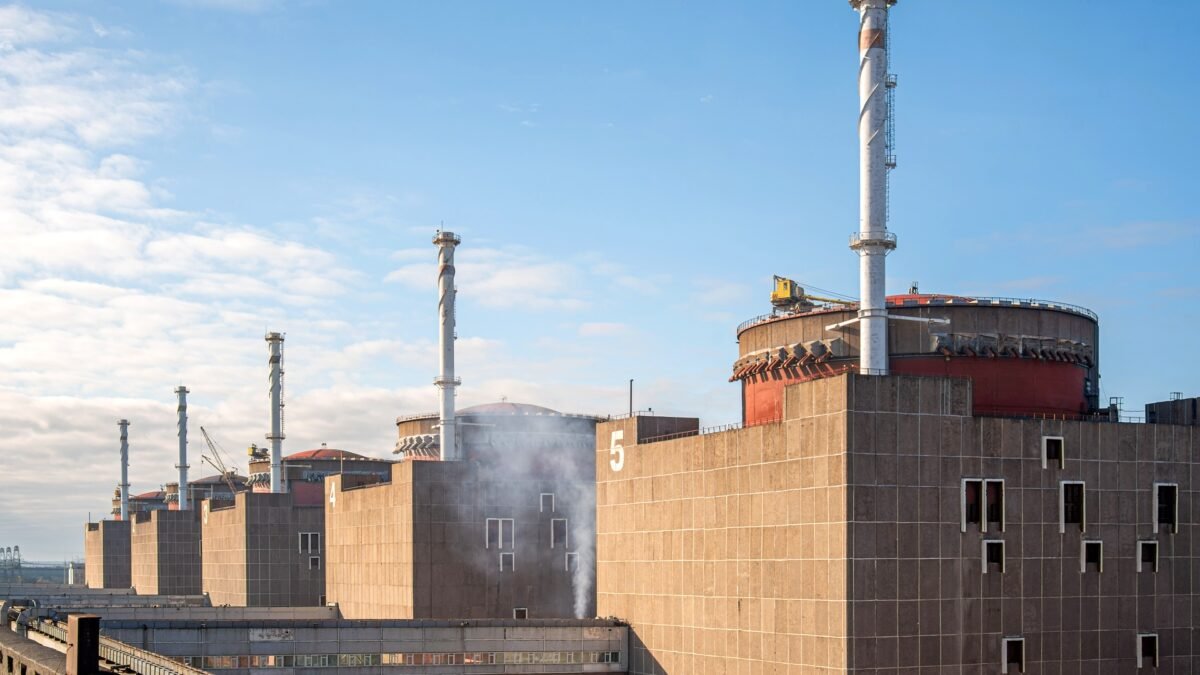
The weekend’s attacks also cut power once again to Europe’s largest nuclear power station. The Russian-controlled Zaporizhzhia Nuclear Power Plant, which has six reactors, lost its external power supply after a damaged power line was disconnected for safety, the plant’s management reported on Sunday. The plant was powered by backup diesel generators after an automatic protection system shut down the damaged Ferosplavna line, and Ukraine’s state nuclear operator, Energoatom, also reported on Sunday that the plant was relying on generators.
External power was restored to the plant late on Sunday, Energoatom said. “The nuclear facility is again receiving external power supply from the Ukrainian power system,” the company said. But it added that the situation at the plant remained “extremely dangerous” and that the risks of power outages and threats to nuclear and radiation safety persisted “as long as the plant is under Russian occupation.”
It was not immediately clear what caused the power outage at the site, although Ukraine reported Russian attacks on energy infrastructure in the surrounding Zaporizhzhia region, which is still under Kyiv’s control. The plant went offline soon after being captured by Russia early in the war, but needs power to keep essential cooling systems running. Its external power supply has periodically been severed, raising fears of a nuclear accident in case of protracted outages, as Moscow and Kyiv have blamed each other for strikes that damaged nearby power lines.
“This is the 16th case of complete loss of external power supply to the [plant] since the beginning of 2026,” Energoatom said. “The systematic loss of external power is a consequence of the [Russian] occupation.” The International Atomic Energy Agency (IAEA) counted the November 8 cut as the 27th loss of external power recorded during the conflict. IAEA Director General Rafael Grossi has called on “military commanders responsible for these actions as well as all others aiming on nuclear power plants and/or their staff to put an immediate stop to these unacceptable actions which… constitute great risks to nuclear safety and security during the conflict.”
Komyshuvakha: rescuers struck at the scene of the bombing
While the grid was being hit, a second front of the weekend’s violence played out in the village of Komyshuvakha, in the Zaporizhzhia region, where rescue workers were still searching the rubble of a bombing that killed at least 55 people a week earlier. On Sunday, a Russian drone struck the emergency workers on rescue missions at the site, hitting a former school and nearby shelter that had been earlier blasted by multiple Russian guided bombs as residents waited for humanitarian aid, authorities said. No one was injured in Sunday’s strike on the village, but specialised rescue equipment was damaged, according to Ukraine’s State Emergency Service.
The original attack, on the morning of Monday 2 November, struck the Dzherelo gymnasium, an underground school that had been converted into a humanitarian aid distribution centre and shelter. Bread and humanitarian aid were being handed out to residents at the centre — a routine Monday operation, since deliveries and distribution had been scheduled for every Monday. Around 80 to 100 or more people were inside the centre, according to estimates. Two smaller guided bombs hit the grounds first. After the initial strike, police officers, rescuers and other people began to arrive at the site, with rescuers urging people to go into the underground shelter within the centre. Then Russian forces struck again with at least nine FAB-3000 bombs — three-tonne weapons carrying about 1.4 tonnes of explosive each — in what Ukraine describes as a deliberate “double tap”, a second strike meant to hit rescuers and survivors. The concrete structure, designed to withstand some force, could not withstand the combined pressure, and began to collapse, creating a large fire underground.
The confirmed death toll had risen to 55 by 7 November, Ukraine’s State Emergency Service said, and the search of the rubble was still going on. As of Sunday afternoon, 45 people were listed as missing, according to the acting head of the regional military administration, Mykhailo Semikin. Ukraine’s military intelligence agency, HUR, put the missing at around 50. Many of the bodies recovered have not been identified, and DNA analysis is ongoing. Among the confirmed dead are two employees of the State Emergency Service and four police officers. One responding military medic was also killed. At least 46 of the dead were civilians.
The village itself has been hollowed out by the war. Komyshuvakha lies about 30 kilometres from the city of Zaporizhzhia and some 17 kilometres from the front line, on an important highway used by the Ukrainian army for traffic, supplies and evacuation. There had been at least four prior strikes on the village before 2 November, and shelling had ramped up since the start of 2026. On 4 November, Semikin reported that only around 200 residents remained in the settlement, from a pre-war population of about 5,251. A mandatory evacuation of children had taken place in June 2026.
On Saturday, police officers and relatives gathered in Zaporizhzhia for a farewell ceremony for six officers killed in Russian strikes on Komyshuvakha, including four who died near the former school. Rain fell as families wept beside the coffins, and officers held portraits of their fallen colleagues. “They used every skill at their disposal to protect themselves. But when the enemy deliberately gathered civilians in one place and then launched strikes against them, no skills could have helped,” said Andrii Khomenko, a police lieutenant colonel who had worked alongside the victims. The community also said goodbye to three residents among the dead. Among those mourning was Yurii Karapetian, whose wife Natalia was killed. He said she was distributing bread to those in the shelter when the Russian bombs struck. “This pain, I would say, is unbearable,” he said, and urged the international community to act. “The whole world must understand that if (the Russians) are not stopped, they will not stop. They will not stop at Ukraine. They will not stop anywhere.”
President Zelenskyy on Sunday called the attack on emergency crews in Komyshuvakha “absolute cynicism and brutality” in a post on X. Ukraine has routinely accused Russia of conducting multiple strikes at the same site in quick succession to target emergency crews responding to the initial attack. HUR said on Saturday that it had identified seven Russian service members it says took part in the 2 November bombing, including the officer it alleges planned the attack, and described the strike as a war crime. Ukrainian law enforcement has opened an investigation into classifying the strike as a war crime under Part 2 of Article 438 of the Criminal Code of Ukraine. That claim has not been independently verified.
Russia has offered a sharply different account. Its defence ministry said its forces had targeted Ukrainian military units in areas around Komyshuvakha and two other settlements, and claimed up to 25 Ukrainian servicemen were killed along with 15 vehicles and an electronic warfare station. Russia has not commented publicly on the Sunday drone strike on the rescue crews, according to the reporting reviewed.
Village resident Mykola Krasnov, 72, told the Associated Press on Saturday that he was still looking for his wife, but had heard no word from rescuers. “She went to get humanitarian aid, and a 3-ton bomb was dropped there. Where is she?” he said. “She didn’t come home, and they didn’t find her body there. She isn’t in the morgue, and she isn’t here alive.”
Russia’s claims and the wider war
Russia’s defence ministry said on Sunday that overnight strikes had hit three cargo vessels carrying military goods for Ukraine, along with two electricity substations, Reuters reported from Moscow. The ministry said it struck two container ships, one headed to the Black Sea port of Odesa and one in the port of Chornomorsk, plus a dry cargo ship south-west of Odesa. The ministry also said it hit two power substations in Ukraine’s Dnipropetrovsk and Zhytomyr regions, both of which it said powered military-industrial enterprises. Reuters said it could not independently verify the claims, and there was no immediate comment from Ukraine.
The weekend’s violence came as diplomacy was supposed to be gathering pace. The latest attacks came a day after Zelenskyy accused Russia of seeking to apply maximum pressure ahead of US-Ukraine-Russia talks in Abu Dhabi by plunging “the entire country into a blackout.” The talks, set for 10 and 11 November, were previously presented as a trilateral meeting between Washington, Moscow and Kyiv. US President Donald Trump, whose administration has been trying to settle the conflict since the start of his second term in January 2025, has said he believed a “big, beautiful agreement” could be close and suggested it might involve not only Ukraine but “all of Europe.”
European officials have pushed back on the suggestion that Europe could be excluded from talks deciding the continent’s security future. French Foreign Minister Jean-Noël Barrot said on Sunday that France and other European representatives would participate in the US-mediated talks in Abu Dhabi. “France will be there and will ensure that Europe’s voice is heard,” Barrot told RTL radio. He did not specify who would represent France, or whether European officials would participate directly in negotiations. US Secretary of State Marco Rubio, who is set to travel to Abu Dhabi, said some progress had been made on the establishment of the “security infrastructure” Ukraine and Europe could see after the war ends. “I think that’s what the president’s alluding to — is that there’s been some advances made in what that architecture could look like post-conflict,” he said. He added that “nothing’s been finalized yet, and maybe some progress can be made in Abu Dhabi.”
Zelenskyy has expressed doubts about the Trump proposals for a new European security order to end Russia’s full-scale war on his country. “It’s not simple, and it can be dangerous, for us,” Zelenskyy told CNN on 6 November. The talks open against the backdrop of the G7 foreign ministers’ meeting in Paris on Monday and Tuesday, where America’s allies were already pressing Washington on Ukraine and on Iran — a meeting that itself followed the Democrats’ gains in the US midterm elections last week.
Analysis: Why It Matters
The blackout as a negotiating weapon
The timing of this assault is the story. Russia did not escalate its campaign against Ukraine’s power grid at a random moment: it did so in the days immediately before the first US-mediated talks with Russia in months, and Zelenskyy said so plainly, accusing Moscow of trying to plunge “the entire country into a blackout” to weaken Kyiv’s hand. That is the logic of energy war as diplomacy by other means. A delegation that arrives in Abu Dhabi with its capital on two hours of electricity a day, its hospitals on diesel generators and its largest nuclear plant freshly back from emergency power is a delegation under pressure to settle — and Moscow knows it. The question for the talks is whether that pressure produces concessions, or whether it hardens the Ukrainian position and the European one behind it. History suggests the latter is at least as likely: every winter of this war, the blackouts have been followed not by Ukrainian capitulation but by deeper Western air-defence commitments. The risk for Moscow is that the tactic that is meant to soften Kyiv instead convinces its partners that no agreement can be trusted while the grid is still a target.
A fourth winter of energy war
What is happening now is not new, and that is precisely what makes it so grim. Russia has targeted Ukraine’s energy sector every winter since the full-scale invasion began in February 2022, and the campaign stepped up again in late September this year. The pattern is familiar — substations, power plants, heating systems, the infrastructure that keeps a modern country alive in the cold — but the cumulative effect is what matters. Each winter, repair crews rebuild what was destroyed; each winter, the system starts from a weaker base. DTEK’s warning that restoration is “complicated by repeated attacks” captures the trap: crews cannot safely repair what is being struck again, and every repair consumes spare parts, transformers and money that are finite. The ministry’s figures — 128 deliberate attacks on energy and oil and gas facilities in a single week, 219 incidents damaging or destroying infrastructure — describe a campaign of attrition, not a single operation. For the people living through it, the war is increasingly measured not in kilometres of front line but in hours of light, heat and water per day. That is a deliberate choice by the attacker, and it is why the energy campaign, more than any battlefield development, defines the civilian experience of this war.
The nuclear risk that keeps returning
The Zaporizhzhia plant is the most dangerous recurring subplot of this war, and Sunday offered another reminder. This was the 16th complete loss of external power at the plant since the beginning of 2026, according to Energoatom, and the 27th such loss recorded by the IAEA during the conflict. Each time, the plant’s six reactors — shut down since soon after capture, but still needing power for cooling — fall back on emergency diesel generators. Each time, the generators work, and the crisis passes. But the margin is not infinite: diesel fuel is finite, generators are machines that can fail, and every loss of off-site power is a roll of the dice with a facility that holds six reactors’ worth of radioactive material. Grossi’s repeated pleas to stop targeting nuclear plants and their staff have not stopped the losses from accumulating. The plant’s power was restored late on Sunday, but the fact that the count keeps rising — 16 in ten months — is itself the warning. A nuclear accident does not require intent; it requires only one bad day in a long series of near misses.
The double-tap pattern
Komyshuvakha matters beyond its own death toll because of what it appears to show about method. The sequence — a first strike on a known aid distribution point, at a known time, followed by a second, heavier strike on the shelter where rescuers and survivors had taken cover, and then, six days later, a drone attack on the rescue crews still working the rubble — is the pattern Ukraine calls a “double tap”, and it has accused Russia of it repeatedly. The evidence in this case is unusually concrete: a police body camera recorded the moments before the second strike; HUR has named seven service members it says took part; and the Sunday drone attack on the same site, with rescue work in its seventh day, is documented by the State Emergency Service itself. Russia’s counter-claim — that it struck military units — has not been independently verified, and it does not address the Sunday attack on rescuers at all. Whether the pattern is deliberate policy or the cumulative effect of a military that treats any gathering of people near the front as a target, the practical effect is the same: it deters rescue, it multiplies the dead, and it turns humanitarian aid itself into a hazard. That is why Ukrainian prosecutors are treating the bombing as a war crime, and why the naming of individual officers by HUR matters — accountability, if it ever comes, will be built case by case, name by name.
What Abu Dhabi can and cannot decide
The talks opening on Tuesday carry real weight, but their limits should be kept in view. They are the first US-mediated meeting of the parties in months, and the presence of Witkoff and Kushner, the travel of Rubio, and the insistence of France and other Europeans on a seat at the table all suggest a serious attempt. But the gap between the parties is visible in the weekend itself: one side arrives having just blacked out twelve regions; the other arrives having just watched its rescuers struck at a mass grave. Trump’s talk of a “big, beautiful agreement” extending to “all of Europe” raises expectations that the format — a trilateral meeting with Europeans present but not yet clearly at the negotiating table — may struggle to meet. And Zelenskyy’s caution, that the proposals are “not simple” and “can be dangerous”, reflects a real fear in Kyiv: that a deal struck under the pressure of blackouts could trade away the security architecture Ukraine needs for a pause that Russia uses to rebuild. The most realistic outcome in Abu Dhabi is not a final settlement but a test — of whether an energy truce, or a framework for one, can be agreed before winter deepens. If the grid is still being hit when the talks end, the world will have its answer about what Moscow’s escalation was for.
What to Watch Next
- The Abu Dhabi talks, 10–11 November: whether the US, Ukrainian and Russian delegations agree on anything concrete — above all, whether an energy truce or a ceasefire framework emerges, and what role France and other Europeans play in the room.
- Restoration figures: how quickly power returns in Dnipropetrovsk and Kyiv, the two regions the energy ministry named as the most difficult, and whether the next wave of strikes outpaces the repair crews again.
- The Zaporizhzhia plant: whether external power holds this week, and what the IAEA reports about the plant’s safety systems after the 27th loss of off-site power.
- Komyshuvakha’s missing: the fate of the roughly 45 to 50 people still listed as missing, and the DNA identification of bodies that could not be recognised — the final toll may still rise.
- Russia’s ship and substation claims: whether independent evidence emerges for the claimed strikes on three cargo vessels near Odesa and two substations, and how Ukraine responds.
- Winter’s arrival: temperatures and heating demand in the coming weeks, and whether emergency blackout schedules in Kyiv and other cities tighten further as the grid absorbs more damage.
Sources
- Associated Press — “Russia targets emergency crews at the site of a deadly strike in southern Ukraine”
- Radio Free Europe/Radio Liberty — “Ukraine Battles To Restore Power After Russian Attacks, Ahead Of Abu Dhabi Talks”
- Reuters via Devdiscourse — “Russian attacks leave consumers without power in 12 Ukrainian regions, official says”
- Reuters via The Hindu BusinessLine — “Russia says hit power substations in Ukraine and three ships in Black Sea”
- Wikipedia — “2026 Komyshuvakha strike” (background on the 2 November bombing, weapons and casualty figures)
- Zark News — “Death Toll in Komyshuvakha Aid-Center Strike Rises to 55 as Drone Hits Rescue Crews”

About the Author — Abdul Mannan
Related Articles

Rubio Faces America’s Allies in Paris as G7 Tests Whether Trump’s Midterm Defeat Changes Anything on Ukraine and Iran
G7 foreign ministers meet in Paris for the first time since the US midterms, with Marco Rubio facing…

At Least 21 Dead as Migrant Boat Capsizes off Senegal’s Coast on the Atlantic Route to Europe
At least 21 people have died after a pirogue carrying migrants capsized off Kébémer in north-western Senegal, with…

Four Killed and 88 Injured as Two Passenger Trains Collide South of Cairo in Egypt’s Al-Ayyat District
Two passenger trains collided near Al-Ayyat in Giza province on Sunday, killing at least four people and injuring…