
Russia and Ukraine Trade Blows on Energy Targets Hours Before Abu Dhabi Talks as Kyiv’s Lights Dim Again


Russia battered Ukraine’s power grid again overnight and Ukraine struck back at one of Russia’s largest oil refineries, officials said on Monday, hours before delegations from Moscow and Kyiv were due to meet for new United States-brokered talks on how to end a war that is now approaching its fifth year.
The exchange, reported by the Associated Press, underlined the distance between the negotiating table and the battlefield: even as American envoys prepared to sit down with both sides in Abu Dhabi on Tuesday, each side was working to weaken the other’s energy system before the talks begin.
According to Ukraine’s air force, Russia launched 317 drones of various types overnight, including 105 jet-powered drones, alongside more than 30 ballistic missiles. Ukrainian air defences suppressed 271 of the drones, including 81 of the jet-powered aircraft, but strikes were recorded at 31 locations across the country, according to the air force.
Russia’s defence ministry said on Monday that it had targeted four electrical substations in Ukraine’s Kyiv, Dnipropetrovsk, Cherkasy and Vinnytsia regions. The attacks are part of a campaign to deny Ukrainian civilians heating, light and running water during the approaching winter, and they came a day after a separate wave of strikes left more than 600,000 people without electricity in the Dnipropetrovsk region alone, according to the power company DTEK.
Ukrainian President Volodymyr Zelenskyy said Moscow was stepping up its bombardment specifically to weaken Kyiv’s hand ahead of the negotiations. “Russia is preparing for the trilateral talks by launching ballistic missiles at Ukrainian critical infrastructure,” he said, according to reports of his remarks.
Meanwhile, long-range drones developed by Ukraine during the war started a fire at the KINEF oil refinery near Kirishi in Russia’s Leningrad region, more than 800 kilometres from the Ukrainian border. The refinery is Russia’s second-largest, and the strike was the latest in a Ukrainian campaign against Russian oil-processing plants that has intensified since late October.
United States President Donald Trump said in a “60 Minutes” interview that aired on Sunday that Moscow and Kyiv are “very close” to a deal, despite what he called the “tremendous hatred” between Russian President Vladimir Putin and Mr Zelenskyy. He said Ukraine would have “a little bit different shape” under a settlement, but he did not elaborate.
The two days of talks in Abu Dhabi, scheduled for Tuesday and Wednesday, will be the first trilateral negotiations since February, when a round in Geneva delivered no significant progress in ending the fighting. American special envoys Steve Witkoff and Jared Kushner are leading the Washington delegation.
A Night of 317 Drones and More Than 30 Missiles
The overnight assault was the latest in a sustained Russian campaign against Ukraine’s energy network that began in late September. Ukraine’s energy minister, Denys Shmyhal, said the country’s power grid has been hit more than 350 times since September, and the pace has quickened as winter approaches.
In Kyiv, the capital’s roughly three million residents are living with only two to three hours of electricity a day, without heating and with intermittent water supply, because the pumping systems also depend on the grid, according to reports from the city. The situation with the capital’s energy supply is “extremely difficult”, affecting heating and water, officials said.
The damage was not confined to the capital. In the port city of Odesa, authorities said Russia used drones to strike electricity distribution centres and other infrastructure, causing additional power cuts. “The Odesa region has suffered a massive hostile attack on the energy sector. Power outages are being recorded in the north of the region,” military administrator Oleh Kiper wrote on Telegram, according to reports.
At least four people were injured in Kremenchuk, in the Poltava region, during Russian drone attacks, the regional military administrator said. In the Zhytomyr region, Mr Zelenskyy said 140 apartment buildings were left without heating following a Russian strike.
Mr Zelenskyy said there were “widespread power outages across the country” and described the situation as most difficult in Kyiv and the Dnipro, Sumy and Donetsk regions, and in Kherson. Power-limitation schedules have been established for industrial customers, and hourly power outages have been implemented for all categories of residents.
The scale of the week’s bombardment was laid out by Mr Zelenskyy, who said Russia had launched 115 missiles, nearly 1,900 guided bombs and more than 3,000 drones at Ukraine in a single week. He urged the European Union to adopt a 22nd sanctions package against Moscow.
The strikes followed a weekend barrage in which Russia fired 36 ballistic missiles, all aimed at Kyiv and its region, along with 172 drones, according to Ukraine’s air force. That attack hit substations carrying electricity from the Rivne and Khmelnytskyi nuclear power stations to Kyiv and central Ukraine, and closed the Northern Bridge across the Dnipro river. One person was killed in the Kyiv region and nine were injured across the country in that attack.
The same weekend also brought one of the deadliest attacks of the war, when a Russian glide bomb struck an aid distribution centre in the village of Komyshuvakha, in the Zaporizhzhia region, killing at least 55 people who had gathered for food parcels. Russian drones returned to the village on Sunday, according to Ukrainian officials.
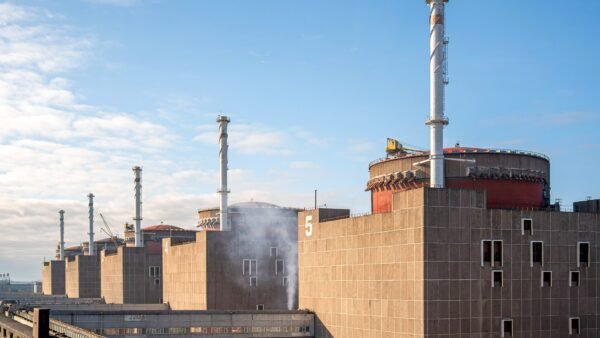
There was one piece of better news on the nuclear front: Ukraine’s state nuclear operator, Energoatom, said late on Sunday that external power had been restored to the Zaporizhzhia nuclear power plant, Europe’s largest, which is currently occupied by Russian forces. The plant had been forced to rely on emergency diesel generators after its remaining external power connection was disconnected.
Ukraine Hits Back at Russia’s Second-Largest Refinery
While Russia was striking Ukraine’s grid, Ukrainian drones were flying in the opposite direction. A Ukrainian drone attack sparked a fire at the KINEF refinery in Kirishi, in Russia’s north-western Leningrad region, regional governor Alexander Drozdenko said on Monday.
Mr Drozdenko said air defences had downed 113 Ukrainian drones over the region overnight, but acknowledged that several drones had struck industrial facilities in the city of Kirishi. “There are confirmed cases of UAV impacts in the industrial zone of the city of Kirishi,” he wrote on Telegram. He said the fire at the refinery had been contained and that authorities were dealing with the aftermath.
Videos filmed by local residents and verified by the Russian independent outlet Astra indicated that the attack targeted the Kirishi refinery, with at least two fires breaking out at the facility following several powerful explosions, including one at a primary crude oil processing unit. NASA’s Fire Information for Resource Management System detected multiple hotspots at the site.
The refinery, formally known as Kirishinefteorgsintez and owned by the Russian oil giant Surgutneftegaz, is Russia’s second-largest, with an annual processing capacity of around 20 million metric tonnes of crude oil, or roughly 400,000 barrels per day — more than 6 per cent of Russia’s total refined output. It has been targeted several times before: Ukrainian drones struck it in September and October 2025, and an attack in August 2026 damaged two of its primary distillation units and forced it to stop all processing for a time.
The human cost of the overnight exchange was felt on the Russian side as well. A woman was killed in the town of Vsevolozhsk, north-east of St Petersburg, after drone debris fell onto the roof of an apartment building, Mr Drozdenko said. Debris also struck an apartment in Kirishi, where one family was evacuated.
Russia’s defence ministry said its air defences had intercepted 430 Ukrainian drones across Russia and annexed Crimea between Sunday night and Monday morning, without giving a regional breakdown. Kyiv had not formally commented on the Kirishi strike by Monday morning, although its general staff has claimed earlier attacks on the plant.
The Kirishi strike is part of a renewed Ukrainian campaign against Russian oil refineries that began in late October and intensified after an energy ceasefire announced by Mr Trump failed to gain traction. Ukraine claimed in early October that its long-range strikes had neutralised more than half of Russia’s oil refining capacity, hampering Moscow’s ability to supply its forces. A fire at the Afipsky refinery was reported during a night of heavy drone exchanges on 6 November.
Europe Moves to Speed Emergency Funds
As the strikes continued, Mr Zelenskyy turned to Brussels for help. On Monday he said he had spoken by telephone with European Commission President Ursula von der Leyen and that the European Union had agreed to activate a special emergency mechanism to speed up funding for power grid repairs.
“Right now, many of our cities and communities are facing a very difficult situation with power, water, and heating supplies due to Russian strikes,” Mr Zelenskyy wrote in a post on Telegram, according to reports. “The situation is most difficult in Kyiv, the Dnipro, Sumy, and Donetsk regions, and in Kherson.”
“I told Ursula about the challenges, and we agreed that the European Union would activate a special emergency mechanism. This will make it possible to quickly provide Ukraine with funding for what is needed most right now. Our teams are already working on this,” he wrote.
The two leaders also discussed additional energy and humanitarian aid to prepare for winter, as well as Ukraine’s European Union integration. The European Commission’s annual enlargement report, published last week, assessed Ukraine’s progress positively, and Mr Zelenskyy stressed the need to open all negotiating clusters and begin closing chapters.
Mr Zelenskyy said he and Ms von der Leyen had also coordinated their positions ahead of the meeting in Abu Dhabi. “We are doing everything to ensure that the trilateral format delivers results,” he wrote.
The European move came as diplomats gathered in Paris for a meeting of G7 foreign ministers on Monday, with United States Secretary of State Marco Rubio in attendance. Ahead of the meeting, diplomats warned that further Russian attacks on electricity infrastructure could leave millions of Ukrainians without power during the colder months. Mr Rubio has said progress has been made on a postwar security architecture for Ukraine.
The Talks in Abu Dhabi — and the Question of Who Sits at the Table
The Abu Dhabi talks were announced by Mr Witkoff on 2 November. They are scheduled to last two days, beginning on Tuesday, and are expected to focus on postwar security arrangements, de-escalation and humanitarian measures.
The last three-way talks, in Geneva in February, also took place amid continuing attacks. They delivered no significant progress in ending the war, but some circumstances have changed since then. Mr Trump, whose stance on the war has varied, must now reckon with Democrats taking over Congress in January following the United States midterm elections. They could demand more support for Ukraine.
Russian state finances are under heavy strain because of the war, and Ukraine’s economy is being choked by the relentless attacks on its infrastructure. Both sides, in other words, arrive in Abu Dhabi under pressure — but neither has shown any sign of being ready to move from its demands.
Ukraine wants NATO-like security guarantees and rejects territorial concessions. Russia demands Ukrainian withdrawal from four regions it claims, military restrictions and a permanent exclusion from NATO. In Abu Dhabi, the planned two days of talks will look at what security guarantees would satisfy Russia, which sees NATO as a threat, and Ukraine, which wants to prevent future Russian invasions.
The Russian delegation will be led again by Vladimir Medinsky, the Kremlin confirmed on Tuesday. Mr Putin briefed his negotiators at a meeting of his Security Council on Friday, telling them that “trilateral talks are to begin in the United Arab Emirates next Tuesday”.
One question hanging over the talks is who, exactly, will be in the room. Mr Putin has sought to sideline European countries and negotiate Ukraine’s future directly with Mr Trump. Moscow says European officials will not be involved in the Abu Dhabi discussions, but French Foreign Minister Jean-Noël Barrot said on Sunday that France and other European representatives would be in the United Arab Emirates.
Kremlin spokesman Dmitry Peskov said on Monday that the meeting would focus on trilateral negotiations, with the United States mediating between Russia and Ukraine. “You are aware that the Americans have their own channels of communication with the Europeans, as do the Ukrainians, and it appears they are already establishing their own methods of coordination,” Mr Peskov said. “But, to reiterate, this is a matter of trilateral negotiations.”
Mr Trump’s claim that the two sides are “very close” to a deal will be tested quickly. He has previously made claims about developments in the war that have not materialised, and the positions set out publicly by both sides remain far apart. The overnight strikes were, if anything, a reminder that neither side is pausing its war effort to make room for diplomacy.
Analysis: Why It Matters
The timing of this latest exchange is the story. Both sides chose to escalate on the very night before they sit down to negotiate, and that choice tells us more about the state of the war than any single statement from Abu Dhabi will.
Leverage by blackout
Russia’s campaign against Ukraine’s grid is not a side effect of the war; it is a deliberate instrument of it. More than 350 strikes on the energy network since September, and a week in which 115 missiles and more than 3,000 drones were fired, amount to a systematic attempt to make Ukrainian cities unliveable as winter arrives. When Kyiv’s three million residents have two or three hours of electricity a day, when hospitals in Dnipro run on diesel generators and 140 apartment buildings in Zhytomyr lose heating, the pressure is not only military — it is psychological and political. Mr Zelenskyy himself framed it that way, saying Moscow is stepping up the bombardment to weaken Kyiv’s hand at the table. The logic is brutal but clear: a delegation that arrives with its capital in the dark is a delegation under pressure to concede. The risk for Moscow is that the same tactic hardens Ukrainian resolve and deepens European anger, and the EU’s emergency funding mechanism is an early sign of that second effect.
The refineries war
Ukraine’s answer has been to take the energy war into Russia itself, and Kirishi shows how far that campaign has come. A refinery 800 kilometres from the Ukrainian border, struck by more than a hundred drones in a single night, is a demonstration of reach as much as of damage. Ukraine’s claim that it has neutralised more than half of Russia’s refining capacity may be impossible to verify independently, but the pattern is visible: refinery after refinery, month after month, with fires now a regular feature of the Russian energy map. The aim is the mirror image of Moscow’s — to choke the fuel supply that keeps Russia’s war machine moving and to impose costs on a Russian public that has largely been shielded from the war’s consequences. The death of a woman in Vsevolozhsk, killed by falling debris, is a reminder that this campaign, like Russia’s, now reaches civilians far from the front. Both sides are, in effect, betting that the other’s energy system breaks first.
Europe’s seat at the table
The sharpest diplomatic dispute ahead of Abu Dhabi is not between Russia and Ukraine at all — it is about Europe. Moscow insists the talks are trilateral and that Europeans will not take part; Paris says France and other European representatives will be in the Emirates anyway. The disagreement matters because the central question of the talks — security guarantees for Ukraine — is one that Europe would ultimately have to underwrite. A guarantee that Europeans have not signed is worth very little, and a deal struck over their heads would be difficult to enforce. Mr Zelenskyy’s careful coordination with Ms von der Leyen, and the EU’s rapid move on emergency funding, suggest Kyiv understands this and is keeping its European lifeline close. The G7 meeting in Paris on Monday is the other half of that strategy: a reminder that Ukraine’s most reliable backers are still in the room, even if Moscow would prefer them outside it.
What “very close” really means
Mr Trump’s assertion that a deal is “very close”, and his hint that Ukraine would have “a little bit different shape”, should be read with caution. The president has made optimistic claims about this war before that did not materialise, and the public positions of the two sides have barely moved: Kyiv rejects territorial concessions and wants NATO-like guarantees; Moscow demands withdrawal from four regions, military restrictions and permanent exclusion from NATO. There is no visible bridge between those positions. What has changed is the context: a new Congress in Washington, strained Russian finances, a Ukrainian economy being choked by bombardment, and a winter that will punish both sides’ civilian populations. “Very close” may describe the president’s hopes more than the negotiators’ positions. The honest test will not be the statements issued after Tuesday’s session, but whether the strikes pause — and whether either side shows movement on the one question that matters, what a guarantee that actually deters the next invasion would look like.
What to Watch Next
- Tuesday’s opening session in Abu Dhabi: whether the talks produce a joint statement, a ceasefire proposal or simply an agreement to meet again — and whether Mr Witkoff and Mr Kushner signal any movement on security guarantees.
- The overnight skies: whether either side pauses its long-range strikes during the two days of talks, or whether the bombardment continues as a form of parallel negotiation.
- Europe’s presence: whether French and other European representatives are admitted to any part of the discussions, despite Moscow’s insistence that the format is strictly trilateral.
- Kyiv’s grid: whether power is restored to the capital’s residents beyond the current two to three hours a day, and how quickly the EU’s emergency funding reaches repair crews.
- The refinery campaign: whether Ukraine follows Kirishi with further strikes on Russian energy infrastructure, and how Moscow responds to attacks deep inside its territory.
- The G7 in Paris: whether the foreign ministers’ meeting produces new commitments on air defence or grid repair equipment for Ukraine.
- Washington’s next move: whether Mr Trump follows up his “very close” remark with a concrete proposal, and how the incoming Democratic Congress reacts to any deal that trades Ukrainian territory for peace.
Sources
- Associated Press — Russia-Ukraine war coverage
- Reuters — Russia says overnight strikes hit three cargo ships and two Ukrainian power substations
- Winnipeg Free Press (via Associated Press) — A day before US-brokered talks, Russia and Ukraine batter each other with long-range strikes
- Devdiscourse (via Reuters) — Ukrainian drone attack sets Russia’s major Kirishi oil refinery on fire, governor says
- Anadolu Agency (via Daily Imroz) — EU to use emergency mechanism to speed funds to Ukraine
- EA WorldView — Ukraine War, Day 1,719: Kyiv Attacks Russia’s 2nd-Largest Refinery

About the Author — Abdul Mannan
Related Articles
Russia’s Weekend Barrage Leaves 850,000 Ukrainians Without Power as Winter Nears — and Rescuers Are Struck Again at Komyshuvakha
Russian strikes on Ukraine's power grid left consumers without electricity in 12 regions on Monday, as rescue workers…

Rubio Faces America’s Allies in Paris as G7 Tests Whether Trump’s Midterm Defeat Changes Anything on Ukraine and Iran
G7 foreign ministers meet in Paris for the first time since the US midterms, with Marco Rubio facing…

At Least 21 Dead as Migrant Boat Capsizes off Senegal’s Coast on the Atlantic Route to Europe
At least 21 people have died after a pirogue carrying migrants capsized off Kébémer in north-western Senegal, with…