
Witkoff and Kushner Meet Putin in Moscow as Ukraine Peace Talks Turn to Europe’s Seat at the Table

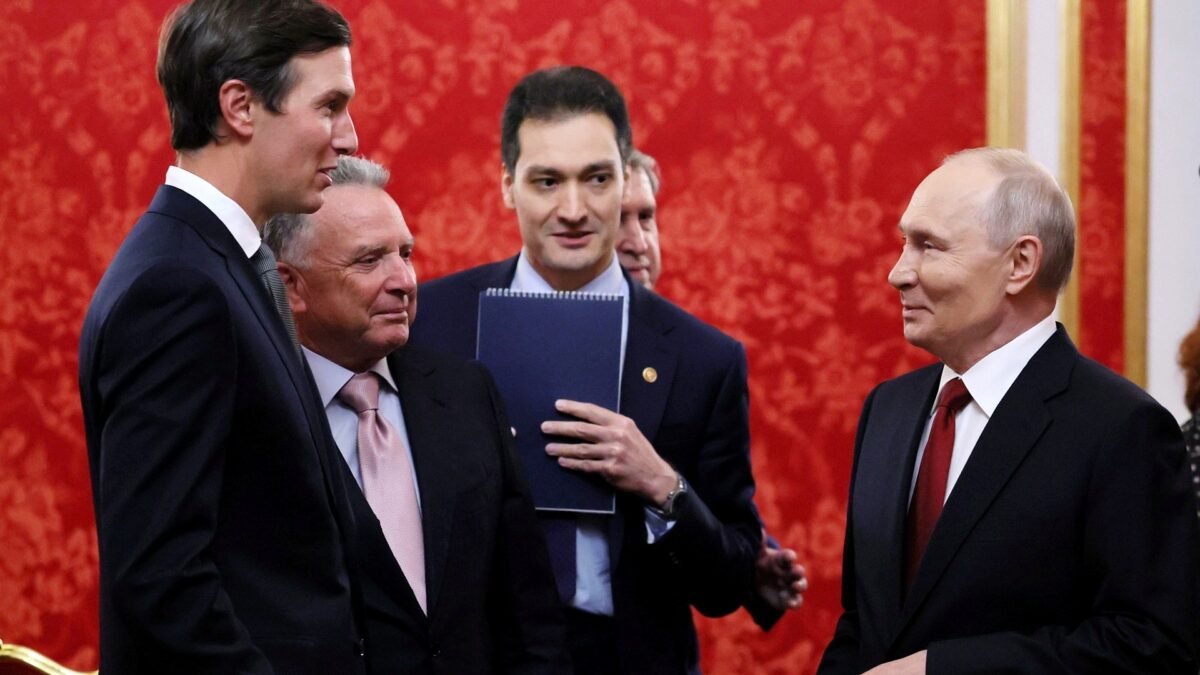
United States envoys Steve Witkoff and Jared Kushner met Russian President Vladimir Putin in Moscow on Thursday, carrying the results of two days of talks in Abu Dhabi that produced a deal in principle for the largest prisoner exchange of the Ukraine war but no breakthrough on ending the fighting. The meeting, the tenth time Witkoff has sat down with Putin in person according to Reuters, is the latest step in a fast-moving diplomatic sequence that now turns to Dublin, where the Americans are due to brief Ukrainian President Volodymyr Zelenskyy later on Thursday.
The two envoys arrived in Moscow on Thursday morning and were greeted at Vnukovo Airport by Kirill Dmitriev, Putin’s special envoy and the head of Russia’s sovereign wealth fund, who accompanied them into central Moscow in wet snow, according to Reuters. Talks with Putin were expected to take place in the first half of the day. The visit follows two days of negotiations in the capital of the United Arab Emirates between Russian, Ukrainian and American delegations, the first direct talks of their kind mediated by the United States in nine months, which ended on Wednesday with what the American side described as progress on some issues but no public breakthrough on the questions that matter most: territory, a ceasefire, and the shape of a lasting settlement.
At the meeting with Putin, Witkoff made clear that Washington wants the next round of talks to look different from the last. “We are hopeful that we can announce shortly, hopefully maybe even at the end of this meeting, the next trilateral meeting that will include the Europeans,” Witkoff said, according to CNN. Kushner, who holds no official role in the Trump administration yet acts as one of its most senior diplomats, added: “The Europeans have a desire for this war to really be the end and for there to be a long peace after.”
Putin, in remarks reported by CNN, said Russia had “never objected (to) pursuing dialogue” with Europe. “You want this peace to be a durable and lasting one, and I confirm that I subscribe to that, and I’d say more. I want this peace to be eternal, for good,” the Russian leader said. Whether those words signal a genuine opening or a familiar diplomatic formulation will be judged by what follows in Dublin, where Zelenskyy is attending a meeting of European leaders and is waiting to hear what the Americans brought back from the Kremlin.
What Abu Dhabi produced — and what it did not
The Abu Dhabi talks, held on Tuesday and Wednesday, were the first trilateral negotiations over the war since a round in Geneva in February, according to reports from the time. The United States delegation was led by Witkoff and Kushner; Ukraine’s team was headed by Rustem Umerov, the country’s foreign intelligence chief, alongside senior officials including Kyrylo Budanov, Sergiy Kyslytsya and David Arakhamia; Russia’s delegation was led by Vladimir Medinsky. The first day ran for more than four hours. The second day, according to multiple reports, lasted less than two hours, one of the shortest sessions of the year, before the delegations announced what they had agreed.
The firm result was humanitarian. The two sides agreed in principle to a large-scale exchange of prisoners of war. Kushner described it as the biggest humanitarian release of prisoners since the war began, according to the New York Post, although he did not give a precise figure. Zelenskyy said the talks had covered swaps of 1,000 prisoners for 1,000, or 1,500 for 1,500, according to the same reporting. The final numbers and the timing still had to be settled, and the arrangement should not yet be described as a completed swap. A Russian military official, Alexander Zorin, said the two sides could return more than 1,000 prisoners to each other over the next two to three weeks, according to Xinhua, as reported by the Vietnamese outlet Stockbiz.
On the wider questions, the gap remained. The American side said differences persisted on major issues, including territory, according to Reuters. Medinsky, Russia’s chief negotiator, told Russian media that Russia would take “every inch” of land it claims and would accept no territorial exchanges, according to the Institute for the Study of War. Moscow’s standing demands, reported consistently through the year, are that Ukraine withdraw its forces from the parts of the Donetsk, Luhansk, Zaporizhzhia and Kherson regions that Russia claims but has never fully captured, abandon its bid to join NATO, accept limits on its armed forces, and drop restrictions on the Russian language and the Moscow-affiliated Orthodox Church. Kyiv has rejected ceding territory and has insisted on an immediate ceasefire first, before any discussion of a final settlement.
Even so, both sides described movement. Ukrainian negotiators reported progress on security guarantees for Ukraine and on how a de-escalation mechanism might work once the war ends, according to the New York Post. Arakhamia, a member of Kyiv’s delegation, said the talks had made “truly significant progress” and that there was “good momentum to reach a solution before the new year”, according to The Times. Kushner said the discussions had “narrowed the gaps” between the two countries and that the meeting with Putin would hopefully make further progress. “We see some openings,” he said, according to The Times.
The talks were framed from the start as something larger than a bilateral dispute. Trump has spoken of a “big, beautiful agreement” that would involve more than Ukraine and “might involve all of Europe”, and the American side has pressed for a new framework for European security to accompany any settlement. The United States has asked Russia to submit a new proposal for a future security agreement with Europe that includes Russian steps to ease tensions with the continent, according to Axios, as reported by Just Security. The Institute for the Study of War has assessed that Moscow is trying to steer the talks toward broader changes to the European security architecture, describing the effort as a revival of the Kremlin’s 2021 demands for a rollback of NATO’s presence in Europe.
Europe’s place at the table
The question of who sits at the table has become one of the central disputes of the week. Ukraine has long argued that Europe should be at the main negotiating table, and the American envoys now appear to be pressing the point. Witkoff’s hope of announcing a next trilateral meeting “that will include the Europeans” is the clearest public signal yet that Washington wants to widen the format. Kushner’s remark that the Europeans want the war to end and want a long peace afterwards was, in effect, an argument that their presence would strengthen rather than complicate a deal.
Moscow has so far resisted. Russian Foreign Minister Sergey Lavrov criticised the presence of European officials in Abu Dhabi earlier in the week, saying their involvement was not a “promising approach”, according to CNN. Kremlin spokesman Dmitry Peskov said on Wednesday that no contacts between the Russians and any European Union representatives had been planned in Abu Dhabi, and none took place. The Europeans were in the city in any case: the so-called E4 of Britain, France, Germany and Italy, together with NATO and European Commission officials, held separate meetings with the American and Ukrainian delegations before the trilateral sessions began, according to reports from the time. Secretary of State Marco Rubio, speaking in Paris at a meeting of G7 foreign ministers, has said the goal is to expand the talks so that the Europeans are “represented at that table directly”.
The European position, as set out by its leaders through the year, is that peace in Ukraine and the security of Europe are inseparable. The French presidency has said the two are “inextricably linked”. Germany’s foreign minister has argued that Europe needs a restoration of the existing security architecture, not a new one. The European Union’s foreign policy chief, Kaja Kallas, has said there is little sign that Russia is negotiating in good faith, and has cited the 1994 Budapest Memorandum, under which Ukraine gave up its nuclear arsenal in return for security assurances, as a warning against paper promises. Zelenskyy has put the point more bluntly: “We don’t want a second Yalta,” a reference to the 1945 conference at which the great powers redrew Europe’s map over the heads of smaller states.
For now, the format remains trilateral, and the question of whether it becomes multilateral will be one of the first things Zelenskyy asks the Americans about in Dublin. The Ukrainian president, who arrived in Ireland on Wednesday for the European leaders’ meeting, said he hoped the Americans would return from Moscow with “specifics”. “Today there really is this opportunity, this window of opportunity, when all those participants who are now engaged in the negotiation process genuinely want to achieve a result before 2027,” Zelenskyy said, according to The Times. He has also said that a peace deal can only be reached at a face-to-face meeting with Putin, although Kushner said on Wednesday that Moscow was not yet open to direct talks between the two leaders. “The Russians have said they would like to see more progress made before that happens,” Kushner said, according to The Times. The Kremlin has previously said Putin would only meet the Ukrainian leader in Moscow, a proposal Kyiv has rejected.
War continues while diplomats talk
The diplomacy has brought no pause in the fighting. Moscow launched a ballistic missile and drone attack on Ukraine overnight into Thursday, according to the Ukrainian Air Force, as reported by CNN. In Kyiv, at least one woman was killed and five other people were injured when a Russian drone struck an apartment block on Thursday morning, according to the city’s mayor, Vitali Klitschko, as reported by Just Security. Russian strikes on Ukraine’s energy infrastructure left more than 850,000 consumers without electricity across the Dnipropetrovsk and Kharkiv regions, according to local authorities and the energy operator DTEK, as reported by the European news digest Nexus Europa, with Kyiv warning of rolling blackouts in the capital.
Ukraine, for its part, has continued long-range strikes against Russian military and energy targets, and its general staff reported successful attacks on Russian positions in occupied areas of Donetsk and Zaporizhzhia, according to the same digest. The exchange of attacks on the two capitals on Thursday morning, reported by Reuters, underlined a pattern that has held through every round of talks this year: negotiation and bombardment proceed in parallel, each side seeking to improve its position before any settlement is signed.
Zelenskyy also raised a separate problem on Thursday, warning of recurring disruptions to Starshield, the military-grade version of Elon Musk’s Starlink satellite service that is critical to Ukraine’s military operations. He said the service had faced “significant disruptions” in recent days, hampering Kyiv’s ability to shoot down Russian drones. “These are not random errors but systematic speed restrictions. For us, this primarily means a significant complication in intercepting Russian jet-powered drones,” Zelenskyy said, according to CNN. “Unfortunately, this is helping the Russians kill more Ukrainians and carry out more accurate strikes against Ukraine,” he wrote on X. Kyiv was “trying to establish all the circumstances with the American side”, he added.
Ukraine reported similar speed limits on Starshield terminals in October, as the relationship between Kyiv and Washington deteriorated. Trump denied approving that decision, while Musk said the Trump administration was behind the restrictions, according to CNN. The recurrence of the problem in the middle of a peace push raises awkward questions about the reliability of the communications backbone on which Ukraine’s air defences depend, and about who, exactly, is making decisions about it.
The wider backdrop
The Moscow meeting comes at a moment when several separate threads of the war and its diplomacy are converging. The war is now in its fifth year, having begun with Russia’s full-scale invasion in February 2022, and the American administration has made ending it a central foreign-policy objective. The 28-point peace plan that has framed much of the discussion this autumn, drafted with input from Dmitriev and Witkoff, envisages Ukraine ceding land, renouncing NATO membership, and accepting American mediation of talks between NATO and Russia, according to reporting at the time. Its details have been contested by Kyiv and by European capitals, which have insisted that no settlement can be imposed on Ukraine and that European security cannot be negotiated without Europe.
At the same time, the conflict’s wider geography has widened. The United States has been engaged in a separate confrontation with Iran since February, when Trump announced major combat operations against Tehran alongside Israel, and the two crises have begun to intersect in the diplomacy. One expert, the Ukrainian-Arab relations specialist Mohammad Farajallah, claimed this week that Putin had proposed exchanging geopolitical concessions over Iran for concessions on Ukraine in talks with Trump, according to the outlet Security Signal, which cited an interview with Radio NV. That claim, which rests on a single expert’s account and has not been confirmed by any government, should be treated with caution. But the fact that such an idea is being discussed publicly at all shows how the Ukraine and Iran files are now seen, in some quarters, as linked.
Other developments this week point in the same direction. The United States has asked Russia to take custody of Iran’s enriched uranium stockpile, according to the Russian foreign ministry, which said on Wednesday that a proposal to transfer the material to Russian territory for dilution remained on the table and that the decision was Tehran’s to make. The G7 foreign ministers, meeting in Paris, issued a joint declaration on the situation in the waters east of Taiwan and on the security of shipping in the Strait of Hormuz and the Red Sea. And in Gaza, an Israeli airstrike hit a building at Nasser Hospital in southern Gaza on Thursday, according to the BBC, as reported by Just Security, a reminder that the Middle East’s wars continue alongside the diplomacy over Ukraine.
Analysis: Why It Matters
1. The prisoner exchange is real progress — and its limits matter
The agreement in principle on a large prisoner exchange is the most concrete outcome of the Abu Dhabi round, and it should not be dismissed. For the families of the men held on both sides, it is the only part of this week’s diplomacy with an immediate human consequence. Exchanges of this kind have been one of the few areas in which Russia and Ukraine have cooperated throughout the war, and a release on the scale described by Kushner — the largest since the invasion began — would be a genuine humanitarian achievement.
But the limits of the achievement need to be stated plainly. The numbers have not been finalised, the timing has not been fixed, and the agreement is described as “in principle”, which in the language of these talks means it can still unravel. The second day of the Abu Dhabi talks lasted less than two hours, which is not the signature of a negotiation that has resolved its hardest questions. A prisoner exchange is a measure of what the two sides can agree on when the subject is humanitarian. It is not, by itself, evidence that they are close to agreeing on territory, security guarantees, or a ceasefire. The danger is that a humanitarian success is presented as a political breakthrough. It is not one, and treating it as one would mislead the public about where the talks actually stand.
2. Europe’s seat at the table is now the central question
The most significant thing Witkoff said in Moscow was not about prisoners or territory. It was his hope of announcing, perhaps before the meeting ended, a next round of talks “that will include the Europeans”. That is a direct challenge to the format Moscow has insisted on, and to the position Lavrov set out in Abu Dhabi, where European involvement was dismissed as not a “promising approach”. The American envoys are now openly pressing for a wider table, and Putin’s reply — that Russia has “never objected” to dialogue with Europe — is, at minimum, a refusal to close the door.
The stakes of this question are larger than protocol. Any settlement that redraws the security map of Europe, limits Ukraine’s armed forces, or commits NATO members to new arrangements will need European governments to accept it, fund it, and in some cases guarantee it. A deal negotiated without them, and then presented to them, would face the same problem as the 28-point plan: it would be contested before it was even signed. Zelenskyy’s warning against “a second Yalta” captures the fear in Kyiv and in European capitals that the great powers will settle the future of a smaller state over its head. The test of the Moscow meeting is therefore not only what Putin says about territory, but whether he accepts, in practice, that the next round will include the Europeans whose troops, money and guarantees any settlement will require.
3. Putin’s language of “eternal” peace deserves scrutiny, not applause
Putin’s statement that he wants a peace that is “eternal, for good” is striking language, and it will be quoted widely. It should also be read carefully. The Russian president has used the language of lasting peace before, including in the run-up to the full-scale invasion, and his government’s negotiating demands have not changed in substance: Ukrainian withdrawal from territory Russia claims, no NATO membership, limits on Ukraine’s military, and concessions on language and the church. A promise of eternal peace that is conditional on the other side accepting all of those demands is not a concession. It is a restatement of the same terms in more generous language.
None of this means the statement is meaningless. Leaders do not use the word “eternal” by accident, and the fact that Putin chose to frame his position in those terms, in front of the American envoys, suggests that Moscow wants to be seen as open to a settlement. But the gap between language and substance is precisely what the Dublin meeting is for. Zelenskyy wants “specifics” from the Moscow meeting, and the specifics that matter are not adjectives. They are whether Russia will discuss a ceasefire, whether it will move on territory, and whether it will accept Europeans at the table. Until those questions are answered, the language should be reported, not celebrated.
4. The war on the ground is getting harder, not easier
While the diplomats talked, the war intensified in ways that should temper any optimism. More than 850,000 people lost power in two Ukrainian regions in a single round of Russian strikes on the energy grid, and Kyiv is warning of rolling blackouts in the capital as winter approaches. A woman was killed in Kyiv on Thursday morning by a Russian drone. And Zelenskyy’s warning about Starshield disruptions points to a vulnerability that goes beyond the battlefield: Ukraine’s ability to intercept Russian drones depends on a satellite service controlled by a private American company, subject to decisions taken in Washington that Kyiv says it does not fully understand.
The Starshield problem is particularly serious because it is recurring. The same restrictions were reported in October, and the explanations given then — Trump’s denial, Musk’s claim that the administration was behind the restrictions — did not resolve the underlying question of who controls the service and on what terms. If Ukraine’s air defences are being degraded by decisions taken outside Kyiv, in the middle of a peace process in which Washington is also the mediator, that is a conflict of interest that needs to be addressed openly. A mediator cannot also be, even inadvertently, a party to the weakening of one side’s defences. The Dublin meeting would be a good place to raise it.
5. The “window of opportunity” is real — and it is narrow
Zelenskyy’s phrase, a “window of opportunity” for a breakthrough before the end of the year, captures the mood of the moment accurately. There is, for the first time in months, a genuine sequence of meetings: Abu Dhabi, then Moscow, then Dublin, with the prospect of a further round that includes the Europeans. The American envoys are shuttling between capitals in a way that recalls the most active phases of earlier peace efforts. The Ukrainian delegation speaks of “good momentum”. The prisoner exchange, if it is completed, will build a measure of trust between the negotiating teams.
But windows close. The obstacles that have blocked every previous round are still in place: Russia’s demand for territory it has not captured, Ukraine’s refusal to cede it, the absence of agreement on a ceasefire, and the unresolved question of who guarantees any settlement. The second day of the Abu Dhabi talks lasted less than two hours, which suggests that the delegations ran out of things they could agree on rather than reaching a breakthrough. The Moscow meeting is the tenth between Witkoff and Putin, and the previous nine did not produce a settlement. The opportunity is real, but it is narrow, and it will be measured not by the number of meetings held but by whether any of them changes a position that has held for four and a half years.
What to Watch Next
- The Dublin readout: What Witkoff and Kushner tell Zelenskyy about the Moscow meeting, and whether the Ukrainian president describes the Russian position as having moved. His use of the word “specifics” sets the bar.
- The prisoner exchange: Whether the numbers are finalised and a date is set, and whether the swap takes place on the scale Kushner described. A completed exchange would be the first tangible deliverable of this round.
- The next round’s guest list: Whether Witkoff’s hope of a meeting “that will include the Europeans” is confirmed, and whether Moscow accepts European participation in practice rather than in principle.
- Territory and ceasefire: Any sign that Russia has moved from Medinsky’s “every inch” position, or that the two sides have agreed even the outline of a ceasefire. Without movement on either, the talks remain a process rather than a path to peace.
- The United States’ security proposal: Whether Russia responds to the American request for a new proposal on a future European security agreement, and what that proposal contains.
- Starshield: Whether the disruptions Zelenskyy reported are resolved, and whether Washington gives Kyiv a clear account of who imposed the restrictions and why.
- The winter campaign: Whether Russian strikes on Ukraine’s energy grid continue at the scale seen this week, and whether Kyiv’s warnings of rolling blackouts materialise as temperatures fall.
Sources
- Reuters — “US envoys arrive in Moscow for latest round of Ukrainian peace talks with Putin”
- CNN — “Witkoff and Kushner in Moscow for Ukraine talks, as Zelensky says Starshield restricted again”
- The Times — “Zelensky says ‘window of opportunity’ exists for peace deal this year”
- Reuters — “Russia, Ukraine exchange attacks on capitals as US envoys head for Moscow”
- New York Post — “Kushner and Witkoff to meet Putin after ‘one of the toughest’ rounds of talks with Russians”
- Just Security — “Early Edition: November 12, 2026”

About the Author — Abdul Mannan
Related Articles
COP31 in Antalya: Guterres Warns of ‘Mutually Assured Destruction’ as Burnham Pledges a New Era of British Climate Leadership
The UN chief told leaders in Antalya that the climate crisis is 'outrunning us' — as Britain's prime…
US Envoys Head to Moscow for Putin Talks as Russia and Ukraine Trade Strikes on Each Other’s Capitals
Explosions shook Kyiv and Moscow shot down drones heading for its capital hours before Jared Kushner and Steve…
Indonesia’s Vice-President Gibran Rakabuming Raka Resigns as Diploma Ruling and Impeachment Push Rock Prabowo’s Government
Indonesia's Vice-President Gibran Rakabuming Raka has resigned after court rulings annulled his education certificate and 120 lawmakers moved…