
COP31 in Antalya: Guterres Warns of ‘Mutually Assured Destruction’ as Burnham Pledges a New Era of British Climate Leadership

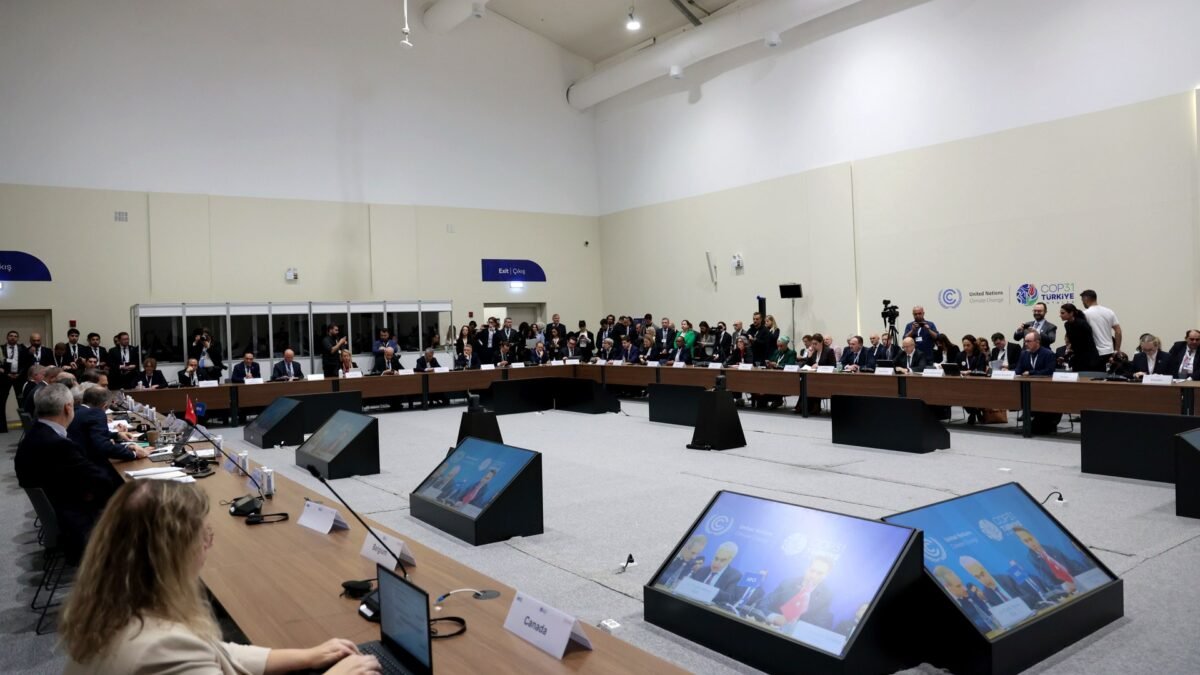
The United Nations climate summit in Antalya entered its most political phase this week with a warning from the UN secretary-general that the world is losing the race against global warming, a declaration of renewed British leadership from the only G7 leader in the room, and a blunt defence of oil from Venezuela — all against the backdrop of an empty chair where the United States used to sit.
António Guterres told dozens of world leaders gathered in the Turkish Mediterranean city on Wednesday that the climate crisis is now “outrunning us” and that humanity’s slow response has put the planet on “the path to mutually assured destruction”, according to Agence France-Presse. His sharpest words were reserved for fossil fuels. “Fossil fuels must go the way of the dinosaurs,” he said, “but that won’t happen on its own. The dinosaurs did not have a lobby, but fossil fuels do.”
On Thursday, British Prime Minister Andy Burnham used his first address to a UN climate conference as prime minister to warn that the political consensus that once carried the climate cause has broken down. “The climate crisis is upon all of us now,” he told delegates, according to the Press Association. “The consensus we once enjoyed on science and climate action has broken down. We will not stand by and that’s why I’ve pledged a new era of British leadership over the next decade.”
The same day, Venezuela’s Acting President Delcy Rodriguez stood at the same summit and told delegates that her country has a sovereign right to develop its oil industry, Reuters reported. “We reaffirm our sovereign right to strengthen our energy and oil industry as a driver of our national development,” she said. “It is possible to grow and protect the environment at the same time.”
The three speeches, delivered within 24 hours of each other, capture the state of COP31: a conference where the science is more alarming than ever, the politics more divided than at any point in the summit’s 31-year history, and the world’s biggest historical emitter absent for the second year running.
COP31, the 31st Conference of the Parties to the UN Framework Convention on Climate Change, opened on Monday, 9 November at the Antalya Expo Center on Türkiye’s Mediterranean coast and runs until Friday, 20 November. Representatives from nearly 200 countries are trying to agree a deal to improve progress in tackling climate change, according to Reuters. The presidency is split in an unusual arrangement: Türkiye hosts the summit and leads the voluntary Action Agenda under Environment Minister Murat Kurum, while Australia’s climate minister, Chris Bowen, presides over the formal negotiations. The UN had expected more than 100 leaders from some 95 countries, and the BBC reported that some 92,000 delegates have registered to attend.
Heads of state and government spoke on Wednesday and Thursday in the World Leaders’ Summit, the high-level opening of the conference. Their segment resumes on 17 and 18 November for countries that did not speak this week, before ministers try to close the negotiations on 20 November.
The warning: “Outrunning us”
Guterres, who has made the fight against climate change a central issue since taking office in 2017, is attending his final COP before his term as secretary-general ends in December. He used the occasion to deliver one of the bluntest speeches of his tenure, aimed squarely at the oil and gas industry.
“The brutal truth is that the climate crisis is outrunning us,” he told the leaders gathered in Antalya, according to AFP. “This is the path to mutually assured destruction.” He accused the fossil-fuel lobby of a deliberate strategy of delay. “Their strategy is simple: Distort the science. Delay the policy. Delay the action. Delay the accountability. It’s time to kick the habit and end the fossil fuel addiction,” he said, to sustained applause.
He also urged governments to tax the windfall profits of oil companies, a call he has made before but which carried extra weight this year because of the surge in oil and gas prices triggered by the US-Israeli war with Iran and Russia’s war in Ukraine. The price shock, as the Glasgow Times noted, has prompted governments around the world to rethink their energy policies — and in several cases to reach for more fossil fuels, not fewer.
Guterres’s warning was grounded in the science published as the summit opened. A World Meteorological Organization report released at the start of COP31 found that 2026 is on track to be one of the four hottest years on record, with the January-to-September average 1.47 degrees Celsius above pre-industrial levels. The Global Carbon Budget, published in the same week, projected that fossil-fuel carbon dioxide emissions will fall by 0.4 per cent in 2026 to 38.2 billion tonnes, but that total carbon dioxide emissions will still hit a record 43.3 billion tonnes. The remaining carbon budget for holding warming to 1.5 degrees is just 150 billion tonnes — under four years at current rates.
A UN report last month found the world was on course to break through the 1.5 degrees Celsius warming limit that countries agreed to pursue under the 2015 Paris Agreement, Reuters reported. Guterres told leaders that global emissions must fall by about six per cent a year, while current national climate plans, including conditional ones, deliver at best a third of that. Even if fully implemented, he said, they would leave the world above 2.5 degrees by the end of the century.
“Science was not telling the world to surrender but to fight harder,” Guterres said, according to a summary of the summit’s opening days. The two-week talks opened, he noted, after a year of searing heatwaves and wildfires in Europe, deadly floods in Nepal and major wildfires in Indonesia.
Britain’s answer: “A new era of leadership”
If Guterres supplied the warning, Burnham supplied the most forthright response from any Western leader at the summit. The British prime minister, attending the annual climate gathering for the first time as prime minister, arrived in Antalya on Wednesday evening with Foreign Secretary Ed Miliband, who had landed on Tuesday. He is the only leader from a G7 country scheduled to address the summit, with US President Donald Trump declining to send a delegation for the second year running.
Burnham told the conference that the summer Britain had just experienced was “not normal”. The country suffered five heatwaves this summer, which was the hottest on record, and recorded a June high of 38 degrees Celsius, according to The Times. “I spent my first three weeks as prime minister responding to the worst wildfires Britain has ever experienced,” he said. “I decided then it was important for me to be here to show British leadership in a world where climate issues have taken too much of a backseat. The climate crisis is not a distant threat. It is upon us all now, devastating lives and livelihoods everywhere.”
He blamed an over-reliance on fossil fuels for driving global warming and sending gas bills “soaring” for businesses and families. “Climate is a national security issue,” he added. That framing was the centrepiece of his speech: climate change, in Burnham’s telling, is no longer only an environmental question but a matter of national security, because dependence on imported oil and gas leaves a country exposed to the decisions of others.
Earlier on Thursday, Reuters reported him telling the conference that energy supply disruptions from the US-Israeli war with Iran and Russia’s war in Ukraine showed the need for countries to switch from fossil fuels to clean energy. “It is now plain for everyone to see that if we depend on energy we do not control, then we leave ourselves exposed to prices we cannot control,” he said. “The shift to clean energy is the only route to energy security.”
Burnham announced that Dame Madeleine Alessandri, the former chairwoman of the Joint Intelligence Committee which provides ministers with national security assessments, has been appointed as the UK’s special representative for climate security — a new post that underlines the security framing. He also announced the UK’s support for the Amplified programme, which aims to secure £5 billion of new private finance for clean energy projects around the world, according to the BBC’s live coverage of the summit.
He insisted the UK “remains determined to reach net zero by 2050”, amid accusations that his Government is deprioritising the green agenda, the Press Association reported. “The message I carry here at my first Cop as UK Prime Minister is this: we’re committed to meeting our 2050 net zero target, and committed to working with all of our partners to reach theirs,” he said. Referring to Conservative and Reform promises to scrap the UK’s 2050 net-zero target, he told the summit: “The consensus we once enjoyed on science and climate has gone and the reality is now the world will reach 1.5 degrees. Climate leadership and action have become more urgent. Britain will answer the call.”
As the UK takes up the presidency of the G20 next year, Burnham said, it would put resilience to climate change “back on the agenda”, according to The Times. He also held a bilateral meeting in the margins of the summit with Brazilian President Luiz Inácio Lula da Silva, and the BBC reported that some environmental campaigners called on him to back up his rhetoric with stronger action after his speech.
The BBC’s live coverage also noted a telling detail about the summit’s atmosphere: with some 92,000 delegates registered, the headline speech by the only G7 leader in attendance was delivered to a hall that was far from full — a visual reminder of how far climate has slipped down the diplomatic agenda.
Venezuela’s defence: “Our sovereign right”
Rodriguez’s intervention on Thursday was the most direct challenge to the summit’s direction from a head of government. Venezuela is a member of the Organization of the Petroleum Exporting Countries, and its acting president told the conference that the country has a sovereign right to develop its oil industry, even as it recognises the importance of combating climate change, Reuters reported.
Her comments jar with efforts by other conference leaders to convince governments to accelerate a shift from carbon-emitting fossil fuels, Reuters noted. But they dovetail with the United States’ efforts to raise billions of dollars towards increasing oil output in Venezuela. President Donald Trump, who withdrew the United States from formal climate cooperation last year after calling global warming a hoax, has said investing in Venezuela’s oil can bolster national security by increasing Western Hemisphere energy supplies.
Rodriguez added that Venezuela’s forests acted as a “lung for the planet”, absorbing more carbon than the country emits. She did not address the impact that oil exported from the country had on global emissions, Reuters reported.
Her position is not an isolated one at COP31. The host country itself is a coal user: coal was Türkiye’s largest source of power last year, and Ankara argues that fossil fuels remain necessary for energy security. Qatar’s climate undersecretary has said emissions can be cut without requiring countries to abandon particular fuels. And a transition away from fossil fuels is not a formal agenda item at COP31 at all — a fact that campaigners have seized on as the summit’s central failing.
The absences: A summit without its biggest players
The most striking feature of COP31 is who is not there. Several prominent figures are absent, AFP reported, with Burnham the only leader from a G7 country scheduled to address the summit. French President Emmanuel Macron, German Chancellor Friedrich Merz and Italian Prime Minister Giorgia Meloni are all skipping it. COP31 coincides with an EU leaders’ summit in Ireland on Thursday, which officials cited as a practical reason for the absences, but the pattern runs deeper than one scheduling clash.
Canadian Prime Minister Mark Carney and Japanese Prime Minister Sanae Takaichi are also absent from the list of expected attendees, according to AFP. European Commission President Ursula von der Leyen is due to attend, but the European Union’s climate commissioner, Wopke Hoekstra, told reporters in Brussels that “expectations are not necessarily high” for this year’s climate conference, while also saying the absences were “not completely atypical” as leaders might have “practical” reasons for being unable to attend.
US President Donald Trump, who withdrew the United States from the Paris Agreement and has not sent officials to climate talks since his re-election in 2024, is not attending the summit. The United States, the world’s largest historical emitter, has now stayed away for a second consecutive year. Chinese President Xi Jinping, who rarely attends COP meetings, will be represented by Vice President Han Zheng. Indian Prime Minister Narendra Modi is also absent. The United States and China are the world’s two largest economies and biggest emitters of planet-warming greenhouse gases.
“It is a shame that some of the bigger European leaders aren’t coming. We need Europe to be showing up strongly at this COP,” Cosima Cassel, a climate diplomacy expert at the think tank E3G, told AFP. Climate Action Network Europe said that absent leaders were missing “more than just a photo opportunity”.
The absences were the theme of Lula’s speech on Wednesday. “Since the start of this year, climate change has disappeared from speeches and documents from our global leadership,” the recently re-elected Brazilian president told fellow leaders. “We’ve turned to talking more about arms and tariffs than the survival of future generations.” Campaigners breathed a huge sigh of relief when Lula, who has overseen a dramatic drop in deforestation in the Amazon, defeated right-wing rival Flavio Bolsonaro in Brazil’s presidential election last month. “Brazil is back to defend the continuity of a healthy planet,” Lula said.
Turkish President Recep Tayyip Erdoğan, addressing the summit on Wednesday, said that “what has taken place in Gaza is not only a genocide, but it is also an ecocide”, according to the Associated Press. He said “centuries old olive trees have been cut down. The soil and water have been polluted in Gaza, and cities in Gaza have been turned into enormous piles of rubble.” He called on the Israeli government to grant more aid access to the Palestinian territory. Erdoğan also said the world needs a “fair” energy transition that “takes into account the energy security and different development needs of different countries”, AFP reported.
Other leaders who addressed the summit on Wednesday included European Commission President Ursula von der Leyen, Chinese Vice-President Han Zheng and Marshall Islands President Hilda Heine, whose country is among the most threatened by rising seas.
What the science says
The gap between what the science demands and what governments are offering is the summit’s central fact, and it was spelled out repeatedly in the opening days. The UN Environment Programme’s report last month found the world on course to break through the 1.5-degree limit. The WMO’s finding that 2026 is on track to be one of the four hottest years on record — at 1.47 degrees above pre-industrial levels for the first nine months of the year — means the world is now living, year after year, at temperatures the Paris Agreement was designed to prevent.
The Global Carbon Budget’s numbers tell the same story from the other side. Fossil-fuel emissions are projected to dip slightly in 2026, by 0.4 per cent to 38.2 billion tonnes, but total carbon dioxide emissions will still reach a record 43.3 billion tonnes, because emissions from land-use change continue to add to the total. At current rates, the remaining budget for 1.5 degrees — 150 billion tonnes — will be exhausted in under four years.
Guterres’s figure that emissions must fall by about six per cent a year, against plans that deliver at best a third of that, is the measure of the gap. Even if every current national plan were fully implemented, the world would still be above 2.5 degrees by the end of the century — a level of warming that scientists say would bring far more severe heatwaves, floods, droughts and sea-level rise than the world is already experiencing.
The adaptation gap is just as wide. The UN Environment Programme estimates that developing countries will need between 310 billion and 365 billion dollars a year by 2035 to adapt to climate change, against about 26 billion dollars of international public adaptation finance in 2023. India has argued that such money should come as grants rather than loans, so that the countries least responsible for warming are not pushed deeper into debt to survive it. At Belém last year, governments agreed to at least triple adaptation finance by 2035, but the pledge has no baseline and no named donors, and an African proposal for a separate agenda item on tripling adaptation finance failed at COP31’s opening.
The four fights that will define the fortnight
Four disputes are likely to define the two weeks in Antalya. The first is who pays for adaptation, and how much. Developing countries won a work programme on finance on the opening agenda, but the money remains the hardest question in the talks, and the gap between need and supply is measured in hundreds of billions of dollars a year.
The second is whether the fossil-fuel exit enters the formal outcome or stays in voluntary coalitions outside the process. Brazil, the previous host, published a voluntary roadmap on 3 November. Germany, France and the Netherlands have set national phase-out plans, though experts have criticised Germany’s 2045 target as unambitious. But a transition away from fossil fuels is not on COP31’s formal agenda, and at Belém last year oil-producing states blocked binding language on a fossil-fuel roadmap, leaving Brazil to take the idea outside the formal process. Greenpeace and other campaigners want governments to turn the COP28 pledge — the first agreement, reached in Dubai in 2023, to “transition away from fossil fuels” — into national roadmaps with dates attached.
The third is the relationship between trade and climate policy, including tariffs on clean technology. China has said it wants COP31 to discuss the free flow of green technology, widely seen as a reference to US and EU tariffs on Chinese solar products and electric vehicles. Former US climate envoy John Kerry used the opening of the conference to argue that China is setting the pace on clean energy and that others, including the United States, must follow. He said most countries are still “stumbling along”, while China is the only country that has “hugely accelerated”, and described the shift as “unstoppable”. Reports of the interview cited China’s clean-technology exports of more than 220 billion dollars in 2025, about 85 per cent of global solar supply-chain capacity and 80 per cent of lithium-ion battery capacity.
The fourth is political weight. A conference without the United States, and with China and India represented below head-of-government level, has less leverage to extract ambitious commitments from anyone. That is the structural problem behind the empty hall and the low expectations: the countries whose decisions matter most for emissions are the ones least engaged with the process designed to govern them.
The hosts under fire
Both COP31 co-presidents have come under criticism from campaigners. Human Rights Watch and 350.org issued scathing reports criticising co-hosts Türkiye and Australia for continuing coal power expansion and omitting fossil-fuel phase-out language. Australia’s Prime Minister Anthony Albanese, in his address to the Leaders’ Summit, made no mention of fossil fuels, despite the urgent need for a plan to move beyond them, according to 350.org. Australian NGOs slammed the Australian Government’s leadership for failing to commit new and overdue funding for communities in the region impacted by climate disasters.
Türkiye, for its part, is promoting a voluntary initiative to accelerate the electrification of transport, buildings and industry, with the aim of increasing electricity’s share of global energy consumption to 35 per cent by 2035, up from about one-fifth today. The European Union has stressed that electrification must be “clean”, potentially setting up a debate over the role of oil, gas and coal in the Turkish proposal. The presidency’s headline initiative is voluntary, and campaigners note that the host country’s own power mix still leans heavily on coal.
Swedish activist Greta Thunberg was also at COP31 on Thursday, addressing journalists alongside campaigners and representatives from Nepal, Australia, Palestine and Canada, and demanding stronger accountability from governments. Her presence, alongside the criticism from Human Rights Watch and 350.org, is a reminder that the summit is being watched not only by negotiators but by a movement that has grown impatient with the pace of the formal process.
Eleven years of summits: What has been settled, and what has not
COP31 opened on Monday in Antalya ten years after the Paris Agreement entered into force. The record of the decade since shows a pattern of progress on principles and delay on delivery.
In Paris in 2015, governments agreed to hold warming well below 2 degrees and pursue 1.5 degrees, and created the system of national pledges — nationally determined contributions — that still governs the process. The promised 100 billion dollars a year in climate finance for developing countries was met only years later than promised.
At Glasgow in 2021, COP26 produced the first COP text to mention coal, though it called only for a “phase down” rather than a phase-out. A pledge to double adaptation finance by 2025 is widely expected to have been missed. The following year at Sharm el-Sheikh, COP27 created a loss-and-damage fund, a long-standing demand of vulnerable states, but money has been slow to follow.
COP28 in Dubai in 2023 reached the first agreement to “transition away from fossil fuels”, with no timetable or enforcement mechanism. At Baku in 2024, COP29 set a finance goal of 300 billion dollars a year by 2035, with an aspiration of 1.3 trillion dollars — a headline figure that developing countries called inadequate. Last year at Belém, COP30 agreed to at least triple adaptation finance by 2035, while oil-producing states blocked binding language on a fossil-fuel roadmap.
That history is the reason expectations for Antalya are so low. With fossil-fuel phase-out off the formal agenda, the likeliest outcomes are procedural gains on finance and adaptation plus voluntary pledges on electrification — not a binding global exit from coal, oil and gas. The summit’s own president, Murat Kurum, said he wanted delegates to leave saying that something had changed in Antalya. The UN’s climate chief, Simon Stiell, said COP31 must “supercharge solutions”. Whether either ambition is met will be decided in the negotiating rooms over the next eight days, not in the leaders’ speeches.
Analysis: Why It Matters
1. The consensus Burnham buried was real — and its burial matters
Burnham’s most important sentence in Antalya was not his pledge of leadership but his diagnosis: “The consensus we once enjoyed on science and climate has gone.” He was careful to say he was not talking about the consensus among scientists, which remains overwhelming, but about the consensus among countries and politicians about what to do — and on that point he is plainly right. A summit where the United States sends no delegation, where the leaders of France, Germany, Italy, Canada and Japan do not attend, and where the host country and its co-president are both criticised for expanding coal, is not a summit with a consensus. It is a summit held in the ruins of one. The question is whether Burnham’s “new era of British leadership” is a genuine attempt to rebuild it, or a speech designed for a domestic audience. The appointment of a climate security envoy and the £5 billion Amplified commitment are real steps; whether they amount to leadership will be judged by what Britain does at the G20 next year, when it holds the presidency and has promised to put climate resilience back on the agenda.
2. Guterres’s last COP is a verdict on his decade
Guterres has made climate his defining cause since 2017, and this is his final COP before his term ends in December. His speech — fossil fuels “must go the way of the dinosaurs”, the lobby’s strategy laid out as “distort the science, delay the policy, delay the action, delay the accountability” — reads as a verdict on a decade in which he warned repeatedly and governments repeatedly agreed in principle and delayed in practice. The numbers he cited are the measure of that decade: emissions still at record levels, the 1.5-degree budget down to under four years, national plans delivering a third of what is needed. His call for a tax on windfall oil profits is the one concrete policy he keeps returning to, precisely because it is the one that governments keep refusing. When the history of the climate negotiations is written, Guterres’s tenure will be remembered as the period in which the warnings became impossible to ignore and the action remained, in his own words, outrun by the crisis.
3. Venezuela’s speech is the summit’s honest counter-argument
It is easy to dismiss Rodriguez’s defence of oil as self-interest — Venezuela is an OPEC member sitting on some of the world’s largest reserves, and the United States is actively trying to raise billions to increase its output. But her argument, that a developing country has a sovereign right to use its resources for national development, is the same argument made, in different words, by India, by African states, and by the host country itself. The climate process has never resolved the question of who gets to burn what, and for how long, in the name of development. The Paris Agreement’s answer — that everyone must eventually stop, but that richer countries should move first — has never been given a timetable that developing countries accept as fair. Until it is, every COP will feature a speech like Rodriguez’s, and every such speech will be both a genuine expression of a real grievance and a convenient shield for the fossil-fuel industry. Both things can be true at once, and the summit’s failure to hold both truths is part of why it keeps stalling.
4. The empty chair is the story
The most consequential fact about COP31 is not anything said in Antalya but the fact that the United States, the largest historical emitter and until recently the country whose engagement made or broke climate deals, is not there at all — for the second year running. Trump’s withdrawal from the Paris Agreement and his description of global warming as a hoax have removed the world’s biggest economy from formal climate cooperation, and the effects ripple through every negotiation. Without the US, there is less pressure on China and India; without the US, the finance numbers shrink; without the US, the summit’s claim to be a global process looks thinner. The Dublin EU summit happening on the same day as Burnham’s speech is a secondary reason for the European absences, but it is also a symptom: climate has slipped down the agenda because war, tariffs and energy prices have pushed it down. Burnham’s framing of climate as a national security issue is an attempt to reverse that slide by speaking the language of the new agenda. Whether it works depends on whether other leaders start to believe that energy dependence is as dangerous as he says it is — and the oil price shock of the past year has given him the strongest evidence he could ask for.
5. China is the summit’s unspoken centre
China did not send its president, but it dominated the summit’s subtext. Kerry’s argument that China is the only country that has “hugely accelerated” on clean energy, with more than 220 billion dollars of clean-technology exports in 2025 and about 85 per cent of global solar supply-chain capacity, is the most important fact about the energy transition that rarely features in COP speeches. The transition is happening — driven not by the climate negotiations but by Chinese manufacturing scale, which has made solar panels and batteries cheap enough to outcompete fossil fuels in much of the world. That is why China wants COP31 to discuss the free flow of green technology, and why US and EU tariffs on Chinese solar products and electric vehicles are now a climate issue as much as a trade issue. The paradox of Antalya is that the country doing the most to make the transition affordable is the country least engaged with the process meant to govern it, while the country that built the process has walked away from it. If the next decade of climate action is going to be driven by industrial policy rather than diplomacy, COP31 may be remembered as the summit where that became undeniable.
What to Watch Next
- The leaders’ segment resumes on 17 and 18 November for countries that did not speak this week. Watch for the speeches of the leaders who were absent from the first two days, and for whether any of them use the second round to make new commitments rather than repeat prepared lines.
- The finance negotiations. Developing countries won a work programme on finance on the opening agenda, but the real fight is over the numbers: whether adaptation finance moves towards the 310 to 365 billion dollars a year the UN Environment Programme says will be needed by 2035, and whether it comes as grants or loans.
- Whether fossil fuels enter the formal outcome. A transition away from fossil fuels is not on the formal agenda, and Brazil’s voluntary roadmap sits outside the process. Watch for any attempt to bring it inside — and for which countries block it.
- The electrification pledge. Türkiye’s voluntary initiative to raise electricity’s share of global energy consumption to 35 per cent by 2035 is the presidency’s headline deliverable. Watch how many countries sign up, and whether the European Union’s insistence that electrification be “clean” produces a fight over coal and gas.
- Britain’s follow-through. Burnham promised a new era of British leadership and a climate security envoy. Watch for the envoy’s first moves, for the £5 billion Amplified programme’s first commitments, and for what Britain puts on the table when it takes the G20 presidency next year.
- The US question. With no American delegation in Antalya for the second year, watch for any signal from Washington about whether the United States will re-engage with the climate process, and for how other countries adjust their own ambitions in its absence.
- The closing text on 20 November. Ministers will try to close the negotiations on Friday, 20 November. The test of COP31 will be whether the final text contains anything that changes what governments actually do — on finance, on adaptation, on electrification — or whether, as at Belém, the real decisions are pushed outside the formal process.
Sources
- Reuters — “Venezuela tells COP31 it has a sovereign right to pump more oil”
- Turkish Minute (Agence France-Presse) — “UN chief urges world leaders to tackle fossil fuels at COP31”
- Glasgow Times (Press Association) — “Andy Burnham pledges ‘new era of British climate leadership’ at Cop31 summit”
- The Times — “Andy Burnham tells Cop31: Climate change is a national security threat”
- NWS Facts — “COP31 Antalya: Guterres Sounds The Alarm as The US Skips The Climate Summit Again”
- BusinessToday — “Australia Takes The Stage At COP31 But Fails To Commit The Transition Away From Fossil Fuel”

About the Author — Abdul Mannan
Related Articles
US Envoys Head to Moscow for Putin Talks as Russia and Ukraine Trade Strikes on Each Other’s Capitals
Explosions shook Kyiv and Moscow shot down drones heading for its capital hours before Jared Kushner and Steve…
Indonesia’s Vice-President Gibran Rakabuming Raka Resigns as Diploma Ruling and Impeachment Push Rock Prabowo’s Government
Indonesia's Vice-President Gibran Rakabuming Raka has resigned after court rulings annulled his education certificate and 120 lawmakers moved…
US Warns Madagascar Against Deepening Military Ties With Russia, Citing the Sahel’s Failed Security Model
Lieutenant General John Brennan, deputy head of US Africa Command, warned Madagascar on 11 November that Russia's "Sahel…