
Thirty-Eight Souls and a Skull Painted Red: What the Unlooted Tomb of Chan Chan Asks of Us

Thirty-Eight Souls and a Skull Painted Red: What the Unlooted Tomb of Chan Chan Asks of Us
What does a king take with him when he dies? Ask the question honestly, and you will hear the whole of human history answer at once. The pharaohs of Egypt took gold, and servants, and boats to sail the rivers of the afterlife. The first emperor of China, Qin Shi Huang, took an army of terracotta, thousands strong, standing guard in the dark for two thousand years. And six hundred years ago, on the desert coast of what we now call Peru, a lord of the Chimú took thirty-seven souls with him into a chamber of mud brick, and then the earth closed over them all, and the world forgot.
It forgot, that is, until the archaeologists came with their trowels and their patience. On 8 September 2026, Peru’s Ministry of Culture announced a discovery that the world is still absorbing: inside the Utzh An palace complex at Chan Chan, near the city of Trujillo, some six hundred kilometres north of Lima, researchers had opened a funerary platform that no looter had ever touched. Thirty-eight individuals, laid to rest with gold and shell and painted clay, in a tomb sealed for nearly six centuries. This week, on 12 November, the story returned to the front pages of the world with new details, and with a question that no press release can answer.
I have spent my life reading history as a mirror. Hold this mirror up, reader, and look into it with me. For what was found at Chan Chan is not only a tomb. It is a judgement.
The Tomb the Looters Never Found
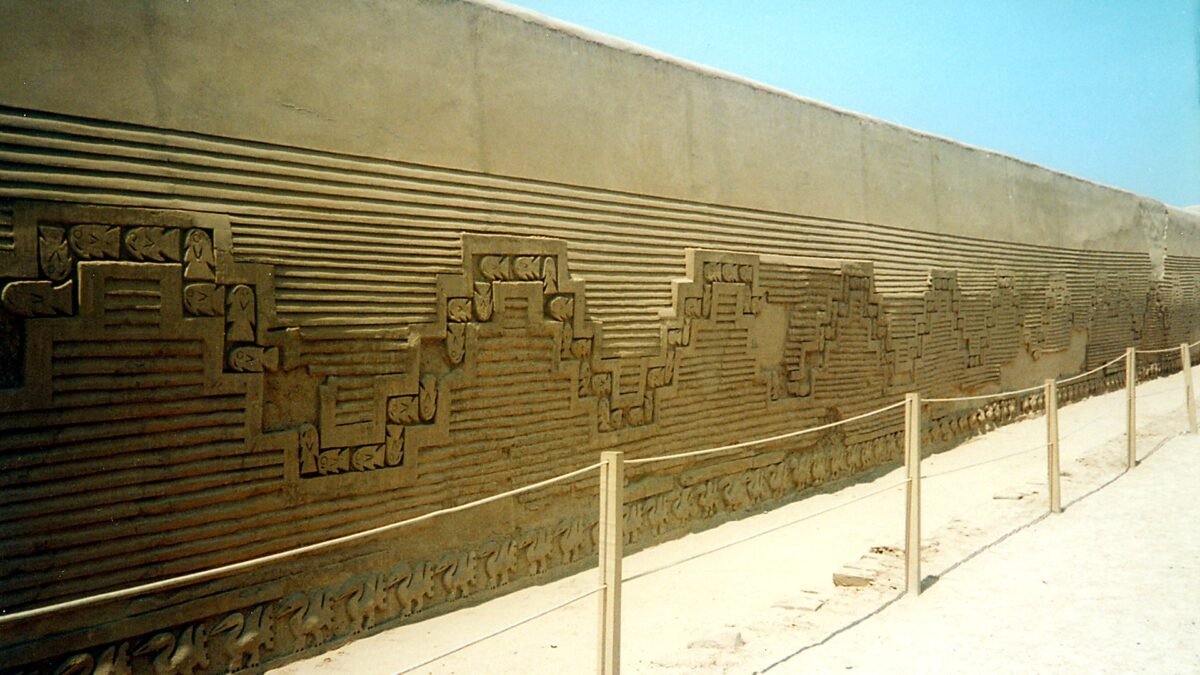
Chan Chan was the capital of the Chimú, a kingdom that flourished on Peru’s northern coast from around 900 AD until the Inca swallowed it in about 1470. It was the largest adobe city in the Americas, a city built of mud brick and water and will, and UNESCO placed it on the World Heritage List in 1986. Its palaces were vast walled compounds, and inside those compounds the Chimú built great funerary platforms for their rulers.
Every one of those platforms, until now, had been robbed. That is the first fact you must hold in your mind, because it is the fact that gives this discovery its meaning. Jorge Meneses, the archaeologist responsible for the excavation, said it plainly: what was known about elite Chimú tombs before this discovery came from funerary platforms that had been looted and destroyed since colonial times, their contexts disturbed, their treasures scattered through collections and museums. The dead had been robbed so often, and for so long, that archaeologists had never once seen a Chimú royal burial as the Chimú themselves had made it.
Now they have. The platform measures some seventeen metres along each side and stands about five metres high. Down a staircase of two and a half metres lies the central chamber, a room just 1.2 metres wide and five metres deep, and beside it two lateral chambers, each a metre and a half wide and eight metres long. In the central chamber lay one individual, and his skull had been painted a deep, blood red.
The paint was cinnabar, a brilliant red mineral of mercury sulphide, sacred across the ancient Andes as a symbol of life force and celestial rebirth. Peru’s Ministry of Culture has said the red pigment was used exclusively in high-ranking burials. Around the central figure lay the wealth of a kingdom: gilded silver headdresses, embossed copper ear ornaments worked with sea birds and deities, necklaces of shell beads, carved wooden boxes with metal appliqués, copper battle axes, gilded spear throwers, engraved wooden shields, and textiles of woven cotton dyed with cochineal and indigo, preserved by the desert air that never lets the damp in. The dry coast of northern Peru had done what no guard could do. It had kept the cloth whole for six hundred years.
Why did this tomb survive when every other was stripped? Because it was sealed beneath a deliberate blanket of stone backfill and compacted clay, and because it was forgotten. The conquistadors came, and the colonial looters, and the modern grave robbers with their shovels and their buyers abroad, and they picked over Chan Chan for five centuries. But this one platform, hidden inside the Utzh An palace, kept its silence. Fortune, for once, favoured the dead.
Three Chambers, Thirty-Eight Souls
Count them with me, because the numbers are the story. Thirty-eight people in all. One in the central chamber, the lord himself, his skull touched with red. A second chamber held twenty more, described in press reports as predominantly young women, buried in ceremonial arrangement with high-status offerings. And in a third chamber, among the remaining dead, lay a vault of military things: copper battle axes, gilded spear throwers, engraved wooden shields, feather-tipped emblems of war.
And then there was the one who would not kneel.
Among the dead in the third chamber, archaeologists found a single skeleton laid out fully extended, flat on its back, in a supine posture. This is not how the Chimú buried their honoured dead. The Chimú dead were buried flexed, folded, seated with the knees drawn up to the chest, in the posture of a child in the womb, as if returning to the beginning of things. To lie stretched out, straight and flat, was a break with everything the burial meant. Peru’s Ministry of Culture, in its statement, raised the possibility that this person had been sacrificed, or that he or she held a social status so different from the others that the rules did not apply.
Meneses himself offered two readings, and the honesty of offering both is worth noting. The extended body may have been an attendant sacrificed to accompany the principal lord into the afterlife. Or it may have been a person of distinct ethnic origin, brought into the court from a conquered land, and buried by a rite that was not the Chimú rite at all. The physical anthropologists are now at work with carbon-14 dating and isotope analysis, reading the chemistry of bone and tooth to learn whether these thirty-eight were locals of the Moche Valley, or subjects carried in from the far territories the Chimú had conquered. The answers will come slowly. The bones do not hurry.
But pause here, reader, and ask yourself the question the archaeologists cannot yet answer. Who were the twenty young women? Who was the one laid out straight? Were they honoured, or were they used? The line between honour and use is the oldest line in the history of power, and it runs straight through this tomb.
History Is a Mirror
This is where history holds up its mirror, and where I ask you to look into it without flinching.
Every empire in the history of the world has buried its kings with a court. The pharaohs took their servants. The emperor of China took his army. The Chimú lord took his thirty-eight. The logic is always the same: power does not end at the grave; it insists on continuing past it. The king who commanded in life commands in death, and the people around him are commanded to follow. We call it burial custom when it is six hundred years old, and we call it by harsher names when it happens in our own century. But the custom is the same, and the mirror does not lie.
And then there is the second mirror, the one held up by the looters. For five hundred years, the Andes were picked clean. The Spanish came for gold and melted down what they could not carry. The colonial treasure hunters came after them. The modern grave robbers, the huaqueros, came with metal detectors and middlemen and buyers in distant cities. The wealth of a continent was dug up, boxed up, and sold, and the dead were left scattered, their names lost, their stories destroyed. That is the fate that awaited this tomb, and it is the fate this tomb escaped by being forgotten.
I think of my own land when I read this story. I think of Seringapatam in 1799, when Tipu Sultan fell and the victors stripped his palace of everything that could be carried, and his famous tiger, that roaring mechanical beast, was shipped to London, where it sits in a museum to this day. The conqueror always robs the dead. It is the final act of conquest: to take not only the land and the throne, but the memory itself, to carry it home as a trophy and hang it on a wall.
So the tomb at Chan Chan survived for a strange reason: it was hidden from the men who would have honoured it least. The earth protected what the living could not. And now, six hundred years later, the living have come back, not with shovels and sacks, but with cameras and brushes, and with a patience the looters never had. That is the difference between archaeology and robbery, and it is a difference worth defending: the archaeologist asks the dead who they were; the robber only asks what they are worth.
The One Who Would Not Kneel
Let me return to the one body that will not leave my mind, because I believe it is the heart of this story. One person, among thirty-eight, laid out straight while all the others were folded. Was he a sacrifice, killed to serve a dead king? Was she a foreigner, buried by a custom no one else in the chamber shared? Was he a person of such rank that even death could not bend him, or of such low rank that he was denied the honoured posture altogether?
We do not know. And perhaps that not-knowing is the point. The dead keep their secrets, and the living must learn to live with unanswered questions. But there is one more fact that changes the shape of the whole mystery. Gabriel Prieto, a professor of anthropology at the University of Florida, told The New York Times that Chimú tombs of this kind were designed to be open. They were not sealed forever. They were meant to be entered, revisited, tended. The dead were not locked away; they were expected to remain part of the living city, to be fed and consulted and remembered.
Think about that. The tomb was a house, not a vault. The thirty-eight were not abandoned; they were installed. The lord and his court were meant to go on presiding, from beneath the floor of the palace, over the city they had ruled. Power, in the Chimú world, did not end at death. It moved downstairs.
And that is why the archaeologists are moving so slowly now. The remains are fragile after centuries of coastal humidity. No bone is lifted until it has been photographed, hundreds of times, from every angle, so that a complete three-dimensional model of the burial can be built before a single thing is moved by hand. The skeletons and their grave goods are being transferred to the conservation laboratory of the Chan Chan Site Museum for stabilisation and study. Excavations will continue through 2027, and the Ministry of Culture plans to publish its full findings in a book. This is how a civilisation treats its dead when it has learned the lessons of the looters: slowly, gently, and in public.
What the Dead Demand of the Living
So what do the dead demand of us, the living? I will tell you what I believe, and you may disagree with me, but hear me out.
They demand that we remember the difference between honour and use. The twenty young women in that second chamber, whoever they were, were placed there by someone else’s decision. The one laid out straight was placed there by someone else’s decision. The lord in the central chamber was placed there by his own power, and by the power of the system that served him. Every burial is a record of who had power and who did not, and this tomb is a record written in bone. To read it honestly, we must ask the uncomfortable questions, and we must let the science answer them, even when the answers are not flattering to the civilisation we admire.
They demand, too, that we protect what remains. The tomb survived by luck, and luck is not a policy. Chan Chan is a city of mud in a desert, and every year the rains and the wind take a little more of it. The platform at Utzh An is the only intact elite funerary platform ever found at the site. There may not be another. What we do with this one, how carefully we study it, how honestly we report it, how fiercely we protect it from the trade in looted antiquities that still runs through the world’s auction houses, that is the test of whether we have learned anything at all from the five hundred years of plunder that came before.
And they demand something of you, reader, something personal. Walk through your own city and look at the graveyards. Look at the old tombs being built over, the names being worn away, the histories being paved flat for another road, another plaza, another tower. Every society chooses, every day, what it will remember and what it will let go. The Chimú chose to carry their dead with them into the future, to keep them in the house. We, in our century, are very good at forgetting, and very quick to call it progress.
Six hundred years from now, what will our age leave in the ground for someone to find? Plastic and concrete and the rust of machines. No gold. No cinnabar. No court of thirty-eight souls waiting in the dark. We build nothing that is meant to last six centuries, and we honour almost nothing that has. The red skull of Chan Chan looks across six hundred years and asks us a question we should be afraid to answer: what have you built that is worth remembering?
The tomb was sealed, and so it survived. Our age seals nothing and preserves less. The dead of Chan Chan were hidden by the earth, and the earth, in the end, was kinder to them than men had been. That is the verdict of this story, and it is not a comfortable one. Empires are not measured by what they conquer. They are measured by what they honour, and by what they refuse to sell. The thirty-eight souls of Utzh An waited six hundred years to be heard. Now that they have spoken, the question is whether we are listening, or whether we are only counting the gold.
Sources & References
The Art Newspaper — “600-year-old funerary platform discovered in Peru”, 18 September 2026 (dimensions of the chambers, Jorge Meneses, Henry Gayoso Rullier, Sinthya Cueva; excavations continuing through 2027).
New York Post — “Researchers uncover 600-year-old burial site in Peru holding 38 bodies”, 12 November 2026 (the fully extended skeleton, the sacrifice hypothesis, the Ministry of Culture statement, the cinnabar pigment, the forthcoming book).
Newstro — “600-Year-Old Burial Mound Packed With 38 Bodies and Ancient Treasures Uncovered in Peru”, 12 November 2026 (chamber layout, grave goods, carbon-14 and isotope analysis, the Ministry of Culture announcement).
Reuters — “Peru unveils remarkably preserved pre-Incan tomb with 38 Chimu individuals”, 8 September 2026 (platform measurements, Culture Minister Alberto Beingolea, first unaltered Chimú elite platform).
The Daily Galaxy — “This Intact Peruvian Tomb Escaped Looters for 600 Years”, 28 October 2026 (cinnabar on the central skull, Jorge Meneses on the sealed chamber).
Peru’s Ministry of Culture (Ministerio de Cultura del Perú) — official announcement of the discovery, 8 September 2026; statement on the extended burial and the sacrifice hypothesis, November 2026.
UNESCO World Heritage Centre — Chan Chan Archaeological Zone, inscribed on the World Heritage List in 1986; the largest adobe city in the Americas.
Featured image: the carved adobe walls of Chan Chan, Peru. Photo: Håkan Svensson, Wikimedia Commons (CC BY-SA 3.0).

About the Author — Abdul Mannan
Related Articles
The Rooster That Still Rattles: What the Boy of Tomis Says to Us After 1,800 Years
In Constanța, Romania, archaeologists opened a sealed Roman sarcophagus and found a child buried with his toys —…
The Floor That Outlived Its Owner: Lessons from a 2,000-Year-Old Mosaic in Türkiye
Archaeologists in Türkiye uncovered a 2,000-year-old mosaic at Kültepe-Kanesh — the first in 78 years of excavation. A…
They Prayed to the God of War on the Edge of an Empire — and the Forest Kept Their Temple
Inches beneath the fallen leaves of a German forest, archaeologists found a temple to Mars — the god…