
The Rooster That Still Rattles: What the Boy of Tomis Says to Us After 1,800 Years

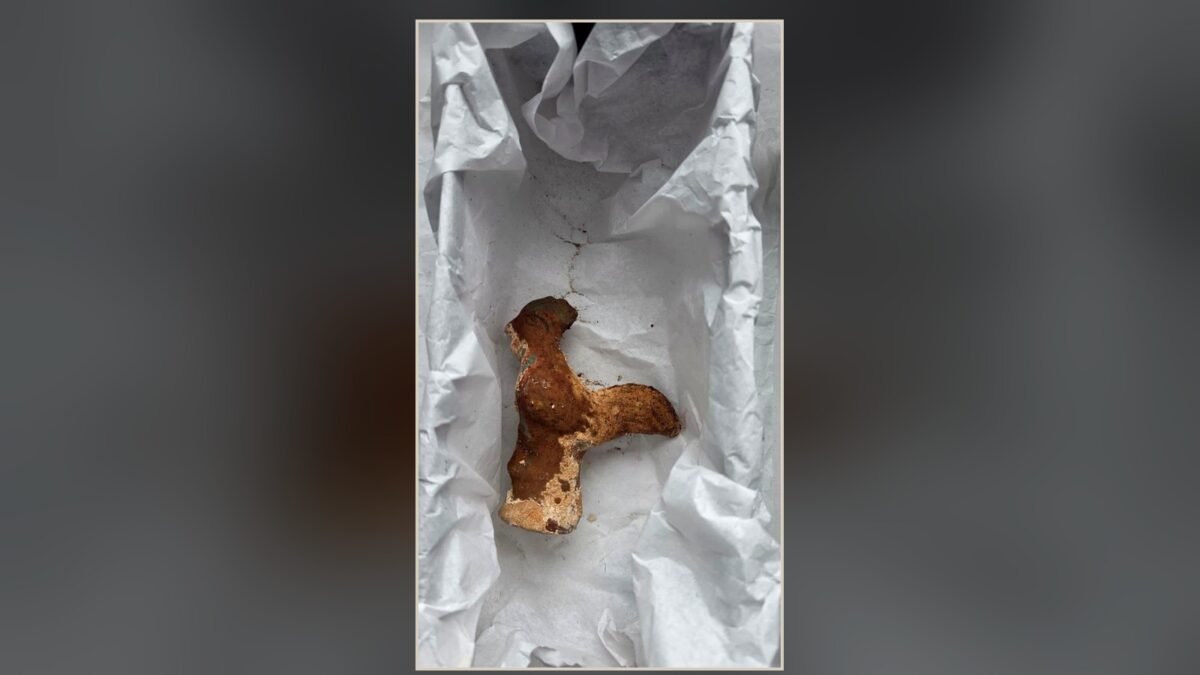
Listen. Can you hear it? A small, dry sound — clay pellets shifting inside a clay bird. It is the sound a child heard eighteen centuries ago, in a house that no longer exists, in a city that has changed its name three times over. And this week, in a museum laboratory in Constanța, on Romania’s Black Sea coast, that sound was heard again.
I have spent my life believing that history speaks in the voice of kings and generals. It does not. History speaks in the voice of a toy. On Tuesday, 27 October 2026, archaeologists from the National History and Archaeology Museum of Constanța — MINAC — lifted the stone lid off a small sarcophagus sealed for some 1,800 years, and inside they found a child, a wooden coffin, flower garlands, a coin, two bronze bracelets, two protective amulets — and two clay toys. One of them was a little rooster. And when the archaeologist Ana Hamat moved it, the rooster rattled.
The museum has given the child a name, because we cannot bear an unnamed child: Băiețelul de la Tomis — the Boy of Tomis. We do not know his real name. We do not know how he died. We know only that someone loved him enough to pack his grave with the things of his short life — and that the earth, for once, kept its promise and gave them back.
A Stone Box Beside the Road to Histria
The sarcophagus came to light on 22 October, during preventive excavations in the Flămânda district of Constanța — rescue archaeology carried out before building work covers whatever lies beneath. The archaeologists Constantin Băjenaru and Cătălin Nopcea first suspected that an intact sarcophagus lay in the ground; it was lifted out and taken to one of the museum’s buildings. The grave stands at the northern edge of the necropolis of ancient Tomis, about a kilometre and a half from the ancient city, close to the old road that ran north to Histria.
When the team gathered to open it on 27 October — an opening broadcast live on social media, watched by thousands — they found the lid held by two lead clamps, the joint sealed with mortar. The stone box is little more than a metre long. Băjenaru told the Romanian news agency AGERPRES that a child’s sarcophagus is something the museum had never had before: small sarcophagi, used for the burial of children, are very rare.
Inside lay a wooden coffin, its panels joined with dovetails, preserved almost intact — “extraordinarily well preserved,” in the words of the museum’s director, Delia Roxana Cornea. The shroud that wrapped the child had survived, and even the child’s hair. The flowers placed with him had survived, folded leaves packed into small bundles shaped like cubes, their species not yet identified. A coin. Two small bronze bracelets, sized for a child’s arms, found beside the body rather than on it. And two bullae, the small amulet pendants Roman children wore around the neck.
The museum dates the burial to the second or third century AD, when Tomis belonged to the Roman Empire. A press conference followed on 28 October, and the discovery has travelled the world since — reels, photographs, headlines. A child. His toys. A rattle that still rattles.
The Poet’s City
But reader, do you know what city this is? Tomis is the city where Rome sent its greatest poet to die.
In 8 CE, the emperor Augustus banished Publius Ovidius Naso — Ovid, the author of the Metamorphoses — to Tomis, a half-Greek, half-barbarian port on the extreme edge of the empire. The reasons were never fully known; Ovid himself spoke only of a poem and a mistake, a carmen et error. He pleaded for nine years in verse — the Tristia, the Sorrows — and neither Augustus nor his successor Tiberius relented. Ovid died in exile at Tomis in 17 CE, and was buried in that foreign earth.
Hold that thought beside the child’s grave. The same ground that swallowed the poet’s pleas now gives up a child’s toys. Ovid wrote of winter and barbarians and loneliness in Tomis; and two hundred years after his death, in that same city, a family buried a little boy with a clay rooster and a horse on wheels — and the empire, which could move legions and build roads and exile poets, could not save him either.
This is how history works, and this is why I write of it as a mirror. Empires remember their poets and forget their children. Rome remembered Ovid because he wrote books; it forgot the Boy of Tomis because he only played with a rattle. And yet, eighteen centuries later, which of the two has just spoken to the whole world? The poet’s verses survive in libraries. The child’s rattle survived in the dark — and when it sounded again this week, millions of people stopped scrolling and listened.
The Toys Tell the Truth the Stones Cannot
Look closely at what the parents placed beside their child, for a grave is a confession. They did not bury gold. They did not bury weapons or jewels or the insignia of rank. They buried childhood itself.
The two bullae are the most eloquent objects in the grave. A bulla was a small amulet worn around the neck of a Roman child — at first only by the children of patricians, and later by all children of free birth. It spoke of protection, and it spoke of citizenship: as Ana Hamat told the Romanian press, the bulla marked the child as a citizen of the city.
The bracelets tell the same story in a quieter voice. They were found beside the body, not on the arms. Perhaps they were his in life; perhaps they were bought new for the burial, because a parent who has lost a child will buy anything, will do anything, to make the last bed beautiful. The coin, too — the kind of coin Romans placed with the dead, for the ferryman, for the road ahead. They were sending their child on a journey, and they packed for it the way any parent packs for a journey: with money for the road, and with something to play with when he arrived.
And the toys themselves — a small horse on wheels, one wheel now detached, and the rooster, its painted eyes and eyebrows still visible after eighteen centuries. The rattle changed the archaeologists’ thinking about the child’s age. The first estimates, based on the size of the sarcophagus, put him at four or five; then the rattle made them think younger, perhaps two to four. “When we brought out the rattle pieces, we realized that this is a very small child,” Hamat said. The exact age will wait for the anthropological study. But the toys have already told us what matters: this was a child still young enough to shake a rattle.
Do not mistake this grave for an exception. In the Roman world, death was a phenomenon of childhood as much as of old age. Demographic historians estimate that perhaps half of Roman subjects died by the age of ten, and that around a quarter to a third of infants did not survive their first year. Think of that number the next time you read of Roman glory — the aqueducts, the laws, the legions. Half of all children never saw their tenth birthday. The Boy of Tomis is not an anomaly of history. He is its rule, made visible at last.
What the Earth Kept — and What It Took
There is a second story here, and it is the story of the earth itself. Why did this burial survive when ten thousand others crumbled to dust? The lead clamps and the mortar seal helped, but the museum’s team suspects something more: a process resembling mummification, perhaps a resin that helped preserve the textiles and the wood. The flowers, when analysed, may even reveal the season in which the child was buried — spring or autumn, eighteen centuries ago, told by a leaf.
That is the honest beauty of archaeology: it does not pretend to know. The museum’s director described the first inventory as only what could be seen “at first sight.” Deeper analyses will follow — the teeth and bones, and DNA analysis if the biological material allows. The cause of death is not known. The child’s sex is not established; the bullae suggest a boy, but the team is careful, and careful is right. The grave sits near other burials the team has excavated, and Băjenaru believes the area was very probably assigned to an important family. But all of this — the family, the status, the season, the cause — is still to be proven. The earth kept the toys and took the answers.
And yet, consider what the earth kept. Somewhere in Siberia, archaeologists found a 4,000-year-old rattle that still rattles. Toys, it seems, outlast empires. But a parent’s gift to a dead child — a small clay bird with pellets inside — survives. There is a lesson in that, if we are willing to learn it.
Why a Rattle Crossed Eighteen Centuries to Reach Us
So I ask you, reader — you who believe the past is silent — what did you hear this week?
A clay rooster rattled in a museum in Constanța, and the sound crossed eighteen centuries to reach your ears. It crossed the fall of Rome, the invasions, the empires and the wars that washed over the Black Sea coast. And when the stone lid came off, the rattle was still there, still holding its small sound, as though it had only been waiting for someone to pick it up.
This is the verdict history delivers, and it is a verdict against all our pride. We measure civilisations by their armies and their monuments, by the length of their roads and the height of their walls. But the thing that survives is not the wall. The thing that survives is the toy. The thing that survives is the love of a mother and a father who, having lost everything, still took the trouble to place a little horse and a little rooster beside their child, so that he would not be alone on whatever road lay ahead. That is the whole of human history, compressed into a stone box a metre long: we loved, we lost, and we refused to let go empty-handed.
That is why the rattle crossed eighteen centuries. Not to teach us about Rome. Not to fill a museum case. But to remind us — you and me, here, now — that every age believes itself permanent, and every age is wrong; that empires are dust and only love is durable; and that the smallest sound in the world, a child’s toy shaking in the dark, can outlast the loudest empire that ever marched. Listen to it. And remember him.
Sources & References
- Bytes Europe — “A Sealed Roman Sarcophagus in Romania Held a Child’s Clay Rooster That Still Rattles” (30 October 2026)
- Bytes Europe — “Archaeologists Open a Sealed Roman Child’s Sarcophagus in Romania, and the Toys Were Still Inside” (30 October 2026)
- Arkeonews — “1,800-Year-Old Roman Child’s Sarcophagus Found Intact with Toys Inside” (29 October 2026)
- Ancientist — “1,800-Year-Old Roman Child’s Sarcophagus Found Intact with Toys in Romania” (29 October 2026)
- Encyclopaedia Britannica — “Ovid” (banishment to Tomis in 8 CE; death in exile in 17 CE)
- Wikipedia — “Demography of the Roman Empire” (perhaps half of Roman subjects died by the age of 10)
- William Smith, A Dictionary of Greek and Roman Antiquities (John Murray, London, 1875), entry “Bulla”, via LacusCurtius
- Muzeul de Istorie Națională și Arheologie Constanța (MINAC) — press announcement, 27 October 2026, via AGERPRES, Antena 3 CNN, Europa FM, Ziua de Constanța and Radio România Constanța
Featured image: The clay rooster-shaped rattle recovered from the Roman child’s sarcophagus at Tomis, Constanța. Photo: Muzeul de Istorie Națională și Arheologie Constanța (MINAC).

About the Author — Abdul Mannan
Related Articles
The Floor That Outlived Its Owner: Lessons from a 2,000-Year-Old Mosaic in Türkiye
Archaeologists in Türkiye uncovered a 2,000-year-old mosaic at Kültepe-Kanesh — the first in 78 years of excavation. A…
They Prayed to the God of War on the Edge of an Empire — and the Forest Kept Their Temple
Inches beneath the fallen leaves of a German forest, archaeologists found a temple to Mars — the god…
The City That Chose Fire Over Chains: Paris’s Rediscovered Celtic Fort and the Price of Freedom
Beneath a Paris hospital courtyard, archaeologists have uncovered the fire-scarred wall of Lutetia — the Celtic town its…