
Iran Launches Second Drone Attack in Three Days on US Base in Bahrain as Hormuz Standoff Deepens

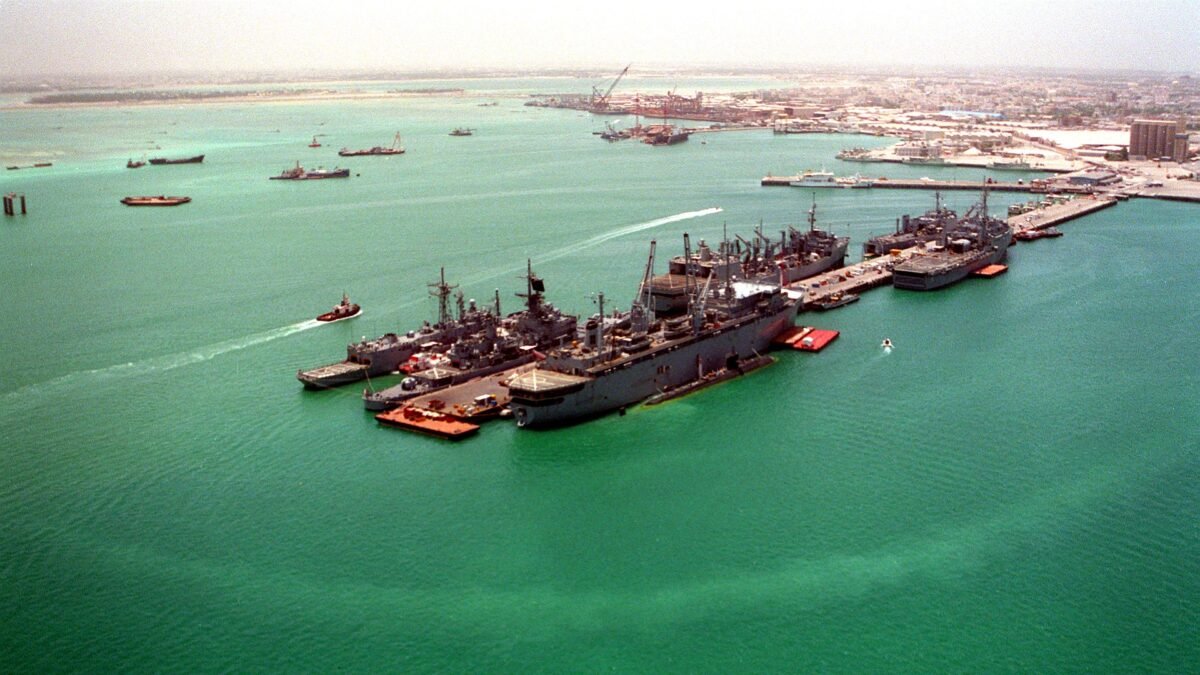
Iran launched a drone attack against a United States military base in Bahrain early on Sunday, its second strike on the Gulf kingdom in three days, as the confrontation between Washington and Tehran over the Strait of Hormuz deepened and diplomatic efforts to end the eight-month war appeared to stall.
According to the BBC, Iran’s Islamic Revolutionary Guard Corps (IRGC) said its Aerospace Force sent six drones against a US air defence radar facility at the Al-Riffa helicopter base in Bahrain. Bahrain’s military said its air defences intercepted and destroyed the incoming attacks “before they could achieve their objectives”, and no damage or casualties had been confirmed by either side at the time of reporting.
The attack came two days after the IRGC claimed it had destroyed a US early-warning radar in Bahrain on Friday, a claim the US military rejected, saying it had shot down two Iranian drones with no injuries or damage. Sunday’s episode therefore does not stand alone. It is the second round of a pattern that is now unmistakable: Iran is striking, or claiming to strike, at American military installations in the Gulf, and the Gulf states that host those installations are being pulled into a war they did not choose.
What remains unresolved, and what matters most, is the gap between what Iran claims and what anyone can independently confirm. The IRGC says it targeted the radar. Bahrain says the drones never reached their targets. The US military, which spoke promptly on Friday, had not publicly commented on Sunday’s claim at the time of reporting, according to Al Jazeera. In that silence, and in that gap, the risk of miscalculation grows with every new round.
What Happened in the Early Hours of Sunday
Explosions were heard over Bahrain at about 4:00 a.m. local time, or 0100 GMT, according to an AFP journalist in the kingdom, and residents reported a second series of blasts at about 6:30 a.m., or 0330 GMT. Air-raid sirens sounded across the island as the attacks unfolded, and Bahrain’s Interior Ministry issued two public-safety alerts within about three hours, telling citizens and residents to remain calm and to proceed to the nearest safe location.
The ministry’s warnings were the first of their kind in weeks, and the interceptions they accompanied were the first carried out by Bahrain’s own air defences since September, according to multiple reports. For a small kingdom of fewer than two million people, much of it densely built around the capital, Manama, the sound of explosions before dawn and the sight of sirens were a reminder that a war fought largely at sea and in the air is now arriving over Bahraini rooftops.
Within hours, the IRGC issued its account. In a statement carried by Iranian state broadcaster IRIB and posted on Telegram, the Guards said: “The US air defence radar system at the Al-Riffa helicopter base in Bahrain was targeted by six drones belonging to the IRGC Aerospace Force.” The statement described the operation as retaliation for what Tehran called “hostile US actions”, and it carried a warning aimed well beyond Bahrain: “The Strait of Hormuz is closed, and any aggression by the American enemy will be met with an even harsher and more forceful response.”
Bahrain’s response was swift and sharply worded. The General Command of the Bahrain Defence Force said in a statement carried by the state-run Bahrain News Agency that its air defence systems had intercepted and destroyed several Iranian aerial attacks, conducted, in its words, with strong resolve and a high level of combat readiness. The statement did not give a detailed breakdown of how many threats were intercepted, nor did it disclose damage or casualty figures, but its message was unambiguous: the attacks had been stopped before they reached their intended targets.
The Foreign Ministry went further, turning the episode into a matter of national principle. “The Kingdom of Bahrain condemns in the strongest terms the continued brutal Iranian attacks on its territory and holds Iran fully responsible for their consequences,” the ministry said, according to the BBC. In a separate statement carried by regional news agencies, the ministry said Bahrain “rejects turning its territory into an arena for settling scores” and held Iran responsible for the attacks and their consequences.
That language matters. Bahrain is not a party to the war between the United States and Iran in any formal sense, yet it hosts the headquarters of the US Navy’s Fifth Fleet and the American naval base at Mina Salman, and its territory is now being used as the ground on which the two sides test each other. Manama’s complaint is that it is being made to absorb the risks of a conflict it cannot control, and its public statements on Sunday were as much a message to Washington and Tehran as they were to its own citizens.
Friday’s Disputed First Strike
Sunday’s attack cannot be understood without Friday’s, because the two are now a sequence, and the dispute over the first shapes how the second will be judged. On Friday 13 November, the IRGC said it had targeted and destroyed a US early-warning radar system in Bahrain, describing the operation as retaliation for an American strike on a telecommunications tower in Sirik, a port in Iran’s southern Hormozgan province near the Strait of Hormuz.
The US military’s Central Command, which oversees American operations across the region, answered within hours, and answered flatly. “The IRGC launched two one-way attack drones toward Bahrain and both were shot down by US forces. There were no injuries or damage,” Central Command said in a statement on X, according to reports by Anadolu and the BBC. Bahrain said separately that it had intercepted two drones that day.
The disagreement was not about whether an attack had been attempted. Central Command’s statement acknowledged that Iranian drones had been launched toward Bahrain. The disagreement was about the result: Tehran claimed a radar destroyed; Washington said the drones were shot down and nothing was damaged. No independent evidence has been published that resolves the question, and neither side has produced imagery or wreckage that would settle it.
Friday’s episode was also significant for what it represented. According to Reuters, as cited by Al Jazeera, it was the first such claim against a Gulf country since early September, breaking a lull in direct attacks on Gulf territory that had held for about two months. That lull ended on Friday, and it ended again, more loudly, on Sunday.
The pattern of the two claims also tells its own story. On Friday, Iran said it had destroyed a radar; on Sunday, it said six drones had targeted a radar, a larger number than the two Central Command said it intercepted on Friday. The escalation in the claimed numbers, from two drones to six, and the shift from a claim of destruction to a claim of a targeted strike, suggest a campaign that is being deliberately stepped up, even if the physical effects remain unverified.
The Claims Neither Side Has Proved
Any honest account of Sunday’s events must begin with what is not known. No American or Bahraini authority had confirmed by the time of reporting that the Al-Riffa installation was struck, and no independent source had confirmed that the radar was damaged. Equally, no authority has produced public evidence that every drone was intercepted, and the explosions heard across Bahrain in the early hours of Sunday were real enough to wake residents and trigger sirens, whatever their cause.
This is the fog that now surrounds the Gulf. Iran announces its operations through state media and Telegram, claiming results it does not document. The United States and its Gulf partners announce interceptions, and they too rarely publish the evidence that would let outsiders judge the claims. Journalists in Bahrain can report the sound of explosions and the sight of sirens; they cannot see what happened at a military radar installation in the dark.
The distinction between an attempted strike and a confirmed hit is not a technicality. It is the difference between a symbolic act and a military success, and it shapes everything that follows. If Iran’s drones were in fact intercepted, as Bahrain says, then Sunday was a demonstration of capability and intent that failed in its physical objective. If a radar was in fact hit, as Iran has claimed in the past without proof, then the United States has suffered a direct blow to its defences in the Gulf, and the pressure for retaliation would be far greater.
The record so far favours caution. On Friday, the American account was specific and prompt: two drones, both shot down, no injuries, no damage. That specificity, and the fact that Bahrain’s own account matched it, gives the interception version of events a credibility that Tehran’s unillustrated claims of destruction have not earned. But credibility is not proof, and the absence of a US statement on Sunday leaves the latest round more open to doubt than the last one.
There is also a wider pattern of competing claims that should make readers wary of any single version. Outlets of uneven reliability have carried accounts of the Sunday attacks that go well beyond what the BBC, AFP, Reuters and Al Jazeera reported, including claims of missile strikes and structural damage that no reputable source has corroborated. This article does not repeat those claims, because they have not been verified. In a conflict where every side has an interest in shaping the story, the disciplined course is to report what the established outlets and the official statements actually say, and to mark clearly where they stop.
Why Bahrain
To understand why Iran is striking at Bahrain, it is necessary to understand what Bahrain is. The kingdom is a small archipelago in the Gulf, connected by a causeway to Saudi Arabia, and it is home to Naval Support Activity Bahrain, the headquarters of the US Navy’s Fifth Fleet and the largest American naval presence in the region. The Fifth Fleet’s area of responsibility covers the Gulf, the Gulf of Oman, the Red Sea and parts of the Indian Ocean, and its ships and aircraft are the instruments of the American naval blockade of Iranian ports and the American escort of oil tankers through the Strait of Hormuz.
That makes Bahrain, in Iranian eyes, not a bystander but a platform. The radars, airfields and ports that Iran is targeting are the infrastructure of the American military campaign, and striking at them is a way of imposing a cost on the United States without striking at American soil or at the American fleet at sea. It is also a way of sending a message to the Gulf states themselves: hosting American forces carries a price, and the price is now being collected in explosions over Manama.
Bahrain’s own position is unenviable. It is a close American ally and a member of the Gulf Cooperation Council, and it depends on the United States for its security. At the same time, it is a small state with a large Shia population, a history of sectarian tension, and a geography that places it within easy reach of Iranian drones and missiles. Its government has spent decades balancing those realities, and the events of the past three days have made that balance harder to hold.
The kingdom’s public language on Sunday reflected that strain. By condemning the attacks “in the strongest terms” and by insisting that its territory must not become “an arena for settling scores”, Manama was speaking to two audiences at once: to Tehran, to say that it will not accept being treated as a battlefield; and to Washington, to say that the American presence on its soil is creating dangers that Bahrain itself must live with. The complaint is not new. Gulf states have been making it, in different forms, since the war began. What is new is that the complaint is now being made after explosions over their own capital.
Nor is Bahrain alone in its exposure. The 14 November session of the United Nations Security Council, reported by NEXA, heard Gulf states demand compensation for war damage, and Iran’s deputy ambassador to the United Nations, Gholamhossein Darzi, told the Council that Tehran had “never closed the door to diplomacy” while warning of “an immediate and decisive response” if bombing of Iran resumed. The Gulf states’ presence at that session, and their demand for compensation, was a sign that the costs of the war are spreading beyond its two principal combatants, and that the states caught in the middle are beginning to count them in public.
The Strait of Hormuz at the Centre
Behind the attacks on Bahrain lies the strait. The Strait of Hormuz, the narrow waterway between Iran and Oman through which a large share of the world’s seaborne oil passes, has been the central prize and the central weapon of the war since it began on 28 February 2026, when the United States and Israel launched surprise attacks on Iran.
Iran insists that it should control the strait, and it has been attacking what it calls “unauthorised” traffic through it, while the US military has been providing protection for tankers carrying oil from Gulf Arab states, according to the BBC. The IRGC’s statement on Sunday made the connection explicit, declaring that “the Strait of Hormuz is closed” and threatening a harsher response to any further American action. The claim of closure is a political statement rather than a physical fact: tankers have continued to move through the strait under American escort, but the threat of closure, and the attacks that back it, have raised insurance costs, forced rerouting, and kept the world’s energy markets on edge for months.
The war’s history on the strait is a history of deals made and broken. In June, the United States and Iran reached a preliminary agreement to end the war and reopen the strait, but it collapsed within weeks after Iranian attacks on shipping resumed and the United States reinstated a naval blockade of Iranian ports, according to the BBC. The blockade has since become one of the central instruments of American pressure on Tehran, choking the oil revenues on which the Iranian state depends, and one of the central grievances in Iran’s account of the war.
Iranian negotiators have been discussing with mediators a proposal to reopen the strait within two days if the United States meets seven conditions, reportedly including the lifting of the naval blockade and the release of frozen Iranian assets, according to the BBC. The proposal has not been accepted, and the conditions attached to it go to the heart of the American strategy: lifting the blockade would remove the economic pressure that Washington believes is working, and releasing frozen assets would hand Tehran resources it could use to rebuild its military.
The attacks on Bahrain are, in this light, a form of leverage. By striking at the American military infrastructure that enforces the blockade and escorts the tankers, Iran is trying to raise the cost of the American position and to force a negotiation on terms it can accept. The risk is that the same strikes harden the American position instead, convincing Washington that Tehran responds only to pressure, and that the blockade should be tightened rather than lifted.
A Diplomacy That Has Run Out of Road
The political context in Washington has made that risk more acute. On Thursday, President Donald Trump said the United States was no longer interested in a deal to end the war with Iran and ordered Vice-President JD Vance, who had been the administration’s chief negotiator on Iran, to focus his attention on domestic politics instead. NEXA reported the announcement on Saturday, and the BBC confirmed on Sunday that the president had pulled his principal negotiator off the file.
Mr Trump’s message was blunt. Writing on Truth Social, he said: “We don’t need a deal with Iran. Those days have long since passed!” The post came the morning after The Wall Street Journal reported that Mr Vance had been weighing re-engagement with Tehran, including face-to-face talks with a senior Iranian security official, and it was understood to reflect the president’s view that the Iranians were not negotiating in good faith.
The administration’s public case for walking away from talks rests on the argument that the war is already, in effect, won. Secretary of State Marco Rubio told the Federalist Society on Friday that the economic pain the United States was inflicting on Iran was so great that there was no need for military action, because Tehran had been weakened so much. Mr Trump has said repeatedly in recent days that the war is “militarily effectively over”, even as he has kept American forces, in his words, “locked and loaded”.
That confidence sits uneasily with the explosions over Bahrain. A war that is effectively over does not usually produce drone attacks on American bases, and a blockade that is working does not usually provoke its target into striking at the ships and radars that enforce it. The attacks of the past three days suggest that Tehran, whatever its economic distress, retains both the will and the means to fight back, and that it has chosen to do so in a way that tests American defences without yet triggering a full-scale American response.
Whether that calculation holds depends on what happens next. The United States has so far responded to Iranian attacks with interceptions and denials rather than with retaliation, and Central Command’s prompt, specific rebuttal on Friday was itself a form of de-escalation: it denied Tehran a victory to claim, without firing a shot in return. But restraint has its limits, and each new round of attacks narrows the space in which it can be sustained.
Analysis: Why It Matters
The second attack is the story, not the first
A single drone attack can be dismissed as an aberration, a miscalculation, or a one-off act of retaliation. Two attacks in three days cannot. The sequence matters more than either incident on its own, because it shows a decision, not an accident. Iran chose to strike at Bahrain on Friday, and having done so, it chose to strike again on Sunday, with more drones and against a named American installation. That is a campaign, however small in scale, and campaigns have a logic of their own: each round raises the stakes for the next, and each round makes it harder for either side to step back without appearing to concede.
The timing is also significant. The Sunday attack came two days after President Trump declared that the United States no longer wanted a deal with Iran and removed his chief negotiator from the file. It is impossible to know whether Tehran timed its second strike as a direct answer to that announcement, but the sequence is suggestive, and it is consistent with the pattern of the war so far, in which military action and diplomatic signalling have been closely intertwined. If the attacks are indeed Iran’s answer to the collapse of diplomacy, then the answer is that the war will continue, and that it will be fought in the Gulf states as well as on the high seas.
A claim is not a hit, and the gap is the danger
The most important fact about Sunday’s attack may be the one that is hardest to establish: what actually happened at the Al-Riffa base. Iran says it targeted the radar. Bahrain says the drones were intercepted. The United States has not yet spoken. In the absence of independent evidence, the truth is unknowable, and that unknowability is itself a source of danger.
Wars are fought as much in the realm of perception as in the realm of physical damage. If Tehran believes, or can persuade its domestic audience to believe, that it has struck a blow against American defences, it may feel emboldened to strike again, and harder. If Washington believes, or can persuade its domestic audience to believe, that its defences held, it may feel that restraint is costless, and that it can afford to absorb further attacks without responding. Both beliefs can be wrong at the same time, and both can lead their holders toward a miscalculation that neither intended.
The Friday precedent offers a small measure of reassurance. Central Command’s response was prompt, specific and matched by Bahrain’s own account, and it denied Tehran the victory it claimed. But the absence of a comparable American statement on Sunday, at least at the time of reporting, leaves the latest round more ambiguous, and ambiguity in wartime is a combustible material. The sooner the United States speaks, with the same specificity it showed on Friday, the smaller the space for misunderstanding will be.
Bahrain is the message
Iran could have chosen many targets. It chose Bahrain, twice, in three days. The choice is deliberate, and its meaning is worth spelling out. Bahrain is small, it is close, and it is home to the headquarters of the Fifth Fleet. Striking at Bahrain is a way of striking at the United States while striking at a state that cannot easily strike back, and it is a way of reminding every Gulf monarchy that hosts American forces that the American umbrella does not cover them from Iranian drones.
The message is also aimed at the Gulf states’ own publics. Bahrain has a large Shia population and a history of sectarian tension, and the sound of explosions over Manama will be heard differently by different communities. For some, it will be a reminder of the dangers of the American alliance. For others, it will be a reminder of the dangers of Iranian aggression. Either way, it puts pressure on a government that has spent decades trying to avoid exactly this choice, and it does so at a moment when the government’s room for manoeuvre is already narrow.
Manama’s response, with its insistence that Bahrain must not become “an arena for settling scores”, is an attempt to reclaim some agency in a conflict that treats its territory as a chessboard. Whether that attempt succeeds will depend on whether Washington and Tehran are willing to hear it, and on whether the Gulf states can act together, as they did at the Security Council, to demand that the costs of the war be recognised and, eventually, compensated.
The strait is the leverage, and it is also the trap
Every element of this war runs through the Strait of Hormuz, and the attacks on Bahrain are no exception. Iran’s leverage is the strait itself: its ability to threaten, disrupt and occasionally close the waterway through which the world’s oil flows gives it a weapon that no amount of American air power can entirely neutralise. The declaration that the strait is closed, repeated in the IRGC’s statement on Sunday, is a reminder of that leverage, and a threat to use it.
But the strait is also a trap for Iran. Closing it, or even appearing to close it, harms Iran’s own oil exports as much as anyone else’s, and it invites the international condemnation and the military response that Tehran has so far sought to avoid. The June agreement, which briefly promised to reopen the strait and end the war, collapsed precisely because neither side could accept the other’s conditions for reopening it, and the seven conditions Iran is now said to be demanding, including the lifting of the blockade and the release of frozen assets, are conditions that Washington has no incentive to accept while it believes the blockade is working.
The attacks on Bahrain can be read as an attempt to break that deadlock by force, to raise the cost of the blockade until Washington decides that the price of maintaining it exceeds the price of lifting it. The flaw in that strategy is that it may produce the opposite result, convincing Washington that the blockade is the only language Tehran understands, and that it should be tightened rather than relaxed. Leverage that is used too aggressively becomes provocation, and provocation invites the very escalation it was meant to prevent.
Washington’s silence is a decision too
The most closely watched fact in the hours after Sunday’s attack may turn out to be not what Iran claimed, but what the United States did not say. On Friday, Central Command spoke within hours, with numbers, with a result, and with a denial. On Sunday, at the time of reporting, it had not spoken at all. That silence may be a matter of timing, of verification, or of operational caution. It may also be a decision, and if it is, it deserves to be read as one.
Silence can be a form of restraint, a refusal to be drawn into a cycle of claim and counter-claim that would only amplify Tehran’s message. It can also be a form of preparation, the quiet before a response that is being weighed in Washington. And it can be a form of uncertainty, a sign that the United States itself does not yet know what happened at Al-Riffa, and is waiting for its own assessment before it speaks.
Whatever the reason, the silence will not last, and when it ends, the words the United States chooses will matter as much as the actions that follow them. A specific, evidenced account of what was intercepted, as on Friday, would narrow the space for misunderstanding. A vague assurance would leave the field open to Tehran’s version. And a threat of retaliation would open a new chapter in a war that has already lasted eight months, and that neither side has yet found a way to end.
What to Watch Next
- The American account of Sunday. Whether, and how specifically, US Central Command responds to the IRGC’s claim will determine how the attack is understood. A prompt, detailed statement, as on Friday, would support Bahrain’s account of interception. Continued silence would leave Tehran’s version unchallenged.
- Any evidence from Al-Riffa. Satellite imagery, photographs or official statements about the condition of the radar installation would settle the central question of whether the drones reached their target. Neither side has yet produced such evidence.
- A third attack. The pattern of the past three days is two attacks in 72 hours. A third, whether on Bahrain or on another Gulf host of American forces, would confirm that Iran has begun a sustained campaign rather than a pair of retaliatory gestures.
- Bahrain’s next move. Manama has condemned the attacks and demanded that its territory not be used as a battleground. Whether it follows those words with diplomatic action, at the United Nations or within the Gulf Cooperation Council, will show how much pressure the kingdom feels able to apply.
- The Strait of Hormuz. Whether tanker traffic continues under American escort, whether insurance and shipping costs rise further, and whether Iran’s claim that the strait is closed is matched by any new interference with shipping will show whether the attacks on Bahrain are part of a wider escalation at sea.
- The seven conditions. Whether the proposal to reopen the strait, reportedly conditional on lifting the blockade and releasing frozen Iranian assets, advances through mediators, or whether it is abandoned now that President Trump has said the United States wants no deal, will indicate whether any diplomatic path remains open.
- The American response. Whether Washington answers the attacks with interceptions alone, with a public warning, with new sanctions, or with military retaliation will set the terms of the next round, and will show whether the administration’s claim that the war is “effectively over” can survive contact with a adversary that is still shooting.
Sources
- BBC News, “Iran targets US military base in Bahrain with drone attack”, 15 November 2026
- Agence France-Presse via Free Malaysia Today, “Blasts in Bahrain as Iran claims attack on US base”, 15 November 2026
- Reuters via The Jerusalem Post, “US intercepts two Iranian drones as IRGC claims strike on radar in Bahrain”, 15 November 2026
- Zark News (Agence France-Presse), “Blasts and Sirens in Bahrain as Iran Claims Drone Attack on U.S. Radar Base”, 15 November 2026
- CPC News, “Iran Attacks US Military Base In Bahrain”, 15 November 2026
- The Delaware Dispatch, “Iran claims a second drone attack on a U.S. radar in Bahrain; the kingdom says it intercepted the strikes”, 15 November 2026

About the Author — Abdul Mannan
Related Articles
Trump Says US Needs No Deal With Iran and Pulls Vance Off the Talks
President Donald Trump has told Vice President JD Vance to stop leading negotiations with Iran, declaring that the…

Supreme Court to Decide Whether Trump Can Bar Asylum at the Southern Border
The justices will decide whether Proclamation 10888 lawfully shut off asylum at the southern border, and whether lower…

Democrat Jonathan Kreiss-Tomkins Wins Alaska Governor’s Race, Ending 28 Years of Republican Rule
Jonathan Kreiss-Tomkins, 37, won 50.8 per cent of first-choice votes to become Alaska's first Democratic governor since 1998…