
NASA’s Perseverance Finds ‘Ghostly’ Silica Rocks on Mars That Could Preserve Signs of Ancient Life

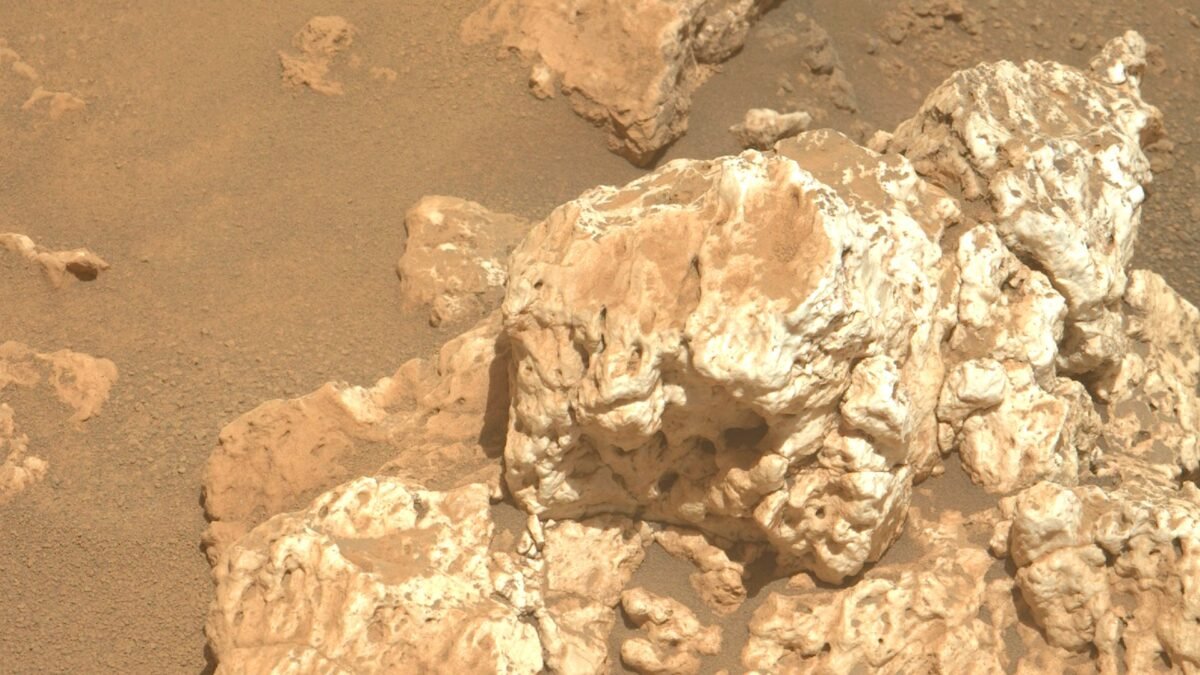
NASA’s Perseverance rover has found a cluster of ghostly pale rocks on Mars that are rich in hydrated silica, a mineral that forms in water and is one of the best materials known for preserving microscopic fossils over billions of years. The discovery, reported by NASA on 16 November 2026, gives the search for ancient life on Mars its most promising new target in years, at a place called Idubi, in a region of ancient crust outside the rover’s landing crater.
According to NASA, the rocks stood out sharply against the darker, dust-covered ground around them. They were brighter even than the igneous and impact rocks the rover team had examined before, and the team suspected at once that they were different from the typical volcanic rock of the area. Newly downlinked data from the rover’s SuperCam instrument has now confirmed that suspicion: the pale rocks are not igneous in origin at all, and instead are rich in hydrated silica.
The find matters because of what hydrated silica is, and what it does. On Earth, the mineral forms in watery settings, including hot springs, groundwater systems and soils, and it has an extraordinary ability to trap and preserve the microscopic remains of living things. NASA’s update, written by research scientist Candice Bedford of Purdue University, poses the question directly: could these pale remnants of an ancient Martian water system hold signs of ancient life?
No such signs have been reported. The update is careful on that point, and so is the science behind it. What Perseverance has found is not evidence of life. It is a lead on where such evidence might be preserved, if it exists at all, and a target large enough to study properly. A detailed close-up investigation of the rocks is already under way, according to NASA, and it is that investigation, not the discovery itself, that will decide how much this find is worth.
What Perseverance Found at Idubi
Idubi is an area of ancient Martian crust exposed in a region known as Lac de Charmes, outside Jezero crater, where Perseverance landed in February 2021. The rover has been working its way through the region as part of a long traverse beyond the crater, and it was there that the team noticed the cluster of eerily bright, light-toned rocks. According to NASA, the fragments stood out sharply against the underlying darker surface, and they were brighter than the igneous and impactite rocks the team had previously investigated in the area.
Brightness alone proves nothing on Mars, where dust, lighting and rock coatings can all mislead the eye. The team therefore directed Perseverance to investigate, and the answer came from SuperCam, the rover’s laser instrument, which can read the chemical makeup of a rock from a distance by firing a laser at it and analysing the light given off. The newly downlinked SuperCam data confirmed that the light-toned rocks are not igneous in origin and are instead rich in hydrated silica, a form of silicon dioxide with water chemically bound inside its mineral structure.
The rover photographed the rocks on 29 October 2026, its 2,023rd Martian day, or sol, on the surface. Its left Mastcam-Z camera took a wide view of the pale cluster against the darker ground, while the SHERLOC WATSON camera captured a close-up of the rock surface the same day. The close-up shows a pitted, almost frothy white surface, dusted with the rust-coloured sand of Mars, and it is that texture, as much as the colour, that marks the rocks out from everything around them.
Hydrated silica can form in many aqueous environments on Earth, according to NASA, including hydrothermal, pedogenic and groundwater systems. That range matters, because it means the rocks at Idubi record water, but not yet which kind of water. A hot spring, a slow-moving groundwater system and a soil formed under rain would all leave hydrated silica behind, and each would say something different about the Mars of long ago. Sorting out which one made these rocks is now the job of the close-up science campaign that NASA says is already under way.
Why Hydrated Silica Matters
To understand why a pale rock on Mars has excited scientists, it helps to start on Earth, where hydrated silica is one of the great preservers of the deep past. When silica-rich water cools or evaporates, it deposits a glassy mineral, often called opal, that can entomb whatever it touches. Microbes living in a hot spring can be sealed inside silica within days, and their shapes can survive, recognisable, for hundreds of millions of years.
The most famous example is the Rhynie chert of Scotland, a deposit of silica laid down around 407 million years ago in a hot-spring system, which preserves early land plants and the tiny animals that lived among them in extraordinary detail. Cells, spores and delicate tissues that would normally rot away are still visible under a microscope, because silica replaced them and held their shape. It is, in the words of NASA’s update, a mineral of immense astrobiological value, precisely because of this remarkable capacity to preserve microfossils.
That is the hope at Idubi. If the silica-rich rocks there formed in water that once supported microbial life, and if that life left any trace in the rock, hydrated silica is among the few Martian minerals that could still hold it after billions of years. The rocks are not evidence of life, and no one on the mission team is claiming otherwise. But they are the kind of rock in which evidence of life, if it ever existed on Mars, would have the best chance of surviving.
There is a second reason the mineral matters. Hydrated silica is a direct record of water itself. Mars is a dry world today, with most of its water locked in polar ice or buried underground, but the rocks of its ancient crust record a time when liquid water shaped the surface. A deposit of hydrated silica is evidence that water was present, moving and chemically active at that spot, and the details of its chemistry can tell scientists how hot the water was, how long it stayed, and whether the conditions were ones in which life as we know it could have survived. Each of those questions is a step towards answering the larger one, which is whether Mars was ever habitable at all.
A Second Chance After the Jezero Rim
This is not the first time Perseverance has found silica-rich rock. Earlier in the mission, the rover came across silica-rich material on the inner rim of Jezero crater, but those deposits were too small for the rover to use its close-range instruments on them. Without the high-resolution chemical and mineral data that only the arm instruments can gather, the team could not work out how the rocks had formed, or how well they might preserve signs of past life. The find was noted, and the rover moved on.
The rocks at Idubi are different in one crucial respect: scale. According to NASA, they offer a much more promising scale for study, large enough for the rover to deploy its robotic arm instruments and examine them at close range. That is what turns a sighting into an investigation. A rock that can be approached, photographed at centimetre scale and analysed grain by grain can answer questions that a distant outcrop cannot, and it is the size of the Idubi rocks, as much as their composition, that makes them worth the rover’s time.
The history of silica on Mars goes back further still. In 2007, NASA’s Spirit rover found opaline silica at a site called Home Plate in Gusev crater, a discovery that at the time was one of the strongest hints that hot-spring activity had once existed on Mars. Spirit’s find was made with a rover that had far fewer instruments than Perseverance, and it could not be followed up in the same detail. The Idubi rocks are the latest chapter in that story, and the first to be found by a rover carrying the tools to study them properly.
That history is also a warning against over-excitement. Silica forms without life, and most silica on Earth has nothing to do with biology. A hot spring can deposit silica whether or not anything lives in it, and groundwater can do the same. The presence of hydrated silica says that water was there. It says nothing, on its own, about whether anything lived in that water. That distinction is the reason the mission team’s language is so careful, and why the coming weeks of close study matter more than the announcement itself.
How the Rover Will Study the Rocks
The detailed proximity science campaign now under way at Idubi will use the instruments on Perseverance’s robotic arm, which can be placed centimetres from a rock face. The SHERLOC instrument, which combines Raman spectroscopy with a camera called WATSON, can map organic molecules and minerals at fine scale, and it is the tool most directly aimed at the question of whether anything lifelike is preserved in the silica. PIXL, an X-ray instrument on the same arm, can map the chemical elements in a rock grain by grain, revealing the fine structure that tells scientists how the rock formed.
SuperCam will continue to contribute from a distance, firing its laser at fresh spots and using its Raman spectrometer to identify minerals. Together, the instruments can build a picture that no single measurement could: the chemistry of the silica, the minerals mixed in with it, the textures visible at close range, and any hint of carbon-rich material that might point to past biology. None of these measurements, on its own, can prove that life existed. Together, they can narrow the possibilities, and that narrowing is the work of the campaign.
One question NASA has not answered is whether Perseverance will collect a sample of the Idubi rocks. The rover has been sealing rock samples in titanium tubes since it landed, building a collection for a future mission to bring to Earth, where laboratories could examine them with instruments far more powerful than anything that can be flown to Mars. A silica-rich rock that might preserve microfossils would be an obvious candidate for that collection. But NASA’s update does not say that a sample will be taken, and the decision will depend on what the close-up study finds, on the rover’s remaining sample tubes, and on the plan for the return mission, which has itself been reworked in recent years. For now, the rocks are a target for study, not yet a target for sampling.
The timing of the find also matters. Perseverance has been driving beyond Jezero crater, and in October it set a record for the longest drive ever made on another world, according to NASA. The rover is now operating in terrain it has never visited before, on ancient crust that predates the crater itself. Idubi is a product of that journey. The rover left the lake bed it was sent to explore, and in doing so it reached rocks that record an older Mars, and possibly a wetter one, than the crater floor ever could.
Analysis: Why It Matters
A rock that is a question, not an answer
The most important thing about the Idubi find is what it is not. It is not the discovery of life on Mars, and it is not even the discovery of the conditions for life. It is the discovery of a rock that could, in principle, hold the evidence that would settle the question, and that distinction is everything. NASA’s update is written in the language of a question, not a claim: could these pale remnants of an ancient Martian water system hold signs of ancient life? The honest answer is that nobody knows yet, and the mission team is not pretending otherwise.
That restraint is a strength, not a weakness. The search for life on Mars has been damaged before by announcements that ran ahead of the evidence, and the Perseverance team has learned to let the rocks speak first. What the team has found is a target worth the rover’s time, and the value of the find will be decided by the measurements made over the coming weeks, not by the headlines written today. A reader who understands that will not be disappointed by what follows, because the follow-up is where the science actually happens.
Size is the story this time
If there is one detail in NASA’s update that deserves more attention than it has received, it is the size of the rocks. The earlier silica deposits on Jezero’s inner rim were scientifically interesting and practically useless, because they were too small for the rover’s arm instruments to study. A rock you cannot touch with your instruments is a rock you cannot understand, and the Jezero rim deposits were left behind for exactly that reason.
The Idubi rocks are large enough to work on, and that changes everything about them. SHERLOC and PIXL need a stable, accessible surface, and they need time. A large outcrop gives them both. It also gives the team choices: different spots on the same rock can be compared, fresh surfaces can be examined alongside weathered ones, and the variation within the deposit can be mapped. Science at this scale is comparative, and comparison needs room. The Idubi rocks have room, and that is why they are the most promising silica target the mission has ever had.
Water, not life, is what has actually been found
It is worth stating plainly, because it is easy to lose in the excitement: what Perseverance has found is evidence of water, not evidence of life. Hydrated silica forms in water, and its presence at Idubi is a record of water moving through rock, long ago, on a planet that is now cold and dry. That alone is a significant result. Every new record of ancient water on Mars adds to the map of where the planet was once wet, and the map of where it was wet is the map of where life could have existed.
But water is necessary for life, not sufficient for it, and Mars has taught scientists that lesson repeatedly. The planet has water ice at its poles, water in its soil, and minerals all over its surface that formed in water, and none of that proves that anything ever lived there. The Idubi rocks add a new dot to the map, and a particularly interesting one, because the mineral involved is a preserver as well as a recorder. Still, the gap between a water-formed rock and a fossil is the whole of the question, and it will not be closed by this announcement.
The rover has left the crater, and that changes the mission
There is a larger story behind the Idubi find, and it is the story of where Perseverance is. The rover was sent to Jezero crater because the crater once held a lake, and the lake’s river delta was the best place to look for signs of ancient life. For more than five years, the mission worked that terrain, climbing the crater rim and sampling the rocks of the delta and the crater floor. Then it left.
The drive beyond Jezero, which set a distance record in October, took the rover onto ancient crust that is older than the crater itself, and Idubi is the first major payoff of that journey. The rocks there do not record a lake. They record water moving through old crust, in a setting that predates the lake by an unknown span of time. That extends the mission’s reach backwards, into an earlier chapter of Martian history, and it shows the value of a rover that can keep going after its first job is done. A mission that stays in its landing site can only answer the questions its landing site poses. A mission that drives on can find questions nobody planned for.
The sample question will decide how far this goes
The most consequential decision still ahead is whether Perseverance will take a sample of the Idubi rocks. The rover’s sample tubes are the mission’s most precious cargo, because they are the only way the rocks of Mars will ever reach an Earth laboratory, where instruments far more capable than anything on the rover can search them for the chemical and structural traces of life. A tube filled with hydrated silica from Idubi would be, on paper, one of the most valuable samples the mission could collect.
But tubes are limited, and the return mission that would fetch them has been through years of redesign and debate. Every sample is a choice against another sample, and the team will want the close-up study to justify the choice before it is made. If the proximity campaign finds textures or chemistry that look biological, or even just unusual, the case for sampling will be strong. If it finds that the silica formed in a setting unlikely to have preserved life, the rover may move on. Either way, the decision will be made on evidence, and it will be one of the most closely watched calls of the mission. The rocks at Idubi have earned their investigation. Whether they earn a tube is the next question.
What to Watch Next
- The proximity science results. The detailed close-up campaign at Idubi is already under way. Watch for NASA updates reporting what SHERLOC and PIXL found in the rocks, and in particular whether any organic material or unusual textures were detected.
- How the silica formed. The key open question is whether the rocks formed in a hot spring, in groundwater, or in soil. Each origin implies different conditions, and the chemistry and texture data should begin to narrow it down.
- Whether a sample is collected. NASA has not said whether Perseverance will take a sample of the Idubi rocks. A decision to fill a tube would signal that the team rates the site highly.
- What the wider traverse finds. Idubi is one stop on a drive through ancient crust outside Jezero. Watch for further reports from the Lac de Charmes region, where other water-formed rocks may be waiting.
- Peer-reviewed publication. Mission updates are not the same as published science. Watch for a paper presenting the Idubi results in full, with the data and the caveats that a short update cannot carry.
- The Mars Sample Return plan. The value of any Idubi sample depends on the mission that would bring it home. Watch for updates on the return architecture, which decides whether the tubes Perseverance has filled will ever reach Earth.
- Claims that go beyond the evidence. A find like this attracts speculation. Treat any claim of fossils or life at Idubi as unverified unless it comes from NASA or a peer-reviewed paper, and remember that the mission team itself has reported no signs of life.
Sources
- NASA Science — Perseverance Update: The Ghostly Rocks of ‘Idubi’ — Bright Remnants of Aqueous Systems from Long Ago
- Around Prague — Mars Rover Finds Ghostly Pale Rocks That Could Preserve Ancient Fossils
- EconoTimes — NASA Finds Hydrated Silica in Bright Rocks Beyond Jezero Crater
- TechBlog News — NASA’s Perseverance Rover Finds Silica-Rich Rocks Outside Mars’ Jezero Crater
- AiSeek — Perseverance Confirms Hydrated-Silica-Rich Rocks
- NJL Design Lab — Daily Positive Signals: A Mars Water Clue, a Child-Safety Classifier, and AI for Science and Care

About the Author — Abdul Mannan
Related Articles

NVIDIA, IBM and Fermilab Launch Quantum Codesign Platform With 13,000x Faster Error-Correction Decoding
NVIDIA, IBM and Fermilab have unveiled a modular quantum computing codesign platform pairing NVIDIA DGX B200 systems with…

Alibaba Unveils Qwen4-Max, Its Largest AI Model Yet, With a 2.4-Trillion-Parameter Design and a 62% Cut in Task Costs
Alibaba has unveiled Qwen4-Max, its new flagship AI model, promising cheaper and longer-running agent work — but the…

Workday Outage Knocks Payroll and Timekeeping Offline After a Disaster-Recovery Test Goes Wrong
A routine disaster-recovery test at Workday connected its backup systems to live production databases on Friday, leaving staff…