
Ukraine Collapses Section of Putin’s Crimea Bridge in Overnight Missile and Drone Strike

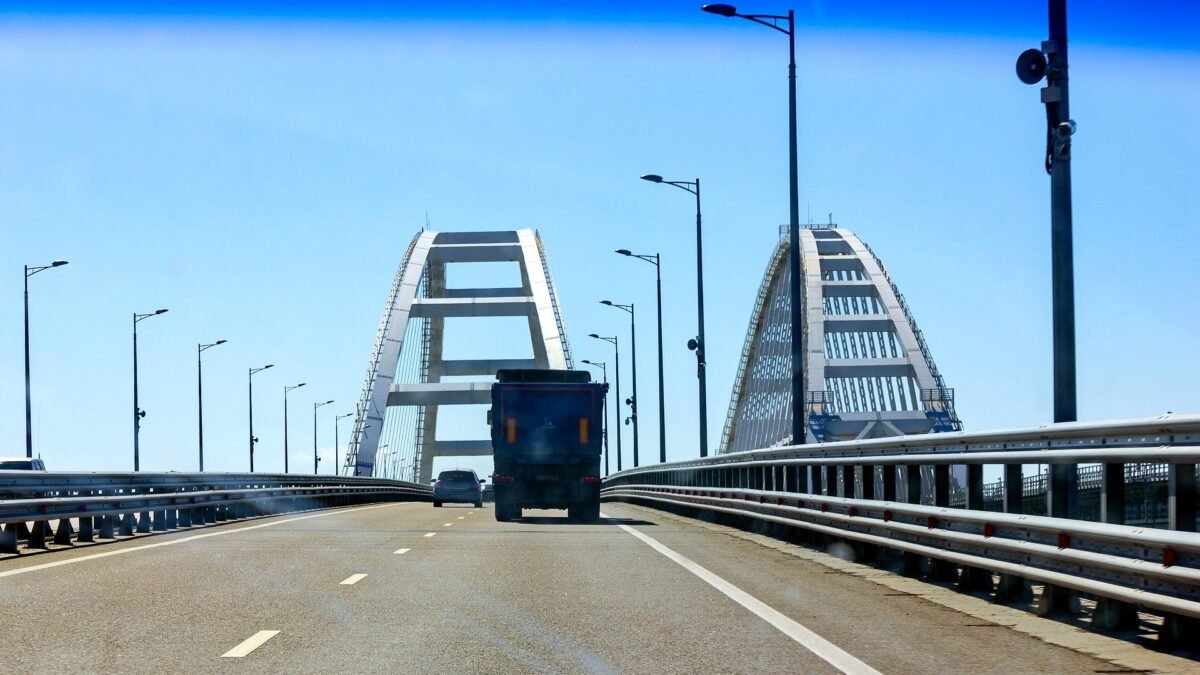
A section of the bridge linking Russia to occupied Crimea collapsed into the Kerch Strait overnight, after Ukrainian missiles and drones struck the crossing for the second night in a row in what President Volodymyr Zelensky described as an “unprecedented operation” weeks in the making.
Images released by Ukrainian officials on Tuesday showed one of the bridge’s great steel arches fallen into the water, with the road span beneath it gone. Ukraine’s Security Service, the SBU, said “one of the metal arches and the road span beneath it were completely destroyed,” and that the railway section of the bridge was also “preliminarily damaged,” according to CNN.
Zelensky said the strike was the seventh stage of an operation carried out over several weeks, and that it was a response to Russian attacks on Ukrainian infrastructure. “Today, at the key stage, the ‘Palianytsia’ drones performed exceptionally well, striking the road section of the bridge, while ‘Neptune’ missiles, ‘Ruta’ drones, and FP-5 drones struck the railway section,” he said in a statement posted on X, according to CNN.
The Crimean Bridge, also known as the Kerch Bridge, is the 19-kilometre road and rail crossing that connects Russia’s Krasnodar region with the Crimean peninsula, which Russia seized and annexed in 2014. It is the longest crossing in Europe, cost an estimated $3.7 billion, and was personally opened by Russian President Vladimir Putin in 2018. According to Russian state media cited by CNN, it was built to handle 40,000 cars a day and move 14 million passengers and 13 million tonnes of cargo a year.
Russia’s transport ministry said traffic across the bridge had been suspended while experts assessed the damage, and that there were no casualties on the bridge itself, according to preliminary information. Sergei Aksyonov, the Russian-installed governor of Crimea, confirmed the attack and the suspension of traffic, and told residents to stay away from the crossing. He said two people had been killed in a Ukrainian drone attack elsewhere in Crimea, in the Lenin district near Kerch, according to Reuters.
Ukraine has attacked the bridge repeatedly since Russia launched its full-scale invasion in February 2022, but the damage reported on Tuesday appeared to be far more severe than in the previous attacks, the BBC reported. CNN, which geolocated videos and images of the damage, said a portion of the road bridge had collapsed into the water, while the parallel rail bridge appeared still to be standing. A fire could also be seen burning on a section of the bridge in one video geolocated by CNN.
The Kremlin moved quickly to play down the blow. Spokesman Dmitry Peskov said the bridge would be rebuilt “even better than before,” according to the Russian state news agency TASS, cited by CNN. Russia’s Investigative Committee confirmed the attack on the bridge, calling it a “terrorist act by Ukrainian armed groups,” and said it had opened a criminal case. Peskov also said Putin had been informed about the attack, according to the business newspaper Business Day, which carried a Reuters report on the strikes.
The strike came two days before Putin is due to meet US President Donald Trump and Chinese leader Xi Jinping in Shenzhen, China, on Thursday, on the sidelines of the Asia-Pacific Economic Cooperation summit. The timing, and the target, were plainly part of the message.
A second night, a different result
The collapse was the culmination of two nights of attacks on the bridge. On Monday night, Ukraine launched what Russia’s defence ministry described as the biggest Ukrainian drone attack of the war, saying its air defences had shot down 1,336 drones across 16 regions. The bridge was struck that night too, but the Kremlin said on Monday that the first attack had caused only minor damage, and the transport ministry said road traffic was only temporarily suspended while rail traffic continued normally.
Tuesday night’s attack was different in kind as well as in scale. According to Reuters, Ukraine struck the bridge for the second time in two days, and it was not immediately clear on Tuesday morning how seriously the bridge had been damaged in the second attack. Within hours, the pictures answered that question. The Times reported that photographs showed the 227-metre central span of the road bridge had collapsed into deep water, with the rubble blocking the shipping channel between the Azov and Black Seas. The SBU shared video apparently filmed by one of its drones flying over the bridge, capturing on camera how the entire span had collapsed into the channel, according to The Times.
The Guardian reported that the fallen span appeared to have blocked the main navigable channel beneath the bridge, which is 120 metres wide and 8.3 metres deep. A Kyiv assessment published on Tuesday put the repair at a year or longer, not months, for a fallen structure weighing some 6,000 tonnes.
Zelensky gave a weapon-by-weapon account of the strike. He said Palianytsia drones struck the road section, Neptune missiles together with Ruta and FP-5 drones struck the railway section, and a Flamingo cruise missile delivered the precision strike. Ukrainian Defence Minister Yevhenii Khmara said the strike had been carried out exclusively with Ukrainian weapons. “It is of fundamental importance: The strike was carried out exclusively with Ukrainian weapons — using our technologies and our solutions,” he said, according to CNN.
Zelensky said the operation had been underway for several weeks, and that Ukrainian forces had first stripped away the air defences, radars and electronic warfare systems guarding the approach to the bridge. The Times reported that the operation was carried out by missile troops and elite drone pilots from the 7th Deep Strike Centre, known as “Magyar’s Birds,” together with the 1st Special Operations Brigade of Unmanned Forces, the SBU, the navy and components of Ukraine’s special operations forces. The Times also reported that the operation proved Ukraine no longer needs to depend on Elon Musk’s Starlink and Starshield networks for strike missions, bypassing recent US restrictions on their use.
Russia’s defence ministry said its air defences had shot down 1,441 Ukrainian drones overnight, surpassing Monday’s figure of 1,336, which had itself set a new record, according to the ministry’s own data cited by Reuters. Both figures are Moscow’s claims, and neither has been independently verified. State news agencies said Russian air defences had repelled the largest Ukrainian drone attack on Russia since the start of the full-scale war in 2022, and that air defence systems had also repelled a massive drone attack on the industrial areas of Ufa and Salavat in Russia’s Bashkortostan region, home to a number of oil refineries, according to Reuters.
The rail question
One part of the picture remained unsettled on Tuesday: the state of the railway section. The SBU said the rail section was “preliminarily damaged.” Ukraine’s General Staff said the arch and a span of the road section had collapsed, but that the rail part of the bridge was still standing, with a damaged arch, according to Business Day. CNN’s geolocation of video from the scene likewise found that the parallel rail bridge appeared still to be standing.
Russia’s transport ministry initially said both road and rail traffic had been suspended. TASS later reported that railway traffic across the bridge had since resumed, according to CNN. Aksyonov said passengers without vehicles could also use a ferry crossing. The BBC reported that the collapse of the arched section cut off the peninsula’s direct road and rail links with Russia, at least until the crossing can be repaired, while a ferry crossing across the Kerch Strait could partly compensate but had limited capacity and was vulnerable to attack.
The ambiguity matters. The road arch is the part that has visibly fallen into the strait. Whether the railway can carry traffic safely, and for how long, will determine whether the strike is a logistical wound or a logistical severance. What is not in doubt is that the road crossing — the part of the bridge most civilians and most military trucks use — is closed, with no timetable for reopening.
Kyiv’s bridges hit the same night
The attack on the Crimean Bridge was one half of a night in which both sides struck the other’s bridges. The Ukrainian capital Kyiv also came under intense bombardment overnight into Tuesday, and two people were killed when Russian forces hit two of the city’s key bridges over the Dnipro River, according to CNN.
“Last night, four ballistic missiles struck the Southern Bridge and three struck the Northern Bridge,” Zelensky said in a separate statement on X, according to CNN. Kyiv’s mayor, Vitali Klitschko, reported that both bridges had been closed. Kyiv is split in half by the Dnipro: the right bank is home to most of the city’s business centres, offices and government institutions, while the left bank is mostly residential. Some 600,000 vehicles as well as trains and Kyiv’s metro cross the two bridges every day, according to CNN.
The strikes on the bridges led to major traffic jams on both the left and right banks, although the scale of the damage was still being clarified, officials said. “Critical infrastructure systems have been damaged, causing disruptions to water and heat supply in some districts,” the city office said, according to CNN. Zelensky also confirmed “significant” power outages in the Dnipro, Kharkiv and Zaporizhzhia regions, saying emergency and repair crews were working to deal with the consequences of the Russian strike on the power grid.
Russia’s military said it had targeted Ukrainian military, transportation, energy and port infrastructure, using drones and ground- and air-based precision-guided weapons, according to CNN. The BBC reported that the damage to the Crimean Bridge appeared far more severe than the damage to Kyiv’s bridges, and that the exchange came a day after Ukraine began its most recent attempt to disable the Crimea crossing.
The pattern is now familiar, and it is escalating. Russia has spent the autumn striking Ukraine’s energy grid and transport links as winter approaches. Ukraine has answered with a campaign against Russian oil refineries and, now, against the most heavily defended structure of the war. Zelensky has said the refinery campaign has knocked out more than half of Russia’s refining capacity, a claim Reuters has said it could not independently verify; industry sources cited last week put the reduction at around 30 percent. Fuel shortages have returned to at least half a dozen Russian regions. The bridge strike is the same campaign, aimed at a different kind of target: not a source of fuel, but the route that fuel and soldiers travel.
A bridge built to make annexation permanent
The Crimean Bridge was never only a piece of infrastructure. Putin made its construction a key priority after Russia’s illegal annexation of the peninsula in 2014, and he personally opened the road section in 2018, driving a truck across it in a ceremony broadcast across Russia. The bridge was intended to render the annexation irreversible: a physical link binding Crimea to the Russian mainland, replacing the ferries that had been the peninsula’s only connection.
Ukraine has targeted it from the start of the full-scale war. In October 2022, a truck bomb exploded on the road bridge, collapsing spans and setting a fuel train on fire. In July 2023, Ukrainian naval drones struck the bridge again, bringing down another span. In June 2025, the SBU said it had detonated underwater explosives at the bridge’s support pillars. Each time, Russia repaired the damage and the bridge reopened. Each time, Ukraine claimed the attack.
What changed on Tuesday is the scale of the destruction. The earlier attacks damaged spans; this one destroyed an arch — the structure that gives the bridge its silhouette and its strength. A span can be replaced in weeks. An arch that has fallen into the strait, blocking the shipping channel beneath it, is a different engineering problem. The Kyiv assessment of a year or longer for repairs may prove optimistic or pessimistic; either way, the bridge will not be carrying traffic normally any time soon.
Ukraine has also stepped up its attacks against Crimea more broadly in the past six months, forcing the Russian-installed authorities to impose a state of emergency over the summer because of widespread power outages and fuel shortages on the heavily militarised peninsula, according to CNN. The bridge strike sits inside that campaign, and it is its most visible success so far.
Two days before Shenzhen
The timing of the attack, on the eve of Putin’s meeting with Trump and Xi in Asia, makes it even more symbolic, according to CNN. The trilateral meeting, on the sidelines of the APEC summit in Shenzhen on Thursday, is the first gathering of the three leaders, and the Kremlin has sought to frame it as a “New Yalta,” in a nod to the 1945 conference at which Soviet leader Joseph Stalin effectively redrew the global map of spheres of influence with the Allied powers. The attack on the bridge makes Yalta, a city in annexed Crimea, effectively inaccessible from mainland Russia, at least until it is repaired, according to CNN.
Trump said on Monday that he expects to discuss the war in Ukraine with his Russian and Chinese counterparts, despite US officials suggesting last week that the topic would not be on the table. “We’ll talk about my favorite subject, Ukraine,” Trump told reporters as he departed the White House, according to CNN. “Ukraine’s losing — Ukraine-Russia is losing 25,000 soldiers a month, so we’ll be talking about that,” he said, without giving any source for that claim. NATO Secretary General Mark Rutte said last week that Russia was losing “more than 40,000 troops — killed or seriously wounded — every month,” according to CNN.
Peskov said the recent attacks by Kyiv could be linked to the upcoming trilateral meeting, according to the Russian state media outlet Vesti cited by CNN, but provided no evidence to support the claim. In October, Zelensky voiced concern that a trilateral meeting between Trump, Xi and Putin might lead to dealmaking about the future of Ukraine without Kyiv being consulted, according to CNN.
The diplomacy around the war has been moving, slowly, in parallel with the fighting. Last week, the first direct talks between Russia and Ukraine in nine months took place in Abu Dhabi, and a prisoner exchange was agreed in principle, though there was no breakthrough on territory. Russia holds around a fifth of Ukraine, and the front line has been largely static. A joint statement by nuclear safety regulators on Monday warned that the risk of a nuclear accident in Ukraine is increasing this winter. Against that background, the bridge strike is a reminder that the war is not waiting for the diplomats.
Analysis: Why It Matters
The arch is the message
Ukraine has hit the Crimean Bridge three times before, and each time Russia repaired it and carried on. The difference this time is not that the bridge was hit, but what was destroyed. A span is a replaceable piece of road. An arch is the structure that holds the bridge up and gives it its identity — the white curve that appears in every photograph of the crossing, and in every piece of Russian propaganda about it. Dropping an arch into the strait does not just close a road. It changes the picture.
That is why Zelensky’s statement dwelt on the weapons and the method, and why the SBU released drone footage of the collapsed span. The strike is meant to be seen. For two years, Ukraine’s attacks on the bridge have been presented as proof that no Russian asset in occupied territory is safe. This one is presented as proof that the asset can be broken, not just bruised. The distinction matters to the soldiers who use the bridge, to the civilians who depend on it, and to the leadership in Moscow that built its claim to Crimea around it.
It also matters to the engineers. A road span that collapses can be lifted out and replaced. An arch that has fallen into a shipping channel must be cleared from the water before anything can be rebuilt, and the channel itself — 120 metres wide and 8.3 metres deep — is now blocked by rubble. The Kyiv estimate of a year or more for repairs may be a wartime exaggeration, but the direction of the estimate is not in doubt: this is a long closure, not a weekend repair.
A bridge war, fought in both directions
The same night that the Kerch Bridge fell, Russian ballistic missiles hit Kyiv’s two main bridges. That symmetry is not a coincidence. Both sides have settled on the same logic: if you cannot win the war on the front line, which has barely moved in months, you attack the infrastructure that sustains the other side’s war effort — and its civilian life.
There is a difference in scale and in effect. The strikes on Kyiv’s bridges killed two people, closed two crossings used by 600,000 vehicles a day, and disrupted water and heat in parts of the capital. The strike on the Kerch Bridge killed no one on the bridge itself, but it severed the main land link to a peninsula that Russia has spent twelve years and billions of dollars binding to itself. One attack disrupts a city’s morning. The other disrupts a strategy.
But the symmetry is real, and it is dangerous. A war fought against bridges is a war fought against the things civilians use every day: the road to work, the train to the shops, the power that heats a flat in November. The winter is coming, and both sides know it. The nuclear safety regulators who warned on Monday that the risk of an accident is increasing this winter were talking about power plants, but the same logic applies to the grid, the water supply and the bridges. The infrastructure war does not pause for the cold. It accelerates into it.
“Exclusively Ukrainian weapons” is a political statement
The most revealing line in the Ukrainian account of the strike was not about the damage. It was Defence Minister Khmara’s insistence that the strike was carried out “exclusively with Ukrainian weapons — using our technologies and our solutions.” That is a sentence aimed at more than one audience.
The first audience is Washington. Ukraine’s long-range strike capability has always depended, in part, on Western systems and Western permission. The recent US restrictions on the use of Starlink and Starshield for strike missions — which Zelensky has publicly complained are operating too slowly — have made that dependence a vulnerability. A strike carried out entirely with Ukrainian-made missiles and drones, guided without American satellite networks, is proof that the dependence is shrinking. The Times reported that the operation proved Ukraine no longer needs to depend on Musk’s networks for strike missions. Whether that is fully true matters less than that Ukraine wants it to be believed.
The second audience is Moscow. A domestically produced Flamingo cruise missile, a Neptune missile, a Palianytsia drone — these are not weapons Russia can stop by pressuring a supplier, because the supplier is Ukraine itself. The message is that the campaign against Russian infrastructure is not something a change of policy in Washington can switch off.
The third audience is Ukrainians. After nearly five years of full-scale war, the ability to build the weapons that strike back is a matter of national pride as well as military necessity. The bridge strike is being presented in Kyiv as a Ukrainian achievement, not an allied one. That framing will matter when the war’s costs are debated at home — and when the next request for Western help is made.
The Shenzhen clock
Nothing about the timing of this strike was accidental. Two days before Putin sits down with Trump and Xi, his showcase project lies in the water. The Kremlin’s framing of the Shenzhen meeting as a “New Yalta” — a conference at which great powers redraw the map — makes the symbolism sharper still. Yalta is in Crimea. The road to Yalta from mainland Russia now runs through a ferry queue, or not at all.
Putin will arrive in Shenzhen with a problem he did not have a week ago. He will be asked, by Trump and by Xi, about a war that his own spokesmen describe as going well — and he will be asked it while the pictures of the collapsed bridge circulate around the world. Peskov’s claim that Kyiv timed the attacks to coincide with the meeting is, in its way, an admission of the point: the strike was designed to be noticed in Shenzhen.
But the timing cuts both ways. A leader embarrassed on the eve of a summit has two options: absorb the blow and negotiate, or escalate to restore the appearance of strength. Russia’s answer on Tuesday night was to strike Kyiv’s bridges. Whether the answer continues — with heavier strikes on Ukrainian cities, or with a new push on the front — will be the first thing to watch after Shenzhen. The bridge strike may have been timed for the summit. Its consequences will be decided after it.
What “completely destroyed” does not yet mean
For all the drama of the pictures, the strategic effect of the strike is still uncertain, and the uncertainty is visible in the reporting itself. The SBU says the rail section is “preliminarily damaged.” Ukraine’s General Staff says the rail part is still standing. CNN’s geolocation agrees. TASS says rail traffic has resumed. The transport ministry said both road and rail were suspended. These accounts cannot all be true at once, and the truth will emerge only when trains either run or do not.
Even if the railway is usable, the bridge’s value as a supply route has been degraded before. Russia has spent the last two years building alternative routes to Crimea — a land corridor through occupied southern Ukraine, and a rail line along the Sea of Azov coast. Those routes exist precisely because the bridge has been attacked before. The bridge’s military importance has declined as its symbolic importance has grown. Destroying the arch hurts the symbol more than it hurts the supply line.
That does not make the strike unimportant. Symbols are what wars are fought over, and the Kerch Bridge is the most potent symbol Russia has in Crimea. But it is worth being precise about what has happened: a road arch has been destroyed, a shipping channel is blocked, a crossing is closed, and a repair will take months at best. What has not happened — yet — is the severing of Crimea from Russia. The ferries still run. The land corridor still exists. The rail line’s status is unclear. The strike is a major blow, and it is also a blow whose full effect will only become clear in the weeks ahead, when the dust settles, the engineers report, and the trains either move or stop.
What to Watch Next
- The engineers’ verdict: Russia’s transport ministry said experts were assessing the damage. The first official assessment of the rail section — and a timetable for any reopening — will settle the most important open question of the strike.
- The shipping channel: The fallen arch and road span are blocking the navigable channel between the Azov and Black Seas. How Russia clears the rubble, and how long the channel stays closed, will affect shipping to the occupied ports of Mariupol and Berdyansk.
- The ferry crossing: Aksyonov said passengers without vehicles could use the ferry. Whether the ferries can absorb the traffic the bridge carried — and whether they themselves become targets — will determine how isolated Crimea feels in the coming weeks.
- Russia’s retaliation: The strikes on Kyiv’s bridges on Tuesday night were the immediate answer. Whether Moscow escalates further, with heavier attacks on Ukrainian cities and energy infrastructure, will show how seriously it took the blow.
- The Shenzhen trilateral: Trump, Putin and Xi meet on Thursday. Watch whether the bridge strike changes the tone of the meeting — and whether Ukraine, which was not invited, is discussed as a subject or as a participant.
- The drone war’s next record: Russia says 1,441 drones were shot down overnight, a new record. The scale of Ukraine’s drone campaign, and Russia’s ability to defend against it, will shape the winter’s fighting.
- Crimea’s winter: The peninsula has already suffered power outages and fuel shortages this year. With its main bridge closed and winter approaching, watch for shortages, price rises and any new state-of-emergency measures from the Russian-installed authorities.
Sources
- CNN — “Ukraine strike collapses section of Putin’s prized bridge to occupied Crimea”
- Reuters — “Russia says Ukraine struck its bridge to Crimea for second day in biggest drone attack of war”
- The Times — “Ukrainian attack partly collapses Putin’s crucial Kerch bridge to Crimea”
- The Wall Street Journal — “Ukrainian Strike Severs Part of Russia’s Crimean Bridge”
- Business Day — “Russia and Ukraine trade bridge attacks amid rising drone strikes”
- Helsinki Times — “Ukraine severely damages Crimean Bridge as Russia strikes Kyiv infrastructure”

About the Author — Abdul Mannan
Related Articles
Third US Aircraft Carrier Reaches the Middle East as Iran War Stalemate Deepens
The USS Theodore Roosevelt has joined two other American carriers in the Middle East, giving President Trump his…
The Bridge Burns Again: Ukraine’s Record Drone Storm and the Shadow of Shenzhen
On the night of 16 November 2026, Ukraine launched the largest drone attack of the war — and…
Russian Strikes Hit Two Kyiv Bridges and Cut Water and Heat as Zelensky Warns of More Attacks
Russian forces struck Kyiv's North and South bridges late on Monday, cutting water and heating in parts of…