
Third US Aircraft Carrier Reaches the Middle East as Iran War Stalemate Deepens

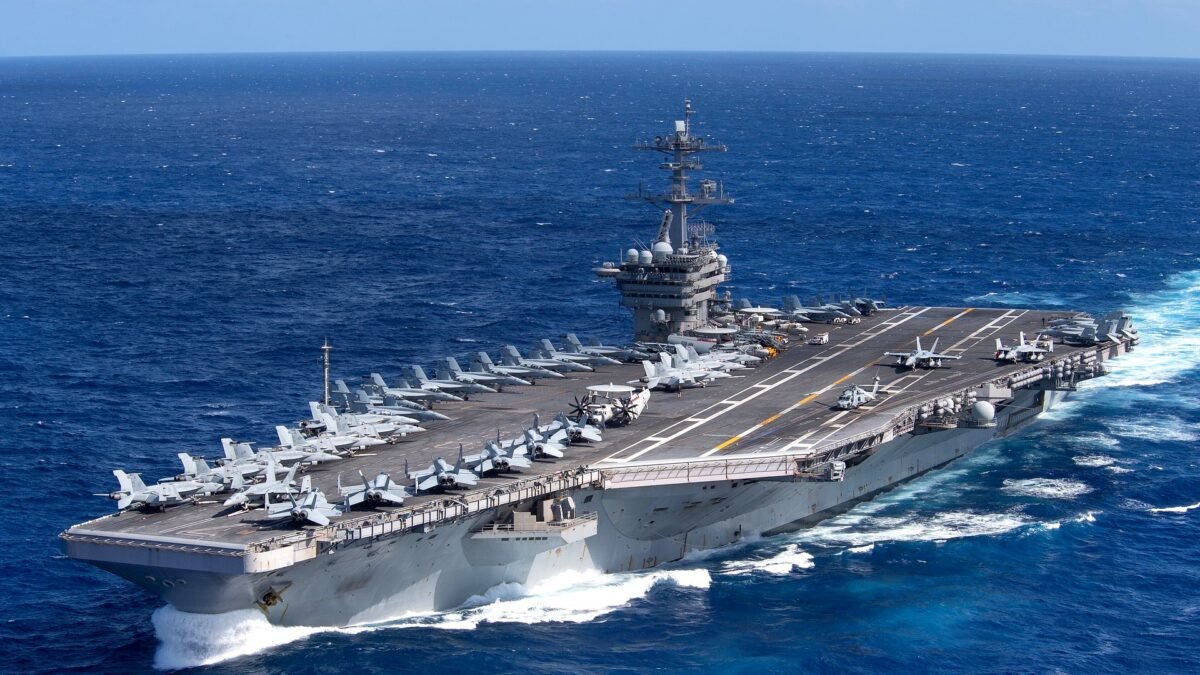
The United States now has three aircraft carrier strike groups in the Middle East, after the nuclear-powered USS Theodore Roosevelt sailed into the region over the weekend, according to a US official who confirmed the arrival to the Associated Press and Al Jazeera on Monday. The deployment gives President Donald Trump the largest concentration of American naval power in the region since the spring, at a moment when the war with Iran is neither advancing toward a settlement nor returning to open fighting.
The Roosevelt crossed into the area of responsibility of US Central Command on Sunday, 15 November, according to USNI News and Al Jazeera, and was confirmed by a US official speaking anonymously on Monday because of the sensitivity of military operations. US Central Command later confirmed the move in a post on X, describing the carrier as operating in its area of responsibility as part of a scheduled deployment.
The ship joins the USS George H.W. Bush, which arrived in April, and the USS George Washington, which arrived toward the end of August. The last time three American carrier strike groups operated together in the Middle East was April 2026, and before that the concentration had not been seen since the invasion of Iraq in 2003, according to the New York Post.
With the Roosevelt in place, the flotilla in the Arabian Sea now includes 13 destroyers, two cruisers and one littoral combat ship in addition to the three carriers, according to the US Navy, with two more destroyers operating in the Red Sea. The build-up, in the words of the Associated Press, expands the military force available to the president as his administration weighs its next steps in a war that is now more than eight months old.
What the deployment includes
The Theodore Roosevelt, commissioned in 1986, carries more than 5,000 personnel and an air wing of more than 60 aircraft, including F/A-18 strike fighters, according to TBS News, drawing on Al Jazeera’s reporting. The New York Post reported that the air wing also includes F-35C Lightning II stealth fighters and EA-18G Growler electronic warfare jets. The carrier’s escorts include the cruiser USS Chosin and the destroyers of Destroyer Squadron 23, according to USNI News.
The ship left its home port of San Diego in September, sailed through the Strait of Malacca on 9 November after a port call in Singapore earlier in the month, and then moved west toward the Middle East. It deployed alongside the USS Makin Island amphibious ready group, which carries the landing ships USS John P. Murtha and USS Anchorage and about 2,000 Marines. Those amphibious vessels have not yet reached the region, according to the Associated Press.
TBS News reported that the latest deployment contributes to an estimated 9,000 to 10,000 additional American troops sent to the region, and that since early February 2026 Washington has positioned more than 120 aircraft there, including F-35 stealth fighters, F-22s and E-3 airborne warning and control aircraft — the largest American airpower deployment in the region since the Iraq war. Nearly 7,000 additional personnel had already been deployed through the Tripoli and Boxer amphibious ready groups and the 82nd Airborne Division, according to the same report.
Relief rotation or reinforcement?
One question has no settled answer yet: whether the Roosevelt is there to relieve one of the carriers already on station, or to add a third deck to the force. USNI News reported that the Roosevelt is expected to relieve the George Washington, which arrived in the Middle East toward the end of August and itself relieved the USS Abraham Lincoln. But the same report said it was unclear how long the George Washington would stay in the area now that the Roosevelt has arrived, and other outlets reported that the question remained open. Al Jazeera noted that whether the third carrier was a relief rotation, a deterrent or a prelude to more fighting had not been confirmed by the Pentagon.
The distinction matters. A relief rotation keeps the force at two carriers and signals continuity. A third carrier on top of the other two signals escalation, or at least the preservation of the option to escalate. The Pentagon had not formally confirmed the deployment when the first reports appeared on Monday, and the arrival was first reported by officials speaking anonymously to Al Jazeera and the Associated Press.
The deployment also carries a cost elsewhere. USNI News noted that the presence of the Bush, the George Washington and the Roosevelt in the Middle East comes at the expense of the American carrier presence in the Indo-Pacific, the region the Pentagon has long described as its priority theatre.
The ship that left, and the one that stayed too long
The Roosevelt’s arrival closes a long chapter for the carrier it follows. The USS Abraham Lincoln headed home after 321 days on deployment, according to USNI News. Two of its escorts stayed behind even longer. The destroyer USS Michael Murphy returned home on Thursday after 346 days deployed, while the destroyer USS Spruance returned to San Diego on Saturday after 357 days — a record for a destroyer deployment, 36 days longer than the Lincoln’s.
The Spruance spent its deployment in the middle of the war. According to a US Navy release cited by USNI News, the destroyer disabled the cargo vessel M/V Touska as part of the maritime blockade, launched Tomahawk missiles at Iranian military targets, shot down 12 drones and four anti-ship cruise missiles, and flew 190 helicopter sorties. It received the Presidential Unit Citation and the Combat Action Ribbon for its role in Operation Epic Fury, the name the United States has given to the war.
Nearly year-long deployments are rare for destroyers, which usually deploy for six to seven months. The Navy has warned sailors and their families to expect deployments approaching a year as the service tries to meet the administration’s demands, USNI News reported.
The war the carrier joins
The war began on 28 February 2026, when the United States launched Operation Epic Fury against Iran. It has not produced a settlement in the months since. A two-week ceasefire in April was followed by a broader memorandum of understanding that collapsed in early July, according to Al Jazeera. Since then the conflict has settled into a pattern of blockade, limited strikes and stalled diplomacy.
The human cost, on the figures the Pentagon itself has given, is 23 American service members killed and more than 800 wounded. The deadliest single Iranian strike on American forces came on 1 March, when a drone hit the 103rd Sustainment Command post at Port Shuaiba in Kuwait and killed six soldiers. That strike is the subject of a whistleblower complaint filed last week by an Army major who survived it, alleging that the Pentagon ignored repeated warnings that the post had no protection against aerial attack — a complaint first reported by CBS and examined by the programme 60 Minutes on Sunday.
Iran has struck far more widely than that single attack. CBS reported, after an eight-month investigation using satellite imagery, that Iran had hit at least 31 American military and diplomatic sites across eight countries. The Pentagon has not confirmed that figure, and it should be treated as the broadcaster’s finding rather than an official count. The Associated Press reported in late October that more than 115 Iranian strikes had damaged or destroyed structures at 26 American sites through August.
The fighting has continued at the edges. Over the weekend, Houthi forces continued to make claims about areas around the Bab el-Mandeb, the strait that connects to the Red Sea, according to USNI News. Iranian forces claimed they had attacked an American radar in Bahrain on Friday; US Central Command denied the claim, saying on social media that the Revolutionary Guard had launched two one-way drones at Bahrain and that both were shot down.
The blockade at the centre of everything
If the war has a centre of gravity now, it is the sea. The United States is enforcing a naval blockade of Iranian ports and trade enforcement measures targeting the Caspian Sea and land routes, and the blockade is the issue on which the diplomacy has stalled most completely.
US Central Command said American forces had redirected 150 merchant vessels and disabled five since June while enforcing the blockade, according to the Associated Press. The blockade restricts Iran’s oil exports, which are the country’s main source of revenue, and it is the first of the conditions Tehran has set for any settlement.
The Strait of Hormuz, the narrow passage through which about a fifth of the world’s oil flowed before the war, remains the most dangerous stretch of water in the conflict. Iranian state television on Monday cited the Revolutionary Guard’s naval arm and the Iranian army as warning shipping companies against using an American-supported route because of mines. The Guard’s navy claimed that mines had damaged six oil tankers since Sunday. That figure comes from Iranian authorities alone: no ship name, flag, owner or casualty information has been independently confirmed, and the claim should be treated as an Iranian assertion rather than an established fact. Earlier Iranian claims of mine damage to tankers in the strait have likewise gone unverified, and the American military has dismissed them.
Separately, the United Kingdom Maritime Trade Organization reported that a projectile struck a tanker attempting to transit the strait, causing a fire in the engine room. No casualties were reported. Independent assessments by the maritime tracking and analysis firm Lloyd’s List put traffic through the waterway at below one-third of prewar levels, according to the Associated Press.
Trump’s two messages
The carrier arrives while the president is sending two different messages about the war. Last week, after meeting Qatar’s prime minister, Mr Trump said new major strikes were highly unlikely and described the military part of the war as effectively over, while adding that American forces remained fully ready if conditions changed. On Thursday he told the conservative broadcaster Hugh Hewitt that American forces were “locked and loaded” and monitoring Pickaxe Mountain, a facility associated with Iran’s nuclear programme, adding: “If something does not work out, I would not hesitate” to act.
In a post on Truth Social, Mr Trump wrote: “We don’t need a deal with Iran. Those days have long since passed. We’ve got their money, Hundreds of Billions of Dollars, and we’ve got their Strait!” Secretary of State Marco Rubio said the economic pressure on Iran was proving effective and warned it would get worse, adding that the measures could make a resumption of large-scale military operations unnecessary.
The politics at home are part of the calculation. The deployment follows midterm elections in which Republicans suffered major losses, driven partly by dissatisfaction with the Iran war and its economic consequences, according to the Associated Press. Vice President JD Vance publicly attributed the defeat to the conflict, writing on social media that “the reason we lost is the war”. Mr Vance has also said the war on Iran will not become a long-term commitment. Mr Trump has continued to defend the decision to launch the war while leaving open the possibility of renewed large-scale attacks, and he has redirected Mr Vance, previously a leading negotiator in ceasefire discussions, toward the administration’s domestic anti-fraud campaign.
Tehran’s answer: no more “neither war nor peace”
Iran has rejected the current state of affairs outright. Iranian leaders describe the situation as “no war, no peace”, and they say they will no longer accept it. Kazem Gharibabadi, Iran’s deputy foreign minister for legal and international affairs, warned that Tehran would not wait for Washington to launch another attack. “The US may be seeking to buy time by abusing diplomacy, in order to prepare the ground for another attack,” he said, adding: “Iran is not Cuba that you can blockade, nor is it Venezuela that you can force to surrender.” He said American forces had achieved no success through air or land blockades, while the Revolutionary Guard continued producing missiles with “new ranges”.
A United States intelligence assessment reported at the same time said Iran still holds up to 2,500 ballistic missiles — a figure that sits uneasily with the president’s suggestion that the military threat has been dealt with, according to Al Jazeera.
Tehran has also set out what it wants. Its chief negotiator, Mohammad Bagher Ghalibaf, the speaker of Iran’s parliament, told Al Jazeera last week that Iran had conveyed seven conditions through a Qatari mediator and was awaiting a formal American reply. The demands include an end to the naval blockade, the lifting of economic sanctions, the release of frozen Iranian funds, an end to hostilities on all fronts and a formal declaration that the war is over.
Mediation has continued in parallel. Pakistan said a formal American reply to Iran’s two-day plan to reopen the Strait of Hormuz was still pending, and Iran says a ten-nation regional bloc has backed the plan, which was fast-tracked from an earlier seven-day proposal. Qatari and Pakistani mediation efforts to reopen the strait and secure a permanent end to the conflict have made little progress, according to Al Jazeera.
Iran has also ruled out nuclear inspections until the war ends, according to the same reporting — a position that keeps the nuclear question, which Mr Trump insists must be addressed in any agreement, firmly unresolved.
The Shenzhen shadow
The carrier’s arrival lands in the middle of a week of high diplomacy. Mr Trump is travelling to Asia, where he is due in Manila on Tuesday for meetings with Southeast Asian leaders and the first leaders’ meeting of the Quad — the United States, Japan, India and Australia — in two years. He then travels to Shenzhen for the Asia-Pacific Economic Cooperation summit, where he is due on Thursday to hold the first-ever three-way meeting with China’s President Xi Jinping and Russia’s President Vladimir Putin.
The White House has said the trilateral will focus on nuclear non-proliferation, and the last American-Russian nuclear treaty expired in February 2026. But Mr Trump has said he also plans to raise Russia’s war in Ukraine with the two leaders, and the American war with Iran is on the agenda too — a country that has often allied itself with China and Russia. China confirmed on Monday that the three leaders would hold in-depth exchanges on safeguarding world peace, describing the meeting as of “groundbreaking significance”.
Mr Trump has also said he may meet the North Korean leader, Kim Jong Un, while in China. The expectation for major deals or announcements from the week is low, but the imagery of the three leaders together will be watched closely — and the three carriers in the Middle East will be part of the backdrop to whatever is said.
Analysis: Why It Matters
A carrier is a signal, not a decision
The most important thing to understand about the arrival of the Theodore Roosevelt is what it does not settle. A third carrier strike group gives the president more options. It does not tell anyone which option he has chosen. The same administration that sent the ship also said, in the same week, that new strikes were highly unlikely and that the military part of the war was effectively over. Both statements can be true at once only if the carrier is understood as insurance: a weapon kept ready precisely so that it does not have to be used, and a warning kept visible precisely so that the other side believes it might be.
That ambiguity is the point. Deterrence works by making the other side uncertain about what will happen next. But it works only if the other side believes the threat is real, and only if the side making the threat knows where its own red lines are. The record of this week suggests that neither Washington nor Tehran is entirely sure of either. The carrier is a clear, physical fact in a conflict that is otherwise made of statements, claims and denials. It is the one thing both sides can see. What they cannot see is what the other side intends to do with it.
The relief question is the real story
Whether the Roosevelt relieves the George Washington or joins it is not a detail for naval enthusiasts. It is the question that decides whether the American force in the region is about to grow or about to stay the same, and it is the question nobody in authority has yet answered. If the George Washington sails home, the deployment is a rotation — the normal business of a navy that has been at war for eight months and needs to rest its ships and crews. If it stays, the deployment is a build-up, and the build-up is the story.
The history of the last few months points in both directions. In April, three carriers operated together for about a month before the Lincoln headed home. The pattern then was a surge followed by a drawdown. But the pattern now is different in one important respect: the diplomacy is further from a settlement than it was in the spring, and the blockade is more entrenched. A rotation would suggest that Washington believes the current level of force is enough. A third carrier staying on station would suggest that Washington believes it is not.
Watch what happens to the George Washington over the next two weeks. Its movements will say more about American intentions than any statement from the White House.
Deterrence that can deter itself into a war
Ali Vaez of the International Crisis Group described Washington and Tehran as caught in a “perilous game of chicken, convinced that striking first may be safer than waiting to be struck”. His warning is worth quoting in full: “The danger is that their efforts to deter another war could inadvertently ignite one that neither can win, contain or easily end.” He added that diplomacy “still has a pulse, but it is suffocating under the weight of mutual mistrust and maximalist demands”.
That is the central risk of this moment. Both sides are behaving rationally by their own lights. Washington is adding force to make Tehran accept that resistance is futile. Tehran is threatening to strike first to make Washington accept that another attack would be costly. Each side’s deterrent is the other side’s provocation. The carrier, the blockade, the missile stockpile, the warnings — each is intended to prevent a war, and each makes the other side more convinced that a war is coming.
The tanker claims in the Strait of Hormuz illustrate the danger. Iranian state media says mines have damaged six tankers. The American military says the claims are false. A British maritime body reports a projectile hitting a tanker. Traffic through the strait has fallen to below a third of its prewar level. In that fog, a single incident — a mine that is real, a missile that misses, a ship that is misidentified — can do what no leader has decided to do.
The blockade is now the war
It is easy to focus on the carriers and forget what they are enforcing. The war, as it is actually being fought today, is not a bombing campaign. It is a blockade. American forces have redirected 150 merchant vessels and disabled five since June. The blockade strangles Iran’s oil exports, and with them the revenue that funds the state. Mr Rubio’s argument is that economic pressure can achieve what bombing cannot, and that it can do so without the political cost of another round of strikes — a cost the midterm results made brutally clear.
But a blockade is also an act of war that never ends. It has no natural stopping point. It does not produce a ceremony, a signature or a parade. It produces a slow strangulation that the blockaded side experiences as an ongoing attack, and it invites the blockaded side to answer in the only domain where it can: the sea lanes, the tankers, the strait. Iran’s seven conditions begin with an end to the blockade for a reason. Tehran understands that as long as the blockade continues, the war continues, whatever the president says about it being effectively over.
That is why the Roosevelt’s arrival matters even if no shot is fired. The carrier is the enforcement arm of a policy that has no exit. Until someone negotiates an end to the blockade, the ships will keep coming, the crews will keep deploying for a year at a time, and the risk will keep accumulating.
Thursday in Shenzhen will show whether the carriers are leverage or luggage
The trilateral meeting on Thursday is the first time the leaders of the three largest nuclear powers will sit together, and it is the first real test of whether the carrier deployment is leverage or merely luggage. If Mr Trump can present the three carriers as the mailed fist behind a demand for a settlement — an end to the blockade in exchange for an end to the missile programme and inspections — then the deployment has done its job. If the meeting produces only photographs and platitudes, the carriers will still be there on Friday morning, and the war will still be exactly where it was.
The omens are mixed. The White House has said it does not expect any agreement on denuclearisation to come out of the meeting. China has described it as groundbreaking. Mr Trump has said he will raise Ukraine, which his own officials said he would not. The one thing that is certain is that Iran will be discussed, because Iran is the country that binds the three leaders together: a partner of China and Russia, an enemy of the United States, and a problem none of them can solve alone.
For now, the Roosevelt sails in the Arabian Sea, its aircraft on deck, its escorts around it, its Marines still on their way. It is the largest American naval force in the region in more than two decades. Whether it is the prelude to a settlement or to another round of fighting is a question that will be answered in the coming days — in Shenzhen, in the Strait of Hormuz, and in the movements of the George Washington.
What to Watch Next
- Does the George Washington stay or sail? Its movements over the next two weeks will reveal whether the Roosevelt is a relief rotation or a genuine third-carrier build-up.
- The Makin Island group. The amphibious ready group carrying about 2,000 Marines has not yet reached the region. Its arrival would add a ground force to a naval build-up.
- The Strait of Hormuz. Independent confirmation — or the lack of it — of Iran’s claims of mine damage to tankers, and any further incidents reported by the United Kingdom Maritime Trade Organization.
- The Shenzhen trilateral on Thursday. What Mr Trump, Mr Xi and Mr Putin say about Iran and nuclear weapons, and whether the meeting produces anything beyond photographs.
- Pakistan’s mediation. Whether Washington formally replies to Iran’s two-day plan to reopen the strait, and what Tehran does if the reply is no reply at all.
- Iran’s missile programme. Any sign of movement on the stockpile of up to 2,500 ballistic missiles cited in the American intelligence assessment, and any further Iranian warnings about striking first.
- The cost at home. Whether the administration’s handling of the war continues to shape American politics after the midterm losses, and whether Mr Vance’s public break with the war’s conduct widens.
Sources
- USNI News — USS Theodore Roosevelt Now in the Middle East, Lincoln’s Last Escorts Finally Home
- Associated Press via NewsLooks — Third U.S. Aircraft Carrier Arrives in Middle East as Trump Weighs Iran Options
- TBS News — Is the US preparing for another round of fighting with Iran?
- Al Jazeera reporting via Geopolitiki — A third US aircraft carrier in the Middle East: USS Theodore Roosevelt joins the George Washington and George H.W. Bush
- New York Post — US hits massive naval firepower milestone in the Middle East as Trump mulls Iran strikes
- World Pulse Wire — Third US Aircraft Carrier Arrives in Middle East

About the Author — Abdul Mannan
Related Articles
The Bridge Burns Again: Ukraine’s Record Drone Storm and the Shadow of Shenzhen
On the night of 16 November 2026, Ukraine launched the largest drone attack of the war — and…

Russian Strikes Hit Two Kyiv Bridges and Cut Water and Heat as Zelensky Warns of More Attacks
Russian forces struck Kyiv's North and South bridges late on Monday, cutting water and heating in parts of…

Five EU Countries to Open Migrant Deportation Hub in Rwanda in 2027 in Landmark Return Deal
Five European countries have unveiled plans to send rejected asylum seekers to a deportation hub in Rwanda, with…