
South Korea Fears a ‘Second Yalta’ as Trump, Xi and Putin Prepare to Meet in Shenzhen

South Korea has warned the United States and China that this week’s first-ever meeting of Donald Trump, Xi Jinping and Vladimir Putin must not become a “second Yalta” — a summit at which the great powers settle the fate of smaller countries without them in the room. The warning, delivered by Seoul’s foreign minister in Beijing on Friday and repeated to reporters the next day, is aimed squarely at Thursday’s trilateral gathering in Shenzhen, where the three leaders are due to discuss nuclear arms reduction, the war in Iran and, possibly, the future of the Korean Peninsula.
“I explicitly told my Chinese counterpart that the US-China-Russia summit should not become another Yalta Conference,” a senior South Korean foreign ministry official told reporters in Beijing, according to the Irish Times. “We have made it clear not only to the United States but also to China that our national interests concerning Korean Peninsula issues must not be compromised.”
The fear is specific. Seoul worries that Trump, Xi and Putin could agree — explicitly or by drift — to treat North Korea as a permanent nuclear weapons state, trading away the goal of denuclearisation in exchange for progress on arms control or a settlement over Iran. North Korea is estimated by the Stockholm International Peace Research Institute to have assembled about 60 nuclear warheads, with fissile material for dozens more. For South Korea, which lives within range of those weapons and hosts about 28,500 American troops under a 1953 mutual defence treaty, the question is existential: a deal struck over its head would decide its security for a generation.
Seoul is not waiting for Thursday to make its case. On Tuesday, in Manila, President Lee Jae Myung sat down with Japanese Prime Minister Sanae Takaichi for their fourth summit, on the sidelines of the East Asia Summit, and the two leaders agreed that “strategic communication” between their countries mattered more than ever as the great powers rearranged the furniture around them. Lee is now travelling on to Shenzhen for the APEC summit, where he is expected to meet Xi — and could potentially meet Putin too.
A warning delivered in Beijing
The warning was delivered in person before it was delivered in public. Foreign Minister Cho Hyun met his Chinese counterpart, Wang Yi, in Beijing on Friday, 13 November, and conveyed Seoul’s position that Korean Peninsula issues must not be discussed without South Korea at the table. A senior foreign ministry official then repeated the message to reporters the following day, according to the Seoul Economic Daily, stressing in particular that no decision should recognise North Korea as a nuclear weapons state or run counter to building a peace regime on the peninsula, and adding that the Chinese side understood Seoul’s position.
The anxiety is shared across South Korea’s political divide. Opposition People Power Party representative Na Kyung-won warned on Monday that Seoul was at risk of being excluded from negotiations that could reshape the security landscape of the peninsula. “A second Yalta conference, in which our very survival becomes a bargaining chip among major powers, is becoming a reality,” she wrote on social media, according to the Irish Times.
South Korea’s largest newspaper, the Korea JoongAng Daily, made the same point in an editorial on Monday, arguing that the greatest concern was that South Korea could be excluded from discussions about its own security while the North’s status as a nuclear weapons state gained tacit acceptance. The editorial called on the government to mobilise every diplomatic channel and, above all, to secure a firm commitment from Washington that any negotiations with Pyongyang would not replace denuclearisation with a nuclear freeze or an arms control arrangement. “The South cannot afford to become a bargaining chip in negotiations among nuclear powers,” it said.
The warning matters because the three leaders approaching the table have sharply different calculations. Trump, weakened by his party’s defeat in the midterm elections, hopes to secure diplomatic achievements through nuclear arms reduction and a resolution of the Iran war; Putin stands to benefit simply by escaping diplomatic isolation over Russia’s invasion of Ukraine; and Xi seeks diplomatic leadership but remains reluctant to discuss nuclear disarmament because of China’s comparatively smaller arsenal, the Korea JoongAng Daily editorial noted. Their conflicting interests make agreement difficult — but, the editorial warned, transactional diplomacy involving concessions among major powers remains possible, with potentially profound consequences for security on the Korean Peninsula.
Seoul and Tokyo close ranks in Manila
The response from Seoul and Tokyo has been to close ranks. Lee and Takaichi met in Manila on Tuesday on the sidelines of the ASEAN gathering, their fourth summit and their first since Takaichi visited Lee’s hometown of Andong in May. “Private-sector exchanges and economic cooperation are expanding, and our security partnership is proving mutually beneficial,” Lee said during the talks. “As you have likely been briefed, the level of mutual favourability between the people of Korea and Japan has improved significantly, reaching what is perhaps the highest level in history.”
According to a statement from presidential spokesperson Kim Sung-wan after the talks, the two leaders acknowledged that their nations were key partners in supply chains and energy security given the energy crisis stemming from the situation in the Middle East, and agreed to strengthen cooperation in those fields. They also noted that there were “active discussions among major powers regarding peace and stability in Northeast Asia amidst a shifting international order” and “agreed that strategic communication between their countries is more important than ever”. Takaichi told Lee that the importance of Japan-Korea relations was growing as the geopolitical landscape became more complex, and expressed hope that the two countries could continue frequent reciprocal visits through shuttle diplomacy. Lee thanked Takaichi for her invitation to visit Japan early next year.
Earlier on Tuesday, Lee and Takaichi had both taken part in the East Asia Summit, a regional security dialogue bringing together the 11 ASEAN nations with Korea, Australia, China, India, Japan, New Zealand, Russia and the United States, and in the ASEAN Plus Three summit involving South Korea, China and Japan. At the East Asia Summit, Lee emphasised the importance of upholding freedom of navigation and overflight in international waters, particularly in the South China Sea, in accordance with international law, and said a code of conduct being negotiated between ASEAN and China “must be consistent with international law and respect the legitimate rights and interests of all involved parties”. He added that “the recent situation in the Middle East further serves as a reminder that free and secure passage is not only a matter of collective security but also the foundation of shared prosperity.”
Lee is on a four-day, two-country Asia trip that will take him to Shenzhen for the APEC summit on Wednesday and Thursday. He is expected to hold talks with Xi on the margins of the summit and could potentially meet Putin, according to the Korea JoongAng Daily. Trump arrived in Manila on Tuesday for ASEAN-related events, including the first Quad leaders’ meeting in two years, before heading to China.
What the three leaders will — and will not — discuss
The meeting at the centre of the anxiety is the first of its kind. Trump, Xi and Putin are due to meet in Shenzhen on Thursday, 19 November, on the sidelines of the APEC summit, which runs on 18 and 19 November. The White House announced the meeting on Friday, 13 November, and the Kremlin confirmed the following day that the three countries had agreed to hold it. China’s foreign ministry described the planned talks as having “groundbreaking significance”, according to its spokeswoman Mao Ning.
The stated agenda is narrow. White House communications official Olivia Wales said on 13 November that Trump would hold the trilateral meeting to discuss nuclear arms reduction, and Washington has said he also intends to discuss the war in Iran. But Trump undercut his own aides’ script before boarding Air Force One on Monday, telling reporters: “We’ll talk about my favorite subject, Ukraine,” and adding that Iran would also come up. Senior United States officials had sought to lower expectations in a briefing on Friday, insisting the summit would focus strictly on nuclear stockpiles and would not address the war in Ukraine — a line Chinese officials echoed. Trump has now put Ukraine back on the table in public.
He also floated the possibility of a meeting with Kim Jong Un during his Asia trip. “We may meet with Kim Jong-un also, so that’ll be good,” he told reporters, adding that whether Kim came to Shenzhen was “up to President Xi”. No confirmation from Pyongyang or Beijing has accompanied the remarks, and Trump did not say whether an invitation had been extended. Kremlin spokesman Dmitry Peskov said Putin could also meet the North Korean leader “if he is at the APEC summit”, according to the Wall Street Journal. The White House had previously played down the prospects of a meeting with Kim during Trump’s visit to Asia, and a senior United States official told the Wall Street Journal on Friday that there were no plans for engagement with North Korea.
The sequencing around the summit adds to the uncertainty. Putin and Xi are due to meet first, on Wednesday, 18 November, to discuss bilateral economic cooperation, Ukraine and the Korean Peninsula, with Putin also set to brief Xi on contacts with the United States, including talks held in Abu Dhabi, according to the Kremlin’s announced schedule. A separate Trump-Putin meeting is also being discussed: the White House has said no separate meeting was planned, while Kremlin foreign affairs adviser Yuri Ushakov has indicated that a one-on-one between Trump and Putin during the Shenzhen summit was being arranged. The two accounts do not match.
The three governments have struggled even to settle on an agenda, because their interests conflict so sharply. Washington is pushing for trilateral nuclear arms reduction talks that include Beijing, but China has been reluctant to take part, citing the gap between its nuclear forces and those of the United States and Russia. On ending the war in Ukraine, an issue Russia has repeatedly raised, Washington has drawn a line against taking it up in the trilateral talks, saying a separate negotiating channel exists. The last treaty limiting United States and Russian nuclear arsenals, New START, expired in February 2026, leaving no binding bilateral arms control framework between the world’s two largest nuclear powers.
Pyongyang is not waiting to be discussed
While Seoul warns against being discussed in its absence, Pyongyang is running its own diplomacy. North Korea’s Korean Central News Agency reported on Sunday that Jo Yong-won, a secretary of the Workers’ Party Central Committee and one of Kim Jong Un’s closest aides, had departed Pyongyang by chartered plane on Saturday leading a party and government delegation on a visit to Russia, at the invitation of Dmitry Medvedev, chairman of Russia’s ruling United Russia party. The agency said the “militant friendship, amity and alliance relations” between the two countries were growing stronger by the day. It did not disclose the specific purpose of the visit or the length of his stay.
Analysts say Pyongyang may be seeking to convey its own positions, including recognition as a nuclear weapons state, to Russia ahead of the trilateral summit. Lim Eul-chul, a professor at Kyungnam University’s Institute for Far Eastern Studies, said Jo would effectively serve as a special envoy delivering Kim’s message to Putin, in a process of “indirect strategic communication” aimed at gauging in advance Trump’s plans towards Russia and North Korea, as well as Putin’s negotiating strategy.
Jo’s trip follows a visit to China earlier this month by Kim Song-nam, the Workers’ Party’s international affairs secretary, after Kim himself visited the Chinese border city of Dandong. By strengthening ties with Beijing and Moscow, Pyongyang may seek relief from international sanctions and abandonment of the denuclearisation objective, the Korea JoongAng Daily editorial warned.
What Pyongyang wants recognised is substantial. The Stockholm International Peace Research Institute estimated in its Yearbook 2026 that North Korea had assembled about 60 nuclear warheads as of January 2026 and possessed enough fissile material to produce dozens more, while accelerating production towards Kim’s stated objective of expanding the arsenal “exponentially”. South Korea’s defence minister, Ahn Gyu-back, has cited a higher range of 80 to 120 warheads, while Trump recently put the figure at 57. The spread between those numbers is itself a measure of the uncertainty: North Korea does not declare its stockpile, allow inspectors to inventory its weapons, or reveal how much highly enriched uranium it has accumulated. It has conducted six nuclear tests, between 2006 and 2017.
Kim has shown little interest in reviving talks with Washington, although Trump said this week that he was open to a meeting while in Asia. Trump met Kim three times during his first term — in Singapore in 2018, in Hanoi in 2019, and at the Korean Demilitarised Zone later in 2019 — but their negotiations collapsed at the Hanoi summit. North Korea’s position has hardened since: its 2024 comprehensive strategic partnership treaty with Russia deepened a military alliance that has since seen North Korean soldiers deployed alongside Russian troops in the war in Ukraine, while China remains its main economic lifeline under an alliance dating back to the Korean War.
Why 1945 still haunts Seoul
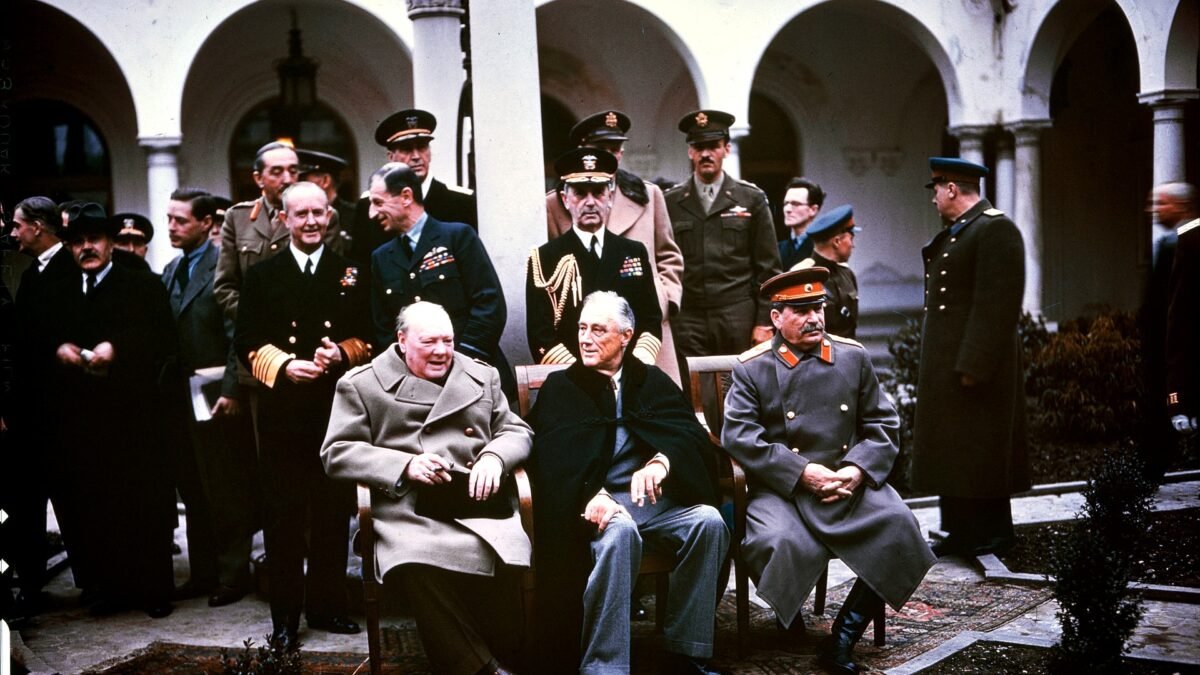
The reason the word “Yalta” lands so hard in Seoul is that Korea was one of the countries decided at Yalta. When Franklin D. Roosevelt, Winston Churchill and Joseph Stalin met at the Livadia Palace in the Crimean port of Yalta in February 1945, the war in Europe was almost over and they set about agreeing a postwar global order, formalising spheres of influence and determining the fate of smaller countries without consulting them. They agreed to dismember Germany into military zones and to shift the borders of Poland westwards. A secret protocol agreed that after Germany’s surrender, Moscow would join the war against Japan in return for territorial concessions at China’s expense. And the leaders agreed informally to place Korea under international trusteeship rather than restoring the independence it had enjoyed for 500 years before the Japanese occupation in 1905.
Six months later, in August 1945, Soviet forces accepted Japan’s surrender in Korea north of the 38th parallel while United States forces did so south of the line, dividing the peninsula into two occupation zones that subsequently hardened into two separate states. The Korean War of 1950 to 1953 fixed the division in blood. For South Koreans, Yalta is not an abstraction from a history book; it is the conference that drew the line through their country.
That is why the comparison has spread beyond Seoul. President Volodymyr Zelenskyy of Ukraine has used the same phrase, warning that he does not want a second Yalta, and European leaders meeting in Dublin last week invoked it in private discussions about what Trump might say about Ukraine. German Chancellor Friedrich Merz was among the most vocal participants before stepping outside to issue a public plea to Washington: “Our message to the U.S. before Trump meets Putin is: No surprises, please,” according to Foreign Policy. One European diplomat put the anxiety more bluntly: “We know that every time President Trump talks to or sees Putin, it translates into bad news for Ukraine and for Europe. We brace for anything.”
Tokyo’s worry runs on a parallel track. Japanese officials have privately relayed concerns to their American counterparts about what a Trump-Xi-Putin stage signals for Washington’s commitment to Taiwan and broader Indo-Pacific security. For Tokyo, a potential public reunion between Trump and Kim would be even more destabilising, risking the legitimisation of North Korea’s nuclear programme without allied coordination. That is the context in which Lee and Takaichi’s Manila meeting matters: the two United States allies most exposed to North Korea are coordinating before the three leaders meet.
The parallel track in Berlin
The Trump administration is running a parallel diplomatic track on the exact same day as the Shenzhen meeting — and its existence is itself a measure of allied anxiety. United States special envoys Steve Witkoff and Jared Kushner are planning to meet Ukrainian and European officials in Berlin on Thursday to work on security guarantees and a postwar economic recovery plan for Ukraine, a United States official told Axios. On the same day, Trump will meet Putin and Xi in Shenzhen, and the official described the two meetings as a coordinated diplomatic effort.
Kushner and Witkoff held virtual consultations on Monday with Ukrainian and European representatives to lay the groundwork. “We discussed how to facilitate direct engagement between Europe and Russia, which has been largely absent over the past four years,” Kushner wrote on X afterwards. “It is important that both sides hear each other’s concerns and proposals directly as we work toward a more stable and secure future for Europe.”
But a sharp contradiction quickly emerged between Washington and Moscow. United States officials stated that Putin had agreed to allow European representatives to join upcoming Ukraine negotiations in Abu Dhabi and to launch a parallel track of talks on a broader Europe-Russia security deal. Senior Kremlin aide Yuri Ushakov flatly disputed that account on Monday, telling reporters that Russia had not yet agreed to European participation in the next round of talks, and that European participation depended on Russia receiving “a clear signal from the Europeans about what they want and what constructive, substantive contribution they can make to a successful settlement”. The dispute is a small preview of the problem facing allies in Shenzhen: Washington’s account of what has been agreed and Moscow’s account do not always match.
The Irish Times, in its explainer on South Korea’s fears, noted that the signs are that Xi, Trump and Putin will not discuss Korea at this week’s meeting, which is not expected to go too deeply into any policy specifics. But it added a warning of its own: if the three leaders agree in Shenzhen to hold regular trilateral meetings, Seoul might have more to fear in the future.
Analysis: Why It Matters
The phrase is the policy
Seoul did not choose the words “second Yalta” by accident. It is a phrase that works in every capital at once: in Washington it recalls the original sin of great-power summitry, in Beijing it signals that China will be judged by the company it keeps, and in Moscow it is a reminder that the 1945 conference took place on soil Russia now claims. By framing its objection in the language of history, South Korea has made its warning impossible to dismiss as a routine diplomatic complaint — and has put the three leaders on notice that any deal they strike on Korea will be measured against the most notorious precedent in modern diplomacy. The phrase is also aimed, quite deliberately, at Washington as much as at Beijing and Moscow: Seoul is telling its own ally that its interests are not a bargaining chip.
The real danger is not Thursday — it is the meeting after Thursday
The reassuring reading of this week’s summit is that it will produce little of substance. The three governments could not even agree on an agenda, China is reluctant to discuss disarmament, Washington has ruled out Ukraine in the trilateral format, and analysts expect symbolism to outweigh results. That reading is probably right about Thursday. It misses the point. The danger Seoul sees is institutional: if Shenzhen becomes the first of a regular series of trilateral summits, the three largest nuclear powers will have created a standing forum in which the Korean Peninsula can be discussed, traded and settled without the Koreans present. A single meeting can be dismissed as theatre; a standing format is a new architecture. That is why the editorial in the Korea JoongAng Daily warned that transactional diplomacy among major powers “remains possible, with potentially profound consequences” — and why Seoul’s demand is not for a seat at this meeting, but for a principle that no meeting may decide Korea’s fate without Korea.
A freeze is not a compromise — it is a verdict
The line Seoul is defending is the distinction between denuclearisation and a freeze, and it is the most important line in the whole story. A freeze would cap North Korea’s arsenal where it stands — at about 60 warheads by the most widely cited estimate, possibly far more — and treat that as the settled outcome. For Pyongyang, that would be recognition as a nuclear weapons state by another name: the arsenal stays, the sanctions ease, and the goal of disarmament quietly disappears. For Seoul, it would mean living permanently under a nuclear threat its ally had accepted. The Korea JoongAng Daily’s insistence that Seoul secure a firm American commitment against any such substitution is therefore not a detail of diplomatic language. It is the difference between a negotiation that ends with disarmament and one that ends with ratification. Every leader in Shenzhen knows that distinction — which is exactly why Seoul is afraid it may be traded away.
Pyongyang is negotiating, not waiting
The most revealing detail of the past week is not what Seoul said, but what Pyongyang did. Kim Jong Un did not wait to see what the three leaders would decide about his country; he sent his closest aide to Moscow and his international affairs secretary to Beijing, making sure his positions were in both capitals before the summit. That is the behaviour of a government that believes it has something to gain from the meeting — recognition, sanctions relief, or at minimum a place in the conversation. It is also a reminder that North Korea is not a passive object in this story. It has a growing arsenal, a treaty with Russia, troops fighting in Ukraine, and a leader who has shown he can extract concessions from an American president in person. Seoul’s fear is not only that the great powers will decide Korea’s fate without Korea; it is that Pyongyang will help them do it.
Berlin is the tell
The parallel meeting in Berlin on Thursday is the most honest admission in this whole diplomatic week. If the allies trusted the Shenzhen summit, there would be no need for a simultaneous gathering of envoys in Berlin to coordinate security guarantees and recovery plans. The Berlin track exists because Europe and Ukraine do not trust what might be said — or agreed — in Shenzhen, and because Washington knows it. The dispute over whether Putin agreed to European participation in the Abu Dhabi talks is the proof: within a day of the American announcement, the Kremlin denied it. When the two sides cannot agree on what was agreed in a phone call, allies have every reason to worry about what might be agreed in a room with no allies present. The split screen is the story: one summit for the cameras in Shenzhen, and another meeting in Berlin to insure against it.
What to Watch Next
- Thursday’s meeting in Shenzhen itself — above all, whether Korea or North Korea appears in any readout, communiqué or leaders’ remarks, and in what terms.
- President Lee’s meetings on the margins of the APEC summit, including his expected talks with Xi and any encounter with Putin.
- Whether Kim Jong Un appears in Shenzhen, or whether Trump’s suggestion of a meeting is quietly dropped.
- The parallel meeting in Berlin on Thursday, and whether Witkoff and Kushner can produce anything concrete on security guarantees for Ukraine.
- The dispute over European participation in the next round of Ukraine talks in Abu Dhabi — and whether the Kremlin’s denial holds.
- Whether the three leaders agree in Shenzhen to meet regularly, turning a one-off summit into a standing trilateral format.
- Any statement from Washington on denuclearisation versus a freeze — the commitment Seoul is demanding, and the line Pyongyang most wants moved.
Sources
- Korea JoongAng Daily — “South Korea, Japan strengthen security ties ahead of Trump-Xi-Putin summit”, by Sarah Kim, 17 November 2026
- Korea JoongAng Daily — “U.S.-China-Russia summit must not sideline Korea on North Korea” (editorial), 16 November 2026
- Seoul Economic Daily — “U.S., China, Russia to Discuss Nuclear Cuts, Iran in Shenzhen”, 15 November 2026
- The Irish Times — “Why does South Korea fear the ‘second Yalta’ meeting in China?”, 17 November 2026
- Foreign Policy — “‘No Surprises, Please’: Why Europe and Japan Fear a ‘Yalta II’ as Trump Meets Xi, Putin — and Possibly Kim Jong Un”, 17 November 2026
- Just Security — “Early Edition: November 17, 2026”, 17 November 2026
- Hiroshima Prefecture / SIPRI — “Status of World Nuclear Forces”, SIPRI Yearbook 2026

About the Author — Abdul Mannan
Related Articles
Russia Stalls UN ‘Killer Robot’ Talks in Geneva as US Opposes Binding Rules on Autonomous Weapons
Russia stalled the opening of a UN conference on lethal autonomous weapons in Geneva on Monday, blocking the…
Ukraine Collapses Section of Putin’s Crimea Bridge in Overnight Missile and Drone Strike
Ukraine says its missiles and drones destroyed a road arch of the Kerch Bridge overnight, cutting Russia's showcase…
Third US Aircraft Carrier Reaches the Middle East as Iran War Stalemate Deepens
The USS Theodore Roosevelt has joined two other American carriers in the Middle East, giving President Trump his…