
Astronomers Find a Triple Star System 28 Light-Years Away That ‘Should Not Exist’

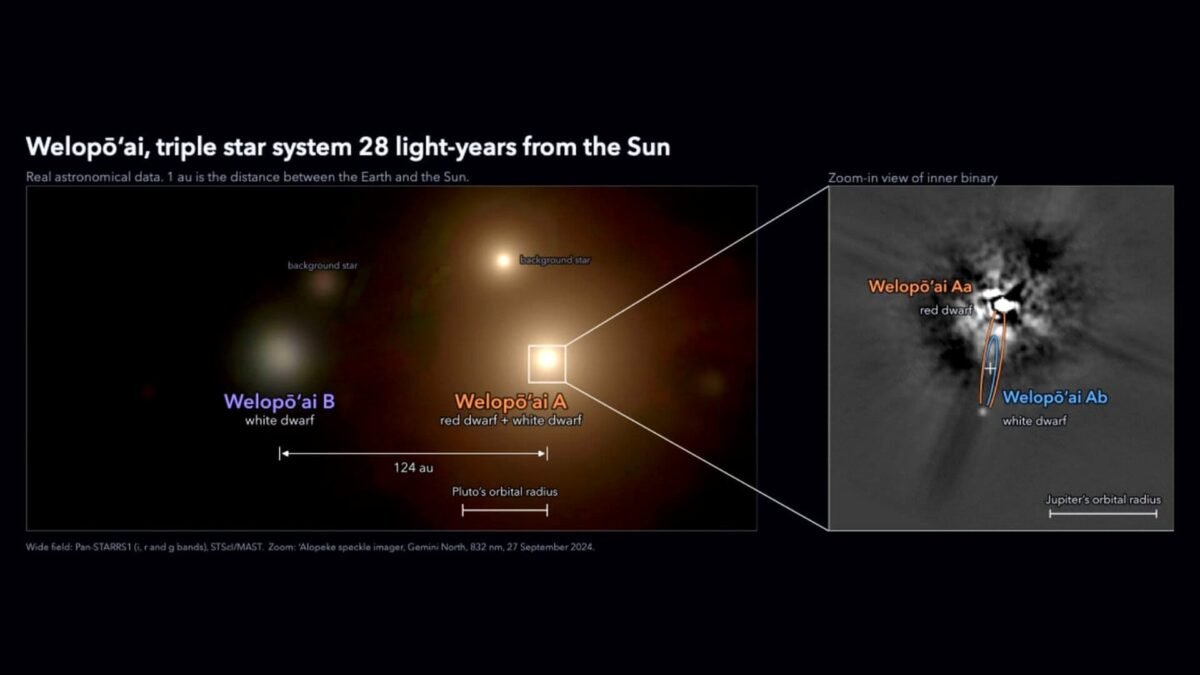
Astronomers hunting for planets around a small, dim star just 28 light-years from Earth have stumbled on something far stranger than the world they were looking for: a triple star system that, according to the accepted rules of how stars live and die, should not exist at all.
The system, named Welopōʻai, contains a red dwarf star locked in a tight embrace with a white dwarf — the burned-out core of a dead star — while a second white dwarf circles the pair from far away. The arrangement is so unusual that the researchers behind the discovery say they have no clean explanation for how it formed, and that no comparable system is known anywhere within 100 light-years of Earth.
“This system should not exist,” said Professor Patrick Dufour, a white dwarf specialist at the Université de Montréal and a co-author of the study. “We have no clean explanation for how it got here. That is the question driving our next observations.”
The discovery is reported in a paper titled “Welopōʻai: A peculiar triple system 8 pc from the Sun”, published in the journal Astronomy & Astrophysics. The work was led by Étienne Artigau of the Trottier Institute for Research on Exoplanets (IREx) at the Université de Montréal, with an international team of collaborators. It was announced on 20 November 2026, and it immediately became one of the most talked-about astronomy stories of the year — not because the system is large or bright, but because it breaks the models astronomers use to understand how stars evolve.
Welopōʻai sits 8.46 parsecs from the Sun — about 28 light-years, or roughly 265 trillion kilometres. By galactic standards that is practically next door: closer than the vast majority of stars visible in the night sky, and about 10,000 times farther away than Voyager 1, the most distant human-made object, has travelled in nearly 50 years of flight. The star at its heart was previously catalogued as IRAS 21500+5903, also known as TYC 3980-1081-1 A, and on first inspection it looks like an utterly ordinary red dwarf, a cool, faint star with just 42 per cent of the Sun’s mass. It is far too dim to see with the naked eye. It was exactly the kind of star astronomers target when they search for exoplanets — small stars whose light is easily disturbed by the gravitational tug of an orbiting planet.
That search is what led to the discovery. Instead of the delicate wobble of a planet, the team found a violent one.
A wobble a thousand times too strong
The first clues came from SPIRou, a near-infrared spectrograph on the Canada-France-Hawaii Telescope, which sits atop the dormant Maunakea volcano in Hawaii. SPIRou is built to measure radial velocity — the tiny shifts in a star’s motion towards and away from Earth as an orbiting body tugs on it. Modern instruments can detect changes of just a few metres per second, the signature of a planet pulling on its star. Astronomers had been watching this red dwarf’s unusual radial velocity signal since 2019, and over almost five years of SPIRou observations the signal refused to behave like a planet at all.
The star’s velocity was swinging by nearly 16 kilometres per second — close to 10 miles per second, or about 36,000 miles per hour — more than a thousand times larger than the team had anticipated from a planet. The red dwarf was also accelerating at a near-constant rate of about 5 metres per second per day, roughly 1,800 metres per second per year. According to the researchers’ calculations, even a planet as massive as Jupiter, on an orbit of a few years around a star of 0.42 solar masses, could induce an acceleration of at most 40 to 130 metres per second per year. The observed signal was up to 45 times stronger than that.
“We were actually looking for planets,” Artigau said in a statement released by the Université de Montréal. “Instead, we found something much more surprising.”
The numbers pointed to a hidden companion far heavier than any planet: something with more than half the mass of the Sun, orbiting close to the red dwarf. Yet whatever it was, it was barely shining at all. “The object’s unusual combination of high mass and dim light left only one plausible explanation: it was the remains of a dead star,” said co-author Charles-Antoine Parent of Université Laval. “The most likely explanation was a white dwarf, although a neutron star or even a black hole couldn’t be ruled out.”
A white dwarf is what remains when a star like the Sun exhausts its fuel, sheds its outer layers and collapses into a dense, Earth-sized ember that slowly cools over billions of years. A neutron star or a black hole would have been even more dramatic. To settle the question, the team turned to a second instrument on Maunakea: ‘Alopeke, a high-resolution speckle imager on the Gemini North telescope, which can cancel out the blurring effect of Earth’s atmosphere and pick out objects that would otherwise be drowned in a star’s glare.
‘Alopeke found it. In images taken in December 2023 and 2024, and in a sharp exposure from 27 September 2024, a faint white dwarf appeared beside the red dwarf — so faint and so close that it had been completely overshadowed by even that dim star’s light. The hidden companion was a second white dwarf, forming a tight inner pair with the red dwarf.
And that was not all. Astronomers already knew the red dwarf had a binary companion: a white dwarf orbiting much farther away, already catalogued before this work began. With the new discovery, the system became a triple: a red dwarf and a white dwarf circling each other closely at the centre, with a second white dwarf orbiting the pair from a distance of 123.9 astronomical units — about 124 times the distance between the Earth and the Sun, or roughly four times as far as Neptune is from the Sun.
The system that should have merged
Triple star systems are not, by themselves, extraordinary. Binary stars are common, and triples, while much rarer, are hardly unknown — the Alpha Centauri system, our nearest stellar neighbour, is itself a triple. What makes Welopōʻai extraordinary is the specific arrangement, and in particular the distance between the two stars of the inner pair.
The problem is one of life cycles. A white dwarf is the end state of a star that was once much larger. The researchers calculate that the newly found inner white dwarf began life as a star about 44 per cent more massive than the Sun. Before it could become a white dwarf, it had to pass through a red giant phase, swelling to hundreds of times its original size. A star of that size, placed where the Sun is, would have expanded beyond the orbit of the Earth. Planets in its path would have been swallowed. Companion stars caught inside that bloated envelope are usually dragged inward, spiralling together until the two stars merge into one.
Yet in Welopōʻai, the inner pair did not merge. The distance between the red dwarf and the white dwarf is now just a little smaller than the distance between Jupiter and the Sun — close enough that the white dwarf’s giant phase should have engulfed its companion. “Strong gravitational tidal interactions and at least partial envelope grazing were nearly unavoidable,” the researchers wrote in their paper. “The stars should have merged.”
Instead, the two stars survived as a pair, and the white dwarf’s orbit is, remarkably, close to circular — a detail that deepens the puzzle, because a violent shared-envelope episode would be expected to leave a much more eccentric, disturbed orbit behind. The system’s name reflects that oddity: Welopōʻai is a Hawaiian word combining welo, an inherited or family trait, and pōʻai, an orbit or encircling path — together evoking a “path of family traits”. The team chose a Hawaiian name because both telescopes involved in the discovery stand in Hawaiʻi. The three stars are formally designated Welopōʻai Aa (the red dwarf), Welopōʻai Ab (the newly found close white dwarf) and Welopōʻai B (the distant white dwarf).
One early theory offered by the researchers is that the distant third star may have saved the inner pair. The gravitational pull of the outer white dwarf, they suggest, may have kept the two tightly orbiting stars from merging during the earlier expanding-giant phase. It is a plausible idea, but it is not yet proven, and it is one of the questions the team now plans to investigate by modelling the gravitational interplay between all three stars in detail.
There is also the question of comparison. As the paper notes, a hierarchical triple with a more distant white dwarf has “no known analogue” within 30 parsecs — about 100 light-years — of Earth. It is, according to the researchers, the closest known triple-star system containing two white dwarfs. That scarcity makes it hard to test ideas about how it formed: there is simply nothing else like it nearby to compare it with.
A measurement of rare precision
One reason the discovery matters beyond its strangeness is the quality of the measurement it delivers. Determining the mass of a solitary white dwarf is notoriously difficult: there are billions of white dwarfs in the galaxy, but precise mass measurements exist for only a handful of nearby ones. Usually astronomers must rely on a white dwarf’s brightness or its spectrum, both of which carry large uncertainties.
Welopōʻai is different, because the new white dwarf tugs gravitationally on the red dwarf. That allowed the team to determine its mass dynamically — from the motion it induces — rather than from how bright it looks. They found a mass of about 0.62 solar masses, and the paper describes the measurement as one of only a handful of such dynamically determined masses for white dwarfs within 20 parsecs, and the most precise of them, at the sub-percent level of 0.7 per cent.
That precision is what makes the system a valuable benchmark. Stellar evolution models are only as good as the data that constrain them, and a white dwarf whose mass is known to better than one per cent, in a system whose history is so clearly at odds with those models, gives theorists a sharp test to work against. If the models cannot reproduce Welopōʻai, then something in the models is missing — and finding what is missing could change how astronomers understand a much wider class of binary and triple star systems.
More puzzles: age, metals and dust
The formation puzzle is not the only one. The ages of the three stars do not match. The white dwarfs appear to be between 9 and 11 billion years old, making them among the oldest stars in the galaxy — born when the Milky Way itself was young. The red dwarf, while undoubtedly an old star, appears younger. That mismatch is itself difficult to explain, because the three stars presumably formed together from the same material at the same time.
Then there is the chemistry. The red dwarf is surprisingly metal-rich for a star of its age. Stars this old formed from gas that had not yet been enriched with heavy elements by many generations of earlier stars, so they are expected to be metal-poor. Reproducing the observed metallicity, the authors write, would require the red dwarf to have captured roughly two-thirds of the metals — and almost none of the hydrogen or helium — ejected by the inner white dwarf’s progenitor star. There is, the paper says, no known mechanism that could do that.
There is also what the authors call hints of dust of unknown origin around the inner white dwarf. Dust around a white dwarf is often a sign of shredded asteroids or comets, the debris of a planetary system destroyed when the star swelled into a red giant. Whether that is what is happening here, or whether the dust is connected to the system’s strange history, is unknown.
“These puzzles, together with the still-open question of how the inner binary avoided a classical common-envelope in-spiral, identify Welopōʻai as a valuable benchmark for future work on binary-star pollution and tidal evolution,” the authors write.
Serendipity, and a neighbourhood still full of surprises
The discovery is also a reminder of how much of astronomy advances by accident. The history of the field is full of researchers who set out to find one thing and found something else entirely — the cosmic microwave background, pulsars and gamma-ray bursts were all discovered by people looking for something different. Welopōʻai joins that tradition: a planet search that found, instead, a stellar system that challenges the textbooks.
It is also a reminder of how little of our own cosmic neighbourhood has been fully mapped. At 28 light-years, Welopōʻai is one of our closer stellar neighbours, and its most remarkable member — a white dwarf with more than half the Sun’s mass — sat undiscovered until now, hidden in the glare of a dim red dwarf, betrayed only by the gravitational wobble it imposed on its companion over five years of patient observation. “Discoveries like this remind us that our own cosmic neighbourhood still contains remarkable surprises,” Artigau said. “Even when we’re searching for planets, our Universe often has something completely unexpected waiting for us!”
The instruments behind the discovery are themselves part of the story. SPIRou, the spectrograph that first detected the anomaly, is one of the instruments built by the same Canadian research community that supplied Canada’s contribution to the James Webb Space Telescope. ‘Alopeke, the imager that finally revealed the hidden star, is a speckle camera designed to defeat atmospheric turbulence. The wide-field view of the system came from Pan-STARRS1, the sky survey telescope, whose images are archived through the Space Telescope Science Institute’s Mikulski Archive for Space Telescopes. Three very different kinds of observation — years of radial-velocity monitoring, high-resolution speckle imaging and wide-field survey photography — had to be combined before the system’s true nature became clear.
Analysis: Why It Matters
Welopōʻai matters for three reasons, and each of them reaches well beyond one small, dim system 28 light-years away.
First, it is a direct challenge to the standard story of how close binary stars evolve. That story is one of the foundations of modern astrophysics. It explains how some stars end their lives, how certain kinds of supernovae explode, and how gravitational-wave sources are born. At its centre sits the common-envelope phase: when one star in a close pair swells into a giant, it can swallow its companion, and the friction of the companion ploughing through that envelope either throws the envelope off into space or drags the two stars together into a merger. The theory predicts, with considerable confidence, that a pair as close as Welopōʻai’s inner two stars, with a white dwarf that was once 44 per cent more massive than the Sun, should not have survived that phase as a pair. The fact that it did survive — in a stable, nearly circular orbit — means that at least one part of the standard picture is incomplete. Either the common-envelope phase can end differently than the models assume, or some other mechanism intervened. The outer white dwarf is the leading suspect, but the mechanism by which a distant third star could hold a merging pair apart has yet to be demonstrated. Until it is, Welopōʻai stands as a counter-example that the theory must now absorb.
That has practical consequences. The same common-envelope physics governs the formation of the tight double-white-dwarf pairs that will be among the loudest sources for the future Laser Interferometer Space Antenna, the space-based gravitational-wave observatory. It also governs the progenitors of Type Ia supernovae, the exploding white dwarfs that astronomers use as standard candles to measure the expansion of the Universe. If the models misjudge how often close pairs survive their giant phase, they misjudge how many of those systems exist — and, by extension, the rates of some of the most important events in the cosmos. A single nearby system will not rewrite those rates on its own, but a system that should not exist is exactly the kind of evidence that forces a model to be re-examined.
Second, Welopōʻai is a laboratory for the physics of dead stars. White dwarfs are the ultimate fate of more than 95 per cent of all stars, including the Sun, which will become one in about five billion years. Yet their masses, which determine almost everything about them — how they cool, how they crystallise, whether they can ever explode — are measured precisely for only a tiny number of nearby examples. A dynamically determined mass accurate to 0.7 per cent, in a system close enough to study in detail, is a rare gift. It anchors the relationship between a white dwarf’s mass and the mass of the star it came from, a relationship that underpins estimates of the ages of stellar populations across the galaxy. The fact that the measurement comes attached to so many other anomalies — the age mismatch, the metal-rich red dwarf, the unexplained dust — only increases its value, because it means the system can test several parts of the theory at once.
Third, the discovery is a warning against assuming that the nearby Universe is fully explored. The stars within a few dozen light-years of the Sun are the best studied in the galaxy, the targets of every exoplanet survey and the subject of catalogues compiled over more than a century. That a star system this strange could hide among them, its most massive member invisible until a speckle imager looked in exactly the right way, suggests that the census of the solar neighbourhood is less complete than astronomers might have assumed. If a 0.62-solar-mass white dwarf can go unnoticed 28 light-years away, it is reasonable to ask what else is hiding in the glare of dim stars that nobody has yet examined closely enough. The answer matters for exoplanet science in particular: planet hunters rely on knowing exactly what is tugging on their target stars, and a hidden stellar companion can mimic, mask or distort a planetary signal. Every undiscovered companion is a potential source of error in the search for other worlds.
There is also a broader lesson in how the discovery was made. It took five years of radial-velocity data, a signal first noticed in 2019, and three different observatories to resolve. That is slow science: no single dramatic observation, but a patient accumulation of evidence until the only remaining explanation was a dead star hiding beside a red dwarf. In an era when astronomy is increasingly driven by vast surveys and automated alerts, Welopōʻai is a reminder that some discoveries still require a team to stare at one unremarkable star for years and take an anomaly seriously when it refuses to go away.
What to watch next
The team’s immediate priority is to understand how the system formed. That means detailed modelling of the gravitational dance between all three stars, to test whether the outer white dwarf could really have prevented the inner pair from merging, and to work out what the system looked like billions of years ago. Further observations are planned, and the researchers say the question of how the inner binary avoided spiralling together is what will drive those observations.
Two other questions will be pursued in parallel. One is the chemistry: explaining how a 9-to-11-billion-year-old red dwarf became so metal-rich, and whether the metals were transferred from the white dwarf’s progenitor in some process the models have missed. The other is the dust around the inner white dwarf — whether it is the wreckage of a planetary system, and what it can reveal about what orbited these stars before one of them died.
There is also the wider hunt. If Welopōʻai is not a one-off, there may be other systems like it hiding in existing radial-velocity surveys, their signals dismissed as noise or misread as planets. The team’s hope, expressed by Artigau, is that the discovery will push astronomers to look more closely at peculiar behaviour from other nearby stars. The solar neighbourhood, it turns out, still has surprises in it — and the next one may be found the same way this one was: by looking for a planet, and finding something nobody expected.
Sources
- Gizmodo — “Astronomers Find Triple Star System They Say ‘Should Not Exist’”
- Universe Today — “A Triple Star System ‘That Shouldn’t Exist,’ Only 28 Light-Years from Earth”
- IFLScience — “Unexpected Triple Star System Just 28 Light-Years Away Could Reshape Models Of Stellar Evolution”
- Artigau et al., “Welopōʻai: A peculiar triple system 8 pc from the Sun”, Astronomy & Astrophysics, Vol. 715, November 2026, A321

About the Author — Abdul Mannan
Related Articles

Japan’s Fugaku Supercomputer Breach Widens: 430 Stolen Keys Confirmed as RIKEN Treats 4,222 Users’ Data as Leaked
RIKEN confirms intruders stole 430 credentials — including 233 SSH private keys with no passphrase — from Japan's…
After Eight Years and Six Billion Miles, BepiColombo Finally Reaches Mercury
After eight years, nine planetary flybys and a journey of some six billion miles, the joint European-Japanese BepiColombo…

Britain Quietly Took Tens of Thousands of Fridges Offline in Secret Race to Stop Hackers Spoiling the Food Supply
Supermarkets, warehouses and restaurants across Britain have spent weeks quietly disconnecting tens of thousands of fridges and freezers…