
More Than 12,000 Evacuated as Suspected Tear Gas Clears Manchester’s Co-op Live Arena During Don Toliver Concert

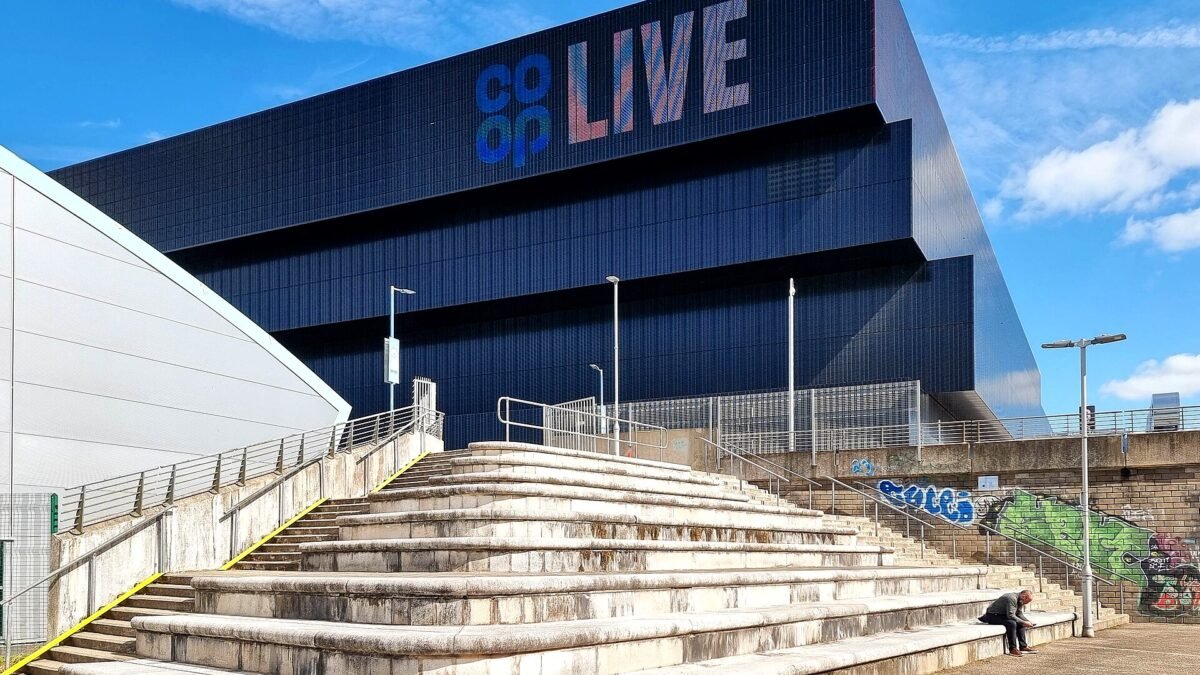
More than 12,000 people were evacuated from Manchester’s Co-op Live arena on Sunday night after a substance believed to be tear gas was released into the crowd during a concert by the American rapper Don Toliver. Greater Manchester Police declared a major incident shortly after 10pm, and emergency services spent the night treating concertgoers for eye and breathing problems. One person was taken to hospital. No serious injuries have been reported, according to the police.
The incident brought the show to an abrupt halt near its end and turned Britain’s largest indoor arena into the scene of a large-scale emergency operation, with police, ambulance crews and fire officers working through the night. By the early hours of Monday, the force said everyone had been safely escorted out of the building, but it could not yet say what the substance was, who had released it, or whether anyone had been arrested.
“It is understood that a substance believed to be tear gas was let off in the crowd towards the end of a concert,” Greater Manchester Police said in a statement on Sunday night. “All attendees are currently being safely evacuated as a precaution. Those showing signs of being impacted are being supported by emergency services, with no serious injuries reported.”
The force added that a major incident had been declared “to ensure emergency services and partner agencies can work together quickly and effectively to coordinate a safe response”, and it asked people to stay away from the arena while concertgoers were helped to their transport home.
What happened on Sunday night
Doors at Co-op Live opened at 6.30pm on Sunday, with a warm-up act performing before Don Toliver took to the stage. According to the Manchester Evening News, fans were asked to leave at around 10pm, while Toliver was performing on the arena’s B Stage. Witnesses told the newspaper they believed a smoke canister had been thrown into the crowd.
Video shared on social media showed concertgoers coughing, covering their mouths and rubbing their eyes as they filed out of the venue, while police vehicles circled the building. An announcement over the arena’s public address system told the crowd the show was over.
“Due to unforeseen circumstances the show is now finished. In your own time please make your way to the nearest exit,” the announcement said, according to footage shared online. “If you require medical assistance please speak to a member of staff or visit the Level 0 concourse.”
Greater Manchester Police posted on social media at 11.23pm that officers were responding to the incident and that attendees were being evacuated safely, supported by emergency services. In a further statement issued shortly after 2am on Monday, the force said concertgoers had been safely evacuated and that several people were still being assessed on site for side effects as a precaution.
Assistant Chief Constable Steph Parker said more than 12,000 people had been safely evacuated from the arena. “There were over 12,000 people in attendance during this concert who were safely escorted from the arena so they could make their way home,” she said. “Several people were treated on site, and one has been taken to hospital at this time.”
She added: “We will now begin to fully understand what this substance was and how this incident came about.”
The emergency response
The North West Ambulance Service said more than 50 people had been assessed by its clinicians, with some reporting eye and respiratory symptoms. Decontamination was carried out as a precaution, and one patient was taken to Manchester Royal Infirmary for further assessment.
“We deployed several emergency crews, including our Hazardous Area Response Team, to support the safe assessment and treatment of people at the scene,” the ambulance service said in a statement. “Anyone at tonight’s event who has since noticed side-effects or become ill should seek medical advice.”
The scale of the response reflected the size of the crowd and the uncertainty in the first hours. Tear gas and similar irritants cause burning eyes, coughing and difficulty breathing, and in a packed, enclosed arena the immediate priority is to move people into fresh air and identify anyone who needs treatment. The fact that more than 50 people needed clinical assessment, even though none was reported as seriously hurt, shows how quickly an irritant can spread through a standing crowd.
A cordon was put in place around the venue, and photographs from the scene showed more than a dozen emergency vehicles, including police cars and ambulances, parked outside the arena’s entrance. Armed officers were also pictured at the scene, which is standard practice when a major incident is declared and the cause is not yet known.
The declaration of a major incident is itself significant. It is not a description of how many people were hurt. It is a formal step that brings police, ambulance, fire and local authority teams under a single coordinated command, so that resources can be moved quickly and decisions taken in one place. It is used when an event is serious enough, or uncertain enough, that normal arrangements may not be sufficient. In this case, the combination of a very large crowd, an unidentified substance and a venue that had to be emptied in minutes met that test.
Don Toliver and the tour
Don Toliver, whose real name is Caleb Zackery Toliver, is a 32-year-old rapper, singer and songwriter from Houston, Texas. He is known for blending hip-hop, trap, psychedelic rap and R&B, and he is signed to Travis Scott’s Cactus Jack label.
Six days before the Manchester show, he was nominated five times at the 2027 Grammy Awards, for best new artist, best rap album, best rap song, best rap performance and best melodic rap performance, according to People magazine. The nominations had made this leg of his world tour one of the most closely watched of his career so far.
He is scheduled to perform at the O2 Arena in London on Monday, and at the OVO Arena Wembley on Tuesday. His representatives did not immediately respond to a request for comment on Sunday night, according to People. Neither the venues nor the tour promoter had said by Monday morning whether the London dates would go ahead as planned, or whether additional security measures would be put in place.
The Manchester show was one of the biggest dates of the tour. Co-op Live can hold 23,500 people, and more than 12,000 were inside on Sunday night, according to the police. The show was stopped before it reached its scheduled end, and fans who had paid for a full performance were sent home early, with no announcement yet about refunds or a rescheduled date.
The venue: Co-op Live
Co-op Live, on the Etihad Campus next to Manchester City’s Etihad Stadium, opened on 14 May 2024 and is the largest indoor arena in the United Kingdom by capacity. It can hold 20,500 people seated and 23,500 with standing, and it was built at a cost of about £365 million by Oak View Group, together with City Football Group.
It was designed from the start as a music-first venue, with a bowl-shaped auditorium intended to bring audiences closer to the stage than in a conventional arena, and it has hosted some of the biggest names in music since it opened, including Paul McCartney, Hans Zimmer and Charli XCX. The indie band Elbow performed the first show at the official opening.
The arena’s opening was itself troubled. Early shows in the spring of 2024 were postponed, and test-event tickets were cut back, before the venue settled into regular operation. Since then it has become a fixture of the British touring calendar, and it is scheduled to host the American singer Phoebe Bridgers on Thursday.
The incident on Sunday night will inevitably raise questions about how a substance of this kind was brought into the building. Arena security in Britain typically includes bag searches and, at larger events, walk-through metal detectors and handheld scanners. Those measures are designed to find weapons and large prohibited items. A small canister, however, is a different kind of challenge: it is compact, easy to conceal, and not something a metal detector is designed to identify as dangerous on its own. That is the practical problem the investigation, and the venue’s own review, will have to confront.
What police do not yet know
By Monday morning, several basic facts remained unconfirmed. The police have described the substance only as one “believed to be” tear gas. It has not been formally identified, and samples will need to be analysed before the force can say with certainty what was released. Some reports have described a smoke canister being thrown into the crowd, but the police have not confirmed that account either.
No arrests had been announced by Monday morning, and the police have not said who released the substance or why. They have not said whether they believe the act was deliberate, whether it was aimed at any individual, or whether it was the work of one person or more than one. Assistant Chief Constable Parker’s statement that the force would “now begin to fully understand what this substance was and how this incident came about” makes clear that the investigation is at its earliest stage.
Co-op Live had not issued its own statement by Monday morning. That silence is not unusual in the first hours after an incident of this kind, while the venue works with the police and the emergency services, but it will not be sustainable for long. Ticket holders, the artists booked to play there this week, and the wider live music industry will all want to know what happened, what went wrong, and what will change.
One question that will be asked quickly is whether the substance was a commercially available irritant spray or a purpose-made device. In the United Kingdom, that distinction matters a great deal in law. Section 5 of the Firearms Act 1968 makes it an offence, without proper authority, to possess any weapon “designed or adapted for the discharge of any noxious liquid, gas or other thing”. Such weapons are classed as prohibited weapons. A person found to have brought a tear gas canister into a concert could therefore face a serious criminal charge, quite apart from any charges relating to the injuries and the disruption caused.
Analysis: Why It Matters
On the available evidence, this was a frightening night that ended, mercifully, without serious injury. That outcome should not obscure how serious the incident was, or how easily it could have been worse. More than 12,000 people were inside a single enclosed building when an irritant was released into the crowd. The evacuation appears to have been orderly, and the emergency response was fast and well coordinated. But the margin between a night of coughing and sore eyes and a far worse outcome, including crush injuries in a panicked crowd, can be very thin indeed.
That is the first reason this story matters. A tear gas incident in a crowded arena is not a prank. It is an act that puts thousands of people at risk at once, including children, older people and anyone with asthma or another respiratory condition, for whom an irritant is not a temporary discomfort but a genuine medical emergency. The fact that more than 50 people needed clinical assessment, and that one person was taken to hospital, is a reminder that “no serious injuries” is a statement about the outcome, not about the risk that was taken.
The second reason is the setting. Manchester is a city that understands, better than most, what can happen inside a concert arena. In May 2017, 22 people were killed and hundreds injured when a suicide bomber attacked the Manchester Arena at the end of an Ariana Grande concert. Co-op Live is a different venue, and Sunday’s incident was a different kind of event, and it would be wrong to draw a direct line between the two. But the memory of 2017 shapes how Manchester reacts to any emergency in a music venue, how quickly a major incident is declared, and how seriously the public takes an evacuation order. The speed and scale of the response on Sunday night, and the calm with which thousands of people left the building, owe something to the hard lessons of that night.
The third reason is the security question. British arenas have spent years hardening themselves against the threat of terrorism: vehicle barriers, bag searches, armed officers, and, since the Manchester Arena attack, a legal duty on venues to prepare for the possibility of an attack. But those defences are aimed, for the most part, at a particular kind of threat, a person bringing a weapon or an explosive device through the front door. A small canister of irritant gas is a different problem. It is cheap, easy to obtain in some countries, easy to conceal, and capable of causing chaos out of all proportion to its size. The industry will now have to ask whether its screening is capable of catching such an item, and if not, what would have to change to do so, and at what cost to the experience of going to a concert.
There is also a legal and cultural question. Irritant sprays are treated very differently in different countries. In parts of the United States they are sold openly for self-defence. In the United Kingdom, possession of a weapon designed to discharge a noxious gas is a criminal offence, and the law makes no exception for a canister carried into a concert. Anyone who brought such an item into Britain, whether as a souvenir, a supposed self-defence tool or something bought online without understanding the law, would be committing a serious offence the moment they carried it in public. If the investigation finds that the substance was brought in by a member of the public rather than supplied through some other route, that legal reality will be central to the case.
Finally, there is the question of what happens next for the people who were there. A concert is, for most of the audience, a rare and expensive night out, planned weeks or months in advance. Thousands of fans were sent home early, some of them unwell, many of them frightened, and some of them travelling long distances. The promoter and the venue will face questions about refunds, and about whether the remainder of the tour can proceed safely. The London dates on Monday and Tuesday, at the O2 Arena and Wembley, will be watched closely: whether they go ahead, what extra security is visible, and whether the police have anything new to say about the investigation.
None of those questions can be answered yet, and it would be wrong to speculate about the motive or the identity of whoever was responsible. What can be said is that the response worked. The arena was emptied, the injured were treated, and nobody was seriously hurt. The task now is to find out how it happened, and to make sure it cannot happen again.
What to watch next
The first thing to watch is the laboratory result. Until the substance is formally identified, every description of the incident carries a caveat, and the police will be cautious in what they say. Confirmation that the substance was CS gas, or something else entirely, will shape the investigation and any charges that follow.
The second is whether arrests follow, and how quickly. Arena crowds are heavily covered by CCTV, and a canister thrown into a standing crowd will have been seen by many people. Witness appeals, footage from phones and cameras, and the venue’s own security records are all likely to be part of the inquiry. An early arrest would allow the police to say more about what happened; a long investigation with no suspect would raise harder questions about how the item got in.
The third is the venue’s own response. Co-op Live will need to explain what its security checks involved on Sunday night, and whether it intends to change them. Other large venues in Britain will be watching, and the live music industry as a whole will be asking whether this was a one-off failure or a gap that exists everywhere.
The fourth is the London leg of the tour. Don Toliver is due at the O2 Arena on Monday night and at Wembley on Tuesday. If those shows go ahead, they will be the first public test of whether the industry regards Sunday’s incident as an isolated event or as a warning. If either show is postponed or cancelled, that will itself be a significant development.
And the last is the health of those who were affected. The ambulance service has asked anyone who was at the concert and has since noticed side effects, or become ill, to seek medical advice. Most people exposed to an irritant recover quickly in fresh air, but some will need follow-up care, and the full tally of those affected may not be known for a day or two.
Sources
Sky News, via KMFM: Concert-goers evacuated from Manchester Co-op Live as major incident declared

About the Author — Abdul Mannan
Related Articles
Centrica Boss ‘Hugely Concerned’ as January Energy Bills Set to Jump £443 and Unpaid Debts Pile Up
Centrica chief Chris O'Shea warns more households will fall behind on energy bills when the price cap jumps…

Theresa May Tells Burnham ‘Brexit Is Done — Move On’ as Former Prime Ministers Split Over EU Rejoining Talk
Theresa May has told Andy Burnham to "accept Brexit and move on", saying she is "aghast" at the…
Cancer Does Change You: Princess of Wales Opens Up in Deeply Personal BBC Documentary ‘Heal’
Catherine, Princess of Wales, speaks more openly than ever about her cancer journey in 'Heal', a BBC documentary…