
Alcaraz Beats Zverev to Win First ATP Finals Title and Join Tennis’s Most Exclusive Club

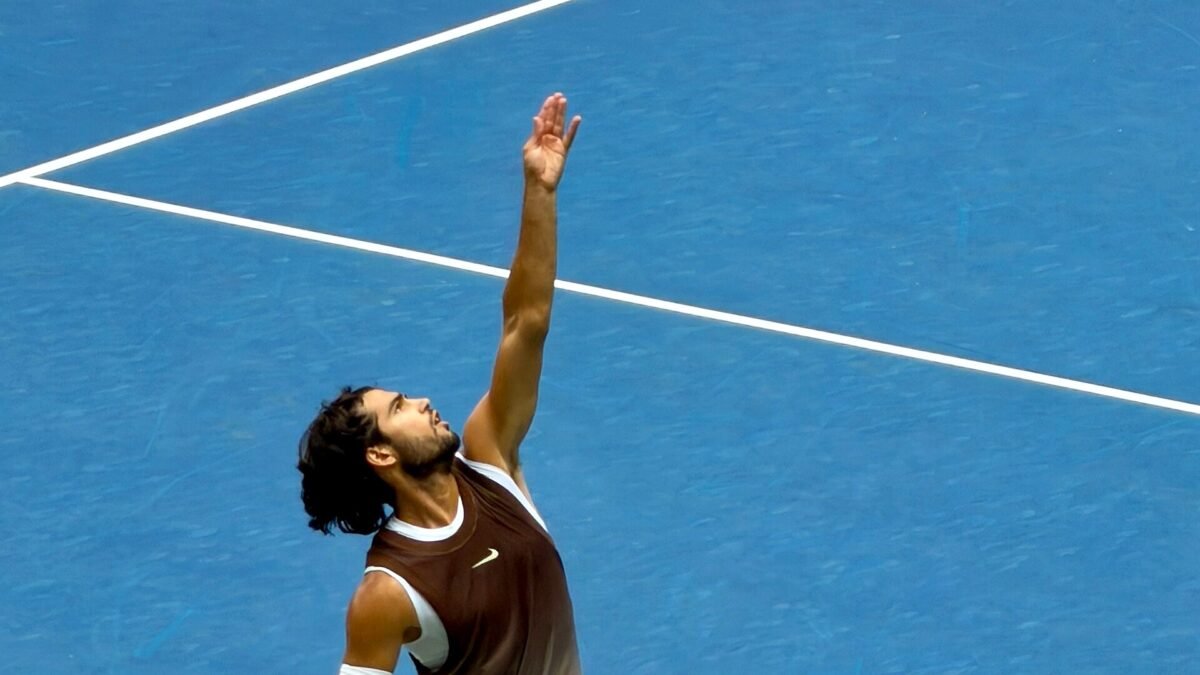
Carlos Alcaraz beat world No. 1 Alexander Zverev 6-2, 7-6(7) in Turin on Sunday to win the ATP Finals for the first time, completing the last great missing piece of his collection and joining one of the most exclusive clubs in tennis history. The 23-year-old Spaniard saved three set points in a dramatic second-set tie-break, rallying from 3-6 down to seal victory after two hours and one minute at the Inalpi Arena and end a season of injury, doubt and comeback with the biggest title of the year.
Alcaraz collapsed to the ground in celebration as a backhand winner closed out the match on his second match point, then rose with a beaming smile to embrace his team at courtside. It was his sixth title of 2026, the 30th of his career, his 14th consecutive victory, and the third straight tournament he has won since returning from the wrist injury that kept him out for more than four months earlier this year.
According to the ATP Tour, Alcaraz became only the fourth man in history to win all four Grand Slam titles and the season-ending ATP Finals, joining Andre Agassi, Roger Federer and Novak Djokovic. He is also the third Spaniard to lift the trophy, after Manuel Orantes in 1976 and Alex Corretja in 1998. The triumph carried a record champion’s payout of $5,171,000 for an undefeated week in which Alcaraz won all five of his matches.
“For me it’s been an amazing week,” Alcaraz said, according to the ATP Tour. “I couldn’t have ended the week in a better way. I’m just really proud and really happy with everything I have done this week. I’ve been through really difficult moments within myself, with my team, and we went through everything playing great tennis. This trophy is something I have been chasing for a really long time. It means the world to me.”
The victory was also a measure of revenge and a statement of intent. Alcaraz had lost the final of this event to Jannik Sinner a year ago, and he arrived in Turin with his fitness under scrutiny after a medical timeout for a left leg problem during his group match against Daniil Medvedev on Wednesday. He played Sunday’s final with heavy strapping on that leg, according to the ATP Tour, yet moved freely throughout and produced some of his sharpest tennis of the week when it mattered most.
How the final was won
The opening exchanges suggested a long evening. Zverev, who had not dropped a set all week and had not lost his serve in four matches on the fast indoor court in Turin, survived a nine-minute opening game in which he fended off three break points. But the resistance did not last. Alcaraz, striking the ball cleanly from the baseline, broke to love in the third game to become the first player all week to break the German’s serve, and the match tilted decisively in his favour.
Alcaraz was put under pressure on his own serve immediately afterwards, but responded impressively to preserve his advantage. In a 10-minute fourth game, the world No. 3 saved three break points, twice with powerful crosscourt backhands, and then built on that escape to break Zverev twice more in the first set. Zverev, sluggish by his own high standards, made 19 unforced errors in the first set alone, according to Reuters, and his usually booming serve deserted him at the worst moments.
Alcaraz continued where he left off at the start of the second set, once again breaking Zverev’s serve to love. Even when Zverev was on the front foot in the rallies, Alcaraz demonstrated remarkable agility to scamper from side to side and stay in points he had no right to win. According to the ATP Tour, the Spaniard used his backhand slice to disrupt Zverev’s rhythm throughout, while the drop shot, deployed consistently in the closing stages, kept the taller German guessing and pinned behind the baseline.
Yet Zverev, the champion of this event in 2018 and 2021, refused to fold. He recovered from a break down to force a tie-break, and for a while it seemed the final might be heading for a deciding set. Alcaraz had squandered a 4-2 advantage in the second set, and at 4-5, 0-30 on his own serve he was two points from losing it. He held his nerve, found first serves and big forehands to regain control, and carried that momentum into the tie-break.
The tie-break that decided it
The tie-break was the match in miniature: Zverev’s power and courage, Alcaraz’s nerve and imagination. The German raced to 6-3, holding three set points, and the Inalpi Arena crowd braced for a third set. What followed was the finest passage of the final. Alcaraz saved all three set points, reeling off six of the next seven points to seal the title, and the manner of it said everything about why he is the sport’s great closer.
According to Tennis Majors, Alcaraz struck 28 winners against 12 for Zverev and won 80 of the 144 points played, a margin that reflected his superiority across the two hours even if the scoreline of the second set did not. The Times reported that Zverev finished with 18 unforced errors to Alcaraz’s eight, and that the German threw his racket in disdain after being beaten by an Alcaraz tweener, a moment of frustration that captured his evening. He also argued with the umpire after losing his first serve for a time violation, a second such offence of the match, but the details of the officiating were a footnote to a defeat decided by tennis, not temperament.
Alcaraz’s own account of the final centred on three words his grandfather has repeated to him throughout his career. “Today’s final, I needed to put the three c’s that my grandpa always tells me that I have to give every time that I step on the court for every match and every practice,” he said, according to the ATP Tour. “He’s watching at home, so I just want to say I love you to my grandparents. In Spanish it’s ‘Cabeza, corazon, cajones’, in English it is ‘Head, heart, balls’, so I think today that was about it.”
It was a fitting summary. The head was visible in the tactical discipline of the first set, when Alcaraz refused to be drawn into serving contests he could not win and instead attacked Zverev’s second serve and used variety to drag him out of position. The heart showed in the second set, when he recovered from losing his lead and from the edge of the tie-break. And the courage was there in the shot that finished it, a backhand winner struck with the title on the line.
Zverev’s best season ends in defeat
For Zverev, the defeat brought an end to the most successful season of his career, according to Reuters, and it did so in the cruellest way: in a final he had every reason to believe he could win. The 29-year-old German won his first two Grand Slam titles in 2026, at Roland Garros and the US Open, and climbed to world No. 1 for the first time in November. He arrived in Turin as the top seed, the year-end No. 1 already secured, and bidding to win this title for a third time.
His week in northern Italy had been close to flawless until the final. He did not drop a set in the group stage or in his semi-final victory over Daniil Medvedev, and he reached the championship match with a tour-leading 69 wins for the season. His serve had been unbreakable, his groundstrokes authoritative, and his confidence, after a year in which he finally converted Grand Slam promise into Grand Slam titles, at an all-time high.
But the final exposed the one gap that remains in Zverev’s game at the very highest level: his record against the two players who now define the sport’s summit. According to the Associated Press, questions over Zverev’s inability to beat Alcaraz or Sinner during his breakout season will continue after this defeat. Alcaraz now leads their head-to-head series 8-6, and Sunday was the first time the Spaniard has beaten the German indoors, having lost their three previous meetings under a roof. Alcaraz has also won his past nine matches against top-10 opponents, according to the ATP Tour, a run that underlines how completely he has mastered the art of winning the matches that matter most.
None of that diminishes what Zverev achieved in 2026. He remains the year-end world No. 1, with 10,350 ranking points, and he leaves Turin having confirmed himself as a genuine Grand Slam champion rather than a nearly man. But the final was a reminder that the summit of men’s tennis is now a two-man contest between Alcaraz and Sinner, and that Zverev’s task in 2027 will be to prove he belongs in it rather than just below it.
The comeback that defined Alcaraz’s year
Alcaraz’s season began with a triumph that already seemed historic and then almost fell apart. In February, he won the Australian Open to become the youngest player ever to complete the career Grand Slam, a few months short of his 23rd birthday, defeating Zverev in a dramatic five-set match along the way. According to Reuters, he made an early statement that season with that victory in Melbourne, and it looked as though 2026 would be a procession.
Instead, in April, he suffered a wrist injury at the ATP 500 event in Barcelona that kept him out for more than four months. He returned at the US Open in August, where he reached the quarter-finals, and from that point on he has been, by the numbers, the best player in the world. According to the ATP Tour’s Infosys Win/Loss Index, Alcaraz has compiled a 22-1 record since his return, winning titles in Tokyo, Vienna and Paris before adding Turin, and he has now won three straight tournaments to end the year.
Four of his six titles this season have come since he returned from injury, according to Reuters, and the sequence has been built on a game that looks more complete than ever. The serve, long the one stroke that could desert him under pressure, held up in Turin even with a strapped leg. The return, which broke Zverev’s serve for the first time all week, was decisive. And the variety, the drop shots and slices and sudden changes of pace, gave him a way to win points even when he was not at his most explosive.
His route to the title underlined the point. He beat Frances Tiafoe in his opening match, then overcame Medvedev in the group stage despite the medical timeout for his left leg, and completed a perfect 3-0 round-robin campaign by defeating Flavio Cobolli on Friday. In the semi-final on Saturday, he came from a set down to beat Ben Shelton 3-6, 6-3, 7-6(1), a match that tested his nerve in a deciding tie-break and prepared him, in hindsight, for what Sunday would demand.
“I’ve been through really difficult moments with myself, with my team,” Alcaraz said after the final, and the remark carried the weight of a year in which his body, his ranking and his season were all at risk at different points. To end it holding the one major trophy he had never won, against the world No. 1, having saved three set points to do it, is the kind of ending that turns a good season into a defining one.
A place among the greats
The historical weight of Sunday’s win is considerable. By adding the ATP Finals to a collection that already includes all four Grand Slam titles, Alcaraz joined Agassi, Federer and Djokovic as the only men to have won the sport’s five biggest prizes. He did it at 23, younger than any of the other three were when they completed the set, and he did it in his third appearance at the season-ending event, having lost the final to Sinner last year.
He is also only the third Spaniard to win the ATP Finals, following Orantes in 1976 and Corretja in 1998, and the third player to win both the Nitto ATP Finals and the Next Gen ATP Finals, joining Stefanos Tsitsipas and Sinner. His 30th career title came in his 23rd year, a pace that invites comparison with the very best, and his sixth title of 2026 put him level with Sinner at the top of the season’s titles list, according to Tennis Majors.
The numbers only tell part of the story. What marks Alcaraz out, and what Sunday confirmed, is the combination of variety and mentality that has become his signature. He is the only player of his generation who can win a match by serving and volleying, by grinding from the baseline, by hitting drop shots from impossible positions, or, as in Turin, by absorbing the best his opponent can offer and then raising his level at the precise moment the match is slipping away. The three set points he saved in the tie-break were not won with power alone but with a calm that has become his defining quality in the biggest matches.
The rankings picture
Although Zverev keeps the year-end No. 1 ranking, Alcaraz’s victory has significantly tightened the contest behind him. According to the ATP Tour, the Spaniard began the week 1,850 points behind world No. 2 Sinner but is now within 350 points of the Italian, who missed the event through injury after his season ended in early October. With Sinner defending a large number of points in the early months of 2027, the race for No. 1 could be decided in the first weeks of the new season, and the Australian Open, where Alcaraz will defend the title he won in February, will be its first great test.
For Zverev, the arithmetic is simpler and more satisfying. He finishes the year as the world No. 1 for the first time, with 10,350 points, and with two Grand Slam titles to his name. No one can take that away from him, and the question for 2027 is whether he can defend both his ranking and his new status against two rivals who have now both beaten him in the biggest matches of the year.
There was also a new name on the doubles trophy in Turin. French pair Theo Arribage and Albano Olivetti won the season-ending doubles title on their tournament debut, beating Marcelo Arevalo and Mate Pavic 3-6, 7-6(2), 10-6, according to the Associated Press, a result that capped a breakthrough season for a partnership that arrived in Turin as outsiders and left as champions.
Analysis: Why It Matters
Sunday’s final mattered for three reasons, and each of them reaches beyond a single trophy. The first is what it says about the shape of men’s tennis. For two years the sport has been framed as a rivalry between Alcaraz and Sinner, with everyone else competing for third place. Zverev’s 2026, with two Grand Slam titles and the No. 1 ranking, was supposed to challenge that framing, to prove that the summit could hold three men rather than two. The final in Turin answered that question, at least for now, in the negative. Zverev played well enough to win for long stretches of the second set, yet when the match reached its decisive moments, it was Alcaraz who found the extra level, as he has done against every top-10 opponent he has faced in recent months. The gap between the top two and the rest is not about talent, which Zverev has in abundance, but about what happens at 6-3 down in a tie-break with a title on the line. That is a gap of nerve and habit, and it is the hardest kind to close.
The second reason is what the win says about Alcaraz himself. Twelve months ago he lost this final to Sinner and left Turin with a question hanging over him: could he win indoors, on a fast court, against the best players in the world, in the event that most rewards consistency and nerve? He answered it by beating the world No. 1 on an indoor hard court, in straight sets, having saved three set points to do it. He also answered a quieter question, about whether the wrist injury that cost him four months of his season had changed him as a player. It has not diminished him; if anything, the evidence of the last three months suggests it has made him more complete, more patient, and more willing to win ugly when winning beautifully is not available. The player who returned at the US Open has lost one match in 23, and that is not a hot streak. It is a level.
The third reason is the simplest and the most important for the sport. Tennis has spent the last two decades watching Federer, Nadal and Djokovic define greatness, and the question since their decline has been whether anyone could match their standard. Alcaraz, at 23, has now won all four Grand Slams and the ATP Finals, a feat only three men in history had achieved before him. He has done it younger than any of them. That does not make him their equal yet, because greatness in tennis is measured over a decade rather than a season, but it puts him on a path that no one else of his generation is on, and it gives the sport a storyline for 2027 that writes itself: the youngest man ever to hold the complete set, defending his Australian Open title against the two players most motivated to stop him, with the No. 1 ranking within 350 points of his grasp.
For Zverev, the lesson of Turin is narrower but no less urgent. He has the game to beat anyone, and he has now proved he has the game to win Grand Slams. What he does not yet have is a winning record against the two players who will decide the biggest titles of the next few years, and until he finds a way past them in a final, his two Grand Slam titles will be read as the beginning of something rather than its completion. That is not a criticism; it is the standard Alcaraz and Sinner have set, and it is the standard every other player in the world is now judged against.
For the sport as a whole, the final was a reminder of how much it has gained from the rivalry at its top. A year ago the ATP Finals ended with Sinner beating Alcaraz; this year it ended with Alcaraz beating Zverev, and the two results together sketch a competitive landscape that is both settled and open. Settled, because the two best players in the world are clearly Alcaraz and Sinner. Open, because Zverev has shown he can reach the summit, and because the gap between him and the top two, while real, is the width of a tie-break. Tennis in 2027 will be played in that gap.
What to watch next
The tennis season now pauses, but the storylines from Turin will shape the opening weeks of 2027. Alcaraz will head to Australia as the defending champion and the form player in the world, with the No. 1 ranking within reach if he can repeat his Melbourne triumph and Sinner, who missed Turin through injury, is still finding his feet. The Australian Open, which begins in January, will be the first great test of whether the momentum of the last three months survives the off-season.
Sinner’s return is the great unknown. He ended his season in early October with a knee injury and watched from the sidelines as his two great rivals contested the year-end title. His ranking is still No. 2, and his record against Alcaraz in finals is the rivalry that now defines the sport, but he will return to a tour in which Alcaraz has won three straight tournaments and closed to within 350 points of him. How quickly he recovers his best level will decide whether the Australian Open is a two-man contest or a three-man one.
Zverev, meanwhile, will spend the off-season knowing that he finished the year as the world No. 1 and a two-time Grand Slam champion, and knowing equally that the final in Turin showed him exactly what he still has to do. His first task in 2027 will be to defend his ranking; his second, harder task will be to find a way to beat Alcaraz or Sinner when a title is on the line. The history of men’s tennis suggests that players who reach No. 1 tend to stay there only if they keep winning the matches that matter most, and Zverev’s 2027 will be judged by that standard.
For Alcaraz, the task is different. He has nothing left to win for the first time, in the sense that every major prize in the sport is now his, and the challenge of the next few years will be to defend what he has built rather than to chase what he lacks. The great players in history are defined not by the titles they win first but by the titles they win twice, and the 2027 season will show whether Alcaraz’s completeness at 23 is the beginning of dominance or a peak he must work to sustain. On the evidence of Turin, where he saved three set points and won the trophy he had chased the longest, the smart money is on the former.
Sources
ATP Tour — Alcaraz defeats Zverev, wins Nitto ATP Finals title
Reuters — Alcaraz charges past world number one Zverev to clinch ATP Finals title
Reuters — Alcaraz turns year of upheaval and injury into season to remember
Associated Press via theScore — Alcaraz beats Zverev in 2 sets to win ATP Finals trophy

About the Author — Abdul Mannan
Related Articles

India Declare on Record 720 for 9 in Wellington as Pant and Rahul Complete Historic SENA Century Sets
India declared on 720 for 9 — the highest Test total ever scored in New Zealand — as…
Verstappen Wins ‘Crazy, Surreal’ Las Vegas Grand Prix After 35 Lead Changes as Russell Crashes Late
Max Verstappen won a chaotic Las Vegas Grand Prix after 35 lead changes in 50 laps, beating Lando…

Leeds Batter Chelsea 4-1 at Stamford Bridge as Alonso Admits His ‘Fragile’ Blues Cannot Take a Punch
Noah Okafor scored twice as Leeds United thrashed Chelsea 4-1 at Stamford Bridge for their first win there…