
China Stages Unannounced Pacific Drills Around Taiwan in ‘Silent Intimidation’ as Xi Demands Reunification

China has carried out a large, unannounced military exercise across the western Pacific and around Taiwan, massing more than 100 naval and coast guard vessels at its peak in early November in what officials in Taipei have described as a campaign of “silent intimidation” aimed at pressuring the island and other governments ahead of a season of major international meetings, according to Reuters.
The revelation, published on Friday 13 November, lifts the lid on an operation that Beijing never announced, never named and has still not publicly acknowledged as an exercise at all. According to a senior Taiwan security official who spoke to Reuters on condition of anonymity, the deployment at one point brought together more than 100 Chinese military and coast guard vessels across the region, conducting drills that included simulated attacks on other militaries and on cities, including Taiwan’s. The scale of the deployment was larger than “Justice Mission 2025”, China’s last formally named set of drills aimed at Taiwan nearly a year ago, and one of the largest Chinese naval deployments to date, the official said.
The same official told Reuters that during the drills a Chinese submarine launched an intercontinental ballistic missile from the Yellow Sea into the Chinese mainland, a detail that, if confirmed, would underline that the operation was about far more than a show of ships near Taiwan. It was, the official said, a rehearsal with a message attached — and the message was delivered without a single public announcement from Beijing.
“It is a silent exercise — and in effect, silent intimidation,” the official told Reuters, in a comparison that has already travelled around the world. “This is like a robber hiding a gun in the pocket of a coat — with the muzzle pointed at the bank teller. It scares the teller into handing over the money, while avoiding setting off the alarm and bringing in a large police response.”
China’s defence ministry did not respond to a request for comment from Reuters. Taiwan’s defence ministry referred the news agency to comments made this week by its minister, Wellington Koo, who said China was carrying out “area denial” drills in the western Pacific involving an aircraft carrier and other naval formations. Beijing has said the carrier is on “routine” exercises that are not directed at any country. China has never renounced the use of force to bring Taiwan under its control.
The disclosure lands on the same day that the consequences of the operation are still visible at sea. The scale of the Chinese deployment has decreased this week, with around 70 vessels operating within the first island chain on Friday, according to two Taiwan security officials cited by Reuters. But the ships have not gone home. Joseph Wu, the secretary-general of Taiwan’s National Security Council, posted details of the latest deployments on X late on Thursday, saying that while the number of vessels had decreased, “the groups of Northern, Eastern & Southern Theater Commands plus Liaoning carrier strike group remain operating in waters east of the Philippines.” He added that Chinese air force activity also remained high near Taiwan.
The timing is impossible to ignore. Beijing is hosting the leaders’ summit of the Asia-Pacific Economic Cooperation forum in Shenzhen next week, on 18 and 19 November, where United States President Donald Trump and Chinese President Xi Jinping are expected to meet for the third time this year. Taiwan also attends APEC. And on Thursday, the day before the Reuters report appeared, Xi gave a major policy speech about Taiwan, urging peaceful “reunification” while making no mention of using force. The words were soft. The ships, Taipei says, were the hard part.
What Taiwan’s officials say happened
The picture assembled by Taiwan’s security establishment, as reported by Reuters, is of an operation that was deliberately kept out of the headlines while it was under way. The first public trace of it came not from Beijing but from Taipei. On 3 November, Joseph Wu posted a map showing more than 100 Chinese navy and coast guard ships deployed from the East China Sea to the South China Sea, with the Liaoning carrier group in the Philippine Sea. A week later, on Tuesday 10 November, Defence Minister Wellington Koo confirmed to reporters in Taiwan’s legislature that China was conducting “area denial” drills in the western Pacific with the Liaoning carrier group and other naval training formations, describing the activity as a form of military intimidation aimed at undermining peace and stability in the Indo-Pacific.
Anti-access and area denial, usually shortened to A2/AD, is the military art of keeping an outside force out of a theatre of conflict. In the Taiwan context it means, above all, stopping the United States or its allies from coming to Taipei’s aid if Beijing attacks. A carrier group operating east of Taiwan, in the Philippine Sea, sits exactly where an American force sailing to the island’s defence would have to pass. That is the geography that makes the Liaoning’s position, as mapped by Wu, so much more significant than a count of hulls.
What is new in Friday’s reporting is the scale, the coordination and the apparent intent. The drills involved coordinated naval forces from China’s eastern, northern and southern theatre commands, the senior Taiwan security official told Reuters, a scale that suggested Beijing was rehearsing not only a Taiwan blockade scenario but broader operations across the western Pacific. That, the official said, also suggested China’s effort to integrate its regional fleets into a single far-seas operational force — the kind of force that can operate far from home waters, for a long time, and in more than one direction at once.
A foreign intelligence source, also speaking to Reuters, described the operation as “silent drills without a name” and said the absence of a public announcement by China appeared deliberate, allowing Beijing to apply military pressure while avoiding a diplomatic backlash. The same source noted that the latter part of the year, when the weather is typically calmer, is when China normally carries out drills — a reminder that the operation’s timing may have had as much to do with the sea state as with the summit calendar.
There is an important limit to what is known. The most dramatic details in the Reuters report — the figure of more than 100 vessels, the simulated attacks on cities, and the submarine missile launch — rest on the account of a single senior Taiwan security official speaking anonymously, and on a foreign intelligence source. They have not been independently confirmed by Beijing, which has said nothing about the operation, or by Washington, which has not commented publicly on the reporting. What is independently established is the physical footprint: Taiwan’s defence ministry has confirmed the area-denial character of the drills, its minister has said so on the record, and its National Security Council chief has published a map of the deployments. The interpretation of that footprint — intimidation, blockade rehearsal, or routine training — is where the two sides part company.
Taiwan’s own daily tallies tell a quieter story about the waters immediately around the island. Between 06:00 on Monday 9 November and 06:00 on Tuesday 10 November, the defence ministry detected four sorties of Chinese aircraft, eight warships and one official ship around Taiwan — modest numbers compared with the surges of previous named exercises. The bulk of the operation, in other words, was not pressed against Taiwan’s shores. It was spread across the western Pacific, east of the Philippines and around the first island chain, where an outside navy would have to come through. That distribution is itself the point Taiwan’s officials are making: this was not a drill aimed only at Taiwan. It was a drill aimed at everyone who might come to Taiwan’s help.
The carrier at the centre
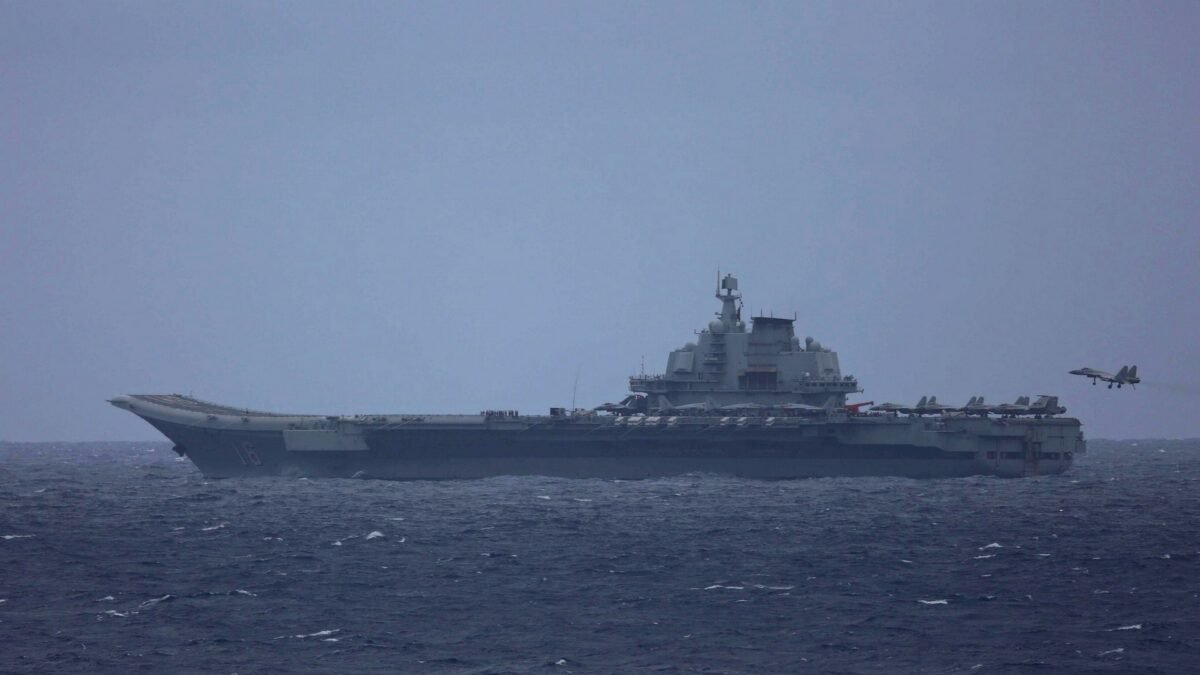
At the centre of the operation, by every account, is the Liaoning. China’s first aircraft carrier, commissioned in 2012 and designated CV-16, has spent the past year at the heart of Beijing’s far-seas training. In October, China’s defence ministry described the Liaoning’s training in the western Pacific as an annual routine to test long-range, open-ocean combat capabilities, aimed at no particular country. That description has not changed. What has changed is the company the carrier is keeping: naval formations from all three of China’s theatre commands, operating together, and a coast guard presence alongside them.
The Liaoning is not China’s newest carrier — that distinction belongs to the Fujian, commissioned on 5 November 2025, which joined the Liaoning and the Shandong to give China a three-carrier navy — but it is the ship with the most experience of the long deployments that Beijing now treats as routine. Its air wing flies the Shenyang J-15, the carrier-based fighter that has become the familiar silhouette of Chinese naval aviation. In May 2022, Japan’s Joint Staff Office photographed a J-15 preparing to land on the Liaoning during exercises in the Pacific, an image that captured the carrier at work far from home waters. The photograph used with this article, taken on 4 May 2022, shows the Liaoning under way with J-15s parked on its deck and one aircraft on final approach — the same ship, the same aircraft, and the same kind of operation that Taiwan says it has been tracking this month.
The carrier’s presence matters for a second reason. A carrier strike group is not just a floating airfield. It is a statement that a navy can project power, sustain it at distance, and protect it with escorts. When the Liaoning operates east of Taiwan, it places Chinese air power on the far side of the island from the Chinese mainland, astride the sea lanes that connect Taiwan to the Pacific and to the United States. When it operates there alongside ships from three theatre commands, it suggests that the different fleets that once guarded different stretches of China’s coast are learning to fight as one force, far from shore. That is the integration the senior Taiwan security official pointed to, and it is the development that will worry military planners in Washington, Tokyo and Canberra more than any single ship count.
China now fields the world’s largest navy by number of hulls, according to United States defence assessments, and it has spent the past decade building the ships, the aircraft and the logistics to use that fleet beyond the waters immediately off its coast. The Liaoning’s deployment is the visible end of that investment. The question Taiwan’s officials are asking is whether the rest of the world is watching closely enough while the deployments grow larger, last longer and attract less and less public notice.
Xi’s speech: reunification without the word force
The drills were still under way when Xi Jinping stepped up to the podium in Beijing’s Great Hall of the People on Thursday 12 November. The occasion was the 160th anniversary of the birth of Sun Yat-sen, the revolutionary hero who helped lead the 1911 revolt that ended centuries of imperial rule and ushered in the Republic of China. Xi used the commemoration to deliver one of his most direct statements on Taiwan in years.
“The tide of history cannot be stopped,” Xi said, according to Reuters. “The complete reunification of the motherland must be realised, and it will certainly be realised.” Resolving the Taiwan question, he said, is an “unwavering historical mission” of China’s Communist Party. He said China adheres to “peaceful reunification and the policy of ‘one country, two systems'” and is willing to talk to Taiwan while upholding the “one-China principle”, Beijing’s position that both sides of the Taiwan Strait are one country. He made no mention of the use of force.
Taiwan’s government dismissed the remarks. Its Mainland Affairs Council described the proposal as little changed from past formulations and said neither Taiwan’s authorities nor its people could accept “one country, two systems”, the model Beijing has repeatedly offered and which is not supported by any major Taiwanese political party. Last month, Taiwan called on its people to steer clear of China’s events marking the Sun Yat-sen anniversary, saying Beijing had a distorted view of him and his legacy.
The speech and the drills arrived together, and the combination is the story. Xi’s words were, on their face, the language of patience: peaceful reunification, talks, a historical tide that will do the work on its own. The ships told a different part of the same story. On the same day as the speech, Taiwan’s defence ministry said it had detected 29 Chinese military aircraft, including J-16 fighter jets and drones, carrying out a “joint combat readiness patrol” around Taiwan in conjunction with Chinese warships. The speech offered Taiwan a peaceful path. The patrol, and the larger operation behind it, showed what Beijing can do if Taipei declines it.
That duality — the soft word and the hard ship — is not new in Beijing’s approach to Taiwan. What is new is the scale on which both are now being deployed at once, and the fact that the hard part is increasingly being conducted without announcement. The Global Times, China’s widely read state-backed newspaper, made the harder edge explicit on Friday, warning that if Taiwan’s ruling party persists in “seeking ‘independence by relying on external forces or military means,’ dragging the residents of Taiwan onto their war chariot, they will inevitably face a harsh reckoning”. The warning was aimed at Taipei. The audience, like the drills, was wider.
Why now: APEC, elections and the calendar
Officials in Taipei have described the drills as a campaign aimed at pressuring Taiwan “and other governments before major international meetings”, according to Reuters. The calendar supports that reading, and it is crowded.
First, the APEC leaders’ summit in Shenzhen on 18 and 19 November. China is hosting the 21-economy forum in its southern technology hub, and the meeting on the sidelines between Trump and Xi will be their third encounter this year, and their third in six months. Their trade truce, agreed in Busan in October 2025 and extended in September 2026 during Xi’s state visit to Washington, now runs until 10 January 2027. The headline question in Shenzhen will be whether the two leaders agree to extend it further. Taiwan is always present at APEC even when it is not on the official agenda: the island takes part as “Chinese Taipei”, and who represents it in Shenzhen is a sensitive question in its own right.
There is also the possibility, unconfirmed, of something larger. Beijing has said it is in contact with Washington and Moscow about a meeting of the three leaders on the sidelines of APEC, and the Kremlin has said work is under way to arrange it. Trump has said he is open to three-way talks focused on nuclear weapons. Nothing is settled, and Beijing has not confirmed the meeting. But the prospect of Trump, Xi and Vladimir Putin sitting together in Shenzhen — days after the United States and Russia resumed direct talks on Ukraine in Abu Dhabi and Moscow — would make this the most consequential APEC summit in years. A display of Chinese naval power in the week before it is, at the very least, a reminder to everyone arriving in Shenzhen of the country they are dealing with.
Second, Taiwan’s own politics. The island holds important local elections at the end of November, a little more than two weeks after Xi’s speech, according to Reuters. Local elections in Taiwan are routinely read as a barometer of the ruling Democratic Progressive Party’s standing, and Beijing has a long history of trying to shape the environment in which Taiwanese voters go to the polls — through military pressure, economic signals, and the steady drumbeat of reunification rhetoric. A large, silent naval deployment in the weeks before an election is a message that does not need to be spoken to be heard.
Third, the G7. On Monday 9 November, the foreign ministers of the Group of Seven, meeting in Paris, restated their “strong opposition” to any unilateral attempt to change the status quo by force or coercion in the East China Sea, the South China Sea and the Taiwan Strait. The statement came the day before Koo’s confirmation of the area-denial drills, and it is the kind of language Beijing has heard before and ignored before. But it is also the language that gives Taipei’s reading of the drills an international echo: the G7, the European Political Community and the United States have all, in different forums this year, warned against coercion in the strait. The drills test whether those warnings have any weight.
Finally, the calendar itself. The foreign intelligence source who spoke to Reuters noted that the latter part of the year, when the weather is typically calmer, is when China normally carries out drills. Not everything about the operation needs a political explanation. Navies train when the seas allow it. But a training cycle that happens to coincide with an APEC summit, a presidential meeting, a local election and a G7 statement is a training cycle that acquires a political meaning whether Beijing intends it or not — and the silence around it suggests Beijing understands that meaning very well.
How this compares: Justice Mission 2025 and the pattern since 2022
To understand why Taiwan’s officials describe this operation as one of the largest Chinese naval deployments to date, it helps to look at what came before. The benchmark they cite is “Justice Mission 2025”, the exercise China’s Eastern Theatre Command announced on 29 December 2025, which ran over two days and was, at the time, the largest set of drills around Taiwan by total coverage.
Justice Mission 2025 was a named, public and deliberately visible operation. Beijing designated seven maritime zones for live-fire drills — more than in any previous exercise — encircling Taiwan tightly and extending into the waters to its east. Five of the zones overlapped Taiwan’s territorial waters, according to Taiwan’s defence ministry. Chinese forces simulated blockades of Taiwan’s two great ports, Keelung in the north and Kaohsiung in the south, launched rockets in a ten-hour live-fire window, and, for the first time, deployed a Type 075 amphibious assault ship capable of launching attack helicopters, landing craft and armoured vehicles at the same time. Taiwan recorded 35 Chinese aircraft crossing the median line of the Taiwan Strait, the unofficial boundary that Chinese aircraft once rarely crossed. The tallies varied by source and by counting window — roughly 71 to 130 aircraft and 22 to 28 naval and coast guard vessels — but the shape of the exercise was unmistakable: an encirclement, practised in the open, with live fire.
The context of that exercise was also public. It came eleven days after the United States approved a record 11.1 billion dollar arms package for Taiwan on 18 December 2025, the largest single sale to the island to date, and it followed remarks by Japan’s prime minister suggesting Tokyo could intervene militarily if Beijing blockaded Taiwan. Beijing framed the drills as punishment for both. The message was delivered loudly, and the world heard it: the exercises forced the cancellation of 76 domestic flights in Taiwan and delays to more than 300 international flights, affecting over 106,000 passengers, according to reporting at the time.
The November 2026 operation is different in almost every respect except size. It was larger than Justice Mission 2025 in the number of vessels involved — more than 100 at its peak, against the two dozen or so warships and coast guard vessels counted in the December exercise. But it was not announced, not named, and not accompanied by live-fire zones or public warnings. There were no flight cancellations, no danger zones, no press conferences. The first map of the deployment came from a Taiwanese official’s social media account, not from Beijing. The first confirmation came from Taiwan’s defence minister, not from China’s. The first full account came from Reuters, citing anonymous officials, not from a military spokesman.
That contrast is the heart of the story. Justice Mission 2025 was a shout. The November operation was, in Taipei’s phrase, a silence. And the silence is what makes it harder to answer. A named exercise with published danger zones can be protested, condemned and waited out; its end is announced and its ships go home. An unannounced deployment that fades from more than 100 vessels to around 70, with the carrier group still operating east of the Philippines, has no clear end and no clear name. It simply persists, and persistence is its own kind of pressure.
The pattern behind both exercises stretches back to August 2022, when China launched its first great encirclement drills after Nancy Pelosi, then the Speaker of the United States House of Representatives, visited Taipei. Since then, Beijing has staged a series of major exercises — Joint Sword in 2023 and 2024, and Justice Mission 2025 — each more sophisticated than the last, each integrating the coast guard more closely with the navy, each pushing further into waters that were once treated as off-limits. The November operation continues that pattern, but it changes the method: the same pressure, delivered without the announcement. If the earlier exercises taught Taiwan to watch for the warning, this one teaches it to watch for the silence.
Analysis: Why It Matters
The silence is the strategy
The most important fact about the November drills is not their size. It is their silence. Every previous major Chinese exercise around Taiwan came with a name, a press release and a set of published danger zones, and that publicity was part of the point: Beijing wanted the world to see the ships, count them and draw the conclusion. This time Beijing wanted the opposite. A foreign intelligence source told Reuters that the “silent drills without a name” appeared deliberate, allowing Beijing to apply military pressure while avoiding a diplomatic backlash, and the logic is easy to follow. A named exercise gives other governments something to condemn, a date to protest about and a precedent to cite. An unannounced deployment gives them nothing but a map posted by a Taiwanese official and a report citing anonymous sources — material that is easy to dismiss, hard to act on, and impossible to schedule a diplomatic response around. The robber in Taipei’s analogy does not want the alarm to sound, because the alarm brings the police. He wants the teller to hand over the money quietly. The question for every government that cares about the Taiwan Strait is whether silence is a reason to do nothing, or the reason to do something.
A blockade rehearsal that does not say its name
The second thing that matters is what the ships were practising. A deployment of more than 100 vessels, drawn from three theatre commands and including a carrier strike group operating east of the Philippines, is not a patrol. It is a rehearsal of the hardest military problem in the Taiwan Strait: keeping outside help away while pressure is applied to the island itself. Taiwan’s defence minister called it what it is — area denial — and the geography confirms him. The Liaoning east of Taiwan sits on the route an American carrier group would take to reach the island. The ships in the Philippine Sea sit on the route supplies would take. The coast guard vessels mixed in with the navy suggest the grey-zone tactics that have become Beijing’s signature: law-enforcement ships doing military work, so that any response can be painted as an overreaction. None of this proves that Beijing intends a blockade. It proves that Beijing is practising one, and practising it at a scale larger than anything it has done before, and practising it in a way designed to attract as little attention as possible. A capability rehearsed quietly is a capability that can be used quietly, and that is precisely what should concern Taipei’s friends.
Xi’s two audiences
The third thing that matters is the pairing of the drills with Xi’s speech. Read together, they are addressed to two different audiences at the same time. To Taiwan, and to the voters going to the polls at the end of November, the message is that reunification is inevitable, that the tide of history is on Beijing’s side, and that resistance is futile. To the leaders arriving in Shenzhen for APEC — above all to Donald Trump — the message is that China is a power to be negotiated with on its own terms, not lectured to about an island it regards as its own. The speech’s omission of force is the part meant for the second audience: a reassurance, offered on the eve of a presidential meeting, that the man across the table is a man of peace. The ships are the part meant for the first audience, and for anyone in the second audience who reads the fine print. Xi has never renounced force, and the drills are the reminder that the option remains on the table, exercised regularly, at growing scale, and now without announcement. The art of the pairing is that each half gives Beijing deniability about the other: the speech can be quoted to prove moderation, and the drills can be described as routine training. Both halves are true. Neither half is the whole story.
The far-seas navy arrives
The fourth thing that matters is the least visible and the most consequential. The senior Taiwan security official told Reuters that the drills suggested China’s effort to integrate its regional fleets into a single far-seas operational force. That sentence deserves more attention than it has received. For most of its history, China’s navy was a coastal force, organised by theatre, guarding its own stretch of shoreline. A far-seas force is something else: a navy that can operate far from home, sustain itself there, coordinate ships from different commands under a single plan, and keep them at sea for weeks. The November deployment — three theatre commands, a carrier group, coast guard vessels, a submarine missile launch, operations spread from the East China Sea to the South China Sea and into the Philippine Sea — is what a far-seas force looks like when it trains. It is also what a far-seas force looks like when it is ready. The distinction matters because the debate about Taiwan has always assumed that a crisis would be a short, sharp event near the island’s shores. A navy that can operate across the western Pacific changes the geography of that crisis, and the time available to respond to it. The United States and its allies have spent years debating how quickly they could reach Taiwan in a crisis. The November drills suggest Beijing is spending its time making sure the answer is: not quickly enough.
The test for everyone else
The fifth thing that matters is what happens next, and it is not in Beijing’s hands alone. The G7’s statement on 9 November, restating opposition to any unilateral change of the status quo by force or coercion, was issued while the drills were under way. The APEC summit next week will put Trump and Xi in the same room while the Liaoning is still at sea. Taiwan’s local elections at the end of the month will show whether the pressure moved any votes. Each of these is a test, and each will be read in Beijing as evidence about how much pressure the world will tolerate. The danger of silent intimidation is not only that it works on its target. It is that it works on everyone else too — that governments, given no announcement to condemn and no incident to respond to, simply carry on as normal, and that normal gradually becomes a sea full of Chinese warships that nobody remarks on any more. The drills ended, or faded, without a shot being fired and without a formal protest being lodged. That is the outcome Beijing wanted. Whether it is the outcome the rest of the world can afford is the question the next two weeks will answer.
What to Watch Next
- Whether the Liaoning carrier strike group remains east of the Philippines through the APEC summit on 18 and 19 November, and whether its position changes once the summit ends.
- What, if anything, the United States government says publicly about the drills, and whether Taiwan’s situation is raised in the Trump-Xi meeting in Shenzhen.
- Whether Beijing gives the operation a name, an announcement or an end date — or whether it simply fades, leaving the question of when it stopped unanswered.
- Taiwan’s defence ministry daily tallies of Chinese aircraft and warships around the island, and whether the numbers rise again after the APEC summit.
- The result of Taiwan’s local elections at the end of November, and any sign that the military pressure shaped the campaign or the vote.
- Whether the proposed Trump-Xi-Putin meeting in Shenzhen is confirmed, and whether Taiwan, Ukraine or nuclear arms are on its agenda.
- Whether the “silent” model is repeated — a large, unannounced deployment before the next major international meeting, with no name and no warning.
Sources
- Reuters — “China stages unannounced Pacific drills in ‘silent intimidation’ of Taiwan, officials say” (13 November 2026)
- Reuters, via KWSN — “China’s Xi says Taiwan ‘reunification’ must happen as history cannot be stopped” (12 November 2026)
- Reuters, via Q1019 — “Taiwan says China is conducting ‘area denial’ drills in Western Pacific” (10 November 2026)
- Geopolitiki — “Taiwan: China holds ‘area denial’ drills in the Western Pacific with the Liaoning” (10 November 2026)
- Brookings — “Trump, Xi, and Putin: What to expect from the APEC summit” (12 November 2026)
- Asia Communique — “Cross-Strait Monitor: What’s New and What’s Familiar in China’s Latest Drills” (2 January 2026)

About the Author — Abdul Mannan
Related Articles
Putin Offers No Compromise in Moscow Talks With US Envoys as Ukraine Peace Push Moves to Dublin
Vladimir Putin told US envoys Steve Witkoff and Jared Kushner in Moscow that Russia will not compromise on…
Witkoff and Kushner Meet Putin in Moscow as Ukraine Peace Talks Turn to Europe’s Seat at the Table
President Donald Trump's envoys Steve Witkoff and Jared Kushner met Vladimir Putin in Moscow on Thursday after two…
COP31 in Antalya: Guterres Warns of ‘Mutually Assured Destruction’ as Burnham Pledges a New Era of British Climate Leadership
The UN chief told leaders in Antalya that the climate crisis is 'outrunning us' — as Britain's prime…